


Most advice about Google Business Profile optimization services starts with the wrong promise: add more cities, publish a few posts, and wait for the Maps top three. That approach ignores how Google evaluates local businesses, and it can push a service-area company toward unsupported locations, duplicate profiles, or wasted budget.
The opportunity is simpler and more commercial. Transactional Marketing targets searches where the customer has money in hand, such as “roofer near me,” “dentist near me,” “plumber near me,” and “air conditioning repair near me.” A credible service connects those high-intent searches to accurate profile information, realistic operating areas, strong reputation signals, and measurable actions such as calls, direction requests, forms, and booked jobs.
This guide gives you a practical way to judge the service. You'll learn what GBP optimization includes, how Google's ranking framework limits what providers can promise, how to avoid the service-area trap, how to compare DIY with hiring, and how reporting should account for Maps, Search, AI Overviews, and revenue.
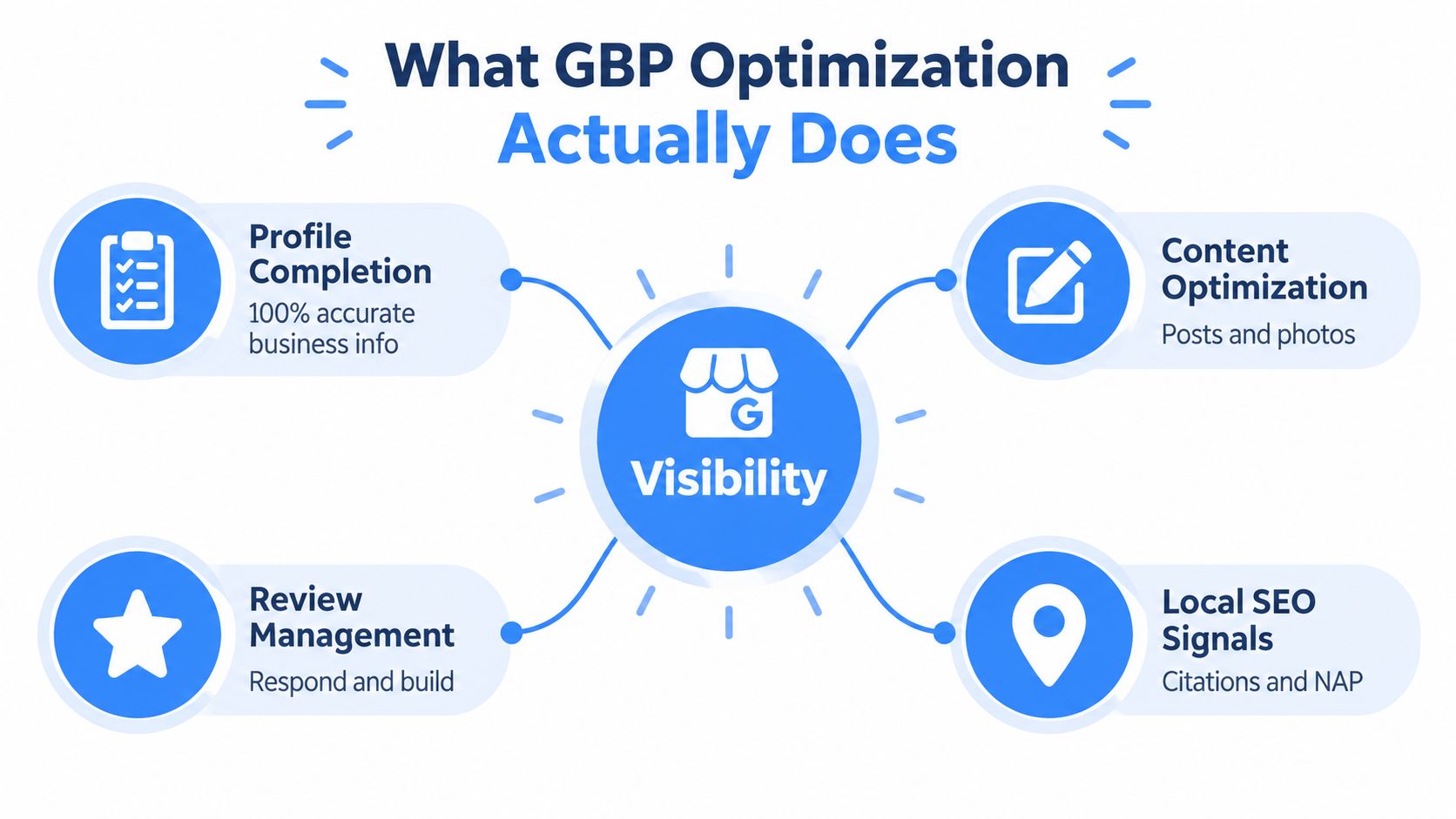
What a Google Business Profile Optimization Service Actually Does
A Google Business Profile optimization service improves the business information customers see in Google Search and Google Maps, then maintains the signals that support local discovery and conversion. It isn't just filling out a listing. It combines profile management, local SEO, reputation work, location governance, content, and measurement.
For a home-service owner, the commercial prize is visibility when someone is ready to act. A person searching “HVAC repair near me” isn't looking for a general educational article. They may need a technician, a phone number, an appointment, or a fast estimate. The same logic applies to “roofing company near me,” “pest control near me,” and “dentist near me.” These are transactional searches, and Transactional Marketing is built around helping service businesses compete for them.
The service is different from a website redesign or paid advertising package. Website pages can strengthen local relevance, and ads can buy visibility, but GBP optimization focuses on the organic local surfaces Google controls. It also isn't a promise that one profile will permanently hold one Maps position across an entire region. Google changes results according to the searcher's location, the query, and the competition.
A useful explanation of the platform's role appears in this guide to what Google Business Profile is. The buyer should expect four practical outcomes:
- Discovery: More qualified visibility for service and location searches.
- Engagement: More calls, website visits, messages, and direction requests.
- Trust: Clearer proof through reviews, photos, accurate services, and responses.
- Revenue tracking: Better connection between Google interactions and booked work.
Where the service fits
| Service | Primary Goal | Typical Trigger | Main KPI |
|---|---|---|---|
| Google Business Profile optimization | Improve local discovery and actions | Low Maps visibility or incomplete profile | Calls, actions, booked jobs |
| Local SEO | Build relevance and authority across the website and web | Weak service or city coverage | Qualified organic leads |
| Paid search | Buy immediate search visibility | Need for controlled lead volume | Calls, forms, cost per lead |
| Website conversion work | Turn visits into inquiries or appointments | Traffic that doesn't convert | Forms, calls, bookings |
The right provider should tell you which work affects the profile, which work supports it from the website, and which outcomes require sales or operations follow-through. Vague “local dominance” language isn't a scope of work.
The Three Factors Google Uses to Rank Local Businesses
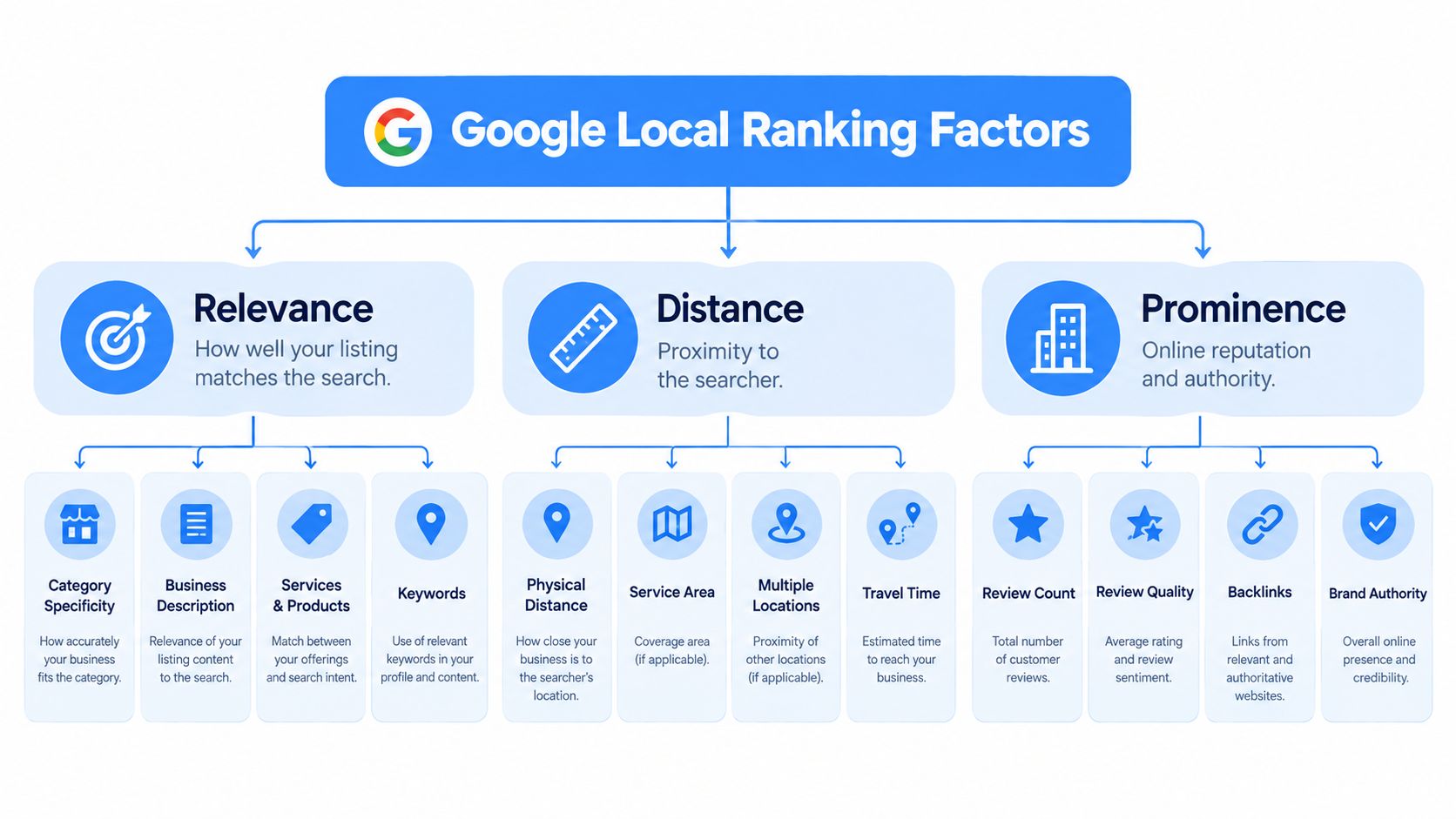
Google's local framework is direct: relevance, distance, and prominence. Google's local ranking documentation explains that these factors shape how businesses appear in local results. A provider who can't connect their recommendations to these dimensions is selling activity, not strategy.
Relevance asks whether the profile matches what the customer searched. For an HVAC company, that means choosing an accurate primary category, adding legitimate services such as air conditioning repair or furnace maintenance, writing a precise description, and using supporting website content that reflects the actual work. A plumbing profile shouldn't rely on a broad category while leaving emergency plumbing, drain cleaning, or water heater services undefined.
Distance reflects how far the searcher is from the business or the location included in the query. You can improve how clearly your operating area is represented, but you can't optimize away geography. A profile near one neighborhood may be a strong result there and a weaker result several miles away, even when the business hasn't changed.
Prominence concerns how established and recognized the business appears. Google identifies reviews, links from other websites, information it can find across the web, and the broader online presence as relevant signals. That makes reputation management and citation consistency more than administrative chores. They support the trust and authority surrounding the profile.
Practical rule: If a proposal promises Maps visibility without discussing relevance, distance, and prominence, ask the provider to rewrite the proposal.
Google also states that businesses can't request or pay for a better local ranking. Legitimate optimization improves accuracy, matching, authority, and customer trust. It doesn't purchase placement, and it shouldn't manipulate the business name with extra keywords.
The ranking mechanics also explain why one “top three” screenshot proves little. Local results vary by search location and query. A serious Google Maps ranking factors guide should lead to tracking by service, city, and search point rather than one check from the owner's office.
What Belongs Inside the Scope of Work
A proper scope separates one-time setup from ongoing optimization. If a provider puts every task into one vague monthly package, you can't tell whether you're paying for meaningful maintenance or repeated low-value edits.
One-time foundation work
The first stage should establish a clean, compliant profile:
- Ownership and access: Confirm the correct business owner controls the profile and remove obsolete access.
- Category selection: Choose the most accurate primary category and relevant secondary categories. Don't add categories only because competitors use them.
- Service structure: Build a complete service list that reflects actual work, not a keyword inventory.
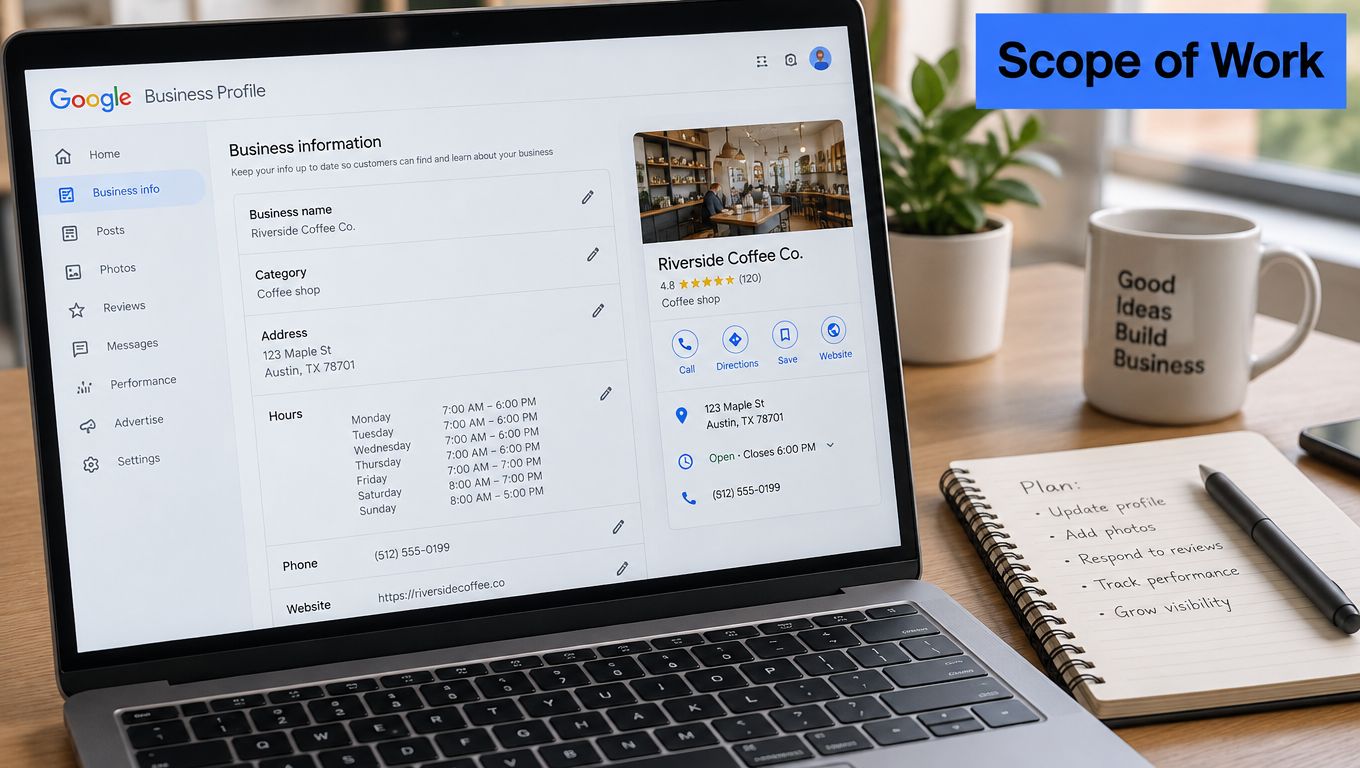
- Business details: Verify the name, address, phone number, website, hours, booking path, attributes, and service-area configuration.
- Description: Explain who you serve, what you do, and where you operate in natural language.
- Media baseline: Upload authentic business photos and short videos that show staff, vehicles, facilities, completed work, or treatment environments.
- Q&A preparation: Identify recurring customer questions and provide accurate answers without manufacturing customer activity.
A profile audit should document errors before changes are made. That makes the Google Business Profile audit useful as a starting point, not just a sales label.
Ongoing work that earns its place
Photos, posts, reviews, and local authority require maintenance. A provider should create a publishing plan tied to real services and seasonal demand, monitor new reviews, respond with specific language, check profile changes, and correct inconsistencies across important directories.
The review workflow should connect completed jobs or appointments to a direct request process. For service companies, review language can reveal whether customers mention responsiveness, workmanship, cleanliness, communication, or outcomes. Those themes can guide both profile messaging and website content.
Citation work also needs judgment. Cleanup means correcting inaccurate business information and removing confusion, while local link development should focus on legitimate relationships and relevant organizations. It shouldn't mean mass-producing directory entries.
For owners comparing outsourced operational support alongside marketing, this small business BPO cost guide provides useful context for evaluating what administrative work can be delegated. Keep the distinction clear: outsourced administration isn't automatically local SEO.
The Service-Area Trap Most Optimization Advice Ignores
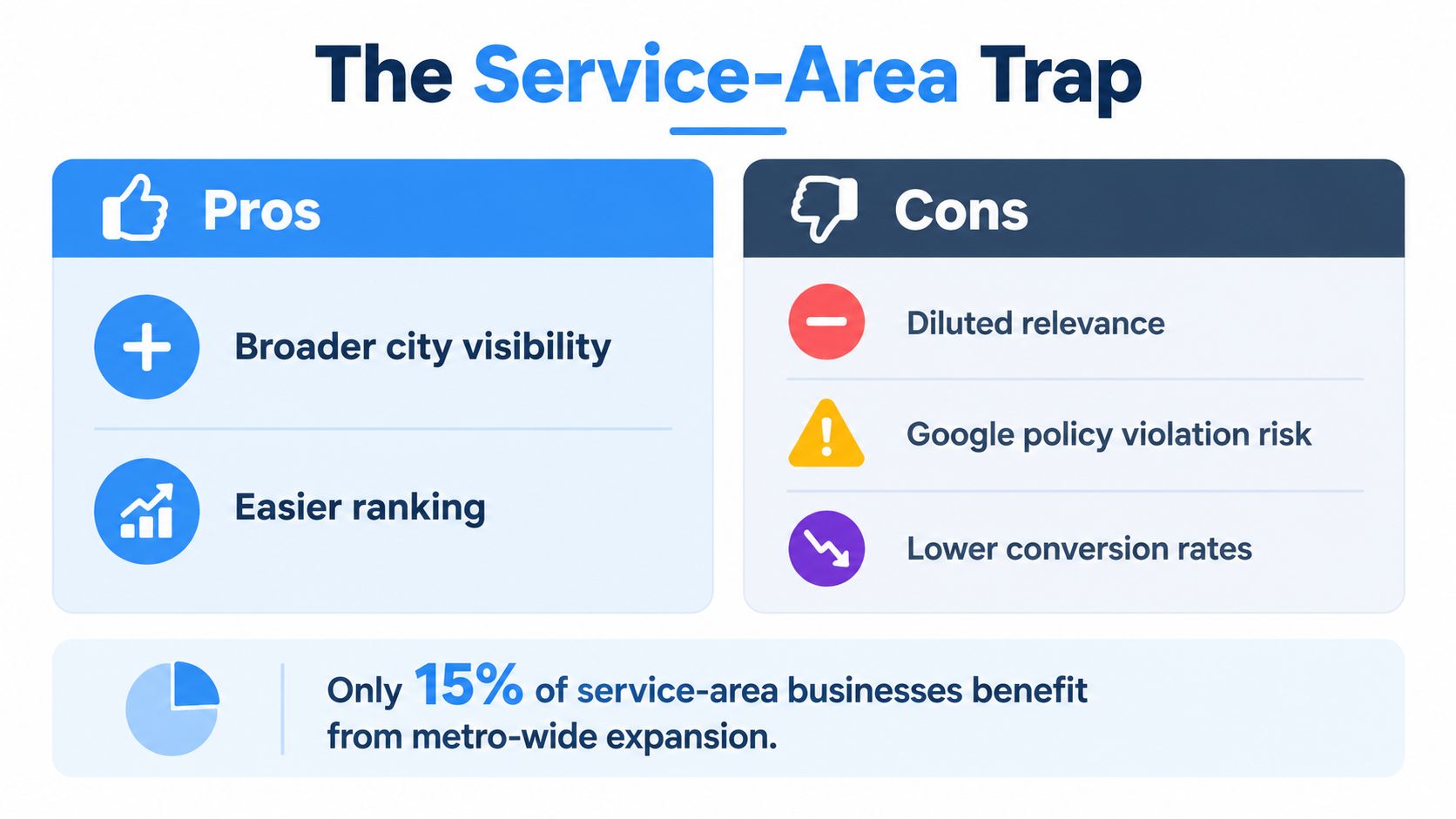
Adding every nearby city to a profile doesn't create genuine local coverage. It can create a mismatch between what the listing claims and where the business can realistically dispatch, serve, or support customers.
Google's guidance for service-area businesses generally points to one profile for the central office or location. Separate profiles may be appropriate when locations have separate staff and service areas. Google also says the overall service area should generally remain within roughly two hours of driving time from the business's base, as explained in its service-area business guidelines.
That rule matters for HVAC, plumbing, roofing, pest control, electrical, and similar operators. A truck may travel across a broad region occasionally, but occasional work doesn't automatically justify a new profile or an expansive service-area list. The profile should reflect actual operating capacity, customer access, staffing, and the location customers can visit, if there is one.
Why profile proliferation backfires
A provider may suggest creating profiles for multiple cities because it sounds like a fast route to broader visibility. That recommendation deserves scrutiny. Unsupported profiles can create policy risk, dilute operational attention, and make it harder to maintain accurate hours, reviews, photos, services, and customer responses.
The stronger strategy is usually fewer, better-supported profiles. Build service-specific landing pages for legitimate markets, report rankings by city, and use technician dispatch data to determine whether a market belongs inside the operating model. A location-governance audit should also identify obsolete service areas and remove them.
A new profile should follow a real expansion, not a keyword plan. Ask whether the location has separate staff, a legitimate business presence where required, and a service area that makes operational sense. If the answer is no, adding a city is not optimization. It is a liability.
For businesses that need location-specific website coverage without inventing storefronts, service-area pages can support relevance while keeping the profile structure honest.
The durable local strategy isn't the one that names the most cities. It's the one the business can actually serve and prove.
How to Evaluate and Choose a Provider
Treat the sales call like an operational review, not a branding presentation. Ask for direct answers and insist that the proposal distinguish profile changes, website work, review operations, reporting, and technical support.
Bring these questions:
- Ranking factors: Which relevance, distance, and prominence issues will you address first?
- Scope split: Which deliverables happen once, and which activities continue each month?
- Coverage: Which services and cities will you track, and why do those locations fit the actual service area?
- Attribution: How will calls, forms, direction requests, messages, and booked jobs be connected to Google?
- Reporting: Will I see discovery searches, branded searches, Search visibility, Maps actions, and rankings by location?
- Ownership: Who owns the profile, website accounts, tracking numbers, content, and reporting data?
- Contract terms: Can I leave without a long lock-in, and what happens to the work when the engagement ends?
Red flags that should stop the conversation
A permanent top-three guarantee conflicts with how Google's local results work. Rankings vary by searcher location, query, relevance, distance, and prominence, so no honest provider can guarantee one fixed position across an entire market.
Be cautious when a proposal includes:
- Keyword-name edits: Adding “best plumber” or a city to the official business name without that being the actual name.
- City stuffing: Listing places the company doesn't realistically serve.
- Unclear activity: Promises of “optimization” without named profile fields, assets, or reporting outputs.
- Long lock-ins: A contract that prevents you from testing communication and reporting quality.
- Vanity reporting: One ranking screenshot with no call, lead, or booking context.
A contract-free engagement isn't automatically superior, but it gives a small business a reasonable way to evaluate execution. For operational tasks that sit outside marketing, a business might separately explore resources such as hire medical virtual assistant, while keeping GBP strategy with someone who understands local search compliance.
What Real Results Look Like in the First 60 Days
A credible first push doesn't begin with a dramatic ranking claim. It begins with a clean baseline, documented fixes, realistic search locations, and a connection between Google actions and the jobs or appointments that follow.
Consider three illustrative composites, not named client case studies.
A roofing company may start with an incomplete service list, inconsistent directory information, and reviews that receive no responses. The initial work clarifies roofing services, improves the profile's customer-facing information, creates a review request process after completed projects, and tracks calls and form submissions by service area. The meaningful result isn't a screenshot from the owner's address. It's whether high-intent roofing searches produce qualified conversations and estimates.
A dental practice may need a different profile structure and conversion path. Categories, services, appointment links, office photos, accessibility details, and review responses all influence how a prospective patient evaluates the practice. The reporting should separate discovery searches from branded searches, then connect calls and appointment requests to the practice's scheduling records.
A pest-control operator often faces strong distance effects because “near me” searches change block by block. Tracking only from the office can hide that variation. A proper report samples multiple points across the actual service area and shows where pest-control searches create visibility, calls, direction requests, and booked visits.
A useful educational resource for homeowners dealing with urgent service demand is this guide to fix plumbing issues fast. It also illustrates why transactional visibility must be measured against response handling. A profile can generate a call, but the business still needs someone to answer, qualify, schedule, and complete the work.
A ranking report is evidence of visibility. A booked-job report is evidence of business value.
Measuring Visibility Beyond Rankings and Your Next Step
Google Business Profile reporting should include profile views, searches, search terms, and customer actions, with discovery and branded searches separated where available. Google also distinguishes whether customers found the profile through Search or Maps. Those details help explain whether a campaign is generating new demand or capturing people who already know the business.
Search Console adds another layer. Google says AI Overviews are counted in the Performance report, with clicks, impressions, and position recorded using the same reporting methodology as other search features, as documented in its Search updates. That matters because a customer may see a business in an AI-generated result, receive enough information to call, and never produce the traditional website visit an agency usually highlights.
BrightLocal's 2025 survey of 1,026 U.S. adults reported that 81% of consumers used Google to find local-business reviews. The figure is self-reported behavior, not a ranking guarantee, but it supports treating review acquisition and response management as a core conversion process. Google states that review quantity and quality can contribute to prominence, yet more reviews still don't guarantee first place.
Rio SEO's 2025 survey reporting found that 84% of consumers search online daily for local businesses and 60% click AI-generated Google overviews. Those figures should change the dashboard, not encourage inflated promises. Track service and city visibility, branded versus non-branded demand, profile actions, AI-surface exposure where available, call recordings or summaries, CRM outcomes, review themes, and booked revenue.
DIY can work if you can maintain accurate profile information, upload authentic media, request reviews after completed work, respond personally, monitor changes, and review performance consistently. Hire a provider when you need city-level rank tracking, citation cleanup, landing-page strategy, call attribution, profile governance, or the discipline to keep the system running while you operate the business.
Transactional LLC offers Google Business Profile and Google Maps optimization, industry-specific SEO, AI-focused content planning, and reporting that connects local visibility with customer actions. If your business needs more exposure for searches where customers are ready to call, visit Transactional LLC to discuss a compliant, service-area-focused plan.