

Most home service business marketing fails for one simple reason. It targets attention instead of action.
A roofer does not need more people vaguely aware of the brand. A plumber does not need blog traffic from homeowners reading general maintenance tips at lunch. An HVAC company does not grow by collecting browsers who may need help someday. It grows by showing up when someone searches air conditioning repair near me, needs help now, and is ready to call.
That is the entire game.
Too many agencies still push broad awareness campaigns, fluffy social posting, and generic SEO that chases volume instead of revenue. That advice sounds polished. It also burns budget. Home service companies win when they rank for transactional search terms, dominate Google Maps, answer the phone fast, and drive visitors into a website built to convert.
This is the approach behind modern home service business marketing that produces booked jobs. It is narrow on purpose. It is local on purpose. It is built for buyers, not spectators.
Why Your Marketing Attracts Browsers Not Buyers
Most marketing advice for service companies is upside down.
You are told to “build your brand,” post constantly on social media, publish broad educational articles, and run campaigns that increase reach. That sounds smart until you look at the result. More impressions. More low-intent traffic. More form spam. Not enough booked jobs.

A home service business does not survive on passive interest. It survives on immediate demand. When a water heater fails, a breaker panel sparks, or a roof starts leaking, the customer does not want to admire your brand story. They want the right company, in the right city, at the right moment.
Traffic is not the goal
If your current home service business marketing reports talk more about sessions, impressions, and engagement than calls and booked jobs, you are looking at vanity metrics.
What matters is simple:
- Did the right person land on the page
- Did they trust you fast
- Did they call or submit a quote request
- Did your team respond before a competitor
That is why conversion work matters as much as rankings. If your site leaks leads after the click, your ad spend and SEO effort get weaker by the day. A focused website conversion rate approach for service companies fixes that gap.
Broad messaging attracts weak intent
Generic marketing pulls in generic visitors.
A page about “home maintenance tips for summer” may get traffic. A page built around “emergency AC repair in [city]” gets buyers. Those are not the same audience, and they should not be treated like they are.
Key takeaway: If your marketing does not start with buyer intent, it will always produce too many clicks and too few jobs.
Many owners stay stuck because the campaigns look busy. The dashboard updates. The website gets visitors. The phones do not ring enough. That is not a lead generation system. That is a distraction dressed up as strategy.
The fix is to stop chasing broad visibility and start owning the searches made by customers with money in hand.
The Transactional Marketing Blueprint
A transactional search term is a phrase used by someone who is ready to hire.
Not curious. Not researching for next year. Not collecting ideas. Ready to act.
Examples are obvious:
- plumber near me
- emergency electrician
- roof repair in [city]
- AC repair near me
- same day pest control
These searches carry urgency, location intent, and buying intent. That is where serious home service business marketing should live.
Buyers search differently than browsers
A browser searches for information.
A buyer searches for a solution.
That distinction changes everything from page structure to keyword targeting to Google Business Profile optimization. It also shows up in performance. The average conversion rate for home services search ads is 10.22%, while urgent categories do better. Plumbing reaches 15.61%, pest control 15.52%, and HVAC sales 15.11% according to CallRail’s home services marketing statistics.
That gap is the reason transactional terms matter so much. Urgency changes behavior.
What this blueprint looks like
The model is straightforward.
| Search type | Typical intent | Business value |
|---|---|---|
| Broad informational terms | Research and comparison | Low immediate value |
| Local service terms | Need + location | High value |
| Emergency terms | Need now | Highest value |
If you own a service business, your first job is not to rank for everything. Your first job is to rank for the searches closest to revenue.
A stronger local strategy starts with a narrow target set. This is why local business marketing strategies built around intent outperform broad campaigns that try to be everywhere at once.
The practical philosophy
Think of it this way.
There is a huge difference between renting a booth at a weekend home show and being the first company visible when a homeowner searches for help with an urgent problem. One gets casual conversation. The other gets direct purchase intent.
That is why the name Transactional Marketing makes sense. The target is the transaction. The call. The booked estimate. The scheduled job.
Practical rule: If a keyword does not suggest immediate service demand, it should not lead your strategy.
Brand matters, but in this industry brand follows performance. Homeowners remember the company that showed up, looked trustworthy, answered fast, and solved the problem. You build that reputation by capturing transactional moments first.
Dominate Your Local Service Area on Google
Google Maps is where local buying decisions happen fast.
When someone searches for a plumber, roofer, or electrician nearby, they often choose from the map results before they ever scroll deep into regular organic listings. If you are not visible there, your competitors get the first call.
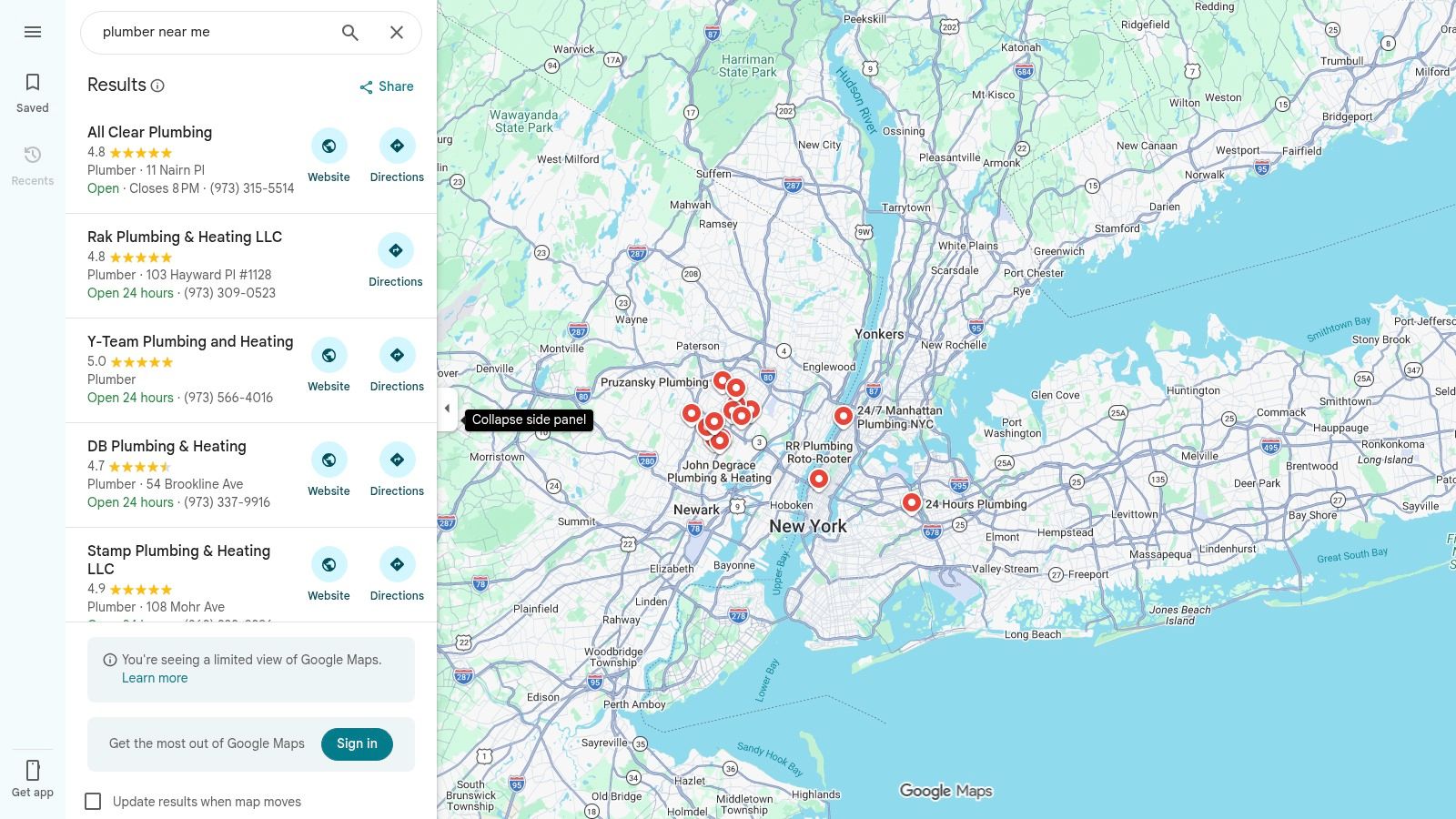
Google visibility is not optional in home service business marketing. It is the battlefield.
Start with a complete Google Business Profile
A half-built profile does not compete well.
Your Google Business Profile should be filled out like a sales asset, not a directory listing. Every field helps Google understand what you do and where you do it.
Focus on these basics first:
- Primary category: Pick the one that matches your money service most closely.
- Secondary categories: Add supporting services only when they are accurate.
- Service list: Include real service lines and location relevance.
- Business description: Write clearly about services, cities, and buyer problems.
- Photos: Upload original job photos, team photos, vehicles, and location-relevant images.
- Hours and service areas: Keep them exact and current.
Reviews decide who gets called
Search behavior is direct. Trust signals must be direct too.
More than 55% of consumers use search engines before scheduling appointments, and 81% of homeowners rely on Google Reviews to decide which business to use, according to these home improvement marketing statistics.
That means your reviews are not decoration. They are part of conversion.
Do three things consistently:
- Ask for reviews after successful jobs.
- Respond to every review in a professional tone.
- Mention services and locations naturally in your responses when appropriate.
Build local relevance, not generic presence
Most companies weaken their Maps performance by being too broad.
If you serve multiple cities, create real service pages for each city and each core service. Do not publish one thin page and expect it to rank across an entire region. Google looks for local relevance, service clarity, and trust consistency.
A good Maps strategy includes:
- City-specific service pages
- Consistent business information across major directories
- Location signals in page titles and copy
- Photos tied to real work
- Questions and answers managed inside the profile
If you want a deeper breakdown, this guide on how to rank higher on Google Maps covers the mechanics in more detail.
A short walkthrough helps make the point:
What owners usually get wrong
They treat their profile like a setup task instead of a ranking asset.
They verify it, add a phone number, upload a logo, and stop. That is not enough. Strong local visibility comes from ongoing updates, review management, service refinement, and alignment between the profile, the website, and the cities you want to rank in.
Key takeaway: In local search, the company that looks most credible and most relevant often gets the call before the company with the prettier website.
Use AI to Build High-Intent Content Silos
Most business owners are using AI the wrong way.
They open a tool, ask it for a blog post about plumbing or HVAC, paste the output onto their site, and hope Google rewards the effort. That is lazy production, not strategy. It creates thin pages, repetitive wording, and weak local intent signals.
AI should not replace expertise. It should accelerate a disciplined content system built around transactional search behavior.
What a content silo is
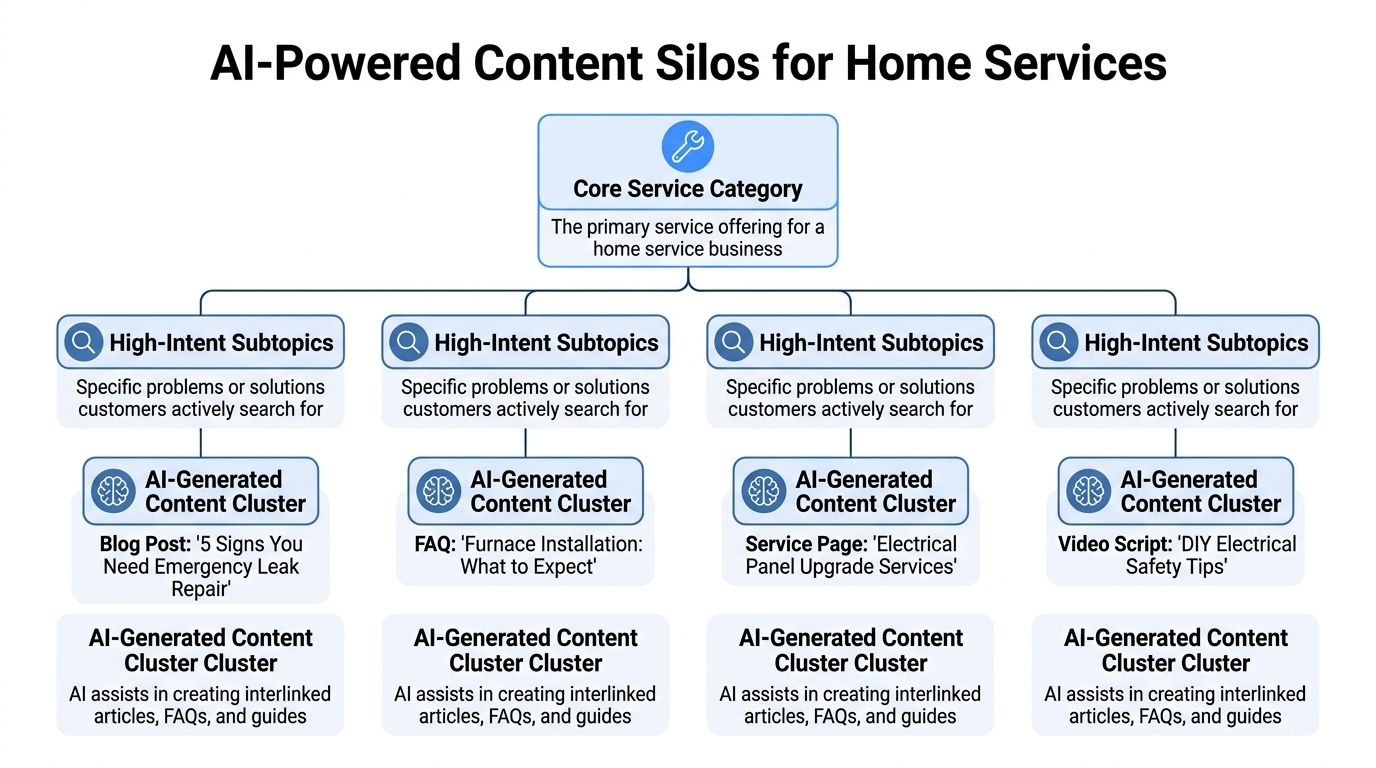
A content silo is a structured group of pages built around one core service.
If you run an HVAC company, your main service page might target HVAC repair. Under that, you build tightly related pages around terms people search when they need help in specific places.
That could include pages such as:
- emergency AC repair in a target city
- furnace repair in a nearby service area
- AC not blowing cold air
- same-day thermostat replacement
- after-hours HVAC service
The point is not to write more. The point is to cover buyer intent with precision.
Why AI matters now
Search is changing. Customers still use Google, but they also rely on AI-generated answers, summaries, and recommendation layers that pull from structured, trustworthy web content. If your site is vague, scattered, or filled with generic AI text, those systems have very little reason to surface your business.
Well-planned content silos help because they make your site easier to interpret. They also let you build coverage around the exact local service terms you want to win.
A proper workflow looks like this:
| Stage | Weak approach | Strong approach |
|---|---|---|
| Keyword planning | Broad topics | Local transactional phrases |
| AI use | One-off article generation | Structured briefs and page clusters |
| Publishing | Random blog cadence | Interlinked service-led architecture |
| Optimization | Generic copy editing | City, service, and buyer-intent refinement |
DIY AI usually creates a mess
There is a reason many owner-led AI projects fail.
According to Coal March’s DIY marketing guide for home services, many businesses using AI on their own produce poor-quality output, while expert AI implementation can significantly reduce PPC cost-per-lead and avoid substantial wasted effort seen among novices.
That should change how you think about AI. The tool is not the advantage. The system behind the tool is the advantage.
The right way to use AI for home service business marketing
Use AI for speed, but control it with strong inputs.
That means:
- Define the service hierarchy: Core service first, then subservices, then city modifiers.
- Build page briefs: Each page needs a clear intent, keyword target, supporting FAQs, and internal link path.
- Add local proof: Mention service areas, real job types, and customer concerns.
- Train consistency: Keep service naming, city targeting, and conversion language uniform.
- Refresh weak pages: Use AI to improve coverage and clarity, not just to create volume.
One option for this kind of workflow is AI search engine optimization for local service businesses, including planning content silos around high-intent terms and tracking how those pages perform by city and query.
Expert tip: If an AI-generated page could work for any company in any city, it is too generic to win transactional search.
The companies that will own local search over the next few years are the ones building structured, intent-driven content libraries. Not giant blogs. Not random AI articles. Tight silos tied to real services and real buying behavior.
Turn Your Website Into a Conversion Engine
A ranking is only valuable if the visitor converts.
That sounds obvious, but many service websites still behave like digital brochures. They look decent. They explain the company. They mention services. Then they hide the phone number, bury the form, and make the visitor work too hard.
A home service website has one primary job. Turn search traffic into calls and quote requests.
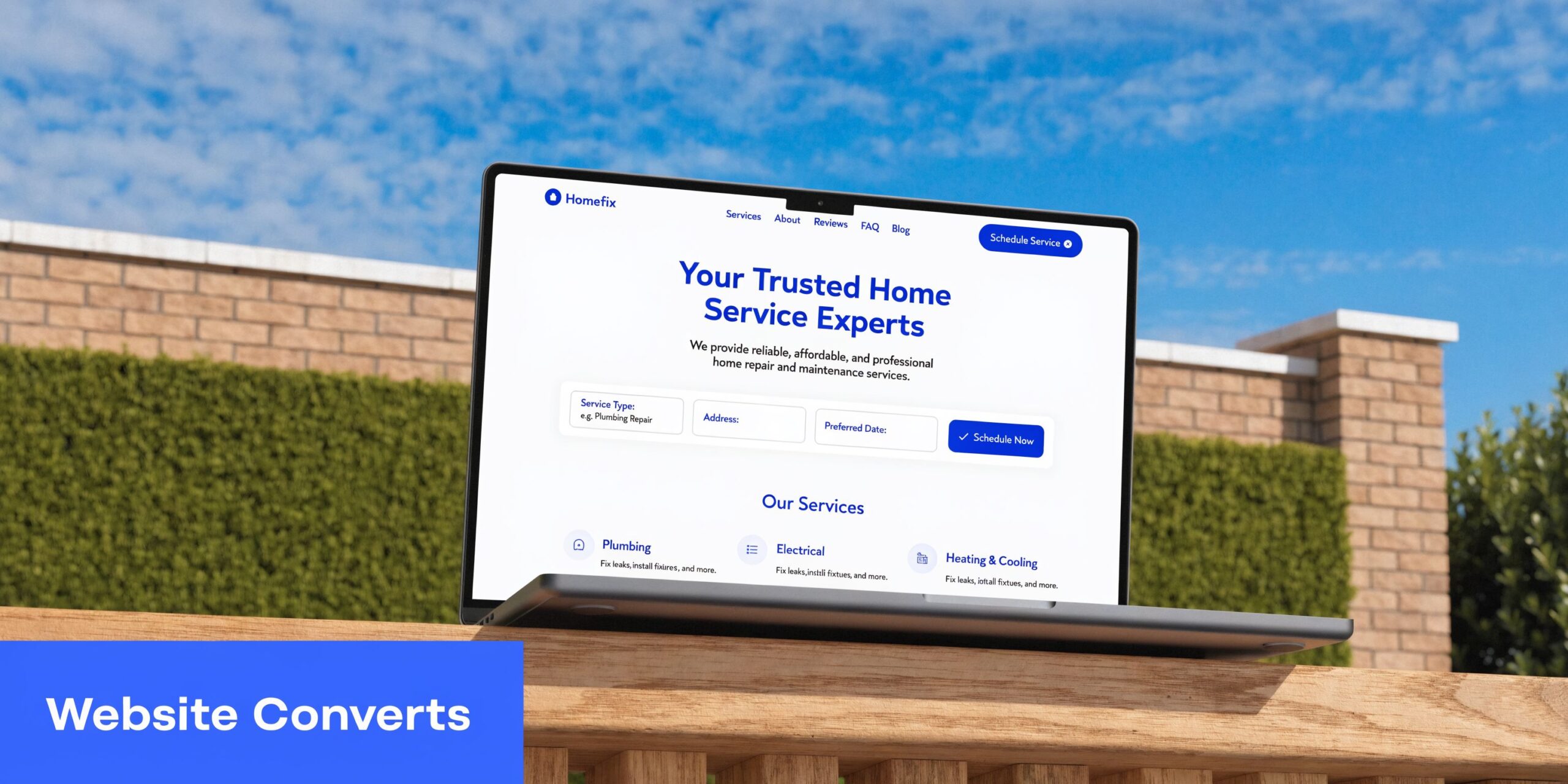
What every high-converting service site needs
Most conversion problems are not mysterious. They are design and messaging failures.
Fix the basics first:
- Click-to-call buttons on mobile: Your phone number should be obvious and tap-ready.
- Short quote forms: Ask only for what your team needs to start the conversation.
- Visible service areas: Tell visitors right away whether you serve their city.
- Trust signals: Licensing, insurance, certifications, financing options, and review snippets matter.
- Clear service pages: One page per service and city intent, not one giant catch-all page.
- Fast load times: If the page drags, the visitor leaves.
- Urgency language: Emergency and same-day services should be easy to spot when offered.
Reduce friction or lose leads
Visitors do not study home service websites. They scan and decide.
That is why page hierarchy matters. The top of the page should answer four questions immediately:
- What do you do?
- Where do you do it?
- Why should I trust you?
- How do I contact you right now?
If any of those answers are delayed, conversion drops.
Multi-channel only works when the site closes the loop
Paid ads can bring in urgent demand fast. Email follow-up, retargeting, and direct mail can support recall. But none of that fixes a weak landing experience.
According to Mspark’s home services ebook, a multi-channel strategy that integrates digital ads with other touchpoints can boost conversion rates by 28%, and 66% of businesses cite lead follow-up as a major challenge. That matters because traffic alone does not produce revenue. The handoff from click to contact to response does.
The pages that usually produce the most leads
A strong site usually relies on a few page types doing most of the work:
| Page type | Purpose | What must be visible |
|---|---|---|
| Homepage | Immediate trust and routing | Core services, cities, phone, quote CTA |
| Service page | Match search intent | Specific service, proof, FAQs, CTA |
| City page | Match local relevance | City name, service details, trust elements |
| Emergency page | Capture urgent demand | Availability, phone prominence, speed |
Generic copy kills these pages.
“Quality service at affordable prices” says nothing. A page that speaks directly to emergency drain cleaning, storm damage roof repair, or panel upgrade service in a named city does the opposite. It reassures the visitor that they found the right company.
Practical rule: Every important page should make it easy for a stressed homeowner to contact you without thinking.
If your site ranks but underperforms, the issue is often not SEO. It is friction. Fix the page, tighten the CTA, simplify the form, strengthen the trust signals, and align the copy with the exact transactional search that brought the person there.
How to Track Your Marketing and Prove ROI
If you cannot prove where jobs come from, you are guessing.
Many home service companies still judge marketing by vague signals like “we seem busier” or “traffic is up.” That is not measurement. It is hope with a dashboard attached.
The right home service business marketing system tracks what creates calls, appointments, and booked work.
Stop reporting vanity metrics
Traffic can matter. Impressions can matter. Rankings can matter. But none of them deserve top billing unless they connect to revenue.
These are the numbers worth watching:
- Phone calls from organic search
- Form submissions by landing page
- Booked jobs by channel
- Keyword movement by service and city
- Google Maps visibility across your target area
- Search Console queries that reveal new transactional demand
Keyword timelines by city tell you where momentum is building. Map heat maps show where you are strong and where competitors are beating you block by block. Search Console exposes the exact phrasing people use before they land on your site. Those three together give you a much clearer view than raw traffic ever will.
Call tracking is essential
Phone leads are the main event in this industry.
According to We Are TG’s guide to measuring home services marketing, phone leads are the top-performing call-to-action at 44%, and dynamic call tracking enables precise attribution that can help businesses achieve up to 28% higher conversions by reallocating budget to the channels that perform best.
That means one static phone number across every campaign is a mistake. If your Google Business Profile, organic pages, paid ads, and other campaigns all drive to the same number without attribution, you lose visibility into what is working.
What a clean reporting setup looks like
You do not need endless reports. You need useful ones.
A practical reporting stack usually includes:
- Google Business Profile insights for local visibility trends.
- Google Search Console for query and page-level search behavior.
- Google Analytics for landing pages and conversion paths.
- Call tracking software such as CallRail for channel attribution.
- CRM or job management data for booked-job confirmation.
One provider in this space, Transactional LLC, offers dashboards that track keyword timelines by service city, map ranking heat maps, Search Console queries, and traffic in one place. That kind of setup is useful because it ties visibility to lead flow instead of separating them into disconnected reports.
Key takeaway: The best marketing report is not the one with the most charts. It is the one that tells you which channel made the phone ring.
Use reporting to make decisions fast
Good measurement should change actions.
If calls are coming from Google Maps, strengthen the profile and review flow. If one city page is generating leads, build more pages around adjacent services in that market. If paid ads convert but a landing page lags, fix the page before raising spend.
The goal is not reporting for reporting’s sake. The goal is to know, with confidence, where your next booked job is coming from and where your next dollar should go.
Your 30-Day Transactional Marketing Kickstart
Most owners do not need more theory. They need a starting point.
Use the next 30 days to clean up the fundamentals and point your marketing at buyer intent.
Week 1
Audit your Google Business Profile.
Check categories, service areas, hours, photos, service lists, and business description. Look at your reviews and your review responses. If the profile feels incomplete or generic, fix that before doing anything else.
Week 2
Choose your core transactional terms.
List the searches that signal direct buying intent for your main service lines. Focus on phrases tied to service plus city plus urgency where relevant. Do not chase broad informational terms first.
Week 3
Outline one content silo.
Pick one core service and build a page structure around it. Start with the main service page, then add supporting pages for related problems, emergency variants, and city-specific targets. Keep the structure tight and practical.
Week 4
Audit your website for conversion.
Review your homepage, top service pages, and top local pages on mobile. Make sure the phone number is obvious, the forms are short, the cities are visible, and the trust signals are easy to find. Then check how leads are being tracked.
If you complete those four steps, your home service business marketing will already be sharper than what many companies run for months.
The next move is consistency. Keep refining local visibility, keep building transactional pages, keep improving conversion paths, and keep tracking which channels produce jobs.
If you want a partner to help build a transactional-only SEO and AI visibility strategy, Transactional LLC works with local service businesses on Google Maps optimization, content silos, web development, and lead-focused search campaigns built around high-intent searches that turn into booked jobs.