


Most HVAC lead-generation advice starts with 24/7 emergency repair and stops there. That approach captures homeowners whose systems have already failed, but it ignores the customers who are planning maintenance, comparing replacement options, researching heat pumps, and searching for a contractor before the first hot or cold day arrives.
The better answer to how to get more HVAC leads is to own transactional search intent across the entire buying journey. A transactional search means the homeowner has money in hand and is ready to contact a business, whether they search for “air conditioning repair near me,” “furnace replacement in [city],” or “HVAC maintenance near me.” Transactional Marketing focuses on those searches, Google Maps visibility, service-city SEO, and content that can be discovered through AI search and LLM-driven recommendations.
Targeting Planned Demand and Transactional Searches
Planned demand is where a lot of HVAC revenue is won. Emergency repair will always produce leads, but replacement, maintenance, inspections, financing searches, and heat-pump research often bring in better jobs, better scheduling control, and better close rates because the homeowner is still choosing who to trust.
The buying signal is still transactional. It just shows up earlier.
That is why your SEO and paid search strategy should cover the searches people make before the unit fails. According to the 2025 home-services marketing study from Tinuiti, more than 60% of homeowners who use seasonal home-service providers prefer booking over a week in advance, while 28% prefer booking at least a month ahead, and spring is the most common period for searching for providers. If you wait for peak weather, you show up late.
Build around money-in-hand searches
Start with service and city combinations that reflect clear purchase intent:
- Replacement searches: “AC replacement in [city]” and “furnace installation near me”
- Evaluation searches: “HVAC replacement estimate” and “air conditioner efficiency assessment”
- Planned service searches: “AC tune-up near me” and “furnace maintenance [city]”
- Equipment searches: “heat-pump installation,” “mini-split contractor,” and “ductless HVAC service”
- Urgent searches: “emergency AC repair near me” and “no-heat furnace repair”
These keywords should not point to one generic homepage. They need separate pages, separate ad groups, and separate calls to action. A replacement prospect wants equipment options, financing details, warranty information, and a clear estimate request. An emergency repair prospect wants fast reassurance, a visible phone number, and proof that someone will answer.
Use a high-intent keyword strategy to separate those audiences by job type and timing. That structure helps you rank for specific searches, improves conversion rates, and gives AI search systems cleaner page-level signals about your concrete offer in each market.
Prepare before the rush
Your campaign calendar should be built around planned demand, not just reactive demand. Publish replacement pages, maintenance content, and city-specific service pages before homeowners start scrambling for the first open slot. Promote inspections and estimate requests while they still have time to compare contractors and book on their schedule.
This also makes your content more useful for AI-driven search results. Pages built around one clear service, one location, and one intent are easier for search engines and LLMs to interpret than broad “we do everything” pages.
Practical rule: Emergency repair is one transactional lane among several. Staff it, but put most of your campaign calendar behind replacement and maintenance demand.
Planned-demand prospects are often easier to book and easier to move into higher-value work, including maintenance agreements, efficiency upgrades, and full system evaluations. Capture that demand early, with pages and campaigns built for the exact search they are making.
Dominating the Google Maps Top Three
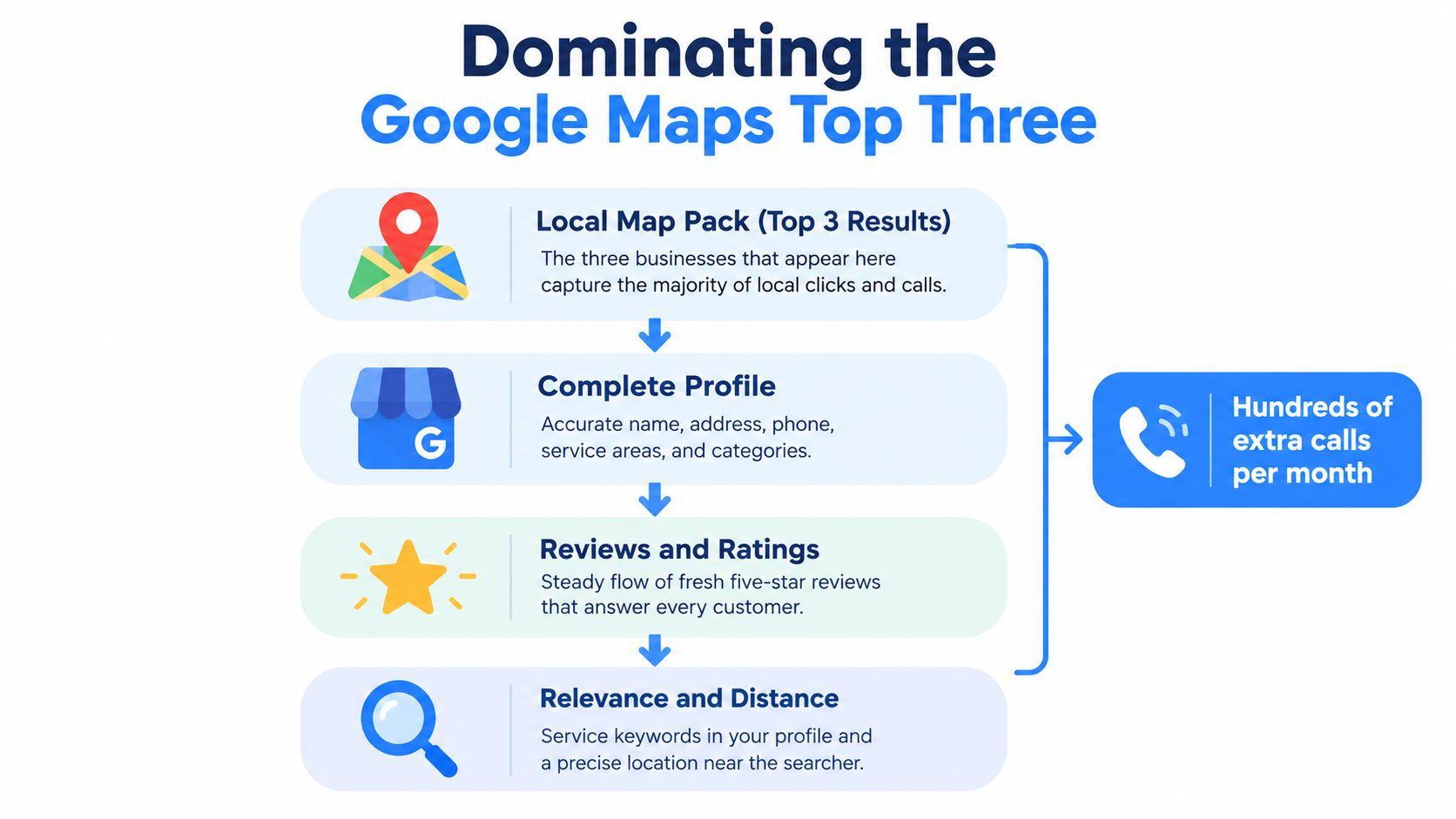
For local HVAC companies, Google Maps isn't a branding exercise. It is a direct response channel. A homeowner searching “air conditioning repair near me” sees nearby businesses, reviews, call options, and directions before deciding who gets the first call.
Google says local results are primarily shaped by relevance, distance, and prominence, as explained in its official guidance on local ranking. Relevance connects your Business Profile to searches such as AC repair, furnace installation, or emergency heating service. Distance reflects proximity to the searcher or the location in the query. Prominence reflects how well-known the business is through signals including links, directory information, and review quantity and ratings.
Make the profile prove local relevance
Complete every meaningful Business Profile field accurately. Use the correct business name, address, phone number, service areas, categories, hours, and service descriptions. Describe the work you perform, including air-conditioning repair, furnace service, heat-pump installation, ductless systems, maintenance, and replacement.
Don't add cities or services that you don't serve. Inaccurate profile information creates poor customer experiences and weakens the connection between your listing and the search intent you want to capture.
Turn reviews into prominence signals
Ask satisfied customers for reviews as part of the normal job-completion process. Respond professionally to every review, including criticism. Fresh, detailed feedback gives prospective customers evidence that your business handles the exact service they need.
Local visibility also depends on broader consistency. Keep your business information aligned across reputable directories, local organizations, supplier pages, and relevant industry websites. For additional background on improving visibility for service businesses, review this local search optimization for hosts resource from CS Outsource. The principles around accurate business information and local relevance apply well beyond hospitality.
Track actions, not vanity rankings
Google Business Profile Performance reporting shows how customers find you through Search and Maps and records actions such as phone-call clicks and direction requests. Google defines calls as clicks on the profile's call button, while direction reporting is designed to focus more closely on unique customer requests.
Track those actions by service area and period. A profile view indicates exposure. A call click or direction request indicates a stronger commercial step. For a deeper operational framework, see how to rank higher on Google Maps.
No company can guarantee a top-three Maps position because Google ranks results algorithmically by query and location. Transactional Marketing's focus is more practical: strengthen relevance, proximity, and prominence for the service-city searches that produce calls, then measure whether those improvements create booked opportunities.
Optimizing for AI Search and LLM Visibility
AI search doesn't remove the need for SEO. It makes clear, crawlable SEO more important.
Google's guidance says generative AI systems use publicly accessible, crawlable content to identify patterns and produce relevant, grounded responses. The same guidance notes that local business information can appear in AI responses and recommends keeping Google Business Profile information current. Read Google's AI search optimization guidance before treating AI visibility as a separate shortcut.
Give AI systems consistent facts
An HVAC business should make its core information easy to find in plain text:
- Services: State whether you provide AC repair, furnace replacement, heat-pump service, maintenance, and ductless installation.
- Locations: Name the cities and service areas you cover.
- Contact paths: Keep phone numbers, booking options, hours, and emergency availability consistent.
- Proof: Show qualifications, service explanations, customer feedback, and real business details.
- Page purpose: Make each URL clearly about one service and one audience.
An AI system can't reliably recommend a company if the business's services and locations are hidden inside images, inaccessible scripts, or conflicting directory listings. A crawlable furnace-repair page for a specific city gives search systems a much clearer association than a vague homepage that lists every service without geographic context.
Publish useful content, not machine-shaped filler
Generative AI can help your team organize topics, draft outlines, and expand a content calendar. It shouldn't publish unreviewed technical instructions. Google permits generative AI content when the finished material meets Search Essentials and spam policies, and it emphasizes manual fact-checking for accuracy, quality, relevance, and trustworthiness.
A human HVAC professional should verify safety guidance, equipment claims, incentive details, service areas, and any technical recommendation. For a broader framework, consult the Machine Marketing playbook on optimizing content for AI search.
Use AI search engine optimization to support conventional SEO, not replace it. Transactional search terms still matter because homeowners ask AI systems for nearby businesses, specific services, and trusted options. Your company needs accurate local information available for both traditional crawlers and AI-driven search experiences.
Building High-Converting Service Landing Pages
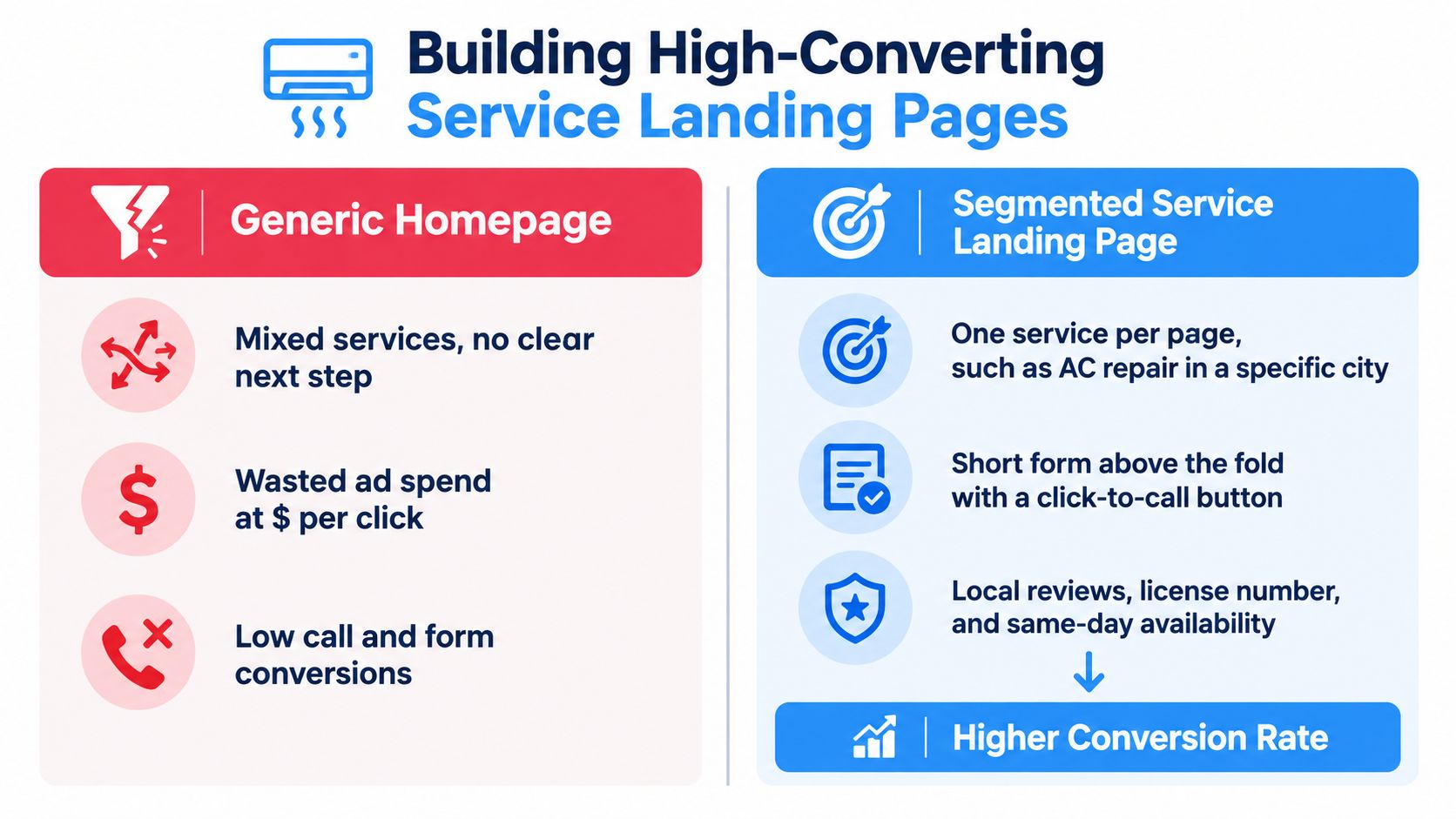
Sending every visitor to your homepage is lazy marketing. A homeowner searching “emergency AC repair near me” should not have to browse a general services menu before finding a phone number. A homeowner researching system replacement shouldn't land on a page written for a midnight breakdown.
Create one focused landing page for each important service and city combination. Give every page one primary action, such as call now, schedule service, or request an estimate.
Match the page to the decision cycle
Available benchmark reporting places average HVAC website conversion around 2% to 4%, while optimized emergency-intent pages can reach roughly 10% to 15%. System-replacement pages commonly perform lower, around 3% to 6%, because homeowners deliberate longer, according to HVAC digital marketing statistics from Webtonic.
Those figures aren't promises. They show why you shouldn't judge every page by the same conversion expectation.
An emergency page needs:
- Immediate contact: Put click-to-call and schedule-now actions above the fold.
- Operational confidence: Explain coverage, response process, and what happens after the call.
- Local proof: Show service areas and relevant reviews without burying the phone number.
- Focused copy: Address no-cooling, strange noises, leaks, or complete system failure.
A replacement page needs a different structure. Explain evaluation steps, equipment options, efficiency considerations, financing questions, installation expectations, and the estimate process. Keep the call to action clear, but give the visitor enough information to make a considered decision.
Build pages that paid campaigns can measure
Use exact or phrase-intent terms in paid search, then send each ad to the matching service-city page. Add negative keywords such as jobs, DIY, parts, and training to reduce irrelevant traffic. Apply geographic controls and call extensions, then import offline conversions tied to booked revenue rather than treating every form submission as a success.
Measure each page by device, city, service, and lead source. Separate emergency repair from replacement because their conversion behavior and follow-up requirements differ. Remove duplicate or spam submissions from reporting, or you'll make poor budget decisions based on inflated lead counts.
The page should continue the searcher's sentence. If the ad says “furnace repair in Denver,” the landing page should immediately confirm furnace repair, the service area, and the next action.
Use service landing page optimization to organize the page architecture around commercial intent. The objective isn't more clicks. It's more qualified calls, booked appointments, and profitable jobs from searches where the customer is ready to hire.
Implementing a Ruthless Speed-to-Lead Workflow
A lead isn't valuable because it entered your CRM. It's valuable when your team contacts it, qualifies it, books it, and turns it into revenue.
The response process should be in place before you increase advertising. Route every website form, chat inquiry, and Local Services lead to an on-call dispatcher. Trigger an immediate SMS acknowledgment, place the first call within 5 minutes, and continue a documented cadence of calls, texts, and voicemail until the prospect responds or the lead is qualified out.
The MIT and InsideSales lead-response study found that contacting a lead within 5 minutes made companies 21 times more likely to qualify it than waiting 30 minutes. An analysis of HVAC speed-to-lead campaigns found that 88% of contractors exceeded the 5-minute window, as reported in contractor lead-response research from PushLeads.
Assign ownership before the lead arrives
A dispatcher should know which person owns each inquiry, including evenings and weekends. Set different routing rules for emergency repair, replacement, and maintenance because the questions, urgency, and qualification standards aren't identical.
Use an immediate acknowledgment that confirms receipt and sets expectations. Then call. If nobody answers, log the attempt and continue the cadence rather than assuming the prospect will call back.
For businesses that need separate tracking or after-hours coverage, a practical virtual phone number guide for small business can help clarify options for routing, business identity, and call management.
Measure response quality, not just lead price
Cost per lead is an incomplete metric. A cheap lead that sits unanswered can produce less revenue than a more expensive lead that receives immediate attention. Track the full funnel:
- Median first-response time: How quickly the team attempts contact.
- Contact rate: How often a real conversation occurs.
- Qualified-lead rate: How many inquiries match your service and area.
- Booked-job rate: How many qualified prospects schedule work.
- Revenue per lead: What each source produces after the job closes.
For owned website leads, set an operational target of under 5 minutes. For shared leads, where several contractors may receive the same prospect, target under 2 minutes. These are workflow standards, not marketing slogans. Test call recording, dispatcher performance, after-hours coverage, and the actual time between form submission and first call.
Executing Seasonal Campaigns and Tracking ROI
Seasonal HVAC marketing wins before the weather turns. Contractors that wait for the first heat wave or cold snap enter the noisiest ad auctions, fill the board with lower-margin urgency work, and miss homeowners already researching planned replacements.
Build campaigns around equipment age, seasonal behavior, and service intent. As noted earlier, replacement activity rises sharply in peak cooling season, which is exactly why AC replacement pages, financing messaging, and estimate-focused campaigns should be live before summer demand spikes.
Use the calendar as a demand map
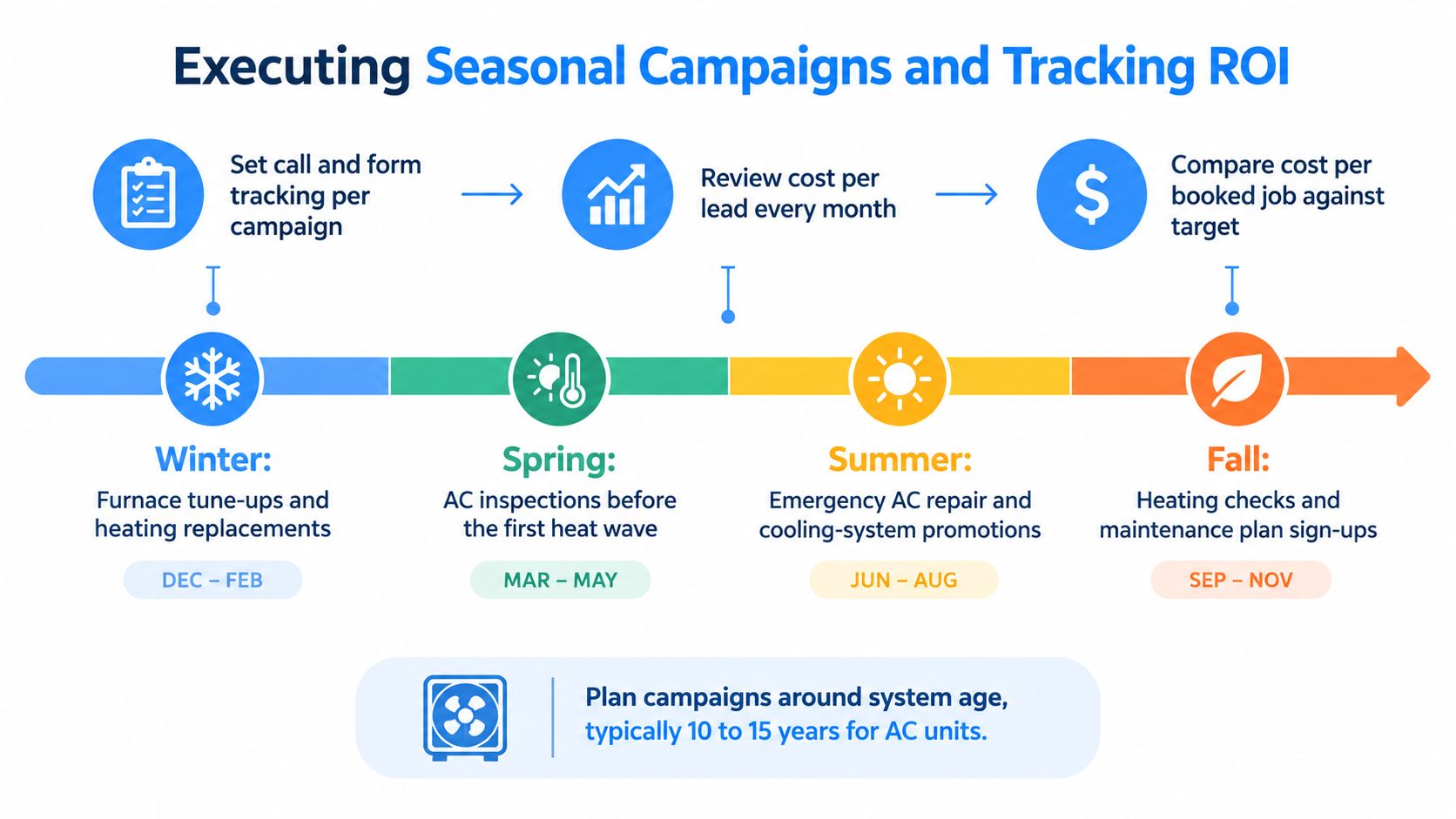
Treat the year like a buying cycle, not a series of emergencies. Homeowners do not search the same way in every season, and your offers should match that reality:
- Winter: Promote furnace tune-ups, heating replacements, and no-heat service.
- Spring: Push AC inspections, maintenance, replacement evaluations, and financing education.
- Summer: Capture emergency AC repair while continuing cooling-system replacement campaigns.
- Fall: Promote heating checks, maintenance agreements, and early replacement planning.
Give heat pumps, mini-splits, and ductless systems their own campaigns. Do not bury them on a generic installation page. Buyers comparing those options are usually deeper in the decision process, and they respond better to pages built around efficiency, home layout, comfort issues, and replacement intent. As noted earlier, that category is gaining share, which supports separate messaging for homeowners considering alternatives to conventional systems.
Connect marketing to booked revenue
Track what produces booked jobs, not what looks busy in a report. Use call tracking, form attribution, CRM stages, and offline conversion imports to see which keywords, pages, and campaigns create qualified opportunities instead of shallow traffic.
Review median response time, contact rate, qualified-lead rate, booked-job rate, and revenue per lead by channel. Those numbers show whether your seasonal campaigns are bringing in profitable replacement estimates or just generating calls your team cannot close.
A service-city page with lower traffic can outperform a broader informational page if it consistently produces booked replacement consultations. That is the right lens for AI-driven search too. If your seasonal pages answer specific buying questions, show real service intent, and connect clearly to conversion actions, they are more likely to surface in both traditional search and AI-generated results.
Transactional Marketing can provide HVAC-focused service-city pages, conversion-oriented website optimization, Google Business Profile management, and call-based lead measurement. Visit Transactional LLC to discuss a strategy built around transactional HVAC searches, Google Maps visibility, crawlable AI-ready content, and tracking that connects marketing activity to booked jobs. Homeowners searching in February will find whoever published in January. Build the pages, the response workflow, and the tracking now, so the seasonal surge finds your phone already ringing.