


Your website page is indexed. Your title tag looks fine. The service is real, the phones should be ringing, and yet the search result doesn't make anyone click.
That gap is where a lot of local service businesses lose money.
When someone searches “plumber near me,” “emergency dentist,” or “AC repair near me,” they aren't doing casual research. They have a problem, they want it fixed, and they're choosing from a short list. In that moment, your meta description isn't a technical footnote. It's sales copy. It's the short pitch that helps turn a search impression into a call, a form fill, a booked job, or a new patient.
If you want to learn how to write meta descriptions that help generate customers, stop thinking about them as an SEO checkbox. For local SEO, they work best when they're built around transactional search terms, local intent, and immediate action.
Why Your Meta Description Is a 160-Character Sales Pitch
Most local business owners have the same complaint. The site exists, the service pages exist, and traffic may even show up in Search Console, but the site doesn't produce enough leads.
That usually means the listing itself isn't doing enough work.
A person searching for a roofer, chiropractor, pest control company, or emergency HVAC service is scanning fast. They're not grading your brand story. They're looking for signals that say, “This company handles my problem in my area, and I should contact them now.” That's why the meta description matters. In practical terms, it's your pre-click sales pitch.

Transactional intent changes how you write
An informational search and a transactional search need different copy.
If someone searches “how does root canal work,” the click driver is education. If they search “dentist near me open today,” the click driver is speed, trust, location, and availability. Same search engine. Completely different psychology.
For local SEO, that means your best meta descriptions usually include some mix of these elements:
- The exact service people want right now
- A local qualifier such as city or service area
- A clear value point like emergency help, same-day scheduling, or free estimates
- A direct next step that invites the click
Your meta description should answer the unspoken question behind the search: “Why should I choose this result instead of the one above it?”
That's the heart of transactional optimization. You're not trying to sound clever. You're trying to sound like the best next move.
Why relevance beats cleverness
There's another reason to keep these descriptions tightly aligned to search intent. Google may not always show the version you wrote. Neil Patel notes that Google rewrites about 70% of meta descriptions and may display them only about 28% of the time in search results, which makes alignment with the query more important than writing a generic brand line in this meta description analysis.
That changes the job.
You're not writing one perfect sentence and assuming it will always appear. You're creating a strong, page-specific summary that gives Google a useful snippet to pull from when it decides your version fits the search. If the page is about emergency water heater repair in a specific city, the description needs to sound exactly like that page.
For local businesses trying to improve click quality, not just traffic volume, this goes hand in hand with stronger click-through rate optimization tactics.
What doesn't work anymore
Weak meta descriptions usually fail in one of three ways:
- They're generic. “We provide quality service for all your needs.”
- They're stuffed. “Plumber plumber emergency plumber drain cleaning near me plumbing service.”
- They're passive. They describe the company without giving the searcher a reason to act.
A strong one sounds closer to a paid ad than a brochure line. Short. Specific. Action-oriented. Built for people with money in hand who need a solution now.
Anatomy of a Meta Description That Converts
A converting meta description has a job. It has to summarize the page, match the searcher's need, and create enough confidence to win the click.
Google's guidance is clear. Meta descriptions should be unique, descriptive, and specific to each page, not keyword lists, and for large sites they can even be generated programmatically at scale, as explained in Google's snippet documentation. In practice, most SEO teams aim for 120 to 160 characters because longer text can get cut off.

The six parts that matter most
Think of a high-performing description as a compressed offer. It usually contains these pieces:
- Service first: Lead with what the page is about. “Emergency AC repair,” “tooth extraction,” “roof leak repair.”
- Location signal: Add the city, metro, or service area when it helps reinforce local relevance.
- Value proposition: Mention what separates the business. Same-day appointments, 24/7 response, licensed technicians, free estimates.
- Search language: Use natural wording that matches how customers search.
- Call to action: Give the user a next move such as book, call, schedule, or get a quote.
- Tight length control: Keep the main message visible before truncation.
Here's the visual breakdown many writers need when they're writing at scale.
What strong local examples look like
Below is a simple pattern comparison.
| Page type | Weak version | Stronger version |
|---|---|---|
| Plumber service page | We offer professional plumbing services for residential and commercial customers. | Emergency plumber in Phoenix. Fast leak and drain repair, upfront service, and easy booking today. |
| Dental page | Learn about our dental office and services for the whole family. | Family dentist in Mesa offering cleanings, exams, and same-day care. Book your visit today. |
| Roofer page | Quality roofing services from a trusted local team. | Roof repair in Tampa for leaks, storm damage, and worn shingles. Request a free estimate today. |
The stronger versions don't try to say everything. They say the few things a buyer cares about most.
Practical rule: If the description could sit on ten different pages without changing, it's too vague.
Write them like ads, not metadata
Local service businesses often improve faster when they borrow from PPC discipline. Good search ads and good meta descriptions share the same DNA. They use direct verbs, surface the offer early, and remove doubt fast.
If you want a sharp refresher on that style of writing, these effective ad copy strategies are useful because the same persuasion principles apply to organic search snippets.
One more warning. Don't confuse “descriptive” with “wordy.” Long intros, mission language, and brand filler are where descriptions go to die. Searchers don't need your origin story in the SERP. They need a reason to click now.
A Step-by-Step Writing Process for Local Services
Most bad meta descriptions come from writing too early.
People open Yoast, Rank Math, Shopify, or their CMS field and start typing before they've decided what the searcher wants. That produces generic copy. The better method is to work backward from the transactional query.
Moz's practical workflow is solid. Start with the user's problem and search intent, write a unique page summary, place the main value proposition early, stay within roughly 120 to 160 characters, and include a clear CTA, as outlined in Moz's meta description guide.
Step one: Identify the exact term
Let's use a local service example: emergency AC repair.
Not “HVAC services.” Not “cooling solutions.” The page should target the search language people use when the unit dies and the house is hot.
That's why keyword targeting comes first. You need the service phrase, the local modifier, and the likely urgency level. If you're building pages around high-intent queries, this is the same discipline used in strong local keyword research best practices.
A few examples of transactional framing:
- HVAC: AC repair near me, emergency AC repair, same-day AC service
- Dental: emergency dentist, tooth extraction near me, same-day dental appointment
- Roofing: roof leak repair, storm damage roofer, roofing company near me
Step two: Define the customer's problem
Now get out of SEO mode and into buyer mode.
A person searching “emergency AC repair” usually isn't comparing brand philosophies. They want the system fixed fast, they want confidence the company serves their area, and they want a reason to believe they should contact this business first.
Write the problem in plain language before you write the description. For example:
- The AC stopped working.
- The property is uncomfortable now.
- The customer wants fast service, not a general consultation.
- They probably prefer a local company that can book quickly.
That short exercise keeps the copy grounded in reality.
Step three: List the proof points
Once the problem is clear, collect the details that lower friction.
For a local service page, those might include:
- Response promise: Same-day availability, emergency help, fast scheduling
- Trust marker: Licensed team, experienced techs, local specialists
- Offer detail: Free estimate, financing options, straightforward booking
- Geographic fit: Specific city, county, or service area
You don't need all of them in one description. You need the right combination for that page.
If your page is transactional, your description should sound useful to someone ready to take action today, not someday.
Step four: Draft, trim, and sharpen
Now write the first draft. Then cut anything that doesn't increase relevance or urgency.
Here are before-and-after examples.
Example one, HVAC
- Before: We are a full-service heating and cooling company offering dependable HVAC solutions for homes and businesses.
- After: Emergency AC repair in Scottsdale. Fast local service for broken units and no-cool issues. Schedule help today.
Example two, roofing
- Before: Our roofing company provides high-quality roofing services with a commitment to customer satisfaction.
- After: Roof leak repair in Fort Worth for storm damage, missing shingles, and active leaks. Request a free estimate.
Example three, dental
- Before: Visit our dental practice for comprehensive dental care in a warm and friendly office.
- After: Emergency dentist in Chandler for tooth pain, broken teeth, and urgent care. Call now to book a same-day visit.
The pattern is consistent. Service first. Problem second. Value point next. CTA last.
A quick quality check
Before you publish, ask five simple questions:
- Does it match the page exactly?
- Would a buyer understand the offer immediately?
- Is the main value proposition near the front?
- Does it sound like natural language, not a keyword dump?
- Would you click it if you had that problem right now?
That last question is underrated. If the answer is no, the searcher probably won't click either.
Optimizing Snippets for Google Maps and GMB
Website meta descriptions matter, but local lead generation doesn't stop at the blue links. For service businesses, the customer often converts straight from Google Maps or the Google Business Profile panel.
That means your snippet strategy needs to carry across both surfaces.
The same principles apply. Clear service language. Local relevance. Fast proof of value. A direct action path. The difference is that the website snippet pushes the click to a page, while your business profile often pushes a call, direction request, or profile engagement.
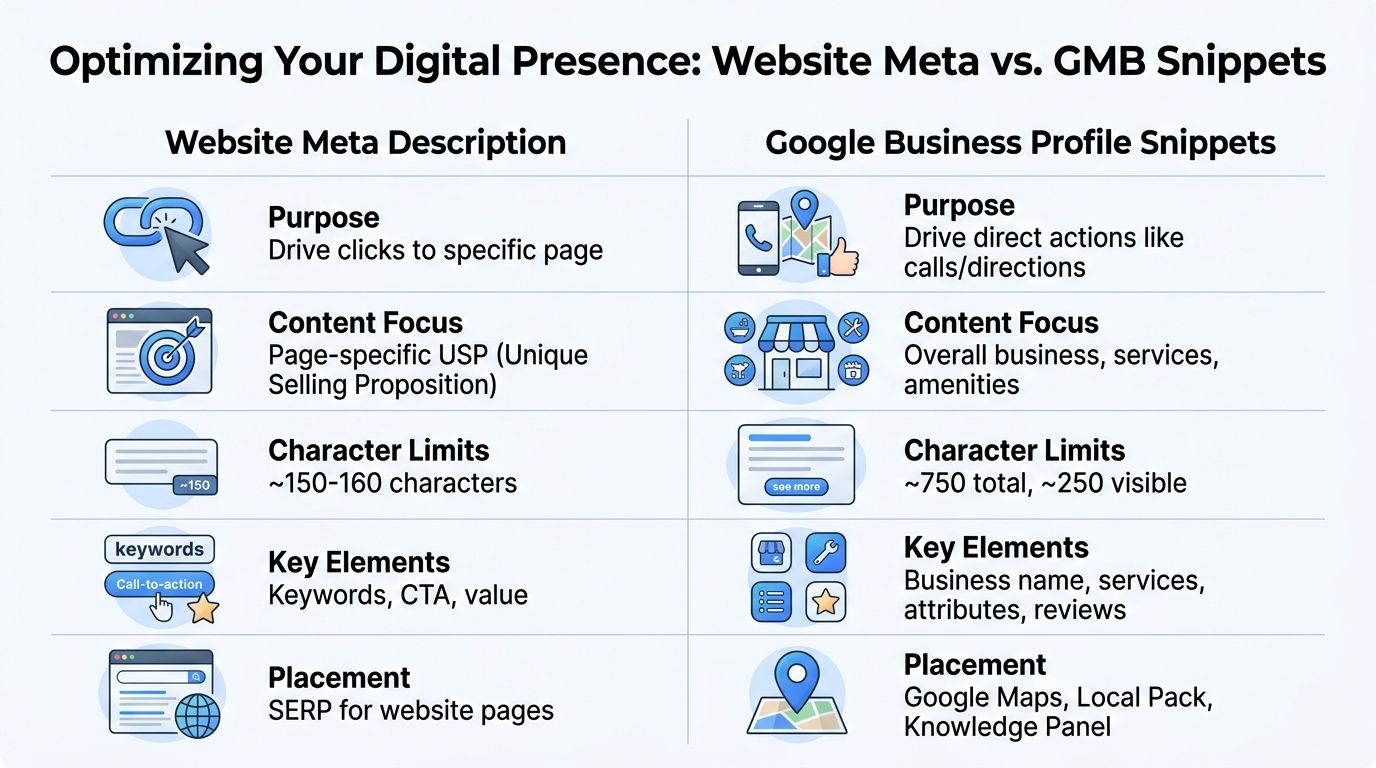
Where your map snippets actually come from
Google Business Profile doesn't give you a classic meta description tag, but it does assemble message signals from several places:
- Business description
- Service list
- Posts
- Review content
- Categories and attributes
That's why local SEO can't treat the website and profile as separate worlds. If your website says one thing and your profile says another, you dilute relevance. If both consistently emphasize the same services, locations, and buyer intent, you strengthen the local signal.
What to emphasize in the profile
A website service page might target “water heater repair in Gilbert.” Your profile content should support that broader service reality without sounding robotic.
Focus on these areas:
- Primary services: Make sure your service list reflects what you want to rank and convert for.
- Local modifiers: Use real service areas naturally where appropriate.
- Action language: Posts should invite booking, calling, or requesting an estimate.
- Urgent use cases: Highlight emergency, same-day, or high-need service types when they're core to the business.
This is especially important in the local pack, where users often decide before they ever land on the website.
Keep the message aligned
A business that wants to dominate maps needs consistency. The page title, page copy, meta description, Google Business Profile details, and review themes should all point toward the same commercial reality.
For teams actively working on local visibility, a focused Google Business Profile optimization process helps connect these moving parts so the messaging stays aligned with transactional searches instead of drifting into generic branding.
The best local snippets don't just describe a business. They make the next action feel obvious.
Common Mistakes and Preparing for AI Search
A lot of businesses still treat meta descriptions like a one-time field. Write something, save it, forget it.
That approach breaks down fast in local search because the search environment keeps shifting. Mobile screens are tighter, Google may choose different snippet text, and AI-driven search experiences are getting better at summarizing businesses based on clarity, relevance, and context.
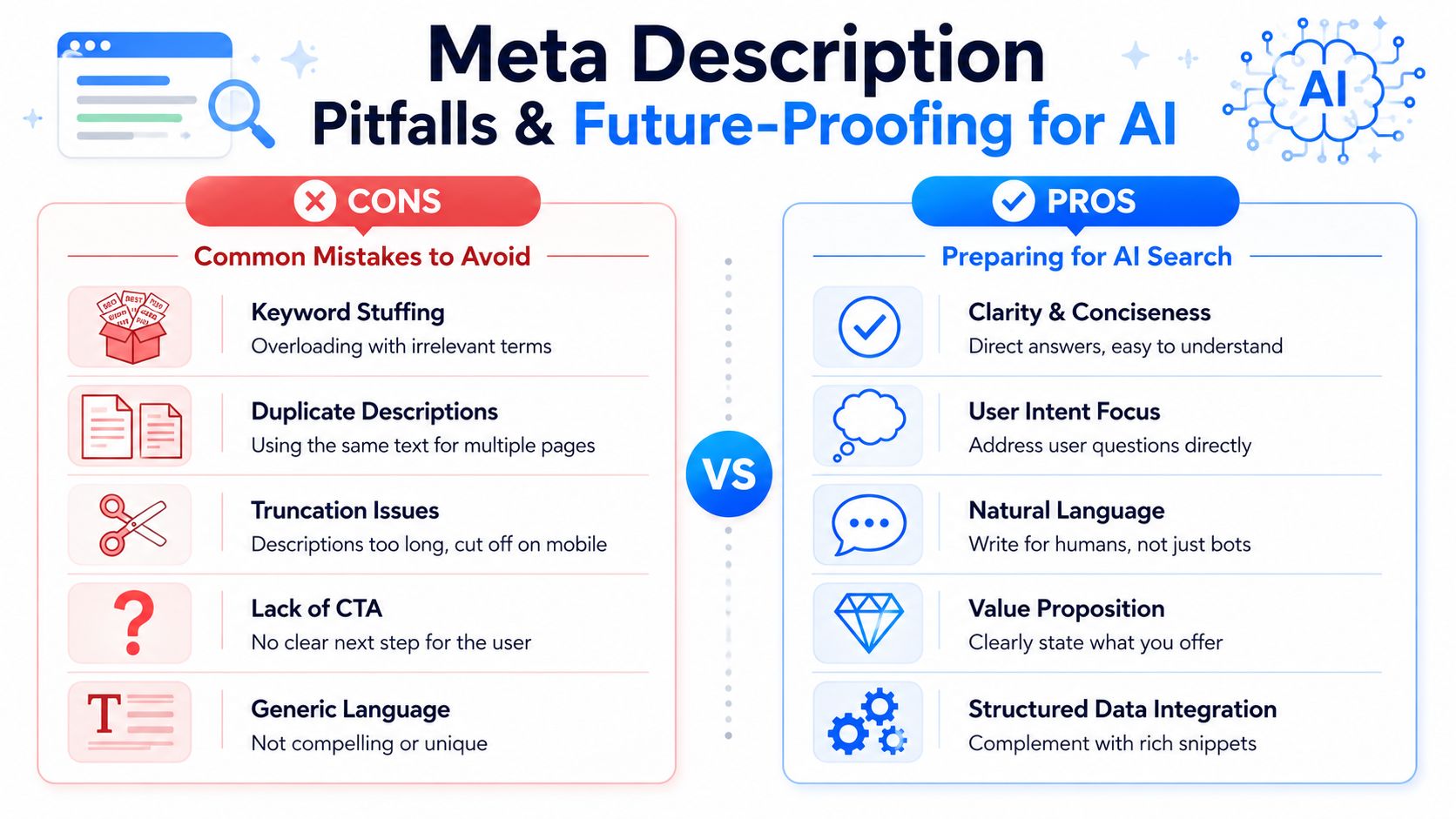
The mistakes that keep costing clicks
Some errors show up over and over.
- Keyword stuffing: Repeating service and city terms makes the snippet look low quality and hard to read.
- Duplicate descriptions: Reusing the same line across service pages hides what makes each page distinct.
- Buried value: If the best benefit appears late, mobile users may never see it.
- No CTA: Without an action cue, the description often reads flat.
- Generic claims: “Trusted professionals” and “quality service” don't separate you from anyone else.
Portent found that mobile snippets often show only about 95 to 105 characters, and date-heavy pages can reduce usable space further, which is why front-loading the message matters so much in Portent's mobile snippet analysis.
Here's the practical takeaway. If your first few words don't communicate service, value, and relevance, you're gambling with the click.
Write for AI the same way you write for buyers
AI search changes the interface, not the need for clarity.
When someone asks an AI assistant for the best emergency plumber nearby or a dentist open today, the system still needs structured, trustworthy summaries to understand what your page or business offers. A tight, page-specific description helps reinforce that understanding.
Good descriptions are useful to AI systems because they are:
| Better for AI retrieval | Why it matters |
|---|---|
| Clear | The business offering is easy to identify |
| Specific | The page topic isn't muddied by broad brand language |
| Intent-matched | The query and page purpose line up |
| Natural | The language sounds like a real answer, not spam |
That same principle shows up in strong local profile work. Contractors and home service companies that tighten service definitions, categories, and business messaging tend to present cleaner signals across search surfaces. This guide for contractors to optimize GBP is a useful reference for that side of local visibility.
Future-proofing means cleaning up the basics
A lot of people want an AI strategy before they've earned a basic, coherent search presence.
Start here:
- Match each page to one clear intent
- Summarize that page in plain English
- Put the offer early
- Support it with consistent local signals
- Review old descriptions on important pages
If you're building visibility for both traditional results and emerging answer engines, practical AI search engine optimization gets its start. Not with gimmicks. With better summaries, clearer page intent, and stronger local relevance.
AI systems can only recommend what they can confidently understand.
Turn Your Search Listings into Client Magnets
The businesses that win local search don't treat meta descriptions as filler text. They use them as short-form sales messaging built for transactional search terms.
That's the difference between a listing that sits there and a listing that produces calls.
If the page targets a buyer-ready search, the description should do buyer-ready work. It should reflect the exact service, show the local fit, surface the value quickly, and make action feel easy. That applies to website pages, and it carries into Google Maps and Google Business Profile visibility as well.
Learning how to write meta descriptions well means writing for the moment before the click. That moment is where local SEO becomes lead generation.
For home service companies, pest control businesses, dentists, chiropractors, med spas, and other local operators, the opportunity is straightforward. Tighten the message around what people are ready to buy now. Build each page around the search terms that signal intent. Make every snippet earn attention.
That's how search listings stop being passive and start functioning like client magnets.
If you want help turning your service pages, Google Maps presence, and AI search visibility into a system that attracts buyer-ready local traffic, Transactional LLC helps service businesses target high-intent search terms, strengthen Google Business Profile performance, and build SEO assets that turn searches into booked jobs and patients.