


A homeowner searches “roofer near me” after a storm. A patient searches “dentist near me” while comparing nearby offices. In both cases, the person has a service need and is ready to spend money. The businesses appearing in the Google Maps top three get the first opportunity to earn the call, while businesses buried below them may never enter the conversation.
Local SEO citations help search engines confirm that a business is real, correctly located, and consistently described across the web. They're not a magic ranking shortcut, and they're no longer the dominant local signal, but they still support the prominence that helps a service business compete for high-intent searches. Google's local framework focuses on relevance, distance, and prominence, with citations contributing mainly to that prominence layer (This Is Gain explains how citations support Google's local framework).

Transactional Marketing focuses on the searches that signal immediate buying intent, including “air conditioning repair near me,” “dentist near me,” and “roofer near me.” Google Maps optimization is central to that work because a strong map presence puts a business directly in front of nearby customers who are choosing a provider.
This guide shows how citations work, why accuracy matters more than listing volume, how to clean up duplicates, which citation tiers deserve attention, and when to stop building. It also connects citation quality to AI visibility, where being mentioned by a language model isn't the same as being used as a trusted source.
Introduction Why Citations Decide Who Gets the Call
A homeowner with a leaking roof may search “roofer near me” from a phone and choose among the map results within minutes. A dental patient may compare offices after work, checking location, category, hours, and contact details before calling.
The Google Maps top three appear at the point of decision. A visible listing can prompt a call, direction request, or visit. Citations do not place a business there by themselves, but accurate references help search engines connect its identity, services, and service area across trusted sources.
Practical rule: Build citations so your business is easy to verify, rather than chasing a larger spreadsheet total.
A citation is an online reference to a business's name, address, and phone number, often called NAP. Moz describes citations as business “thumbprints” crawled across the web, and the subject has been part of local SEO discussions since at least 2013 (Ahrefs summarizes Moz's citation and local ranking-factor research). Their value now depends more on data quality, relevance, and confidence in the business entity than on raw listing volume.
That distinction matters for service businesses. A plumber with dozens of inaccurate profiles can create conflicting signals about its location or services. A smaller set of maintained listings can make the business easier for search engines, customers, and AI systems to identify. BrightLocal's study found that the average local business had 81 citations, with larger footprints in some verticals, including 152 for hotels and B&Bs, 107 for dentists, and 101 for medical businesses (BrightLocal's citation study provides the industry averages).
For Transactional Marketing, citations support searches with immediate buying intent, such as repair, appointment, and installation queries. They work alongside Google Business Profile optimization, service-area relevance, website content, reviews, and map monitoring. The profile is the central public record, so start with these Google Business Profile fundamentals.
Quality should guide the target. For many service businesses, 30 to 50 quality citations can provide clearer prominence signals than hundreds of thin, duplicated listings. Prioritize sources by vertical: trade associations and home-service directories for contractors, healthcare directories for medical practices, and locally trusted business or community sources where customers look.
The practical question is not how many directories you can submit to. It is which references strengthen local prominence for “near me” searches and give AI systems dependable evidence about the business.
What Local SEO Citations Are and How They Work
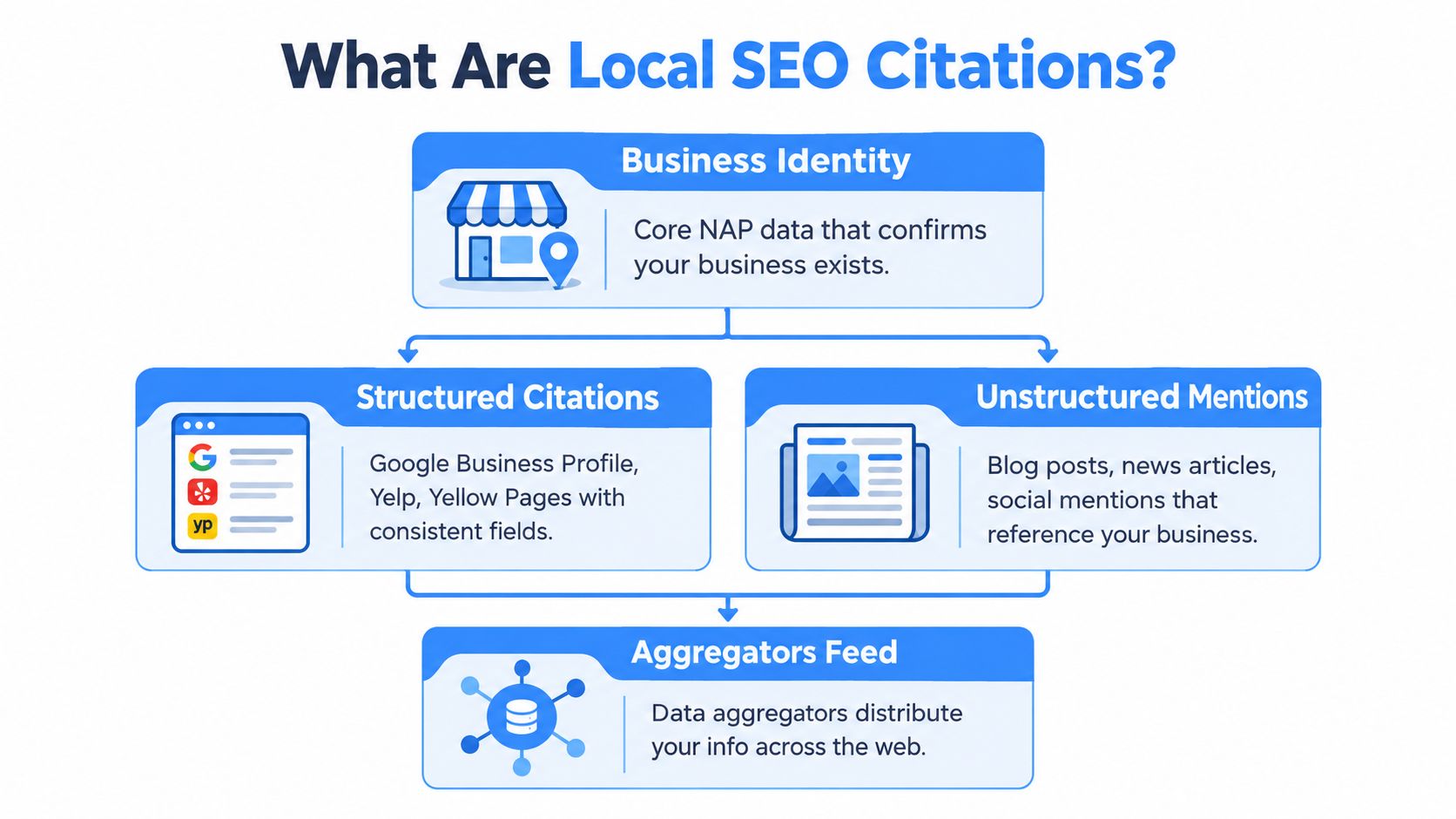
Think of a citation as a digital thumbprint. One directory records a business name, address, phone number, category, hours, and website. A local news article may mention the company by name and location without using a formal listing. Together, these references help create a consistent public identity.
Structured citations use dedicated listing fields. Google Business Profile, Yelp, Yellow Pages, Apple Maps, and Bing Places are familiar examples. Unstructured citations appear in blogs, local news, community pages, association websites, and other content that references a business without following a directory template. Moz defines local citations as online mentions of a business's NAP information and distinguishes these formal and informal forms (Moz's local ranking guidance defines citations and their role).
The three concepts people often confuse
- Citation: A reference that confirms the business's identity and location. It may include a link, but a link isn't required.
- Backlink: A link from another website to the business website. Backlinks can support authority, but they serve a different purpose from NAP validation.
- Google Business Profile signal: Information and activity associated with the business's Google profile. It directly affects how the business appears in Google Maps and local results.
A Yelp listing can contain both a citation and a link, but those aren't automatically the same signal. The citation helps establish identity and location. The backlink, if present, is evaluated as a link from that website.
Data aggregators add another layer. They distribute business information to other platforms, which means an error in one upstream source can spread through multiple listings. That's why a citation campaign needs both initial accuracy and ongoing monitoring.
Citations matter most when a service business is competing for location-based, high-intent searches. A customer searching for “air conditioning repair near me” needs a provider that Google can associate with the relevant service and service area. A citation on a random, thin directory may contribute little, while a complete profile on a relevant platform or a mention from a trusted local organization can reinforce the business's identity.
Businesses that want to boost product discovery with geo search can apply the same principle: location context makes an online presence more useful when customers search with geographic intent.
Why NAP Consistency Builds Trust and Prominence
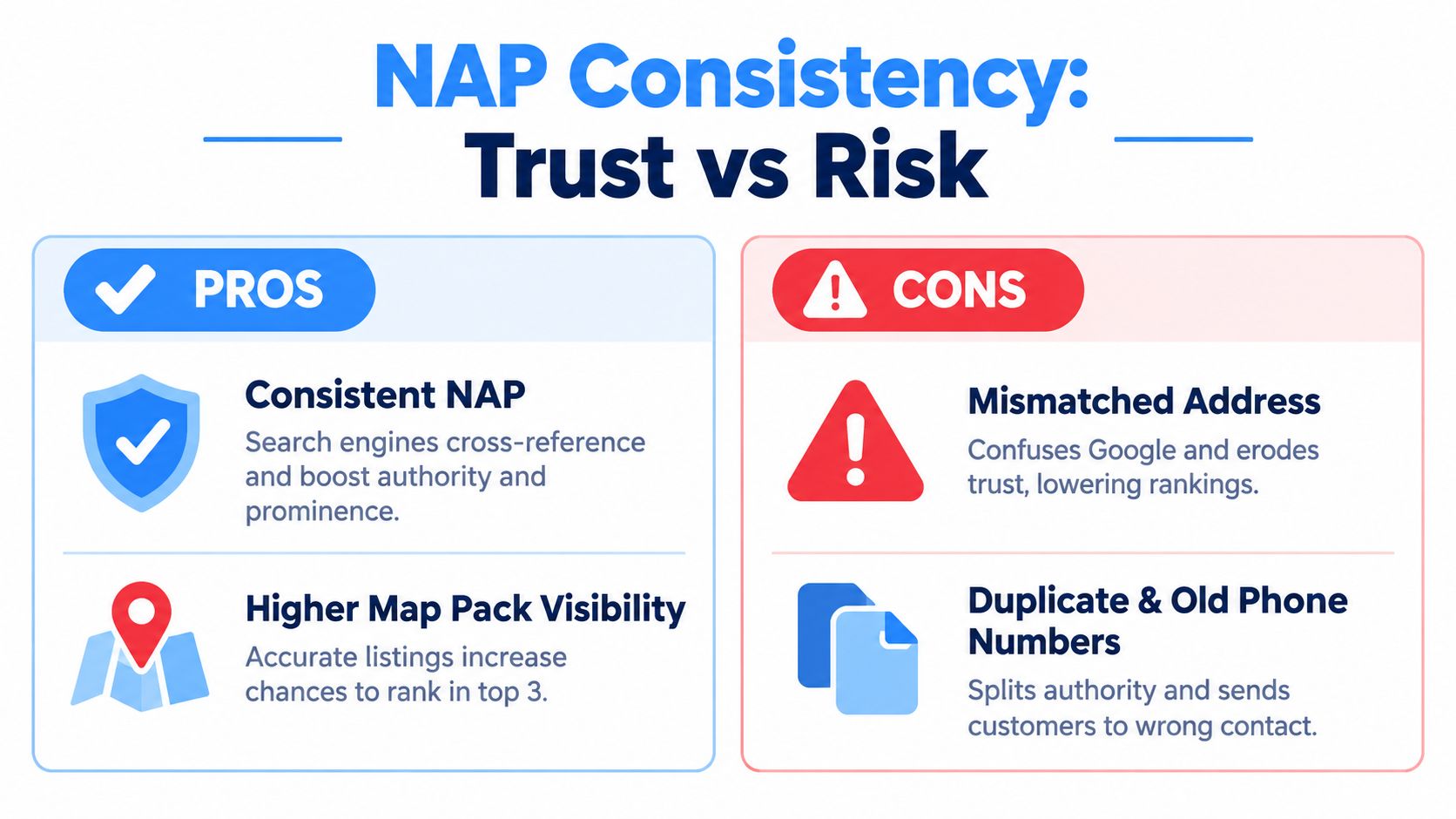
Citation volume can't compensate for contradictory business information. Search engines cross-reference a company's name, address, and phone number to determine whether the references describe the same real-world business. If one listing shows an old phone number and another uses a different suite format, the business creates uncertainty at the exact point where citations should create confidence.
Consider a service company that moved offices. Its Google profile shows the new address, but an industry directory still lists the old location. A local association includes a tracking number, and a duplicate profile uses an abbreviated business name. Customers may call the wrong number, drive to the former office, or see multiple versions of the same company.
BrightLocal's citation research defines citations through NAP data and reports that search engines use those references when assessing local authority (BrightLocal's citation research examines NAP consistency and local authority). Independent summaries of local audit data associate fully consistent NAP information across major platforms with more frequent local pack appearances. The practical conclusion is straightforward: clean data has more value than a crowded list of conflicting entries.
How prominence fits the local algorithm
Google's local search framework uses three broad ideas:
- Relevance: Does the business match the service or category the customer searched?
- Distance: How close is the business to the searcher or the location implied by the query?
- Prominence: How well-known and established does the business appear across the web?
Citations mainly support prominence. They don't override distance, turn an irrelevant business into a relevant one, or guarantee a top-three map position. They provide supporting evidence that the business exists, operates where it says it operates, and is recognized beyond one profile.
For a business owner, that changes the order of operations. Don't begin by chasing every directory. First create a written NAP standard, then use it consistently across the website, Google Business Profile, map services, directories, and local references. The exact presentation should be deliberate, especially for suite numbers, legal business names, phone numbers, and service-area details.
You can use this explanation of what NAP stands for as a reference when creating that standard. Once the information is stable, citation building becomes an authority exercise instead of repeated damage control.
How to Audit and Clean Up Citations Without Missing Duplicates
A citation audit should produce a decision list, not just a software report. The task is to find every meaningful reference, compare it against one approved business record, and resolve the entries that could confuse customers or search engines.
Start with one source of truth
Record the official business name, address, phone number, website, hours, primary category, service categories, and service-area description in a master document. Include acceptable formatting for suite numbers and abbreviations. If the company uses a call-tracking number, decide where it belongs and keep the primary NAP phone stable across core listings.
Then collect listings from:
- Core platforms: Google Business Profile, Apple Maps, Bing Places, Yelp, and Facebook.
- Industry sources: Trade directories, professional associations, referral platforms, and vertical-specific sites.
- Local sources: Chambers of commerce, civic organizations, local publications, and community directories.
- Data feeds: Aggregators and platforms that distribute business details to other websites.
Search the business name, phone number, street address, former business name, and old website URL. Search engines often reveal duplicate listings that a single brand-name query misses.
Classify before changing
For each result, mark it as accurate, inaccurate, duplicate, unclaimed, inaccessible, or irrelevant. Capture the listing URL, platform, login owner, last update, and required action.
A duplicate may use a shortened name, an old suite number, or a former phone number. Don't create another listing to compete with it. Claim the profile when possible, request a merge when the platform supports that process, and document the request.
The same caution applies to aggregator errors. Fixing a downstream directory without correcting the upstream feed can allow the wrong data to return. Trace the error back to its source, update the source record, and then recheck the affected platforms.
Cleanup principle: Correct the source that distributes the error, then confirm that the correction reached downstream listings.
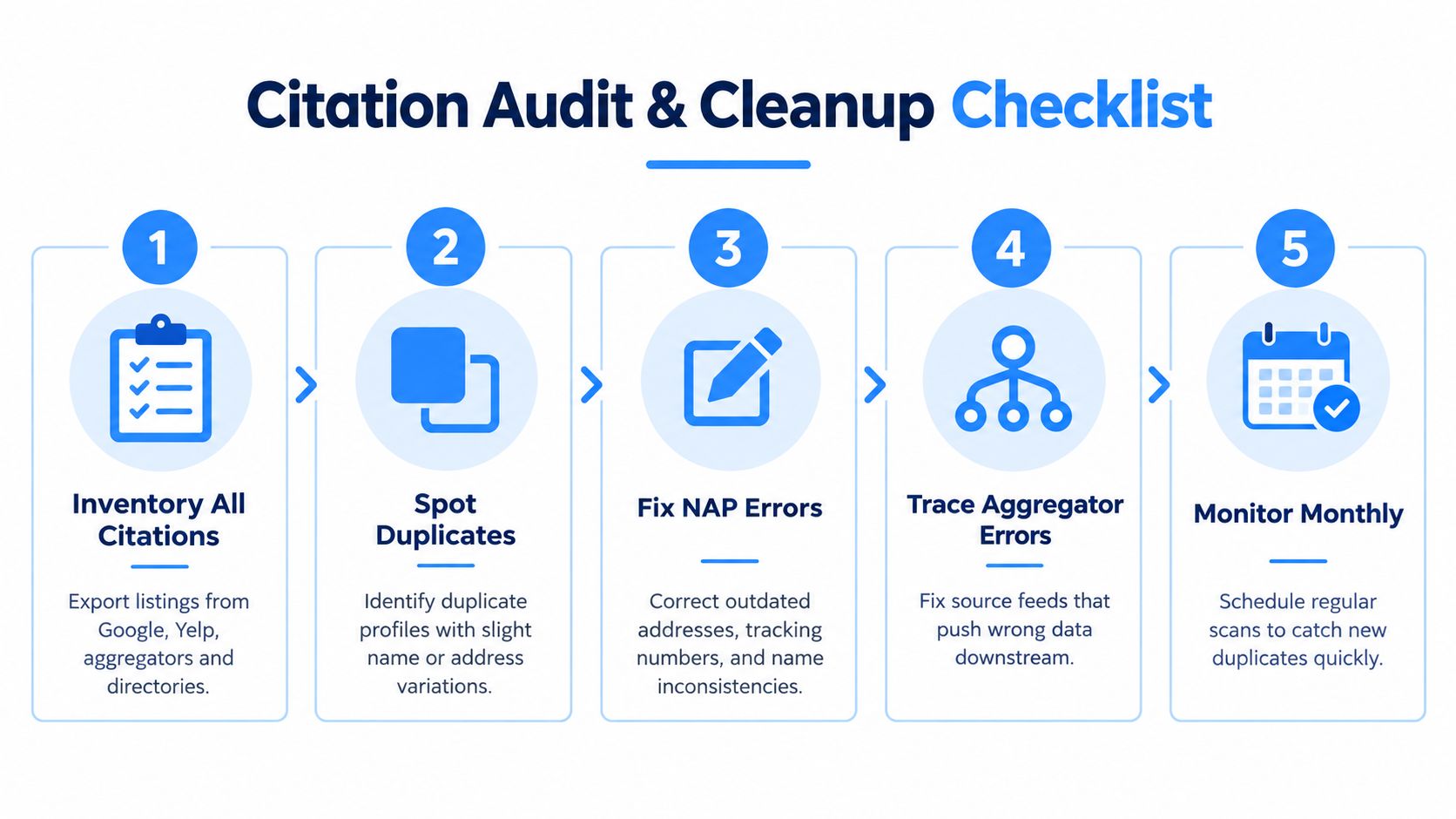
A recurring audit matters because old business data gets re-scraped and new directories appear. The 2026 guidance from Secret Optimizer recommends periodic audits and prioritizes complete, authoritative citations over thin listing volume (Secret Optimizer's 2026 citation guide discusses quality, tiers, and maintenance).
You can use BrightLocal, Whitespark, or Moz Local to identify listings, but manual verification still matters. A tool may find the profile, while a person must decide whether the address is current, whether the listing is a duplicate, and whether the directory is relevant to the business.
Use the Google Business Profile audit service as part of the broader review, especially when profile categories, hours, service areas, and contact details need to align with the citation record.
High Value Directories by Vertical and When to Stop Building
A homeowner searching for “roofer near me” is not comparing every directory on the web. They need a business that appears credible, relevant to roofing, and connected to the local area. Your citation portfolio should reflect that decision. A dental practice and a roofing company need different supporting sources because customers, professional groups, and trusted directories vary by vertical.
Use tiers to set priorities. Begin with platforms that establish the business entity and support discovery. Then add sources that clarify industry and geographic relevance.
Citation Tiers by Priority and Vertical Fit
| Citation Tier | Examples | Best For | Priority Level |
|---|---|---|---|
| Core platforms | Google Business Profile, Apple Maps, Bing Places, Yelp | Every local service business | Highest |
| Data distribution sources | Major aggregators and established business databases | Businesses needing consistent information across platforms | High |
| Vertical directories | HVAC and plumbing directories, roofing platforms, dental directories, pest control resources | Reinforcing industry relevance | High |
| Local civic sources | Chamber of commerce, city business directories, local associations | Strengthening geographic prominence | Medium to high |
| Unstructured mentions | Local news, trade articles, community pages, sponsorships | Building contextual recognition | Selective |
| Thin general directories | Low-quality sites with little local or industry value | Rarely worth pursuing | Low |
BrightLocal reported that 64% of experts considered niche and industry directories the most valued source of structured citations, supporting a relevance-first approach (Ahrefs reports the BrightLocal expert finding in its citation research summary).
Vertical fit makes a listing more useful than a generic entry. A roofing company can prioritize home-service platforms, construction associations, and community sources covering property services. An HVAC business can choose heating and cooling directories, trade relationships, and local home-maintenance sources. A dental practice should focus on healthcare and dental directories, professional organizations, and accurate office profiles. Pest control companies should seek home-service and property-care sources instead of unrelated general listings.
Citations also provide context for stopping points. BrightLocal found an overall average of 81 citations. Businesses ranking in position 1 averaged 86, those in positions 1 through 3 averaged 85, and businesses in position 10 averaged 75 (Link Building Journal summarizes the citation and ranking-position comparison). This is a modest correlation, not proof that adding listings produces a predictable ranking increase.
For many businesses, 30 to 50 high-authority, fully completed citations can be a more sensible target than hundreds of thin listings, according to the 2026 industry guidance cited earlier. The practical stopping rule is coverage: core platforms, relevant vertical directories, valuable local sources, and duplicate records are handled. After that, time may produce more value through stronger transactional pages, reviews, Google Business Profile quality, and customer experience.
A smaller set of relevant citations can function like a clear signpost for both near me searches and systems evaluating local business visibility. Relevance and completeness should decide the next listing, not the raw count.
Building Authoritative Citations at Scale for Transactional Terms
After cleanup, citation building should support a specific commercial objective. For Transactional Marketing, that objective is visibility for searches such as “air conditioning repair near me,” “dentist near me,” and “roofer near me.” Each listing should reinforce the same business identity while making the service and location clear.
Start with complete profiles. Use the approved business name, address, phone number, website, hours, categories, service descriptions, photos, and location details. Avoid copying a generic description everywhere. Keep the core identity consistent, but describe the actual service context in language that fits each platform.
A practical growth pattern
- Establish the entity: Make the Google Business Profile, Apple Maps, Bing Places, and major directory records accurate and complete.
- Deepen vertical relevance: Add industry-specific sources for the exact service category, such as heating repair, roofing, dentistry, or pest control.
- Add local context: Pursue chambers, associations, community organizations, local publications, and legitimate partnerships.
- Reinforce the website: Build service and city pages that match the information in the listings, without creating thin pages for every minor variation.
- Measure search intent: Review Search Console queries, map-ranking heat maps, calls, direction requests, and website actions.
Citations support the broader system, but they shouldn't distract from Google Business Profile optimization. One 2026 local ranking-factor analysis assigns citation signals roughly 7% of local ranking weight while placing Google Business Profile signals at about 32%, illustrating why citations work best as a supporting trust layer rather than the main ranking lever (Localo's ranking-factor analysis compares citation and profile signals).
AI search adds another consideration. An AI citation is a source a language model uses as a reference point, while a mention may name a business without crediting it as evidence (BrightLocal distinguishes AI citations from mentions in its local AI visibility resource). A business can therefore be mentioned without being treated as a reliable source.
That distinction makes consistency and relevance more important. When an AI system evaluates local options, complete profiles, trustworthy directory references, local context, and aligned website information give it a clearer entity to interpret. Transactional Marketing can support this work through citation building, Google Maps optimization, and an AI-driven content engine that organizes content around high-intent services and cities.
Putting Citations to Work for Maps Top Three Results
Citations become commercially useful when they support a focused local search system. The sequence is simple:
- Audit the existing footprint. Find duplicates, old contact details, incorrect addresses, and incomplete listings.
- Standardize the identity. Use one approved name, address, phone number, website, and category structure.
- Prioritize the right sources. Cover core map platforms, vertical directories, and credible local organizations.
- Optimize the Google Business Profile. Align categories, services, service areas, hours, photos, and supporting content.
- Target transactional terms. Build around searches such as “air conditioning repair near me,” not broad, low-intent phrases.
- Monitor the map results. Use ranking heat maps and Search Console queries to identify where visibility improves and where gaps remain.
Transactional Marketing's process is designed to laser-focus on specific service and city searches, with a stated goal of getting client websites onto page one of Google within 30 to 60 days. Results depend on the market, competition, website condition, profile quality, and execution, so citations should be treated as one component of the system rather than a standalone guarantee.
Businesses seeking more context on the signals involved can review these Google Maps ranking factors. The key is continuous optimization, not a one-time listing dump. Accurate citations make the business easier to verify, while strong service pages and a complete Google Business Profile make it more relevant to the customer's actual search.
Transactional Marketing also positions Google Maps optimization around reaching the top three results in a service area. That visibility can create substantially more opportunities for calls, directions, and website visits, but the business still needs accurate information, responsive follow-up, and a service experience that earns customer trust.
Transactional LLC helps service businesses build and maintain consistent citations, optimize Google Maps and Google Business Profiles, and target transactional searches such as “roofer near me,” “dentist near me,” and “air conditioning repair near me.” Visit Transactional LLC to request a focused local SEO review and identify the citation, map, and content improvements most relevant to your service area.