


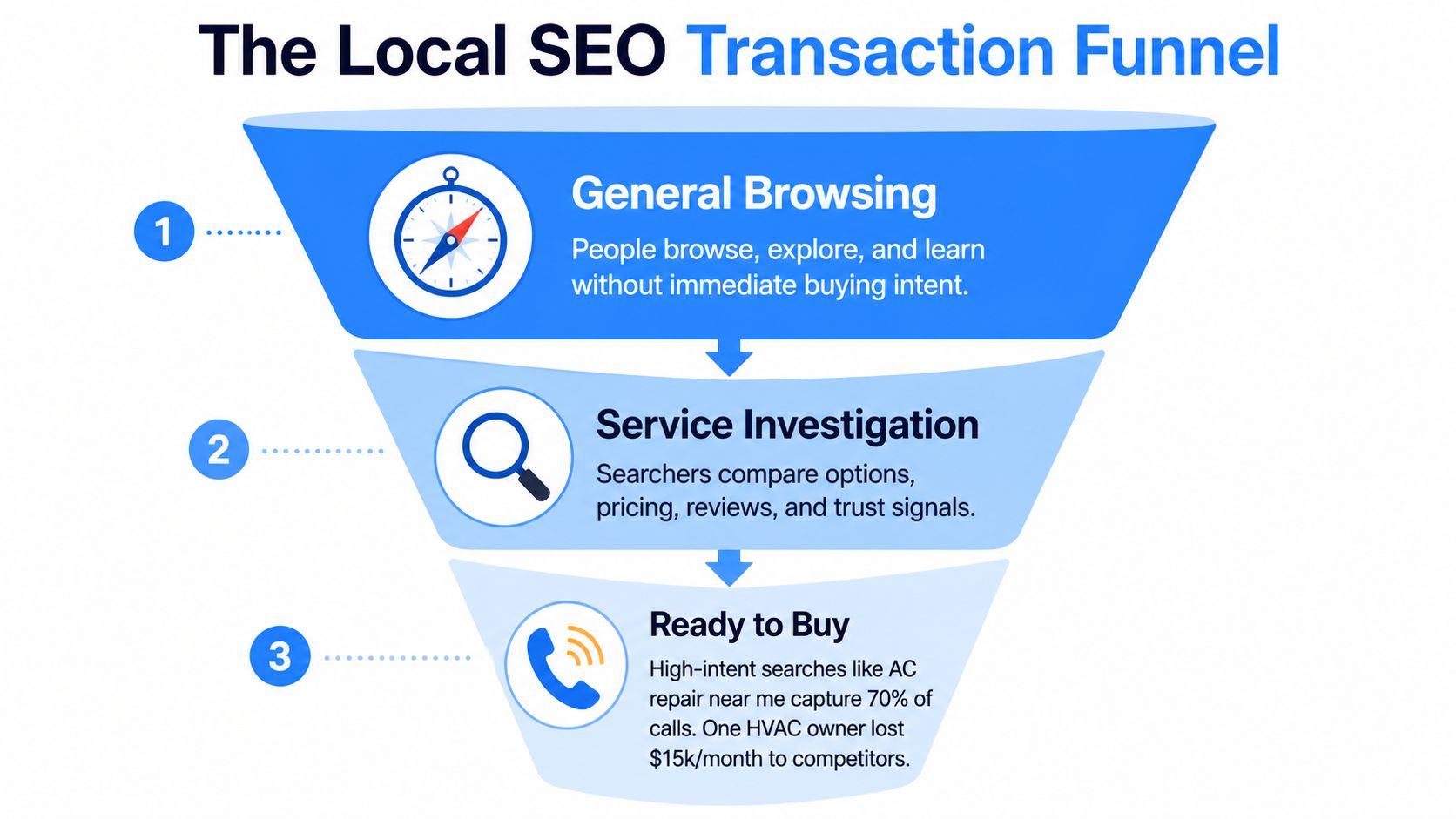
A two-truck HVAC owner checks the phone after lunch and sees nothing. Across town, another contractor is answering calls from people searching “AC repair near me.” The demand exists. The buyer is already looking. The competitor is visible at the moment the problem becomes urgent.
That's the difference between passive traffic and local SEO optimization built for transactions. Transactional Marketing focuses on searches such as “roofer near me,” “dentist near me,” “plumber near me,” and “air conditioning repair near me,” where the searcher has money in hand and wants a provider, not a general article. The objective is clear, show up in Google Maps, the Local Pack, organic results, and increasingly AI-generated answers before the buyer calls someone else.
Why Local SEO Optimization Is a Transactional Game
Local SEO isn't a vanity traffic exercise. For a service business, it's the process of capturing location-based searches from people who need a specific service and are ready to contact a provider.
A homeowner searching for “water heater repair in Dallas” isn't casually researching plumbing. A patient searching for “dentist near me” may be comparing offices, hours, reviews, and appointment options in the same session. A pest control customer may be dealing with an active infestation. The page that appears first has a direct opportunity to receive the call, form submission, or directions request.
Transactional Marketing goes after that money-on-the-table intent. Ranking for an informational phrase such as “how to maintain an air conditioner” can support visibility, but it usually sits earlier in the buying journey. A service page or Google Business Profile that appears for “AC repair near me” meets the customer at the point of action.
Google says local results are mainly shaped by relevance, distance, and prominence. Relevance connects the profile to the requested service, distance reflects proximity to the searcher, and prominence includes signals such as links and reviews, as explained in this overview of Google's local ranking principles.
The conversion gap between visibility and demand
The 2025 consumer study cited by Rio SEO found that 84% of consumers search online for local businesses daily, while 75% read at least four reviews before choosing. It also found that 53% say inaccurate listings drive them away and 59% expect a response within 24 hours (Rio SEO's 2025 local search consumer behavior study).
Those findings change the operator's priorities. Accurate information, credible reviews, and rapid lead response aren't cosmetic improvements. They determine whether a searcher trusts your business enough to call.
Businesses with several locations also need a consistent structure across profiles, pages, and service areas. A practical multi-location local SEO strategy can help organize that work without treating every location as a disconnected marketing project.
Google Business Profile Setup That Earns the Map Pack
A homeowner searching “roofer near me” or “dentist near me” already has commercial intent. Your Google Business Profile must turn that intent into a call, direction request, booking, or website visit before the searcher reaches a competitor. Set the fields that affect eligibility, relevance, and conversion before spending time on posts or decorative photos.
Build the profile in ranking priority order
Claim and verify ownership. Use the actual business and a legitimate operating location. Service-area businesses should follow Google's rules for businesses that travel to customers, rather than presenting a virtual office as a storefront.
Choose the most specific primary category. Select the service customers hire you to perform. An HVAC contractor should use a precise HVAC category instead of a broad home-services category when the specific option fits. Add secondary categories only for genuine services.
Match your business information everywhere. Keep the business name, address, phone number, website, and hours consistent with the company website and major directories. Pin the address accurately, then configure service areas based on where the team works.
Complete the commercial details. Write a clear description, add services, include appointment links, publish accurate hours, and select relevant attributes. Use natural service and city language. Do not stuff keywords into the business name, create duplicate profiles, or combine unrelated industry categories.
Add evidence of a real operation. Upload exterior and interior images, team photos, equipment, and work-in-progress images. These assets give a ready-to-buy searcher a quick reason to trust the listing and call.
Maintain the profile. Publish useful Google Business Profile posts, update holiday hours, add services when they launch, and monitor user-suggested edits. Incorrect hours can lose an urgent lead even when the profile ranks well.
Build the profile around the customer's next action. A homeowner seeking emergency plumbing should immediately see the service, location, opening status, phone number, and booking path. Use this Google Business Profile setup guide to check each field against that journey.
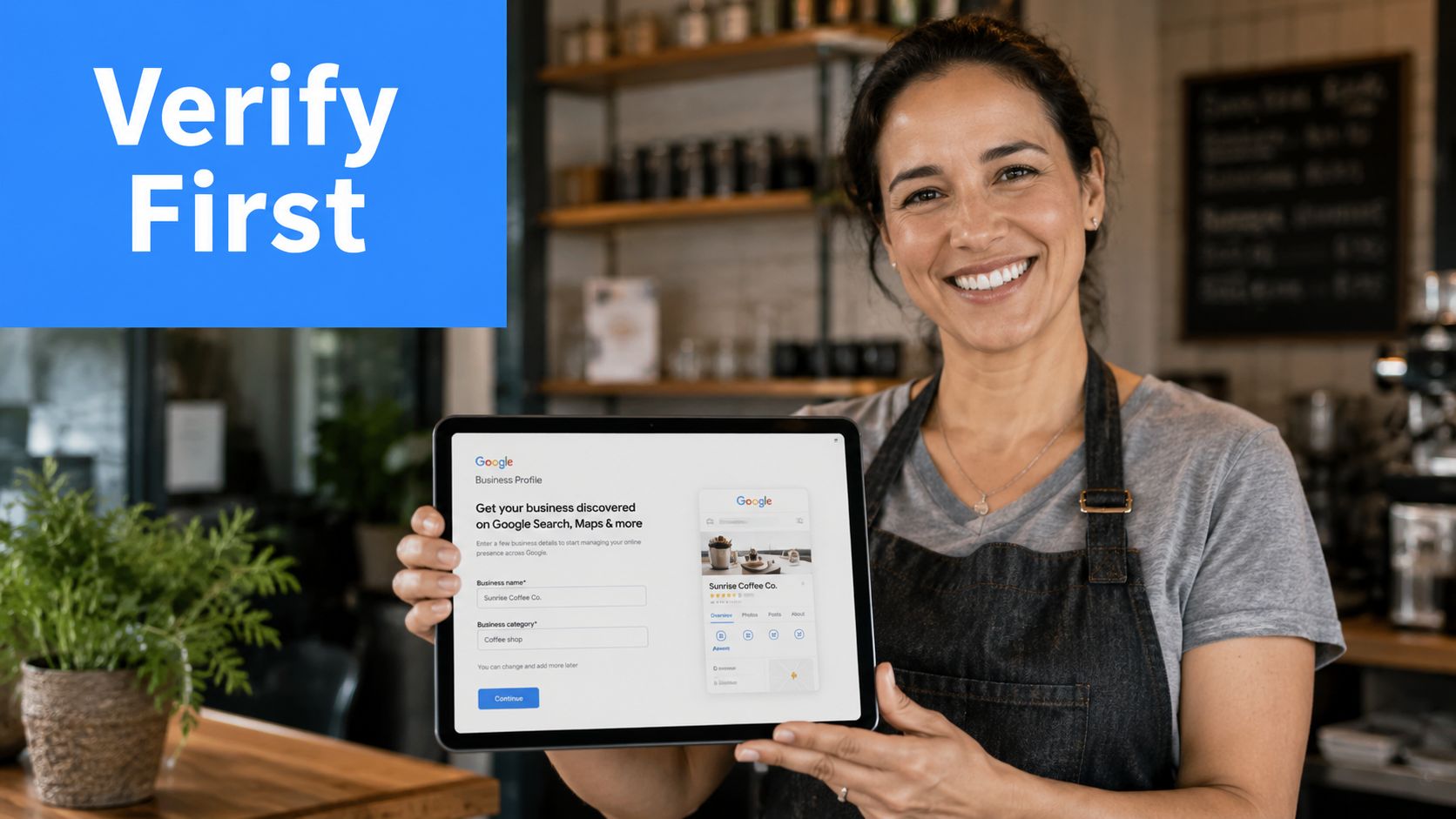
A complete profile still needs ongoing quality control. Review the listing after changes, confirm that the phone number works, and check that service areas and hours match the operation. Those details support both visibility and the conversion that matters, a qualified local lead.
Avoid shortcuts that create profile risk
A keyword-stuffed name can create compliance and suspension problems. Virtual offices, duplicate listings, false locations, and irrelevant categories create the same risk while targeting the wrong search intent.
Operator rule: Complete the core profile accurately before chasing minor activity signals. A polished listing with the wrong category still attracts the wrong customer.
Ranking Factor Priorities for Local Pack and Organic
Local SEO gets expensive when every tactic receives equal attention. A 2026 survey weighted Google Business Profile signals at 32%, review signals at 20%, on-page signals at 15%, behavioral signals at 9%, link signals at 8%, and citation signals at 6% for local pack and Maps influence. Treat those figures as an effort-allocation framework, not a guarantee for every market.
| Ranking Factor | Relative Weight | Time to Impact | Effort Level |
|---|---|---|---|
| Google Business Profile signals | 32% | Early, after corrections and verification | High |
| Review signals | 20% | Builds through consistent acquisition | Medium |
| On-page signals | 15% | Compounds as pages are crawled and evaluated | High |
| Behavioral signals | 9% | Depends on real customer actions | Ongoing |
| Link signals | 8% | Usually compounds over time | Medium to high |
| Citation signals | 6% | Useful after primary data is correct | Low to medium |
Week one
Allocate the first effort to the highest-weight factor. Check whether the profile's category and location relevance match the service behind searches such as “roofer near me” or “dentist near me.” The survey identifies the primary GBP category, keywords in the business title, physical address in the search city, and being open at search time among the strongest individual factors.
Use those findings to identify ranking constraints, not to manipulate the name or location. A profile that attracts urgent searches but represents the wrong business has little commercial value.
Month one
Shift attention to the next major opportunity: organic relevance. On-page signals carry more weight for local organic rankings than for the Map Pack, so evaluate whether each target query has a page that clearly matches the service and location. Correct weak title tags, headings, topical coverage, and internal relationships between relevant URLs.
Keep review work on its own operating track because review signals have a separate weighting. Do not let review volume distract from pages that fail to answer a buyer's service question. The goal is qualified calls and bookings, not broader traffic.
Quarter one
Use the remaining effort according to expected return. Behavioral, link, and citation signals have smaller stated weights, so measure whether improvements produce more calls, direction requests, form submissions, or booked jobs before expanding them.
Review the local search ranking factors guide to keep prioritization tied to buyer intent. Low-weight activity cannot compensate for a weak relevance match or an unresolved high-weight constraint. Rank work by money-on-the-table searches, then test the effect on leads rather than rankings alone.
Service Area Pages and Content Silos That Convert
A city page shouldn't exist merely because a city name was inserted into a template. That approach produces thin pages that don't help buyers and rarely give search engines a strong reason to rank the URL.
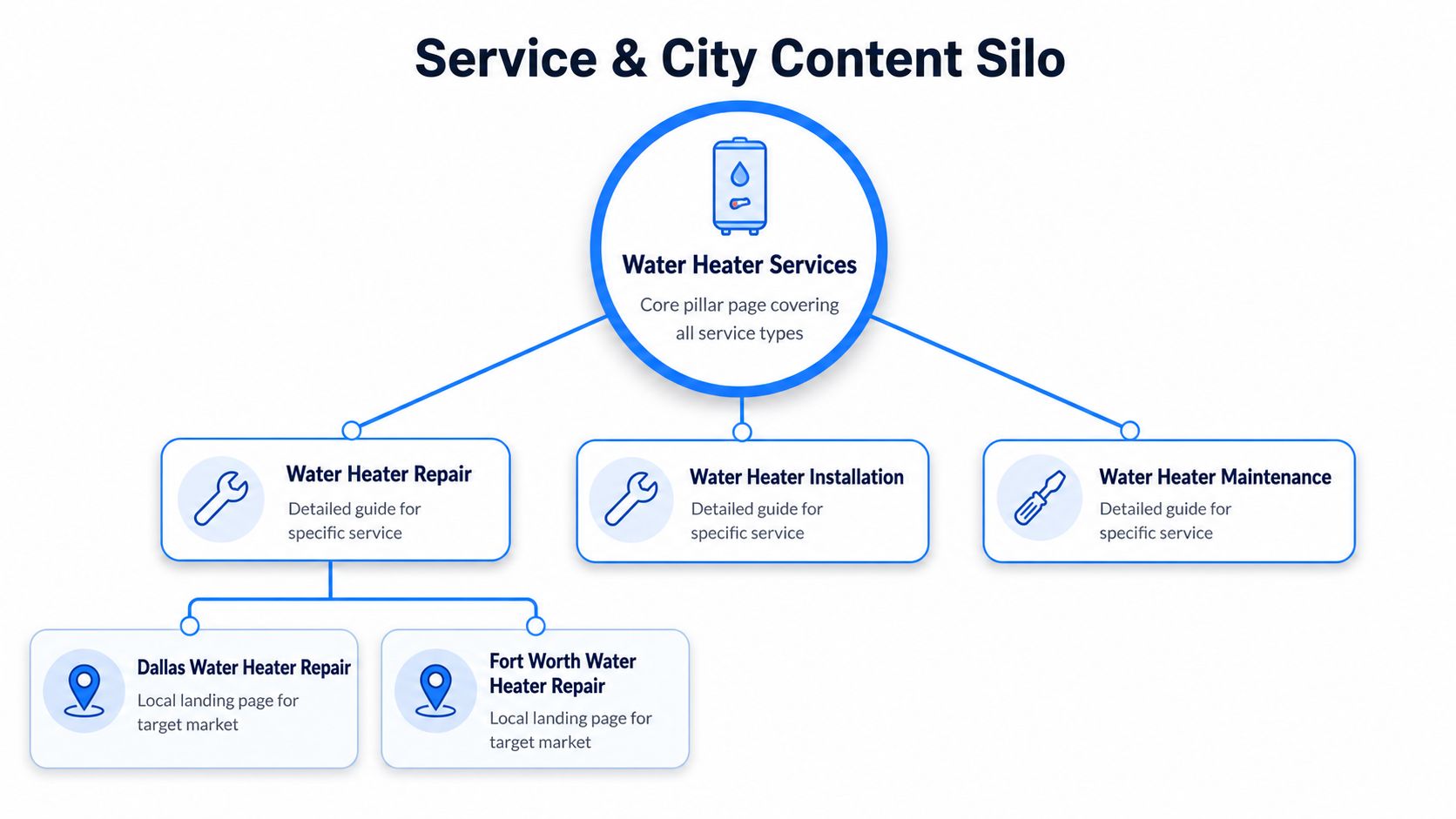
Build a service-and-city content silo instead. For a plumbing company, the architecture might start with a central water heater services page. Under that hub, create dedicated pages for water heater repair, water heater installation, and water heater maintenance. City pages should branch from the relevant service page, such as Dallas water heater repair and Fort Worth water heater repair.
Give every page a real local job
A page targeting “plumber in Riverside” needs Riverside-specific information and a clear conversion path. Include the neighborhoods served, relevant landmarks, actual service limitations, local FAQs, directions, hours, and a prominent call option. Use LocalBusiness schema where it accurately describes the business, and connect the page to the relevant Google Business Profile without implying a location that doesn't exist.
Don't manufacture addresses or fictional customer stories. If you have genuine work examples, describe the service and outcome accurately. If you don't, use useful local guidance instead of fake case studies.
The page should answer the questions that delay a call:
- Service fit: Does this company handle the exact problem?
- Coverage: Does the team work in this city or neighborhood?
- Availability: Can the customer request service now?
- Trust: Are reviews, credentials, and business details consistent?
- Next step: Is the phone number, form, or booking path obvious?
A useful location page blueprint for SEO can help teams evaluate whether a page offers genuine local value rather than repeated copy.
Link the silo toward conversion
Every city spoke should link back to its service pillar, and each pillar should link to the relevant city pages. Blog posts can support the structure by linking to service pages when the reader has moved from education to evaluation.
For a single-location business, don't force a large city-page network. Build deeper pages around neighborhoods, urgent service modifiers, and specific buyer problems. A dental practice might separate emergency dentistry, implants, and cosmetic consultations by actual services, then use local context where it adds decision-making value.
See the service-area page strategy for local search before publishing a batch of city URLs. The standard is simple. Each page must help a real buyer choose the business and contact it.
Review Generation Built for AI and Trust Signals
AI Overview systems and human buyers respond to reviews that describe the job, location, and result. A plumber with recent feedback naming water heater repair in a target city gives a ready-to-book searcher stronger evidence than a profile filled with vague praise. Build review generation around the exact transactional questions behind searches such as “roofer near me” and “dentist near me.”
A review program should produce useful buying evidence, not increase the star average. Review recency, specificity, sentiment, and volume shape how customers assess a business and how local search systems interpret its reputation.
A buyer wants proof that the company handled the same service, in a relevant area, with a satisfactory result. Ask for that detail without scripting the customer's words.
Replace the one-time review push
Start the workflow when the job closes. The office system sends a review request after the technician confirms completion, the message opens easily on a phone, and the owner monitors responses instead of abandoning the process after sending one link.
The technician can make the request in person while the customer remembers the work. The office should also identify dissatisfaction quickly and address the service issue directly. That is customer recovery, not a method for hiding criticism.
Ask customers to describe the actual service, problem, location, and experience in their own words. A review that names water heater repair in a specific city gives future buyers more useful information than a generic sentence about a pleasant technician.
Respond like a local business
Reply to every review, including negative feedback. Keep the language natural, acknowledge the work performed, and mention the service or city only when it fits the response. Repeating the same keyword-heavy reply across profiles makes the business sound automated and adds little trust.
Review count remains competitive. An independent benchmark of 1,122 Google Business Profiles found that more specific primary categories were associated with approximately 36% higher presence in the top ten local results, with 12.5% versus 9.2% for less specific category choices (Local Hero's local SEO benchmarks). The benchmark also reported a median of 79 reviews for the number one profile compared with 25 for profiles ranked outside the top ten. Volume helps a profile compete, while relevant, detailed reviews help turn visibility into calls.
Set a steady, compliant review routine. Do not buy reviews, script customer language, or offer incentives that violate platform rules. Honest feedback collected after real jobs gives buyers the evidence they need to choose and contact the business.
Citations, Local Links, and Schema That Hold It Together
Citations establish the basic identity of a local business. They don't replace a strong profile, relevant pages, or genuine authority. Treat them as the floor, then invest the serious effort in sources that confirm the business belongs in its market.
Start with the major platforms and industry directories that customers and search systems use. Audit Apple Maps, Bing, Yelp, the Better Business Bureau, Facebook, trade directories, and local organizations. Correct the business name, address, phone number, website, hours, and duplicate listings before expanding into secondary directories.
| Tactic | Effort | Impact |
|---|---|---|
| Correct primary directory data | Medium | High foundation value |
| Remove duplicate listings | Medium | Prevents conflicting entity signals |
| Add relevant industry citations | Medium | Supports service relevance |
| Earn chamber and association links | Medium | Strong local context |
| Secure local press coverage | High | Valuable authority and awareness |
| Add accurate schema markup | Medium to high | Improves machine readability |
Put links where local relevance is real
A chamber of commerce profile, trade association membership, supplier page, local sponsorship, or hometown publication can reinforce both geography and industry. A relevant local newspaper mention is usually more useful than a large batch of generic directory submissions because it carries a stronger connection to the community.
Don't buy random links or publish low-quality guest posts solely to place anchor text. Build relationships around real business activity, charitable work, education, events, and useful local resources.
Use schema to clarify the entity
Add accurate LocalBusiness markup to the appropriate business pages, Service schema to service pages, and BreadcrumbList markup across the site. Use Review and FAQ schema only where the visible page content supports it and the markup follows search engine guidelines.
Schema won't rescue a weak service page. It helps machines interpret information that already exists, such as business identity, services, address, hours, and frequently asked questions.
Run a technical crawl with Screaming Frog or Sitebulb on a recurring schedule. Check for missing markup, broken internal links, duplicate titles, indexation problems, and location pages that have drifted out of the intended structure. The citation-building process for local SEO should follow the same sequence, clean core data first, then expand authority.
Tracking Results and Winning in AI Overviews
A local SEO campaign earns its keep through booked jobs and patients. Ranking screenshots do not pay the phone bill. Track Google Business Profile calls, website clicks, direction requests, form submissions, booked appointments, and assisted conversions. Use Google Tag Manager for event tracking, then connect lead activity to its source with a call attribution platform such as CallRail or WhatConverts.
Set expectations by task, not by a promised ranking date. Transactional Marketing describes a 30-to-60-day window for targeted visibility work. Profile cleanup and review activity can move sooner, while on-page changes and citation improvements build as search engines recrawl the site. Content silos and local links usually require sustained work before their full value appears.
Measure the AI discovery layer
Local discovery now extends beyond standard blue-link results. The 2025 Rio SEO study reported that 60% of consumers click AI-generated overviews in Google Search, making AI visibility worth tracking alongside Maps and organic rankings. A separate analysis reported that AI Overviews may appear for a substantial share of local business queries, with estimates ranging from about 40% to 68%, depending on the study and query set. It also found no meaningful distance correlation with ranking position inside an overview once a business is included (QuickSEO's 2026 local search analysis).
Optimize for the information a buyer needs before calling. Maintain a complete Google Business Profile, consistent entity information, clear service pages, useful FAQ content, accurate schema, and reviews that describe the work performed. AI systems need concise, verifiable answers to questions such as who provides emergency drain cleaning, which neighborhoods a roofer serves, and how a patient can schedule an appointment.
Track AI visibility with BrightEdge, Semrush AI Overview tracking, and repeatable manual prompts in ChatGPT and Perplexity. Record whether the business appears, which sources are cited, which services are associated with it, and whether the details are accurate. Compare those findings with calls, forms, bookings, and revenue so AI visibility stays tied to money-on-the-table searches such as “roofer near me” and “dentist near me.”
Monday morning measurement checklist
- Call reconciliation: Verify dashboard call data matches Google Business Profile insights, then investigate missing or mismatched totals.
- Conversion review: Compare calls, forms, bookings, and direction requests with the previous reporting period.
- Source validation: Check whether each lead is assigned to Maps, organic search, paid search, referral, or an unknown source.
- Ranking scan: Review Maps visibility across the priority service area, not only from the business address.
- AI prompt test: Ask local, transactional questions and record appearance, citations, service associations, and factual errors.
- Event QA: Test form submissions, click-to-call actions, booking completions, and direction-request tracking.
- Reporting notes: Log ranking changes, lead volume, conversion rate, and notable data gaps before making optimization decisions.
Transactional Marketing works with service businesses on Google Maps optimization, Google Business Profile management, industry-specific content silos, and AI-focused content for high-intent searches. Visit Transactional LLC to discuss a focused plan for ranking on transactional searches and turning local visibility into calls, booked jobs, and new patients.