


83,342 paid-employee establishments competed in the U.S. electrical-contracting category in 2023, employing 1,015,983 people and generating approximately $77.77 billion in annual payroll, excluding nonemployer businesses, according to the industry baseline for NAICS 238210. That's a substantial industry, but an electrician doesn't compete with all of it. The competition is whoever answers the same service-area searches and can dispatch a qualified technician.
Marketing electrical contractors in 2026 should start with that constraint. Build visibility for transactional searches, then match the inquiries to work your crews can deliver profitably. Google Maps, organic SEO, and AI-ready content should support that operating model, not generate an impressive report full of jobs you can't book.
Why Electrical Contracting Is a Local, Transactional Market
An electrical contractor's addressable market isn't the entire region shown on its website. It's the collection of cities, neighborhoods, and properties the company can serve without losing its margin to travel, scheduling gaps, or unsuitable work.
That makes geographic visibility a business decision before it becomes an SEO task. A contractor might be competitive around its dispatch location yet barely visible in a neighboring suburb. Treat those locations as separate opportunities to evaluate, not interchangeable place names to insert into a template.
The local buying model is straightforward:
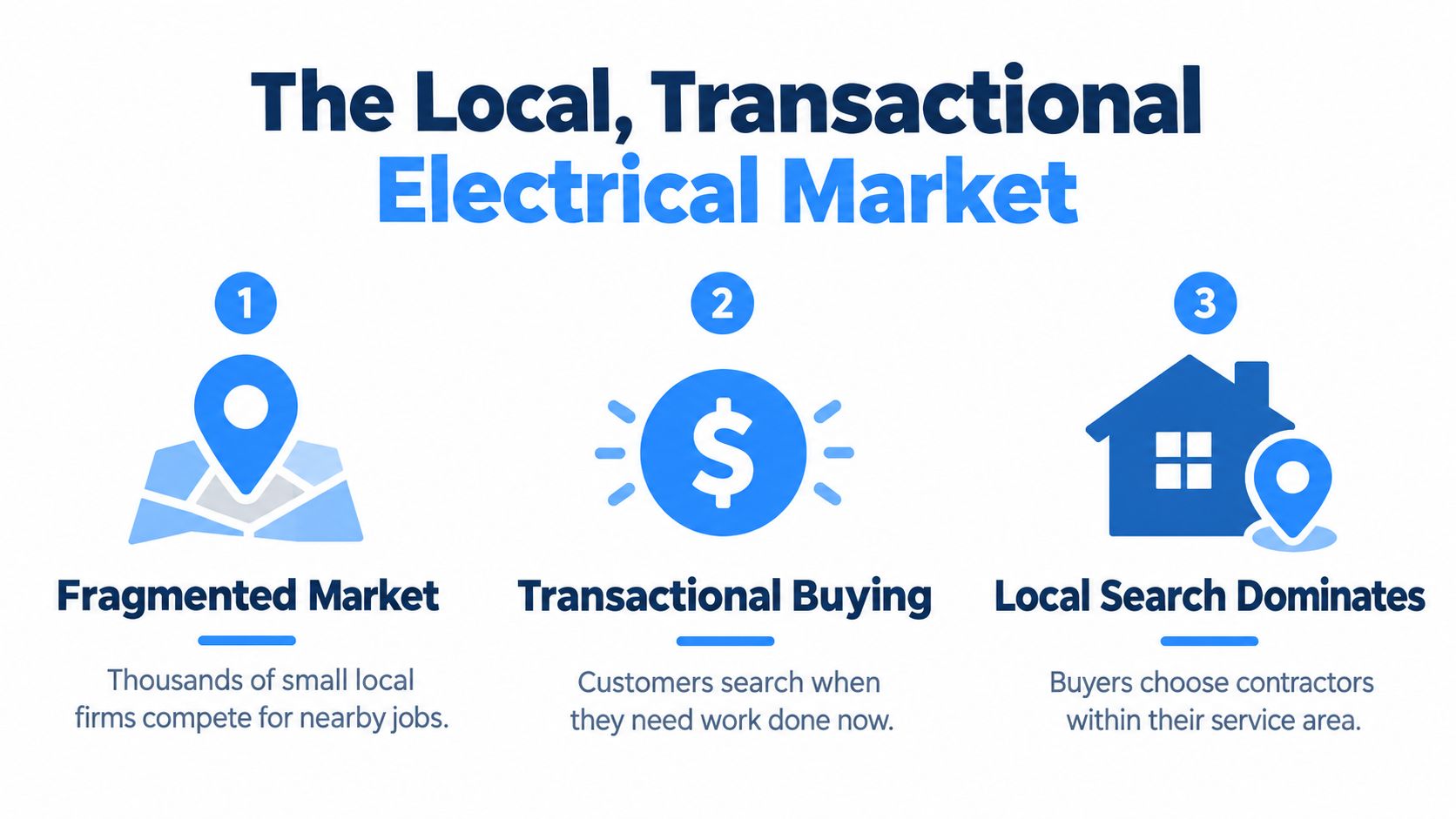
Buying intent should determine the target
Someone searching emergency electrician near me is expressing a different need from someone researching how a circuit breaker works. The first query suggests a hiring decision. The second may lead to a future customer, but it doesn't deserve the same priority when the immediate objective is booked work.
Other useful transactional targets include panel replacement, generator installation, commercial electrical repair, and EV charger installation paired with a location. Don't treat every phrase as equally valuable. A generator inquiry outside your practical service radius can be less useful than a modest repair near an existing appointment.
Transactional Marketing's focus is this hiring intent: reaching people searching for a provider, not collecting visits from people interested in electricity. The money-in-hand idea is a useful targeting principle, although no search phrase guarantees that a prospect is ready to authorize work.
Local context also needs substance. When preparing Minneapolis project content, for example, ATEK Distribution's resource on electrical distributors in Minneapolis offers a relevant starting point for exploring the local supply scene. Supplier resources can inform useful content, but don't imply a commercial relationship that doesn't exist.
Audit the profile against Google's actual factors
Google identifies relevance, distance, and prominence as its primary local-ranking factors and explicitly says businesses can't request or pay for better organic local rankings through a guaranteed method, as explained in Google's local-ranking guidance. Those factors give contractors a more useful checklist than vague promises about “beating the algorithm.”
- Relevance: Choose an accurate primary category and applicable secondary categories. Add service entries for the work you sell, such as rewiring, panel upgrades, generators, and charger installation.
- Distance: Represent your location and service territory accurately. Adding distant cities to a service-area field isn't a substitute for evaluating your proximity to customers.
- Prominence: Develop genuine customer feedback and legitimate visibility through relevant local organizations, directories, articles, and business relationships.
Upload original project and team photos to help prospects assess the business. Keep operating hours and emergency availability accurate, and request honest reviews without scripting service or city keywords for customers.
Practical rule: Optimize the profile for the business you can deliver today, not the larger operation you hope to become.
The local map pack deserves focused attention because it puts business profiles directly into the hiring journey. Targeting its top three positions is a sensible objective, but a ranking target isn't a guarantee, and profile optimization alone doesn't substantiate promises of hundreds of additional calls.
Measure movement across the actual service territory rather than checking from the office computer. A useful map report distinguishes strong coverage near dispatch from weak coverage in a profitable suburb, then connects those observations to qualified calls. That's how map optimization becomes an operating decision instead of a screenshot.
Building Service-by-City SEO Silos That Convert
Build the website around the jobs people want to hire you for. A broad electrical-services page can introduce the company, but a panel-upgrade prospect should reach a page that explains panel work, assessment, scheduling, and the next step.
The website and Business Profile need separate attention. BrightLocal's consumer search research found that 45% of respondents default to Google for local searches, 15% begin directly in Google Maps, and 39% estimated that at least 41% of their searches involve finding local businesses.
Build a useful hierarchy, not a page factory
Start with substantive service pages and connect them to the cities where you can fulfill that work. Create dedicated city-and-service pages when there's enough genuine information to help a customer decide. Don't manufacture every possible combination by swapping location names.
- Choose commercial priorities: Ask dispatch which service-city combinations fit crew skills, travel time, and available appointments.
- Write specific titles: Describe the actual offering and location, such as panel upgrades in Denver or EV charger installation in Tampa.
- Add decision-making evidence: Include verified licensing information, insurance details, original project photographs, scope boundaries, and realistic availability.
- Connect related pages: Link city pages to relevant services and project examples so visitors can follow a clear route to an inquiry.
A practical approach to service-area pages starts with distinct customer needs, not a target page count. A generic areas-served list provides little room to explain why a customer in a particular city should contact you.
A location page earns its place when it helps someone make a hiring decision that the main service page doesn't fully address.
Use structured data that matches the visible business information, and keep phone numbers and booking paths easy to use. Before publishing, have the person who schedules work review the page. If the offer would create an awkward conversation at dispatch, fix the offer before trying to rank it.
Optimizing for AI Search and Large Language Models
Treat AI optimization as disciplined publishing. ChatGPT, Perplexity, and Google's AI Overviews reward the same basics that drive local rankings: clear relevance to the query, believable distance or service-area signals, and prominence from citations, reviews, and consistent business data. The added filter for 2026 is capacity. If the schedule cannot absorb panel upgrades in one city this month, do not let AI-facing copy imply otherwise.
No format forces an LLM to cite a contractor. FAQ blocks and schema help interpretation; they are not recommendation switches.
Publish answers a customer can verify
Keep name, address, phone, license, service list, and city coverage identical across the site and profiles. Say who reviewed technical guidance, separate company projects from general education, and mark outdated offers before a model repeats them. Structured data should describe what a visitor can see on the page.
Then answer the hiring problem behind prompts such as best electrician for a panel upgrade near me: assessment steps, estimator inputs, permit expectations, appointment request, response time. Use original photos and job scope where the work is real.
The useful job of AI search engine optimization is to connect these answers to existing service-city pages instead of spinning up thin “AI content.” Let AI-assisted drafting organize notes; have a qualified reviewer check code references, load calculations, and local details.
Discovery still needs a clean handoff. When evaluating an AI receptionist for booking appointments, SkipCalls provides a resource to consider alongside human answering options. Test scripts against booking rules, escalation, and emergency routing before customer calls.
Paid Search Economics for Electrical Contractors
Paid search should complement organic SEO, not hide weaknesses in it. Use campaigns to evaluate specific demand, support a new service territory, or capture work that warrants immediate acquisition spending.
The benchmarks make disciplined targeting important. LocaliQ's home-services search-advertising benchmarks report the following electrical-contractor figures, including a 5.15% click-through rate compared with a 6.37% home-services average.
2025 Electrical Contractor Paid Search Benchmarks
| Metric | Electrical Contractors | Home Services Avg |
|---|---|---|
| Click-through rate | 5.15% | 6.37% |
| Average Google Search cost per click | $12.18 | Not provided |
| Commercial electrical query cost per click | $19.48 | Not provided |
| Search conversion rate | 9.08% | Not provided |
| Cost per tracked lead | $93.69 | Not provided |
Treat these as reported benchmarks, not a forecast for your account. Don't reconstruct the reported lead cost by combining averages from potentially different underlying groups, and don't confuse a tracked conversion with a qualified electrical job.
Buy a defined opportunity
An emergency-repair campaign needs a different offer and answering process from a commercial-installation campaign. Give each a relevant landing page and evaluate performance by location and job type.
- Control geography: Exclude areas you won't serve profitably and review where inquiries originate.
- Review search terms: Filter irrelevant employment, training, product-only, and DIY intent when those searches don't match the campaign.
- Match operating hours: Don't purchase urgent inquiries when nobody can handle them.
- Use suitable landing pages: Send charger-installation traffic to charger content, not a homepage listing unrelated services.
Polish's resource on crafting an intent-driven SEM system is a useful planning reference for aligning campaign intent with the destination page. The same principle should govern Google Ads for contractors.
Keep organic content as the durable reference for service scope and customer questions. Use paid campaigns selectively where the expected job economics justify the auction expense. Increasing bids won't fix an offer your crew can't fulfill or a landing page that doesn't answer the buyer's question.
Marketing Recurring Maintenance, Not Just Emergencies
A facility manager searching for an electrical maintenance contract is solving a different problem than a homeowner staring at a dead panel. The homeowner wants a truck today. The facility manager wants a vendor who can document testing, coordinate a shutdown, and show up on schedule for years. Marketing that treats both searchers as urgent leads wastes the second one.
The shift in NFPA 70B toward an enforceable electrical-maintenance standard is raising attention to testing, infrared scans, breaker maintenance, arc-flash studies, and documentation, as discussed in Meridian Capital's electrical-contracting industry update. Obligations vary by facility and jurisdiction, so keep the claim narrow: attention is rising, but no two buildings carry identical requirements.
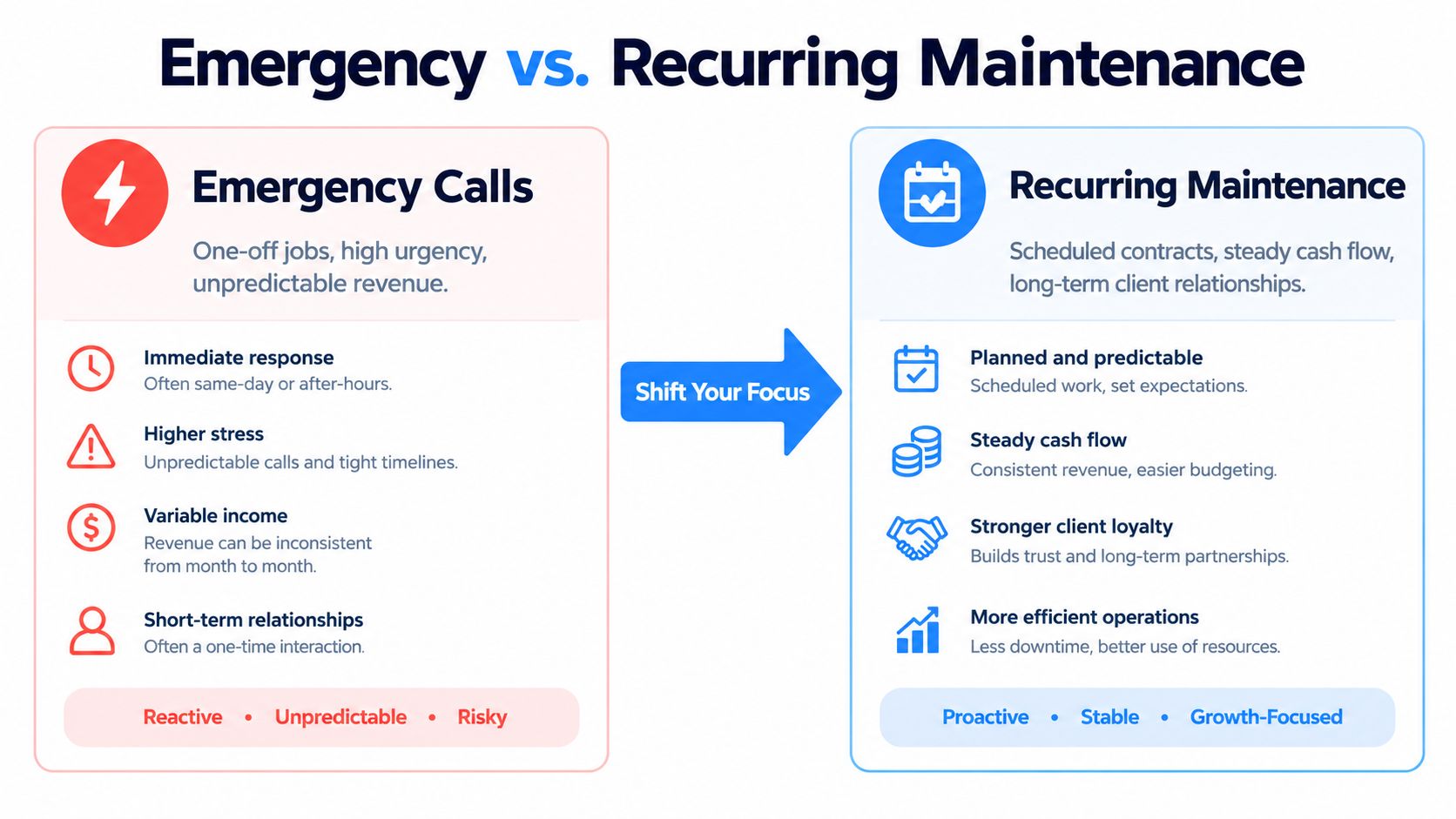
Match the page to the buyer's trigger
Maintenance searches come from at least three distinct jobs-to-be-done, and each deserves its own page and proof.
A facility manager planning a shutdown needs access logistics, reporting formats, and how you coordinate around operations. A commercial landlord wants portfolio scheduling, tenant communication, and documentation that survives an audit. A plant owner at a manufacturer needs to know how you scope work without stopping production. One generic commercial-services page answers none of them well.
Set the conversion accordingly. A maintenance-program discussion or paid site assessment fits this buyer, while an emergency-call form disqualifies exactly the person you worked to attract.
Positioning test: If a facilities buyer could replace your company name with any residential emergency electrician's name, the page isn't specific enough.
On the agreement itself, spell out what the annual price covers, what requires separate authorization, and how findings get documented. I tell contractors to sell the agreement only after confirming the crew can honor the promised inspection windows. Recurring work fills the schedule predictably, which is also why overselling it produces a backlog instead of a book of business.
For additional context alongside the maintenance material, the following video is available:
Publish supporting answers about assessment scope, reporting, and what a program visit includes beneath the commercial offering. Keep compliance language precise and reviewed by someone qualified to vouch for it. Fear-based copy can generate an inquiry, but a buyer signing a multi-year agreement is purchasing trust, and scare tactics undercut that before the first site visit.
Capacity-Aware Marketing During an Electrician Shortage
83% of surveyed leading electrical firms reported labor shortages in 2025, while U.S. projections indicate 9.5% electrician employment growth from 2024 to 2034, according to EC&M's electrical-contractor special report. That survey covers leading firms rather than every local shop, but the planning question applies to all of them: which inquiries can your available people fulfill?
The schedule is a marketing input, not just the destination for whatever arrives.
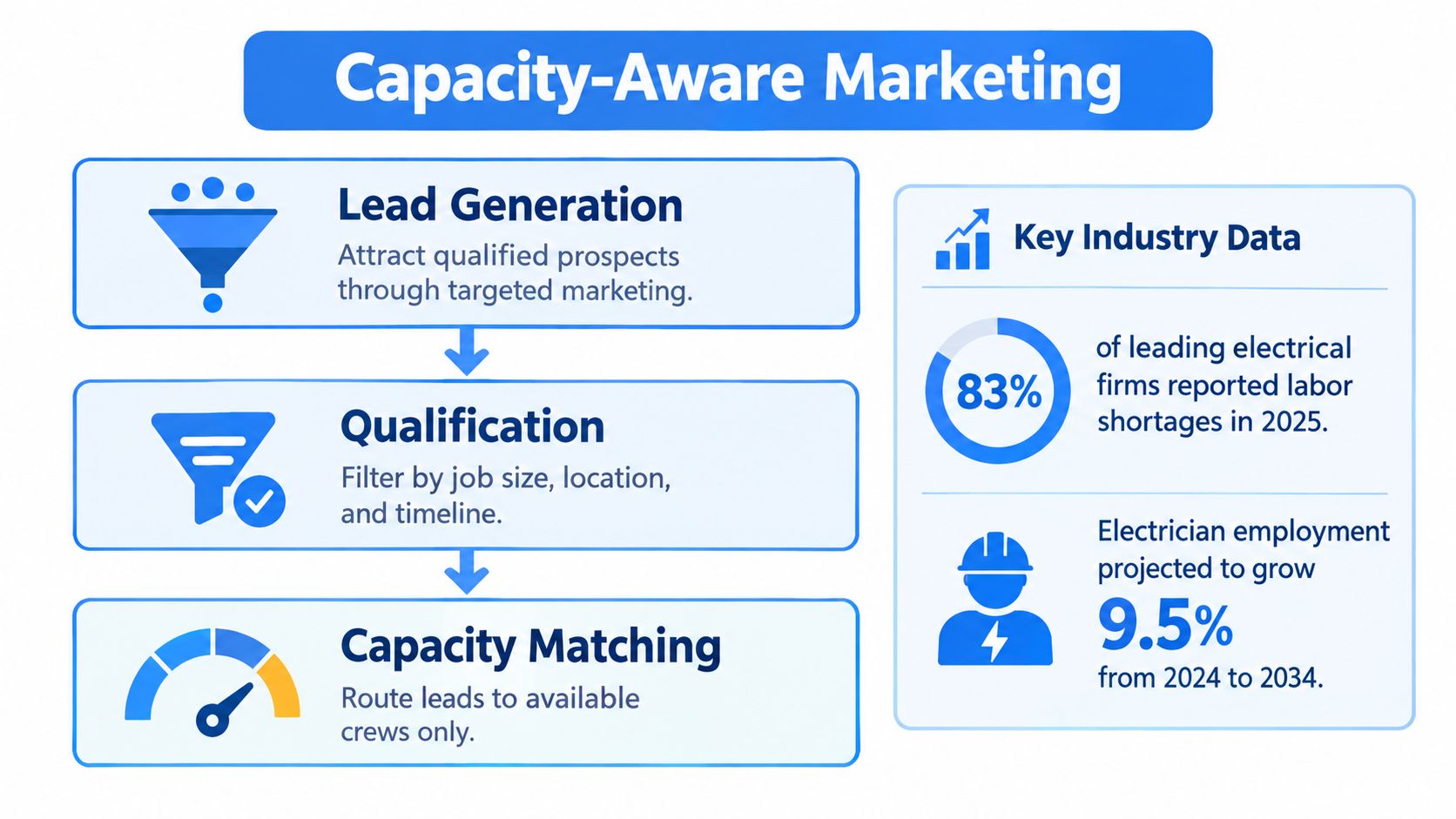
Google already limits your visibility through relevance, distance, and prominence. Capacity should limit it further. Ranking for panel upgrades across three cities means little when the two techs qualified for that work are booked for a month, and every call you can't serve still costs you a CSR's time and a disappointed homeowner who may not call back.
| Campaign type | Operational requirement | Marketing decision |
|---|---|---|
| Emergency repair | Available response coverage | Promote only where coverage is dependable |
| Recurring maintenance | Reserved future capacity | Qualify scope before offering an agreement |
| Specialized installation | Appropriate skills and equipment | Target capabilities the assigned crew can deliver |
| Commercial project | Estimating and project supervision | Separate project inquiries from urgent dispatch |
Take two real configurations I see often. One contractor has strong installation capacity but thin after-hours coverage, so leading every page with 24/7 emergency promises buys calls the schedule can't answer. Another prefers tightly clustered repair work and would rather dominate two adjacent suburbs than chase a distant project that ties up a specialist for a week. Same trade, opposite marketing.
Before expanding coverage in any service city, run the opportunity through four questions. Does the work match technician qualifications and equipment? Can dispatch place it alongside existing jobs without excessive travel? Does the expected margin justify the crew time? Can the customer's deadline be met without displacing better work? A failed answer on any one of those means the page, ad group, or keyword is generating demand you'd pay to turn away.
When capacity tightens temporarily, keep useful organic pages live but update booking expectations and pause ads for work you can't schedule. A legitimate specialty stays in your footprint even when the calendar is full; what changes is the promise you make about response. Selective visibility beats volume here: market the work you want, qualify it clearly, and stop selling availability that dispatch cannot honor.
Measuring What Actually Books the Job
Two contractors run identical ad budgets. The first reports 40 calls last month and calls it a win. The second reports 40 calls, filters out 11 spam and out-of-area contacts, books 9 jobs, and knows which campaign produced them. Same phone volume, completely different marketing decision.
A call isn't a booked job, and a form submission isn't necessarily a customer. Reporting has to separate an actionable inquiry from duplicates, unsuitable work, and existing-customer administration. Response time belongs in that report too. An analysis of 1.25 million sales leads found that companies contacting an inquiry within one hour were nearly seven times more likely to qualify it than those waiting an additional hour; waiting at least 24 hours reduced qualification likelihood by more than 60 times, as summarized in Venture Harbour's lead-response analysis. That research wasn't electrician-specific, so read the ratios as direction rather than an industry forecast.
Follow every inquiry to the invoice
The reporting chain runs from first contact to collected revenue:
Inquiry → Response → Qualified → Estimate → Booked → Completed → Paid
Call tracking, tagged website links, and form-source fields attach each stage to a channel, so Business Profile calls, organic landing-page inquiries, paid campaigns, and referrals stay distinguishable. Log the first human contact and whether the prospect was reached. A consistent customer record keeps repeat contacts from counting as fresh demand, and recording margin at the end shows which sources produce work worth wanting.
The useful question isn't "Which channel produced the most calls?" It's "Which channel produced work we wanted and completed profitably?"
A practical framework for measuring marketing effectiveness should include booked-job rate, acquisition cost, revenue by source, and response performance. Split branded searches from service-discovery searches so existing awareness doesn't get credited as newly generated demand.
Review losses as carefully as wins. Qualified inquiries that stall on a full calendar mean more traffic is the wrong fix. Prospects who vanish before an estimate point at answering, qualification, or follow-up, not the SEO strategy.
Attribution won't be perfect when a customer touches several channels. Keep the rules consistent, document the uncertainty, and use findings to improve decisions rather than manufacture precision.
Putting the Electrical Contractor Playbook Together
The strongest marketing plan starts with commercial priorities and works backward to visibility. Decide which jobs belong on the schedule, identify the search intent behind them, and build a clear route from discovery to qualification.
Transactional Marketing's name reflects that focus on transactional search terms. For electricians, the objective is relevant hiring demand in reachable service cities, not broad traffic that looks impressive but creates little usable work.
Use this summary to keep the implementation grounded:
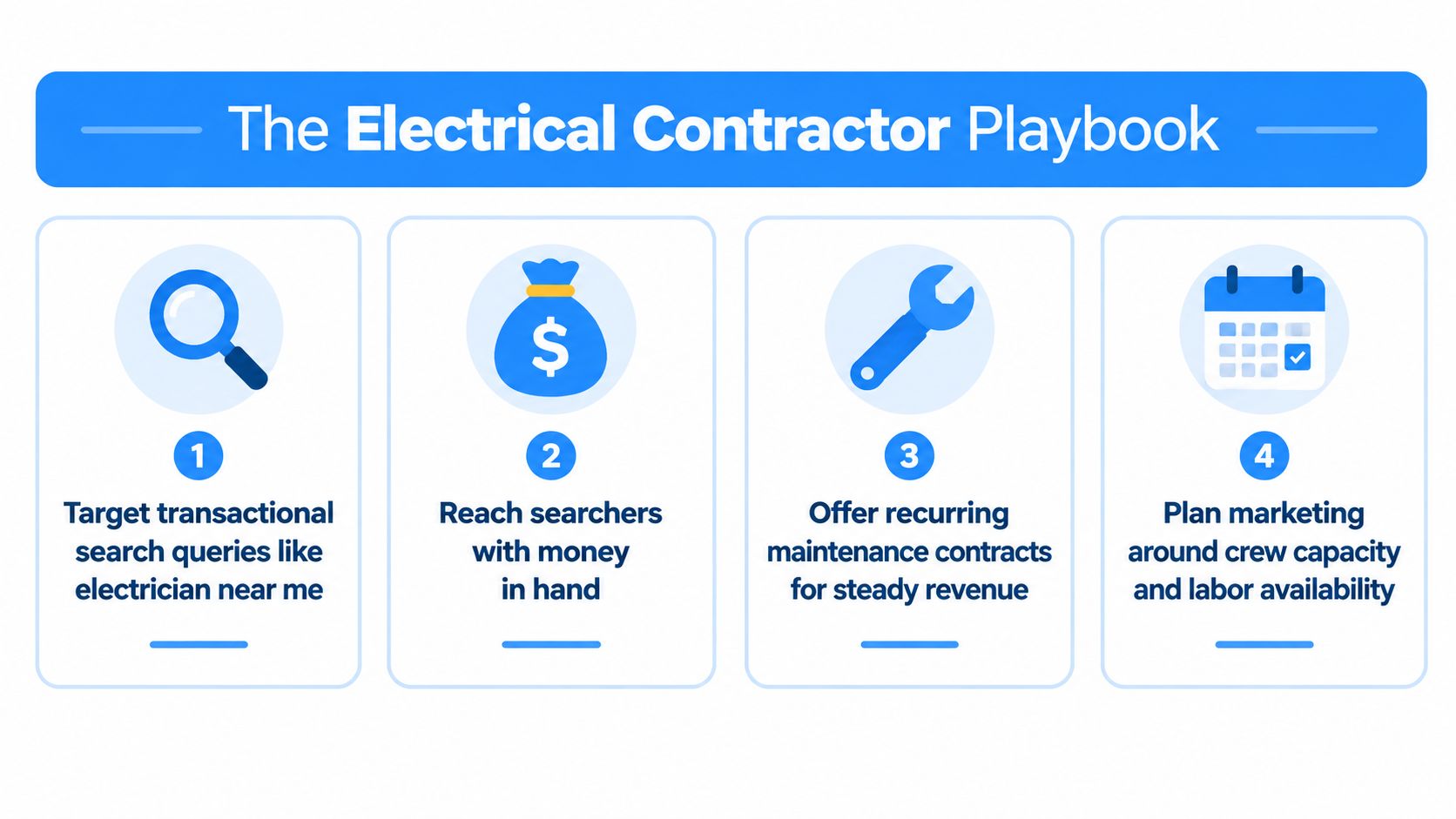
Sequence the work before expanding
Begin with an operational audit. Have ownership, estimating, and dispatch agree on priority services, practical territory, and capacity constraints. Check current search coverage and inquiry handling against those choices.
Repair the foundation. Correct inaccurate business information, remove unsupported promises, improve weak commercial pages, and make contact paths functional. Establish measurement before launching additional acquisition activity.
- Publish selectively: Add useful pages where a genuine service opportunity lacks adequate coverage.
- Review AI readiness: Check clarity, evidence, business identity, and technical accuracy.
- Test paid demand: Support a defined offer rather than advertising every available service.
- Reallocate from outcomes: Expand what produces suitable completed work, not merely higher impressions.
Treat early implementation as a delivery schedule, not a promise of page-one rankings within a fixed window. Likewise, targeting prominent Maps placement is legitimate; promising a predetermined volume of additional calls without account evidence isn't.
The work should remain connected to dispatch. When profitable capacity changes, adjust targeting and offers. When qualified prospects fail to book, improve the handoff. That's a more accountable approach to marketing electrical contractors than continually buying more attention.
Transactional LLC offers local SEO, Google Maps optimization, AI-focused content, and paid campaign support for electrical contractors. Visit Transactional LLC to discuss a service-city strategy built around the jobs your crews can deliver, with reporting tied to qualified inquiries and booked work.