


In 2025, 78% of 1,000 surveyed U.S. consumers said they had abandoned a business after an unanswered call, according to CallRail's consumer survey reported by RedialBPO. That turns missed phone calls into a timing problem, not a voicemail problem. A caller who found you through roofer near me, dentist near me, or air conditioning repair near me is ready to spend. If nobody answers, the next business in the results usually gets the conversation.
Fix the actual cause first. Some calls leak at lunch, some never appear because screening blocks them, and some arrive after your team has gone home. Each cause needs a different repair, and buying more advertising before you diagnose the leak only sends more demand into the same gap.
Find Out Where Your Missed Calls Come From
Run a three-minute audit before you change providers. Export the last 30 days of call logs, sort missed calls by hour and weekday, and tag each number as a new prospect or an existing customer. That pattern tells you more than a monthly total.
That distinction matters because a first-time caller searching for help behaves differently from a customer returning your call. It also helps separate inbound demand from outbound follow-up, a difference explored in the inbound and outbound insights from MakeAutomation. If you're not recording source, caller status, and outcome, start with disciplined phone call tracking before you blame staff.
Read the Pattern, Not Just the Total
| Pattern you see | Likely cause | Fix to try first |
|---|---|---|
| Gaps at lunch or during technician shifts | Single phone line with no ring group | Ring group with a named backup person |
| Calls from known customers never logged | Spam filtering or silent screening | Consistent business name and a steady outbound number |
| Missed calls mostly after 5 pm or on weekends | No after-hours coverage | Answering service or on-call rota with a posted schedule |
| Callers hang up with no voicemail | Long greeting or full mailbox | Short greeting and voicemail-to-text |
| Map listing calls go unanswered | Phone number or hours differ from the website | Match number, hours and address across profile and site |
Gaps clustered around lunch or shift changes usually mean one desk phone owns every call and nobody else is authorized to pick up. Calls missing only after hours point to coverage, not effort. Calls that never appear in the log need a different diagnosis. Google's 2025 Phone Scam Report found that 31% of Americans had missed at least one important call because it was labeled spam.
Google Call Screen can also decline a detected spam call without alerting the user, so that attempt may be invisible in an ordinary office log. Callers who hang up near the end of a greeting are often reacting to friction, a long message, a full mailbox, or no clear instruction. Confirm each cause in the log before you spend money.
Practical rule: I would start with the cheapest fix that matches the pattern, then recheck the log the following week.
If one line fails at predictable times, add a ring group and name the backup. If known numbers aren't reaching you, fix identity and screening first. If evenings produce the misses, solve coverage. Don't buy a broad solution for a narrow leak.
What Each Missed Call Costs Your Business
A missed call can turn paid demand into a higher customer acquisition cost. The size of that loss depends on three things: whether the caller was a real prospect, whether your team could have booked the work, and the value of the job.
A 2025 survey of 1,000 U.S. consumers found that 82% of respondents would call a competitor if a business failed to answer, according to the survey summary. Only 42% of callers typically leave a voicemail when a business doesn't pick up, so an unanswered call often creates no clear callback task.
Use Reported Rates as Benchmarks
| Sector and source | Reported result | Data type |
|---|---|---|
| Home-services calls, Invoca platform data (May 2024) | 27% of calls unanswered | Platform call data |
| Healthcare businesses, Invoca platform data (2021) | 29% of calls unanswered | Platform call data |
| 85 small businesses across 58 industries, 30-day study (2016) | 37.8% reached a person; 37.8% went to voicemail; 24.3% got no response | Direct call monitoring |
These figures come from different samples and definitions. Treat them as reference points, not a forecast for your trade or city. Your own call log should guide decisions about staffing and spending.
Run Your Own Five-Minute Calculation
Suppose your business receives 100 inbound calls in a month. At a 27% unanswered rate, about 27 callers need follow-up. Some may be spam, wrong numbers, or poor-fit inquiries. Estimate the genuine prospects, apply your usual booking rate, then multiply by average job value.
Compare the result with your cost per acquisition calculation. Each unanswered prospect may have come through ads, search visibility, referrals, or staff time, so the missed call can leave that acquisition effort without a return.
The estimate matters most for transactional searches such as emergency plumber near me or AC repair near me. Those callers are looking for a nearby provider to solve an immediate problem. If your line rings out, the potential loss is the booking you could have made, not every missed call multiplied by your average job value.
Stop Legitimate Calls Being Labeled Spam
Start with a test most owners skip. Call your business line from a personal phone, then repeat the test through a second carrier if you can. Note whether the call rings normally, arrives with a warning label, lands in a screened folder, or doesn't appear at all.
Then reverse the test. Place a follow-up call from your normal outbound line to a personal phone and inspect what the recipient sees. An unfamiliar number, a missing business name, or a spam warning gives the customer a reason to ignore you even when they're waiting for help.
Fix Identity Before You Increase Call Volume
Work through four repairs in order:
- Use one recognizable identity: Keep the same business name and outbound number on listings, ads, invoices, estimates, and follow-up calls so people and devices see a consistent caller.
- Register verified or branded calling: Ask your phone provider what's available, because a displayed business name is easier to trust than a bare number. For a practical walkthrough of carrier labels and remediation steps, use Attorney Assistant's guide to spam labels.
- Call from the number customers know: Don't return a service inquiry from a rotating number, a technician's new mobile line, or a campaign number the customer never dialed.
- Make voicemail identify you clearly: State the business name, the reason for the call, and the number to call back in the first sentence, so a screened message still feels legitimate.
Carrier filtering and customer behavior aren't the same failure. One customer may see your call and choose not to answer an unknown number. Another may never receive an actionable alert because screening handled it. Your log alone can't always separate those cases.
A sudden drop in logged calls isn't automatically a quiet day. Treat it as a possible filtering signal until a test call proves otherwise.
Check whether your number appears consistently in your Google Business Profile, website, invoices, and directory listings. Inconsistent names create recognition problems for customers and muddy the identity they saved after an earlier job. Consistency is dull work, but it's the work that makes legitimate calls easier to recognize.
This is also where search and phones meet. Transactional Marketing focuses on getting service businesses found for ready-to-buy searches, yet that visibility loses value if your callback looks suspicious. Diagnose caller ID reputation before you hire an answering service or push for more calls from Google Maps.
Route Calls and Cover Evenings and Weekends
Decide who answers and where each call lands before you buy software. Point the number on your Google Business Profile, website, and ads to one tracked line, then have that line ring a group instead of one desk. A single handset is a single point of failure.
Set the first ring group for the dispatcher and a trained backup. If nobody answers after about 20 seconds, ring the next named person. After that, send the caller to a short greeting with voicemail-to-text, so the message becomes a task instead of a recording nobody checks until morning.

Keep the number, hours, and address identical across your profile and website. Google's local guidance treats relevance, distance, and prominence as central ranking factors, and profile data also feeds AI-generated local discovery. Consistent contact details make it easier for search systems and customers to identify the same business. Our Maps plan includes keeping contact details, hours, and location up to date, but the operational point applies even if you manage the profile yourself. A customer who calls from a map listing should not reach an old number or hear hours that contradict the listing.
Match Coverage to the Constraint That Bites Hardest
| Coverage model | Best fit | Main trade-off |
|---|---|---|
| Owner or dispatcher answers live | Teams under five technicians | Pulls people off jobs during peak hours |
| Rotating on-call schedule | Shops with a dependable on-call rota | Fails when a shift is not posted or tested |
| Answering service that takes messages and books | High call volume or frequent after-hours calls | Needs scripts and rules for emergency calls |
| After-hours text-back system | Low-volume evenings and weekends | Callers who want a live voice may still hang up |
I would choose based on three constraints. First, can the person on duty safely step away from active work? Second, how many usable inquiries arrive after hours? Third, do you have written emergency rules that tell responders what to book, what to escalate, and what can wait until morning?
A rotating rota looks inexpensive until an unposted swap leaves nobody responsible. An answering service looks complete until it receives vague instructions and treats a sewage backup like a routine estimate. Text-back is useful for low-volume evenings, but it won't satisfy every urgent caller. There's no clean winner, only the model your team can staff consistently.
Finish with three checks. Name a backup for every shift, write emergency rules that override the normal schedule, and place a weekly test call to confirm that each route still rings the right phone. Test after staff changes, holidays, number changes, and phone-system updates.
Build a Five-Minute Callback Workflow
Speed wins or loses the recovery attempt. A callback made hours later may still be professional, but the customer has already had time to book someone else. Build the workflow around the first attempt, then define what happens when that attempt doesn't reach a person.
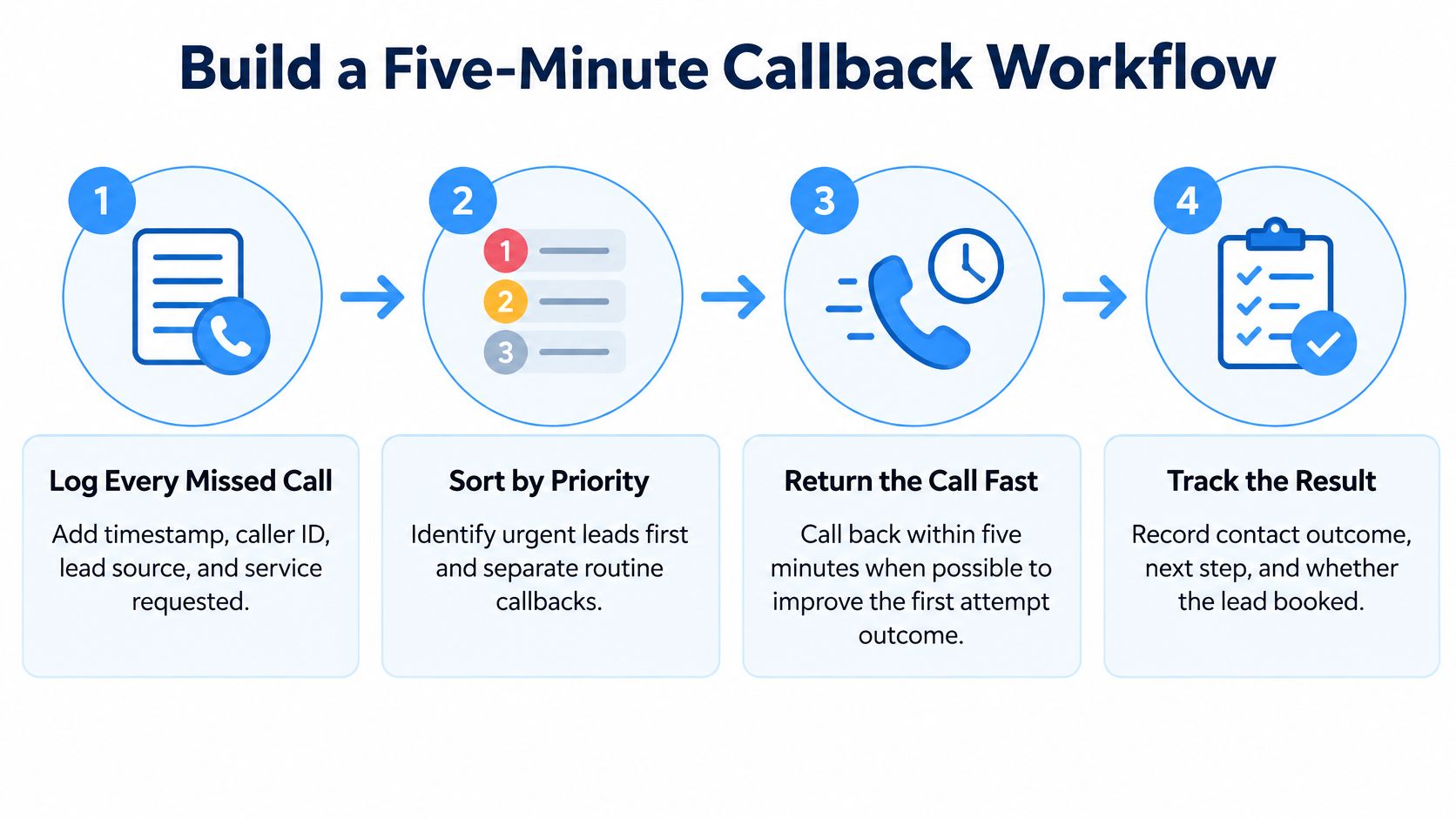
An analysis of more than 55 million sales activities involving 5.7 million inbound leads found conversion rates more than 8 times higher when the first attempt occurred within 5 minutes than when it occurred after 5 minutes. Only 0.1% of inbound leads were engaged within that window. I wouldn't promise that exact lift for a plumbing shop or dental practice, but I would treat the direction seriously. Faster follow-up gives you a chance while the need is still active.
Run These Six Steps Every Time
- Log the missed call: Capture timestamp, caller ID, source, and service requested in the CRM or dispatch board, not on a sticky note.
- Text immediately: Send a short acknowledgement with a callback window, such as 15 minutes during business hours, plus a direct booking option when you have one.
- Alert a named owner: Route the task to the on-duty employee, with a backup who receives the alert if the first person is driving, treating a patient, or already on a call.
- Call within five minutes: Make the live voice attempt while the customer is still likely beside the phone.
- Retry and record disposition: Use defined intervals and mark each result as reached, voicemail, no answer, booked, unqualified, or lost.
- Review weekly: Segment outcomes by source, location, employee, urgency, and booked job instead of relying on one blended callback percentage.
The steps work only when ownership is visible. A shared inbox with no named responder creates the assumption that someone else handled it. Put the alert, deadline, and backup on the same screen your dispatcher already uses, then connect that process to your follow-up automation so an unanswered callback doesn't disappear after the first notification.
Recover the Silent Caller
Silent callers need the same first text, but they need careful prioritization. Emergency-intent calls go first, followed by repeat callers and existing customers, then routine inquiries. Segment results the same way, because a blended recovery rate can hide failures on the urgent work that carries the most value.
Do not count contact activity as recovery: A dial, automated text, or voicemail is an attempt. Recovery means a live conversation, a qualified opportunity, or a booking.
2025 survey reporting from Morgan Systems indicates 42% of U.S. consumers say they leave a voicemail after a business doesn't answer, 24% use online chat, and 21% immediately call another provider. Those are self-reported responses, not measured conversion paths. Test them against your own logs instead of treating them as a forecast.
Use a permission-based opening like "We missed your call. How can we help?" and let the customer reply by text if that's easier. Some people avoid voicemail because they're at work, have hearing or speech accessibility needs, or prefer written communication. Giving them chat or text lowers friction without forcing another phone call.
Make one second touch after 24 hours, then stop after two attempts unless the customer replies or the issue is an ongoing service matter. Persistence beyond that point can feel intrusive and produce opt-outs. For a useful customer-side perspective on the dead end callers face, read what to do when nobody answers, then compare that experience with the greeting and callback options your own callers receive.
Track speed to first attempt, live connection, qualified opportunity, appointment, and completed job separately. A team can look responsive because texts fire instantly while live conversations remain rare. Another team can make fast calls but fail to book because the responder can't quote availability. Separate measures show you where to intervene.
After-hours missed calls should enter the same queue with the same timestamp discipline. If nobody works them until the next business day, your five-minute standard becomes a next-morning standard for the callers who may need help most urgently.
Measure Recovery Weekly With a Simple Scorecard
Review recovery each Monday using one owner, one date range, and consistent definitions. Segment results by location, technician, lead source, and call type. Averages can conceal weak Saturday coverage or poor recovery on map calls.
The Weekly Scorecard
| Metric | What it tells you |
|---|---|
| Median callback time | How quickly the team responds to missed calls |
| Share called within 5 minutes | Whether the callback target is met across shifts |
| Contact rate | Whether callbacks reach a live person |
| Booked-job rate | Whether contacted callers book work |
| Missed-call recovery rate | The share of missed calls that result in a booking |
| Revenue per missed call | The revenue associated with unanswered calls |
| Opt-out or complaint rate | Whether follow-up calls or texts are causing friction |
Keep these measures together on a performance dashboard for tracking results. Late callbacks point to a speed or staffing problem. A weak contact rate calls for reviewing caller identity and timing; if people answer but do not book, examine availability and the booking conversation. Connection rate alone is not a win if booked jobs and revenue remain flat.
Test Rapid Response Instead of Assuming It Works
If call volume allows, compare rapid callbacks with your standard response process. Assign comparable missed calls randomly to each group. Keep lead source, service category, geography, staffing, offer, and script consistent. Timestamp each attempt and set the same number of attempts and follow-up period for both groups.
Historical lead-response research in the MarketingSherpa report found that each slower response tier was associated with approximately a 4.3% decline in qualification rates and nearly a 2% decline in close rates. Faster contact generally gives teams a better chance to qualify a lead while interest is fresh. Treat the research as a reason to test, not as a forecast for your own calls.
Keep the comparison fair. Check call quality before counting unreachable or wrong numbers as lost demand. Give both groups the same follow-up opportunities, keep the offer unchanged, and judge results by more than connection rate. Gross profit, show rate, and completed work reveal whether faster callbacks are producing useful outcomes.
Change one variable at a time, assign an owner, and review the scorecard the following Monday. Use the results to address the cause of missed-call losses, whether that is response timing, caller reachability, or the path from conversation to booking.