


Most advice about persuasive writing techniques is pointed at the page. Better headlines. Better emotional hooks. Better calls to action. That matters, but local service businesses usually win or lose persuasion earlier, inside the search itself.
When someone types “plumber near me,” “dentist near me,” or “air conditioning repair near me,” they're not browsing. They're shopping. They have a problem, they want a solution close by, and they're ready to spend. That is transactional intent. One local search study notes that 76% of people who search for a local service on a mobile device visit the business within 24 hours. That's why Transactional Marketing is built around transactional search terms, not vanity traffic.
In the AI era, persuasive writing techniques aren't just about prose. They include keyword clustering, schema markup, Google Maps optimization, internal linking, and content architecture that helps Google, Google Maps, and LLM-driven search surfaces understand exactly who you serve and where you serve them. Persuasion starts before the click.
For service businesses, this shift is massive. Transactional Marketing focuses on getting companies found for exact terms buyers use when they have money in hand. Searches like “roofer near me,” “dentist near me,” and “air conditioning repair near me” are where revenue lives. The right AI-driven system can push those searches toward your Google Business Profile, your local landing pages, and your phone line. That's how you generate hundreds of more phone calls every month and build local dominance that compounds over time.
1. Intent-Driven Keyword Clustering for High-Converting Transactional Queries
Generic keyword lists don't persuade anyone. They scatter effort across broad phrases that attract low-intent visitors, while actual buyers search with tighter language like “emergency plumber near me” or “dentist near me accepting new patients.”
The fix is intent-driven clustering. Group keywords by service, urgency, geography, and buyer stage. For an HVAC company, “air conditioning repair near me” belongs in a different cluster than “how long should an AC unit last.” One is transactional. The other is informational.
How clustering changes the writing
When you build content around clusters instead of single keywords, every page can match a cleaner search intent. That gives AI systems and search engines a clearer signal about what page should rank for what query.
A practical example:
- HVAC cluster: air conditioning repair near me, emergency AC repair [city], AC not blowing cold air [city]
- Dental cluster: dentist near me, same-day dentist [city], dentist accepting new patients [zip code]
- Pest control cluster: termite treatment [city], emergency termite treatment [county], exterminator near me
Use keyword clustering methods for local SEO to separate those terms into content silos. Then connect those silos to service pages, city pages, and Google Business Profile categories.
Practical rule: If one page tries to rank for emergency repair, routine maintenance, and educational queries all at once, it usually persuades no one.
AI tools help by identifying semantic variants and micro-intent phrases that standard keyword exports miss. I still validate clusters against Search Console and live local SERPs because AI can over-group terms that look related but convert differently.
For execution, I like pairing cluster planning with tools to triple organic traffic, then narrowing everything back to the exact local service terms that produce calls. That trade-off matters. Bigger keyword lists look impressive. Tighter clusters make money.
2. Urgency-Triggered Copywriting for Immediate-Need Service Queries
A homeowner with a leaking pipe doesn't want brand poetry. They want speed, clarity, and proof that someone can solve the problem now.
That's where urgency-triggered copy beats generic service page writing. Your title tags, meta descriptions, map descriptions, and page headlines should mirror the urgency of the search. “Roof Repair Services” is weak. “Emergency Roof Repair in Tampa, Same-Day Response” matches the buyer's state of mind.
Here's the visual that fits that moment:

What works and what backfires
Urgency works when it's real. If your office answers after hours, say so. If you offer same-day appointments, lead with it. If you don't, fake urgency creates a mismatch that kills trust once the visitor lands.
In persuasive web copy, quantifiable trust signals increased perceived credibility by 34% in A/B testing of over 1,200 conversion-focused landing pages, and emotional problem-resonance paired with those signals drove a 2.3x higher click-through rate than emotional appeals alone. For local service pages, that means “Same-day appointments available” plus concrete proof usually outperforms vague reassurance.
Use language like this:
- Roofing: Emergency Roof Repair in [City]. Local crews available now.
- Dental: Dentist Near Me. Same-day appointments for new patients.
- Chiropractic: Auto injury specialist. Seen today when scheduling allows.
The trade-off is simple. Aggressive urgency can lift clicks, but false urgency damages both reviews and conversion quality. Match your copy to actual operating hours, staffing, and response times. Then make sure your Google Business Profile, landing page, and call handling all tell the same story.
3. AI-Generated Comparison Content for Service-Area Competitive Positioning
Comparison content gets dismissed too often because people associate it with affiliate blogs. For local service SEO, that's a mistake. Buyers compare before they call, especially in categories with anxiety, price sensitivity, or trust concerns.
A page built around “best plumber near me,” “licensed electrician near me,” or “local pest control vs national chain” can intercept someone who is already evaluating options. That's persuasive writing at the search stage, not after the sale.
The smart way to compare
Don't write attack pages. Write decision pages.
A pest control company can publish a page around “Local termite treatment vs national chain service in [county].” A dental office can compare “same-day emergency dentist vs urgent care for tooth pain.” An electrician can address “licensed vs unlicensed electrician near me” with safety and compliance front and center.
The strongest comparison pages do three things:
- Clarify risk: explain what goes wrong when buyers choose the wrong provider
- Show local relevance: reference service area realities, response windows, and neighborhood coverage
- Direct the next action: move the visitor to a booking page or call button fast
AI helps speed up the research and page structure. It can summarize competitor positioning, identify repeated customer objections, and draft outlines that your team sharpens into market-specific content. That's one reason AI-powered content building can scale local contracting businesses faster, but the final page still needs human judgment. AI tends to flatten nuance, and local SEO wins on nuance.
Buyers don't trust comparison pages that feel anonymous. They trust pages that show you understand the local buying decision.
I avoid national competitor comparisons unless the local SERP is dominated by franchise brands. In most service markets, the better move is comparing decision factors the customer already cares about. Licensing, response time, warranty handling, insurance, financing, and service area coverage usually outperform generic “we're better” claims.
4. Location-Specific Long-Form Content Optimized for Google Maps and Local Pack Dominance
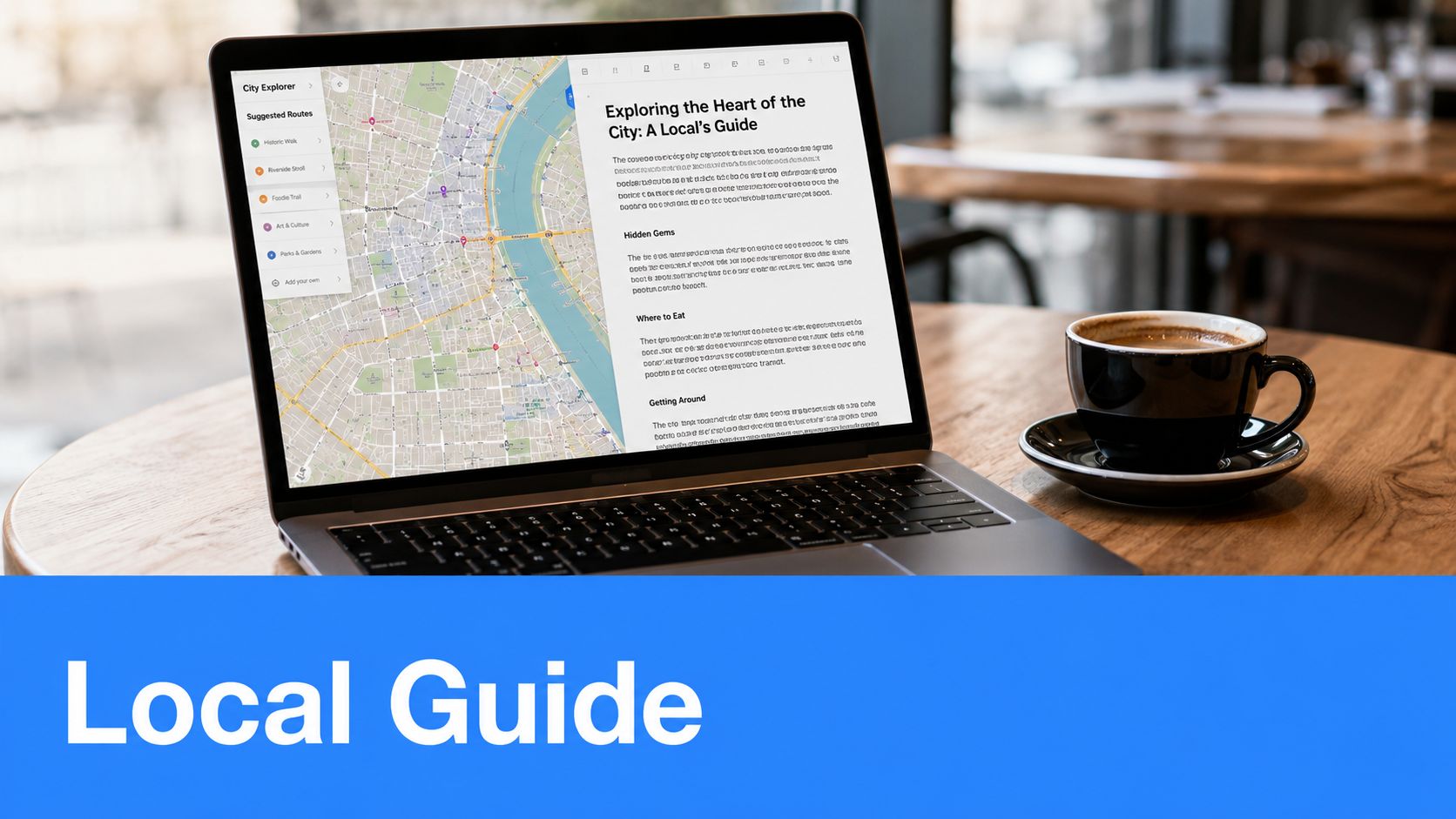
A strong local guide page can do more than rank organically. It can reinforce your map relevance, support your service area visibility, and feed LLMs better geographic context about what you do and where you do it.
That only works if the page is local. One generic page swapped across ten cities won't carry the weight. Search engines and AI systems need distinct local signals.
This type of content benefits from a hyperlocal visual:
What a real local guide includes
For roofing, a page like “Roof Repair in Southlake” should address storm patterns, common roof types in that market, permit considerations if relevant, neighborhoods served, and what the repair process looks like. For dentistry, “Family Dentist Near [Suburb]” should cover appointment types, common patient concerns, insurance questions, and directions or proximity cues.
The page should also support your Google Maps strategy. Transactional Marketing puts major emphasis on Google Maps optimization because map visibility drives call volume where intent is highest. The goal isn't just traffic. The goal is top-three map visibility in the service area, supported by location pages, review signals, category alignment, and consistent local entities across the site.
A few rules make these pages stronger:
- Distinct city focus: each page needs unique local details, not spun copy
- Integrated local proof: add service examples, nearby landmarks, and relevant reviews
- Clear conversion points: phone buttons, request forms, and map cues should sit high on the page
Long-form local pages work especially well when paired with service pages and Google Business Profile updates. That connection matters because search behavior in local services is often immediate, and many “near me” searches are emergency-driven. In those situations, trust and speed beat decorative storytelling. I'd rather have a direct city page with sharp local proof than a polished brand essay that never answers the buyer's immediate need.
5. AI-Powered Voice Search Optimization for Near Me Transactional Queries
Voice search changes the phrasing, not the intent. Someone who types “dentist near me” may say, “Where can I find a dentist near me accepting new patients?” The purchase intent is still there. The wording is just more conversational.
That means your persuasive writing techniques need spoken-language coverage. FAQ blocks, concise answer sections, structured service descriptions, and fully completed business profiles all help voice interfaces understand your business.
How to write for spoken intent
Voice-driven local queries usually include one or more of these patterns:
- Immediate availability: open now, today, this week
- Service qualification: emergency, accepting new patients, licensed
- Action language: call, book, find, get
A chiropractor page should answer “Can I get a same-day chiropractor appointment near me?” in plain language. A Med Spa page should address “Where can I get botox in [city] this week?” without making the reader dig through a wall of copy.
The best format is natural Q and A. Use the exact spoken question as a subheading or FAQ prompt, then answer directly in the first sentence. Keep business hours, phone number, online booking, and service menus current across your site and Google Business Profile. Voice results fall apart when the business data is incomplete or inconsistent.
I've seen local businesses over-optimize voice pages by stuffing them with robotic question variants. That usually makes the page worse for both users and AI. Write the way customers speak, then support it with schema and clean local page structure. Spoken search doesn't reward awkward repetition. It rewards direct answers.
6. Dynamic Schema Markup and Structured Data for LLM and Search Result Feature Dominance
Schema markup is one of the most underrated persuasive writing techniques because it persuades machines first. If Google, Maps, and LLM-driven systems can read your business data cleanly, they can present your business more confidently in results.
That matters more now because AI-assisted search surfaces don't rely only on page text. They pull from structured business details, service definitions, hours, locations, reviews, and related entities.
What to mark up first
For service businesses, start with the basics and get them right:
- LocalBusiness schema: name, address, phone, area served
- Service schema: each core service, written distinctly
- OpeningHours and availability: especially for emergency categories
- FAQ and review markup: where appropriate and accurate
Use JSON-LD. Keep it synced with what users see on the page and in your Google Business Profile. If the site says one set of hours and your structured data says another, you create confusion for both search engines and prospects.
There's another reason to tighten this up. A recent industry analysis projected that 65% of AI-synthesized search results penalize content that leans heavily on emotive or repetitive persuasion without substantiating data, favoring concession-based structures that address counterarguments. Schema isn't a style flourish. It's part of that substantiation layer.
Operational note: Structured data doesn't replace page quality. It sharpens the meaning of a page that already deserves to rank.
For a dental practice, schema can clarify accepted appointment types, office hours, location identity, and service definitions. For HVAC, it can reinforce emergency service availability and service-area relevance. For Med Spas, it can help define treatment pages in a way that AI systems can interpret more accurately. The pages still need strong copy. Schema just makes the copy easier for machines to trust.
7. Service-Area-Specific Landing Pages with Transactional Conversion Optimization
Some pages should educate. Others should convert immediately. Service-area landing pages belong in the second group.
If someone searches “electrician near me” from a specific suburb, they don't need a long essay on electrical systems. They need confirmation that you work in that area, handle the exact problem, and can be reached fast. Consequently, persuasive writing techniques become conversion architecture.
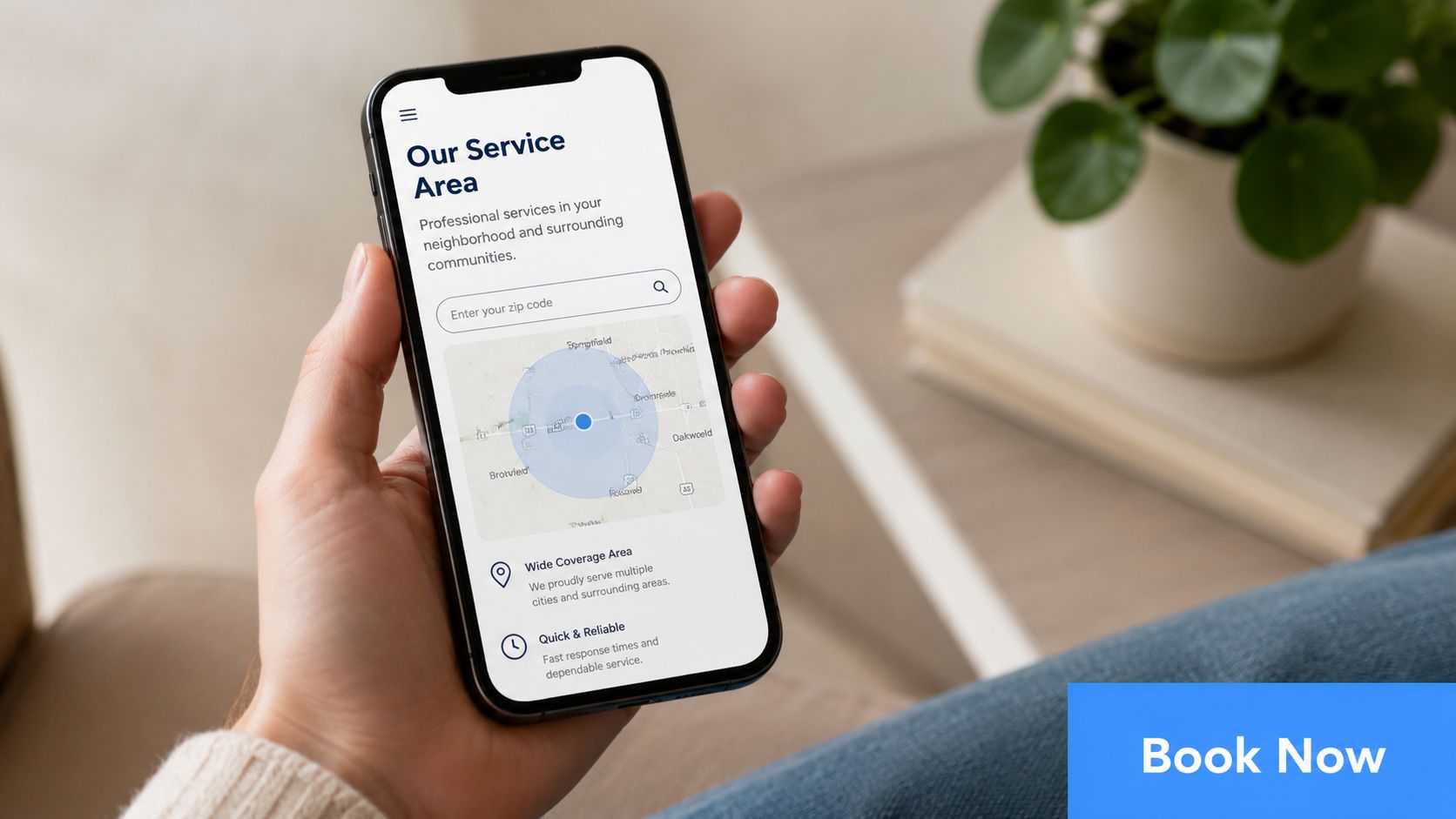
Here's the kind of mobile-local context these pages need to support:
What belongs on these pages
A city page for a plumber should open with a local headline, a direct service promise, visible phone CTA, and immediate proof. A dental location page should highlight new-patient availability, insurance or financing language if applicable, and booking access near the top.
I keep these pages tight and useful:
- Location-specific headlines: match the city, neighborhood, or zip-focused query
- Area proof: local reviews, neighborhood references, directions, and map context
- Fast CTAs: call now, request quote, schedule visit
These pages also fit the broader move toward answer-driven search. If you're building for AI visibility, optimizing for AI answers isn't separate from local SEO anymore. It's part of the same job. Your city page needs to answer who you serve, what you do, where you operate, and why a searcher should trust you.
One warning. Thin service-area pages still fail. If every city page says the same thing with the city swapped out, don't expect stable rankings. Add the actual differences. Service mix, response area, local concerns, and nearby geography all matter. Search engines can tell when you built a page to convert. They can also tell when you built it to fake coverage.
8. AI-Driven Review Generation and Response Strategy for Ranking and Trust Signals
Reviews don't just support conversion after the click. They shape whether the click happens at all, especially in Google Maps.
For local service companies, review strategy is persuasive writing in public. The review itself persuades. Your response persuades. The recency, specificity, and language around service quality all reinforce what a buyer thinks before they ever call.
What to automate and what not to automate
You should automate the request workflow. You shouldn't automate authenticity.
Send review requests after a completed service call, after a dental visit, or after a follow-up confirms the issue was resolved. Use AI to draft response templates, categorize sentiment, and flag recurring objections. Then have a human review anything sensitive, especially complaints.
A practical setup looks like this:
- Request timing: right after successful service completion
- Response focus: cost concerns, scheduling, warranty questions, bedside manner, cleanup
- Profile alignment: reinforce the same services and locations you're trying to rank
Use review request templates for local businesses to build a repeatable system around email and SMS follow-ups. Then write responses that sound like your business, not a generic AI voice.
One of the biggest mistakes I see is stuffing responses with keywords. That reads badly. A better response is specific and useful. “Thanks for trusting us for same-day AC repair in Mesa” works because it sounds natural and reinforces both service and geography. “Best AC repair Mesa emergency air conditioning near me” makes the business look careless.
A polished negative-review response often persuades future customers more than a short positive one.
When review management is done right, it supports map rankings, trust, and conversion together. That's exactly the kind of compound effect local SEO should create.
9. Transactional FAQ Content Optimized for Featured Snippets and AI Search Result Capture
A strong FAQ section answers the buyer's final objections before they call. That's why it belongs in any serious discussion of persuasive writing techniques.
The key is transactional scope. Most FAQ pages drift into generic education. Better local FAQ content tackles practical money questions. Can you come today? Do you accept new patients? Do you offer weekend service? What happens after I call?
Write answers the way search systems extract them
Featured snippets and AI answer layers prefer direct answers. Ask the question in the way customers phrase it, then answer immediately in a tight block before adding detail.
Examples that work well:
- HVAC: Do you offer emergency AC repair on weekends?
- Dental: Can I get a same-day appointment?
- Plumbing: How fast can a plumber get to my home in [city]?
This format also fits current AI-quality expectations. Traditional persuasive writing advice still pushes repetition and rhetorical flourish, but search quality is shifting toward objection handling and substantiation. That's one reason concession-based structures are gaining ground. If a customer worries about timing, pricing, insurance, or disruption, answer it plainly instead of trying to out-market the concern.
For implementation, I like building FAQ blocks into service pages and separate support pages, then marking them up properly. If snippet visibility is part of your local strategy, featured snippet optimization for service businesses should be tied to transactional queries, not just broad informational questions.
The common mistake is writing FAQ copy that sounds like a brochure. Real transactional FAQ content sounds like a front-desk answer or dispatch answer. Short, specific, useful, and easy for both Google and customers to trust.
10. Conversion Path Optimization Through Transactional Content Layering and Internal Linking
Most local sites don't have a content problem. They have a path problem.
They publish blogs, service pages, and city pages, but they don't connect them in a way that moves a searcher from question to decision. Internal linking fixes that. More precisely, strategic content layering fixes that.
Build the path a buyer actually follows
A pest control customer may start with “signs of termites,” then move to “termite treatment comparison,” then look for “termite treatment near me.” A dental patient may go from “tooth pain causes” to “same-day dentist near me.” If your internal links don't guide that progression, you lose people who were already leaning toward action.
There are established copy frameworks for this kind of movement. PAS and AIDA are used by 68% of top-performing copywriters in the U.S. and EU markets, PAS shows a 29% higher lead conversion rate in B2C service industries when agitation is amplified, and combining logical and emotional appeals reaches a 41% higher engagement rate than using only one appeal type. On local SEO sites, those principles show up as content sequencing and link placement, not just page copy.
A simple content layer might look like this:
- Awareness page: signs your AC system needs repair
- Comparison page: repair vs replacement in your city
- Decision page: emergency air conditioning repair near me
Then link each page to the next with a clear reason to continue.
I also keep budget discipline around transactional coverage. Best-practice guidance recommends allocating 60–70% of a keyword budget to high-converting transactional terms and testing 10–15 precise transactional keywords before scaling. That aligns with how I build internal link structures. Most of the authority flow should support the pages tied to booked jobs, not vanity traffic.
The trade-off is that educational content often attracts easier clicks. Transactional layers attract better leads. If revenue is the priority, the link structure should reflect that.
10-Item Comparison of Persuasive Writing Techniques
| Title | Implementation complexity | Resource requirements | Expected outcomes | Ideal use cases | Key advantages |
|---|---|---|---|---|---|
| Intent-Driven Keyword Clustering for High-Converting Transactional Queries | Medium, LLM analysis + silo mapping | AI SEO tools, analyst time, location data, periodic updates | Faster ranking for transactional local terms (30–60 days); higher conversion from intented queries | Local service businesses targeting immediate-purchase searches (emergency, scheduling) | Captures high-intent queries; precise geographic & micro-intent targeting |
| Urgency-Triggered Copywriting for Immediate-Need Service Queries | Low–Medium, templates + testing | Copywriters/AI prompts, A/B testing, accurate availability data | Large CTR and click-to-call uplift (reported 40–60% CTR lift) | Emergency and same-day service providers (plumbers, dentists, HVAC) | Mirrors buyer urgency; boosts CTR and conversions quickly |
| AI-Generated Comparison Content for Service-Area Competitive Positioning | Medium, competitor analysis + content creation | Market/competitor data, LLM content generation, regular refreshes | Improved local CTR and market share within ~90 days; better consideration-stage conversions | Competitive local markets where customers compare providers | Establishes local authority vs competitors; addresses objections pre-contact |
| Location-Specific Long-Form Content Optimized for Google Maps and Local Pack Dominance | High, large-scale content program, schema integration | Writers/LLMs, editorial QA, schema/Maps embeds, coordination with GMB | Organic + Maps ranking lift; 2–3x phone calls per market after ~60 days | Multi-location businesses aiming for top organic & Maps positions | Synergistic Maps + organic dominance; deep local authority signals |
| AI-Powered Voice Search Optimization for "Near Me" Transactional Queries | Medium, conversational modeling + snippet focus | Conversational content creation, FAQ/schema, mobile optimization | Capture growing voice channel; higher featured-snippet presence; early adopter advantage | Businesses targeting mobile/voice users and "open now"/near-me queries | Positions for voice assistants and featured snippets; often lower competition |
| Dynamic Schema Markup and Structured Data for LLM and Search Result Feature Dominance | High, technical schema implementation + automation | Developer time, integration with business systems, validation tools | Rich result eligibility; accurate Knowledge Panel and AI answer representation | Businesses preparing for AI-driven discovery and rich-result exposure | Ensures machine-readable accuracy; future-proofs AI search presence |
| Service-Area-Specific Landing Pages with Transactional Conversion Optimization | Medium–High, many unique pages, CRO focus | Content creation at scale, maps/embed, local reviews, tracking tools | Higher conversion rates (5–15% typical); stronger Maps authority per area | Multi-location service businesses needing direct conversions per locality | Highest ROI for converting transactional searchers; precise local relevance |
| AI-Driven Review Generation and Response Strategy for Ranking and Trust Signals | Medium, workflow automation + moderation | Review request automation, LLM for responses, monitoring and moderation | Improved local pack rankings (volume/recency); 40–60% conversion lift with visible stars | Businesses relying on trust signals and local rankings (plumbers, dentists) | Boosts ranking and trust through review volume and timely responses |
| Transactional FAQ Content Optimized for Featured Snippets and AI Search Result Capture | Low–Medium, Q&A creation with schema | FAQ content, schema markup, query research, periodic updates | Featured snippet capture (30–50% chance for optimized pages); AI assistant answers; fewer support queries | Services with repeat transactional questions (pricing, availability) | Position zero opportunity; directly addresses decision-stage objections |
| Conversion Path Optimization Through Transactional Content Layering and Internal Linking | High, architecture design + continuous optimization | Extensive layered content, AI linking tools, analytics/CRO resources | 20–40% conversion rate improvement; increased time on site and funnel efficiency | Businesses with multi-step buyer journeys seeking higher conversion yield | Guides users through funnel; builds topical authority and maximizes traffic value |
Turn Transactional Searches Into Profitable Actions
These aren't just writing tips. They form a complete local search persuasion system built for how customers buy now. In the AI era, persuasive writing techniques start with how your business is interpreted by Google, Google Maps, and LLM-driven search results, then continue through the pages, FAQs, reviews, and conversion paths that push a buyer toward action.
That's why classic persuasion advice often falls short for service companies. It tells you to write more emotionally, use stronger hooks, or repeat your message more often. Those tactics can still help, but they don't solve the deeper local SEO problem. If your business isn't visible for the exact transactional terms people use when they need service now, your copy never gets the chance to persuade anyone.
Historical persuasion still teaches a useful lesson. Strong persuasive writing has always balanced reason and emotion, from Thomas Paine's Common Sense in January 1776 to Martin Luther King Jr.’s Letter from Birmingham Jail on April 16, 1963, and educators still frame effective persuasive structure around a clear thesis, evidence-backed body sections, and addressing a counterargument directly, as summarized in Grammarly's overview of persuasive writing techniques. The difference now is that local businesses need that same balance to persuade algorithms and buyers at the same time.
There's also a discipline issue here. Good persuasive writing doesn't overload the audience with endless numbers. Guidance on using facts and statistics in persuasive writing stresses limiting statistics at any single point, presenting them with context and a clear basis, and making the source credible enough that the reader understands why the data matters, as outlined in this persuasive writing guidance on facts and statistics. The same principle applies to local SEO pages. A few precise trust signals work better than a cluttered page packed with unsupported claims.
For Transactional Marketing, the focus stays on the searches that produce revenue. “Roofer near me.” “Dentist near me.” “Air conditioning repair near me.” Those are transactional search terms. The person searching is ready to act, and your business needs to show up where that decision is happening. That means page-one organic visibility, strong Google Maps placement, location-specific landing pages, clean schema, review momentum, and AI-optimized content silos built around exact buying intent.
The company's no-nonsense approach makes a difference. Transactional Marketing doesn't use the same recycled campaign every other agency sells. It laser-targets the terms that matter in your service cities, pushes visibility in Google Business maps, and uses AI-driven optimization to help businesses get found in the places buyers look. The objective is simple. Get your business in front of local customers with money in hand and turn that visibility into calls, leads, jobs, and patients.
If you're going to start anywhere, start with one high-impact move. Tighten your urgency messaging. Build better city pages. Clean up your schema. Strengthen your review response workflow. Then stack the rest of the system on top of it. Done right, this is how local service businesses turn search visibility into booked revenue and move toward page-one rankings for the terms that matter in 30 to 60 days.
Transactional LLC helps home service companies, pest control businesses, dental practices, chiropractors, Med Spas, and other local service brands dominate transactional search terms that lead to real revenue. If you want stronger Google Maps visibility, sharper GMB optimization, AI-driven content silos, and a local SEO strategy built to rank for terms like “roofer near me,” “dentist near me,” and “air conditioning repair near me,” Transactional LLC delivers a focused system designed to turn searchers into calls, bookings, and paying customers.