


Your plumbing company is probably doing good work and still losing calls to weaker competitors. That happens because homeowners don't buy plumbing services the way they used to. They search by problem and city, compare the map results, scan reviews, and call the company that looks easiest to trust right now.
That's what plumbing company marketing should be built around. Not broad awareness. Not social media vanity. Not traffic reports that don't connect to booked work. The only strategy worth funding is one that captures transactional search terms like "plumber near me," "emergency plumber [city]," or "water heater repair [city]" when the customer is ready to spend.
The market is big enough to justify a serious system. The U.S. plumbers market reached $124 billion, and the broader opportunity is getting more competitive as the global plumbing fixtures market is projected to reach $132.97 billion by 2027 according to IBISWorld market data referenced here. More competition means basic marketing won't carry you.
The Foundation for Transactional Leads in Local Search
A transactional search is simple. Someone has a plumbing problem, they want help now, and they type the exact service into Google with local intent. "Plumber near me." "Drain cleaning in Austin." "Emergency water heater repair." Those searches matter because the buyer isn't browsing. They're shopping.
For plumbers, local search is the front line. Industry guidance from Workiz makes that clear: plumbers need an updated Google Business Profile, local keywords such as "water heater repair in [your city]", and active review management because location-based demand capture now sits at the center of lead generation, as outlined in this plumber marketing guide from Workiz.
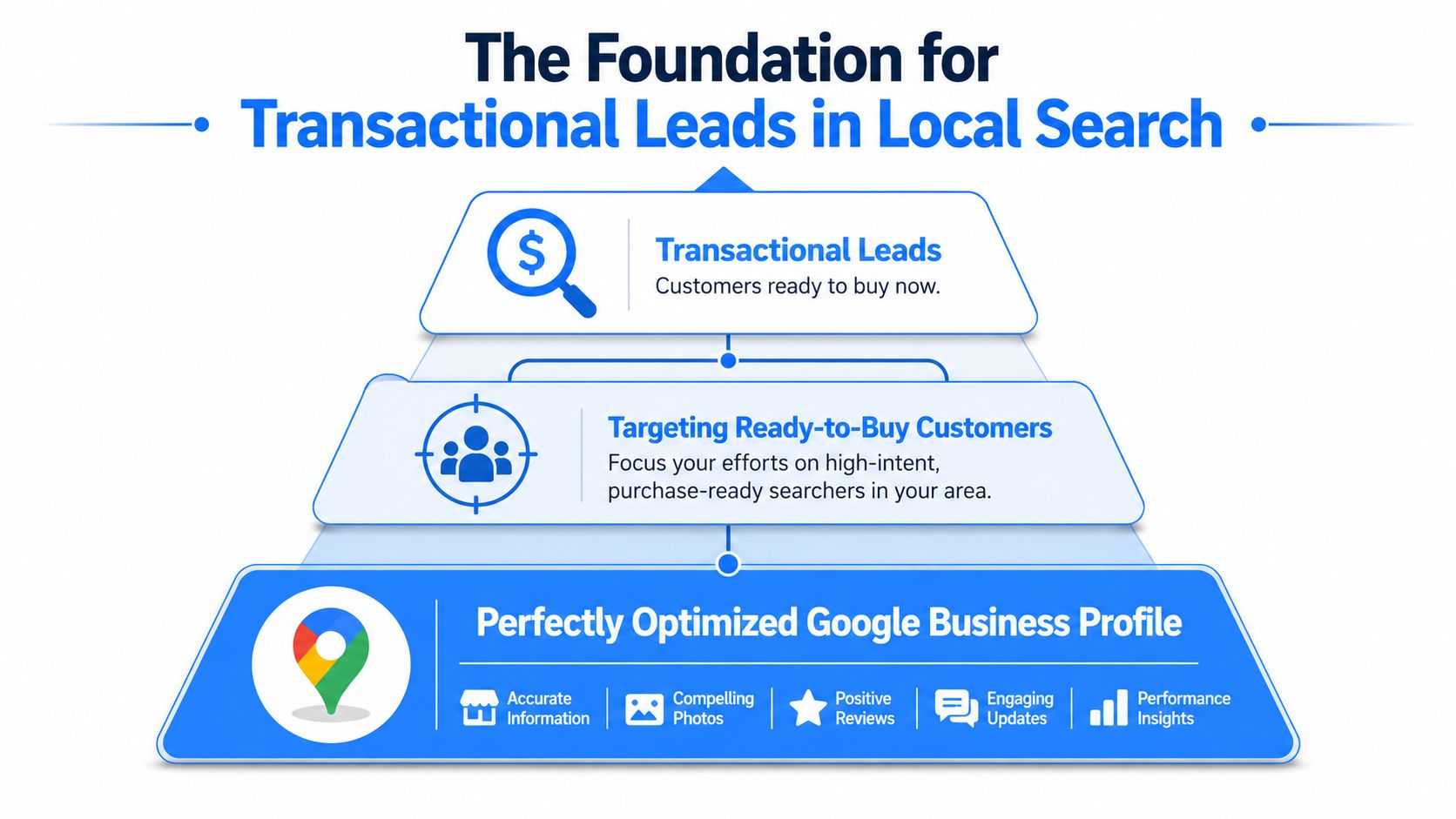
What an optimized Google Business Profile actually includes
Most plumbing companies fill out the basics and stop. That leaves money on the table. Your profile needs to function like a local sales page.
Claim and verify the listing
If you haven't fully claimed the profile, fix that first. You can't control visibility or trust signals if Google doesn't see you as the verified business owner.Choose the right primary category
Your main category should match your core service. Secondary categories should support real offerings, not random keyword stuffing.List services clearly
Add individual services such as drain cleaning, leak repair, sewer line repair, water heater repair, and emergency plumbing. This helps align your profile with transactional searches.Write a tight business description
State what you do, where you do it, and what type of jobs you want. Skip fluffy brand language.Upload real photos
Use team photos, trucks, jobsite images, branded equipment, and completed work. Fake stock visuals weaken trust.
The map pack is where the best calls happen
The Google Maps 3-pack gets the clicks and calls that matter most because it sits directly in the path of urgent search behavior. A homeowner with water on the floor isn't scrolling through ten pages of results. They're comparing a few visible options and choosing fast.
Practical rule: If your Google Business Profile isn't complete, current, and review-active, you're invisible for the best searches even if your company has a decent website.
A strong local profile also needs ongoing maintenance:
- Keep hours accurate so emergency demand doesn't hit a dead end.
- Post updates regularly to show activity and relevance.
- Answer questions fast if they appear on the profile.
- Monitor reviews because reputation and ranking work together.
- Match your service areas to where you want booked jobs.
If you want a deeper look at how this local visibility system works, review this guide on local SEO for plumbers. The core idea is straightforward. Own the map results for the searches with buyer intent, and you'll own more of the best calls.
Building a Website That Converts Searchers into Jobs
A generic five-page plumbing website is a liability. It doesn't rank broadly enough, it doesn't answer specific searches well enough, and it doesn't convert serious buyers with enough confidence. If your site has a homepage, an about page, a contact page, and one services page, you're telling Google and your customers almost nothing.
The better structure is service-page depth plus location-page depth. Simpro's contractor guidance recommends creating a dedicated webpage for every service and every location you target, then measuring each page against revenue goals in this plumbing marketing article from Simpro. That's the difference between vague SEO and scalable plumbing company marketing.
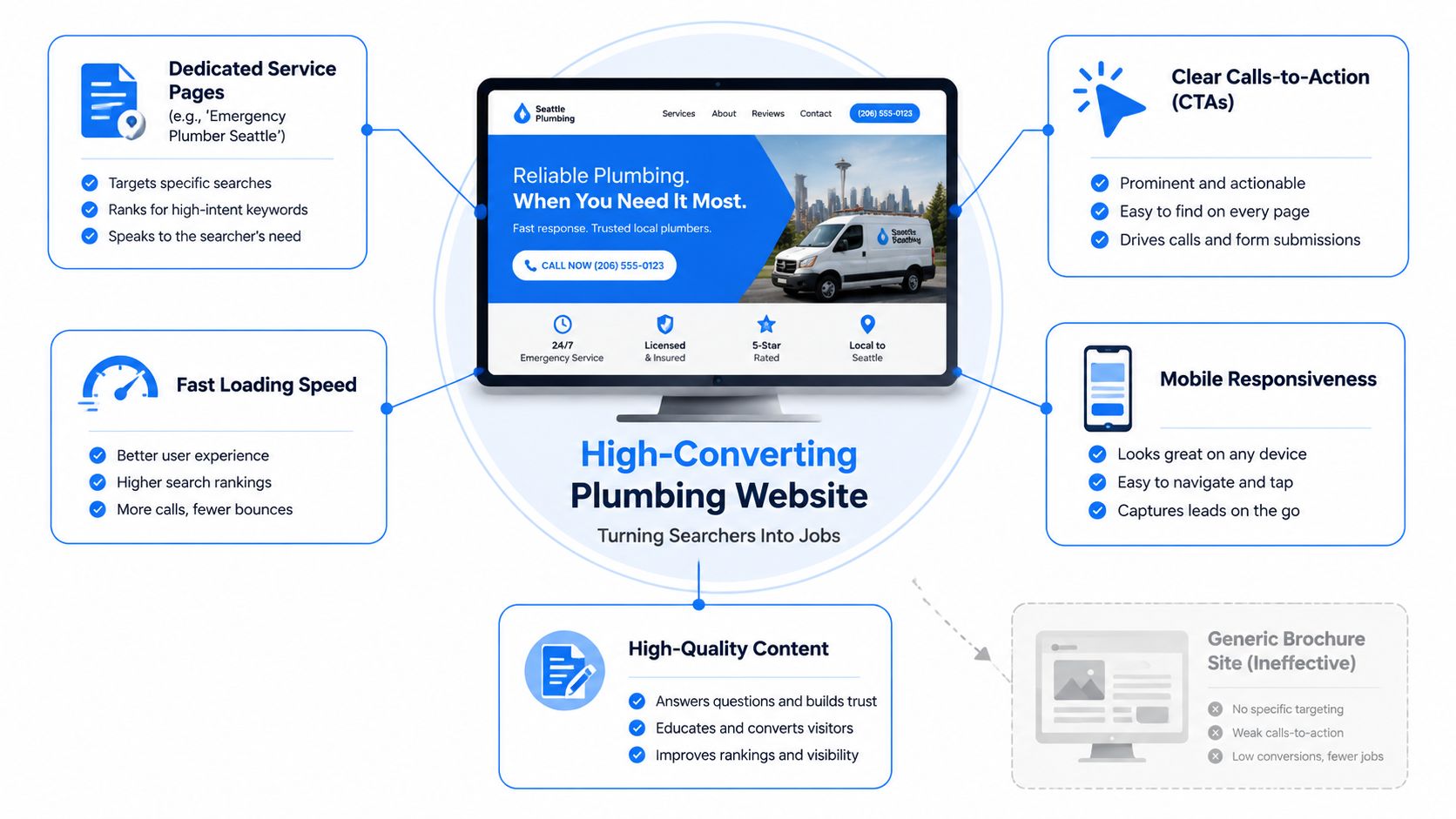
What a revenue-focused site structure looks like
Don't build pages around broad categories alone. Build them around the searches people make when they're ready to hire.
| Page type | Weak version | Better version |
|---|---|---|
| Service page | Plumbing Services | Emergency Plumber in Phoenix |
| Repair page | Water Heaters | Tankless Water Heater Repair in Mesa |
| Cleaning page | Drains | Drain Cleaning in Scottsdale |
| Location page | Areas We Serve | Plumber in Tempe |
| Combined intent page | Contact Us | Sewer Line Repair in Chandler |
That structure does two jobs at once. It gives search engines a specific answer for a specific query, and it gives the visitor immediate confirmation that they're in the right place.
What each service and city page needs
A strong page isn't long for the sake of being long. It needs the right content blocks.
Clear search alignment
Put the service and city in the title, heading, and opening copy naturally.Problem-specific content
A water heater page should talk about no hot water, strange noises, leaks, pilot issues, or replacement decisions. A drain cleaning page should address backups, slow drains, and emergency signs.Fast path to contact
Put the phone number and request form where people can act without hunting.Trust elements
Add review snippets, service guarantees, technician credibility, and real photos.
A website shouldn't act like a digital brochure. It should act like a dispatcher that qualifies the search and pushes the visitor toward a booked job.
AI optimization fits naturally into this structure. Large language models and AI search tools favor clear, specific, well-organized answers. A page about "plumbing" is weak. A page about "burst pipe repair in Fort Worth" is useful. Specificity wins.
If your site still behaves like an online business card, rebuild it around actual buying intent. This resource on website design for service company growth is a good benchmark for how service businesses should structure pages that rank and convert.
Using Reviews to Build Unshakeable Customer Trust
Reviews don't support plumbing company marketing. They control it.
Scorpion reports that 64% of consumers only consider providers with at least a 4-star rating, and plumbing companies with 50+ reviews generate 54% more revenue in the source's reporting, as noted in this plumbing marketing strategies analysis from Scorpion. That's not a branding footnote. That's a conversion threshold.
Why review volume changes who gets called
A homeowner dealing with a leak isn't auditing your technical skill. They use shortcuts. Star rating, review count, recency, and tone of feedback become trust filters.
That means two plumbing companies can offer the same service in the same city and get very different outcomes before either phone rings. The company with stronger visible proof gets picked first.
Here's the practical takeaway:
Star rating is the first filter
If you fall below what buyers consider acceptable, many won't even click.Review count validates consistency
A handful of good reviews can look accidental. A deep bench looks dependable.Recent reviews reduce hesitation
Buyers want proof that your service quality still holds up now.
Build a review process, not a wish
Most owners ask for reviews when they remember. That's sloppy. The request should happen after every completed job through a repeatable workflow.
A basic system looks like this:
- Technician finishes the work and confirms satisfaction.
- Office sends a direct review request the same day.
- Team follows up once if the customer doesn't respond.
- Best reviews get reused on service pages and quote pages.
- Every review gets a professional response.
If you want a clean tool for collecting and organizing customer proof, platforms that focus on solutions for authentic feedback can help you turn scattered praise into usable trust assets.
Reviews should be treated like sales collateral. If a customer says you solved an emergency fast, use that language on the page selling emergency service.
Don't hide your best feedback inside your Google profile and hope prospects find it. Put it on your site. Put it on core pages. Put it near contact forms. For a more systematic process, this guide to online review management is worth applying.
Activating Immediate Leads with Paid Advertising
SEO builds an asset. Paid ads buy speed.
If your rankings are still developing or your service area is crowded, Google Ads and Local Services Ads can put you in front of ready-to-book searchers right away. That doesn't make paid search better than organic visibility. It makes it useful for immediate demand while the larger local search system matures.
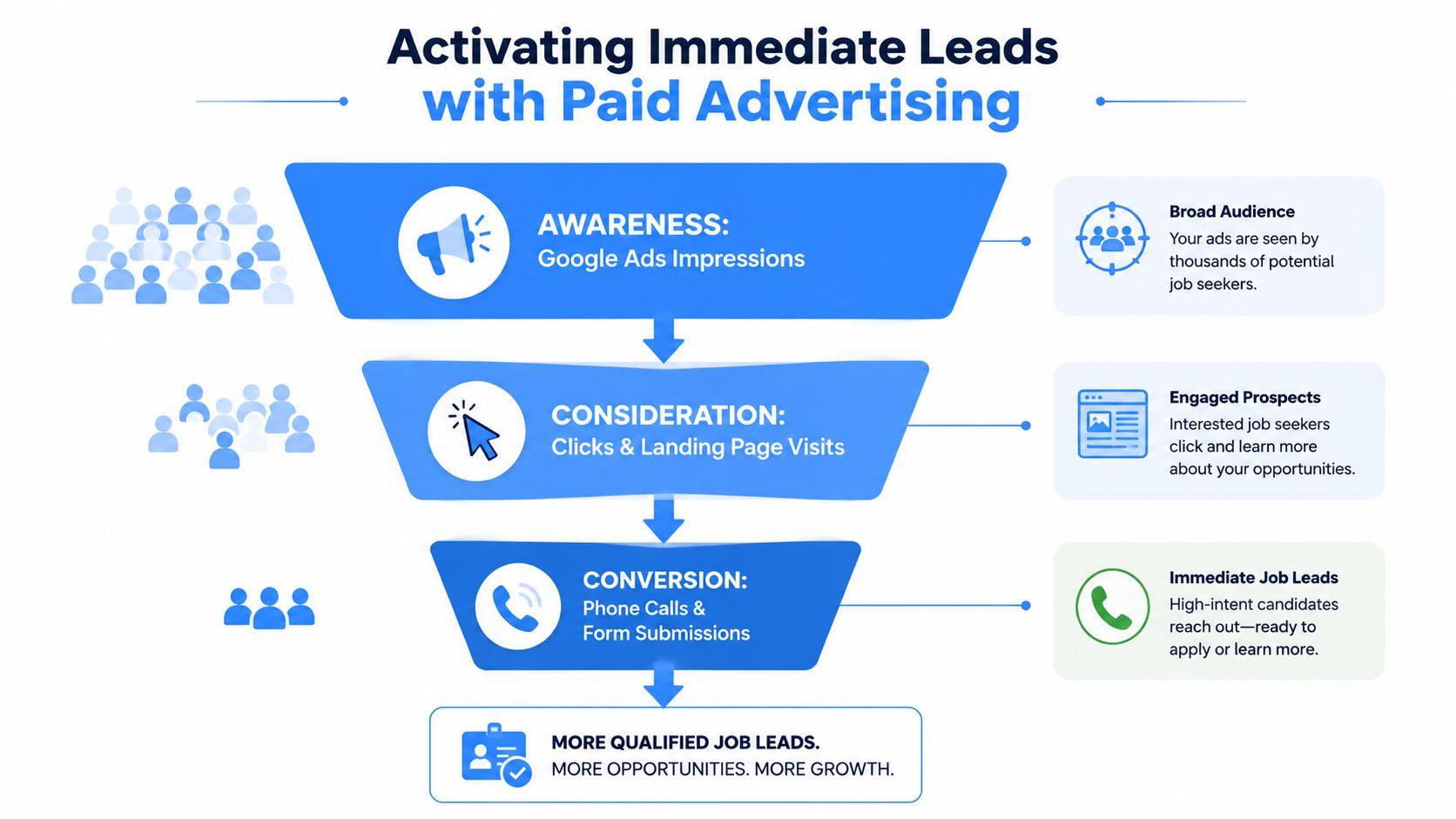
The right channel order is straightforward. CI Web Group recommends sequencing plumbing marketing by intent: local SEO first for "near me" discovery, then paid ads for immediate demand. The same guidance recommends allocating 10 to 15% of sales to marketing and tracking every lead to its source in this plumbing business marketing guide from CI Web Group.
SEO and PPC play different roles
| Channel | Best use | Main strength | Main risk |
|---|---|---|---|
| Local SEO and Maps | Ongoing lead capture | Builds durable visibility | Takes time and consistency |
| Google Ads | Immediate service demand | Fast entry into searches | Burns budget if targeting is sloppy |
| Local Services Ads | High-intent local inquiries | Strong trust format | Lead quality still needs review |
Paid advertising works best when you narrow the target. Bid on the services that produce worthwhile jobs. Send traffic to pages that match the exact search. Answer calls fast. Track outcomes by keyword and landing page.
This video gives a useful visual overview of how paid campaigns fit into the broader lead flow.
Where plumbers waste ad budget
The biggest mistakes are boring and expensive:
- Broad keyword targeting that attracts research traffic instead of buying traffic
- Weak landing pages that don't match the searched service
- No call tracking discipline so nobody knows which campaign produced real jobs
- Slow phone response after paying to generate urgency
If you're already spending and want a second opinion, a structured PPC performance review for home services can help surface wasted spend, bad targeting, and landing page mismatch before more budget disappears.
Future Proofing with AI Optimized Content
A homeowner asks ChatGPT or Google's AI results for a plumber who can replace a leaking tankless water heater in your city today. If your site only has a generic services page, you are invisible at the moment that buyer is ready to call.
AI search rewards specificity. It pulls from pages that clearly connect service, problem, location, and proof. Plumbing companies that keep publishing vague, catch-all copy will lose high-intent searches to competitors with tighter page structure and clearer service coverage.
As noted earlier, this market is crowded and growing. That makes precision more valuable, not less.
What AI optimization means for plumbers
AI optimization for a plumbing company is simple. Build pages that answer real transactional searches with enough detail that both a customer and an AI system can trust the answer.
Start with the jobs that make money. Emergency drain cleaning. Water heater replacement. Sewer line repair. Tankless installation. Repiping. Then build dedicated pages for each service in each priority city or service area.
A strong page gives AI systems something concrete to surface:
One service intent per page
Keep the topic tight. "Water heater repair in Plano" beats a bloated page trying to rank for every plumbing job in North Texas.Clear local and commercial context
State who the service is for, where you offer it, what problems you solve, and what the next step is.Proof that reduces risk
Include reviews, photos, warranty details, licensing, response times, and a plain explanation of your process.Direct language
Cut the brand slogans and filler. Say what you do, where you do it, and why someone should call now.
This structure helps search engines. It also helps AI answer engines summarize your business accurately instead of pulling a half-relevant sentence from a weak general page.
The mistake is obvious. Plumbing companies publish "helpful" content that attracts research traffic, while the pages tied to booked jobs stay thin. That is backward. Your content system should start with bottom-of-funnel service pages and use educational content only to support them. If you want the right model, study this approach to content marketing for plumbers built around transactional searches first.
Content organization matters too. Group related service pages, supporting FAQs, and location pages so the site forms a clean topical structure. AI tools prefer clear relationships between pages because that makes your expertise easier to interpret and cite.
The plumber who gives the clearest local answer wins the recommendation.
If you use AI in chat, lead handling, or internal knowledge tools, input quality still controls output quality. Guidance on improving FOMOchat's AI quality shows the same rule your website has to follow. Better structure produces better answers.
Future-proofing your search presence does not mean chasing every new AI feature. It means publishing the pages that deserve to rank, tightening the signals on those pages, and focusing every piece of content on one goal: more booked jobs from high-intent searches.
Measuring Success by Profit Not Just Leads
Most agency reporting is padded with numbers that don't help you run a plumbing business. Clicks. Impressions. Sessions. Visibility graphs. None of those matter if the calls are weak, the jobs are small, or the margins are bad.
The measurement standard should be harsher. PM Magazine's contractor guidance says owners should track lead quality, new customer counts, revenue per source, cost-per-lead, and acquisition cost of a new client in this marketing guidance for plumbing contractors from PM Magazine. That's the right lens because not every lead turns into profitable work.
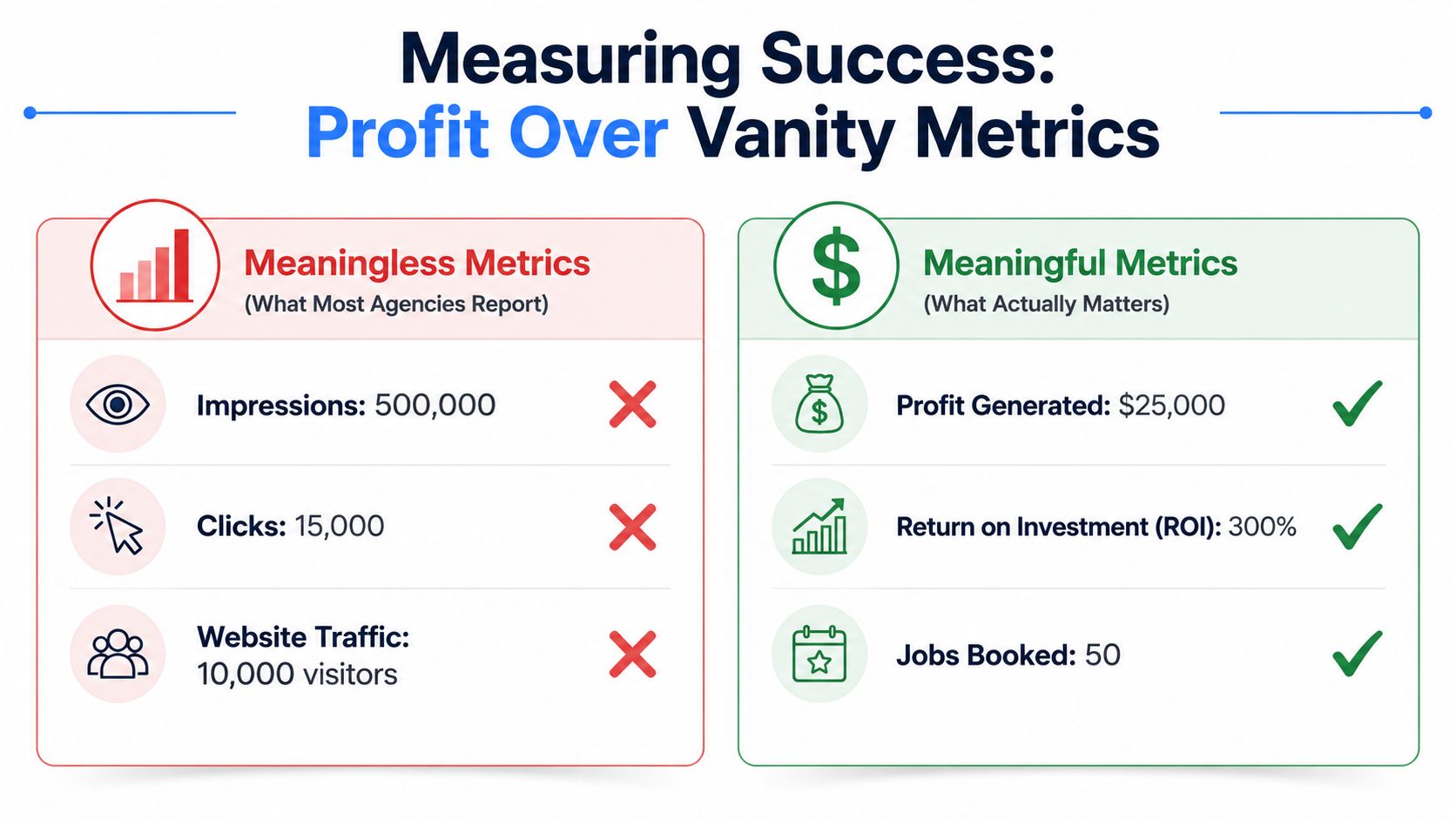
The wrong scoreboard
A campaign can look great in a dashboard and still fail in the field. Plenty of emergency search terms generate calls from shoppers, renters, non-service-area inquiries, or low-value issues that eat dispatch time.
Use this split to keep your reporting honest:
| What most agencies show | What you should demand |
|---|---|
| Traffic trends | Booked jobs by source |
| Click volume | New customers by source |
| Impression growth | Revenue by service page or campaign |
| Form fills | Cost to acquire a profitable customer |
Track the whole path to revenue
You need to know four things for each source of lead:
- Did the call come from a real prospect?
- Did that prospect book?
- What service did they buy?
- Was the job worth the acquisition cost?
That's the filter that separates useful plumbing company marketing from expensive noise.
Operator mindset: A lead isn't valuable because it happened. It's valuable if it turns into a profitable job in the service area you actually want.
This also changes budget decisions. If drain cleaning leads book well but low-ticket repair calls don't, spend should shift. If one city page produces stronger jobs than another, expand around the winner. If a search term floods the phones with poor-fit calls, cut it.
Marketing should be managed like dispatch capacity and technician utilization. Measured inputs. Clear outputs. Ruthless pruning.
Your 90 Day Plumbing Marketing Implementation Plan
Most plumbing owners don't need more ideas. They need a sequence. If you try to fix everything at once, you'll end up with half-built pages, inconsistent reviews, and no reliable tracking.
Use this as a working rollout.
Days 1 through 30
Start with the local assets that influence buyer choice fastest.
Lock down your Google Business Profile
Complete categories, services, hours, photos, and service areas. Remove outdated details.Identify top transactional keywords
Focus on the services people search when they need help now. Emergency plumbing, drain cleaning, water heater repair, sewer repair, leak detection.Audit your current website
Find thin pages, generic service copy, slow mobile sections, and missing calls to action.Set up lead tracking
Every call and form needs a source label. If you can't trace the lead, you can't manage the budget.
Days 31 through 60
Now build the website around buyer intent.
Publish the first core pages
Don't wait for a giant site rebuild. Get high-value pages live.
- Service pages first for your most profitable work
- City pages next for your best service areas
- Review placement on every key page
- Short forms and click-to-call buttons throughout mobile layouts
A simple priority order works best:
- Emergency plumbing
- Water heater repair
- Drain cleaning
- Leak repair
- Sewer line repair
Launch the review workflow
Discipline matters. Tie review requests to completed jobs, not random memory. Give the office a script. Give technicians a handoff line. Respond to every review.
Days 61 through 90
Add acceleration and tighten measurement.
Launch a focused paid campaign
Target only the services and cities you know you want. Send each ad group to a tightly matched page.Review lead quality weekly
Separate booked jobs from bad-fit calls, repeat customers, spam, and price shoppers.Expand what proves itself
If one service-city combination works, build more around it. Don't spread effort evenly. Double down where intent is strongest.Cut weak channels fast
If something produces noise instead of revenue, stop defending it.
By the end of this cycle, you should have a real operating system. Stronger map presence. Better service pages. More reviews. Cleaner tracking. Smarter ad spend. That's what plumbing company marketing is supposed to do. Turn search demand into booked jobs without wasting time on metrics that don't pay the bills.
If you want help building a no-nonsense local search system around transactional keywords, Google Maps visibility, service-and-city page SEO, and AI-optimized content, Transactional LLC is built for exactly that. They focus on getting service businesses found for the searches that lead to booked jobs, then tracking performance in a way owners can use.