


A $183 average cost per lead for non-branded plumbing search campaigns makes one point unavoidable: plumbing PPC services can't be managed like broad awareness advertising. That benchmark covered 524 plumbing contractors, 2,554 campaigns, and $14.6 million in tracked spend during Q1 2026, according to the 2026 plumbing PPC benchmark. Every click needs a job-focused destination, every call needs a fast response, and every campaign needs to target someone already looking for a plumber.
That searcher usually has money in hand and a problem that won't wait. Queries such as “plumber near me,” “emergency plumber,” “burst pipe repair,” and “water heater replacement” are transactional search terms. Transactional Marketing builds its strategy around those moments, combining paid search with Google Maps optimization, Local Services Ads, and AI search visibility so plumbing companies can capture demand wherever the customer makes a decision.
Why Plumbing PPC Demands a Transactional Mindset
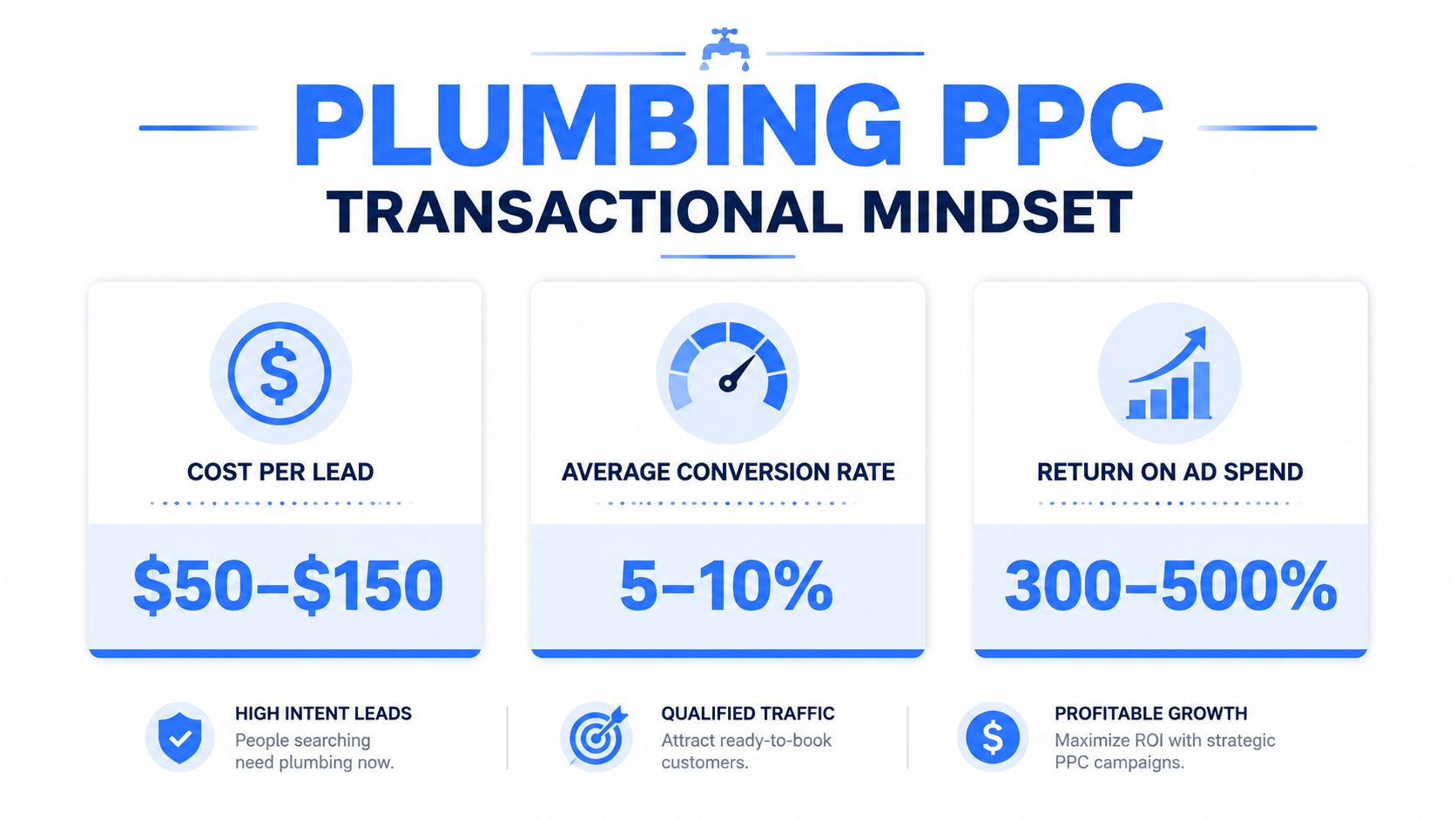
Plumbing paid search is expensive because the intent is valuable. The 2026 benchmark reported an average $10.49 cost per click, a 4.97% click-through rate, and a 7.63% conversion rate across plumbing keywords, as documented in the plumbing ad creative statistics benchmark. Emergency-related plumbing terms can reach $25 to $45 per click in the same dataset, so careless targeting can drain a budget before a dispatcher answers the phone.
A plumbing PPC campaign isn't trying to make a homeowner remember a brand for later. It's trying to win the call now. That changes how you judge performance. A click from someone researching pipe materials isn't equal to a call from someone searching “emergency plumber near me,” even if both count as traffic inside an ad platform.
The economics favor precision
The benchmark's $183 average cost per lead for non-branded search makes service-line segmentation mandatory. A small improvement in conversion quality can change acquisition economics, but a cheaper lead isn't automatically better if the lead is outside the service area, asking for free advice, or calling when nobody can dispatch.
The broader home services benchmark reported a 10.22% average conversion rate, while plumbing reached 15.61%, according to the 2025 home services marketing benchmarks. That advantage reflects urgency, but it only becomes revenue when the page, phone experience, and dispatch process support the searcher's decision window.
Practical rule: Optimize for booked jobs and qualified calls, not raw clicks or form volume.
Transactional terms are the operating system
Transactional Marketing uses the phrase “transactional marketing”. A query like “roofer near me,” “dentist near me,” or “plumber near me” signals a person who is actively evaluating providers. For plumbing, the strongest terms usually combine a service, a location, and urgency.
That means the campaign should prioritize terms such as “emergency plumber,” “drain cleaning near me,” and “water heater repair [city]” over broad informational searches. A useful resource for evaluating the fundamentals is the Come Together Media LLC playbook for Google Ads for service businesses, particularly its focus on connecting paid traffic with local service conversion paths.
Building a Campaign Structure Around Service Intent
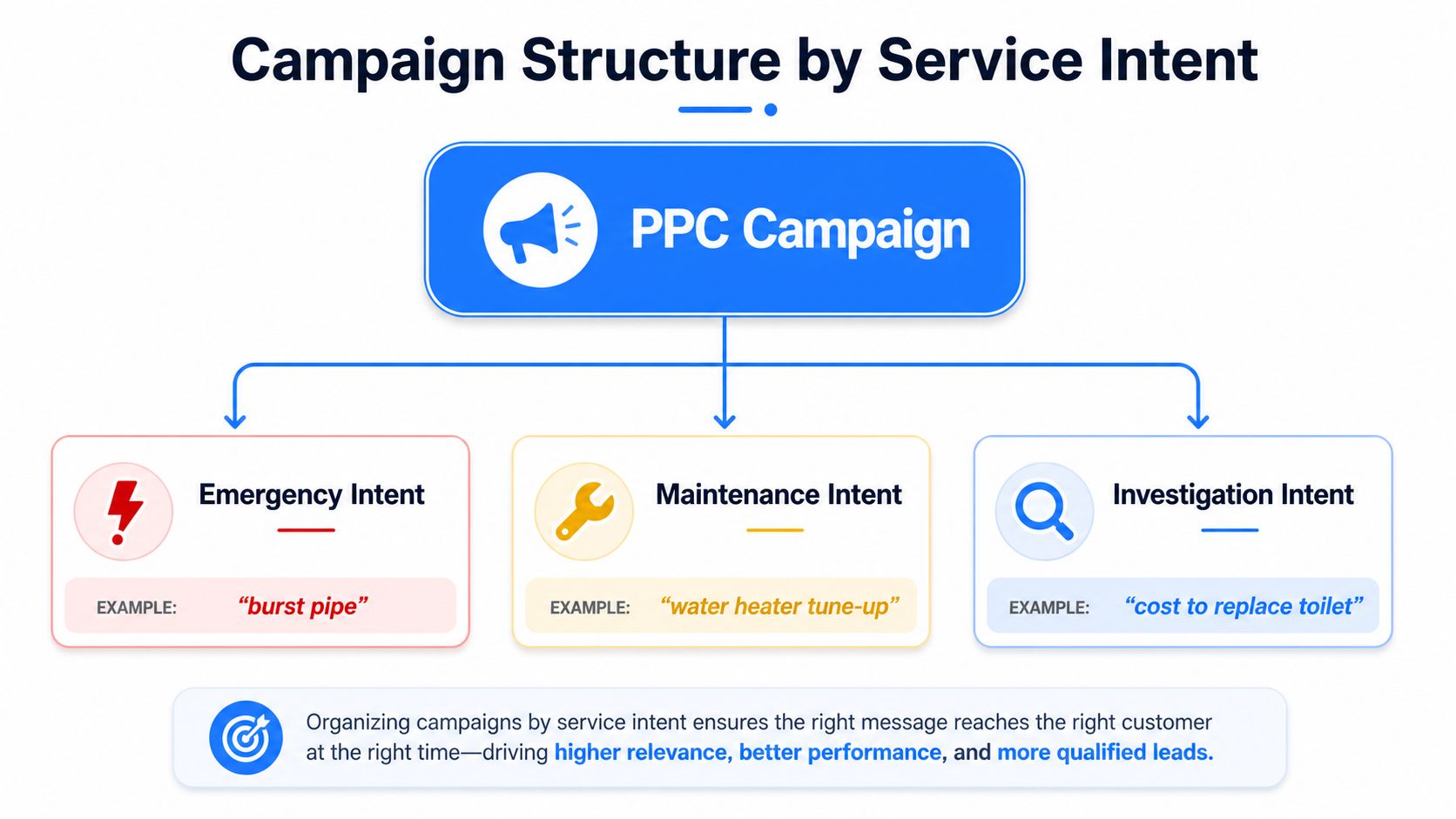
A plumbing account should mirror the way customers describe their problems. One campaign for every plumbing keyword creates poor visibility into costs, weak ad relevance, and landing pages that speak to nobody in particular. Emergency plumbing, drain and sewer, water heaters, and general repair deserve separate campaign logic.
Separate the money-making searches
Build an emergency campaign for terms such as “burst pipe repair,” “emergency plumber,” “flooded basement plumber,” and “24 hour plumber.” Use urgent copy, phone-forward landing pages, and bidding that reflects when your team can answer and dispatch.
Create a drain and sewer campaign for “clogged drain,” “sewer line repair,” “hydro jetting,” and related service queries. These searches need different proof, different service descriptions, and often different qualification questions than emergency leak calls.
Water heater campaigns should separate repair, replacement, installation, and service intent. The benchmark found category-level CPL variation from $161 for general plumbing to $256 for water heater campaigns, as reported in the 2026 data-driven PPC answers for plumbers. Treating those services as one blended group hides the economics.
Use a general repair campaign for lower-specificity terms, but don't let it absorb every vague query. Add negative keywords for searches involving jobs you don't perform, employment, training, parts, manuals, do-it-yourself instructions, and free estimates if those leads don't fit your operating model.
Match the ad to the search
Use tightly related keyword groups and write ads that repeat the customer's actual problem. Someone searching “water heater replacement” should see replacement language, financing information if available, service-area relevance, and a direct booking option. Someone searching “emergency plumber near me” should see immediate availability and a call action.
Start with controlled phrase and exact match coverage for the highest-value transactional terms. Expand only after search-term reports show that the added queries produce qualified leads. Broad automation has a place, but it shouldn't be allowed to decide which plumbing services deserve budget before you have clean conversion data.
For a practical implementation reference, use this guide to set up a Google Ads campaign. The important principle is simple: each campaign should answer one customer problem, in one service area, with one clear next action.
Geo-Targeting and Local Services Ads for Map Dominance
Plumbing customers buy locally, and paid search must respect the actual dispatch territory. A campaign that reaches people outside your service area isn't generating demand. It's purchasing irrelevant clicks.
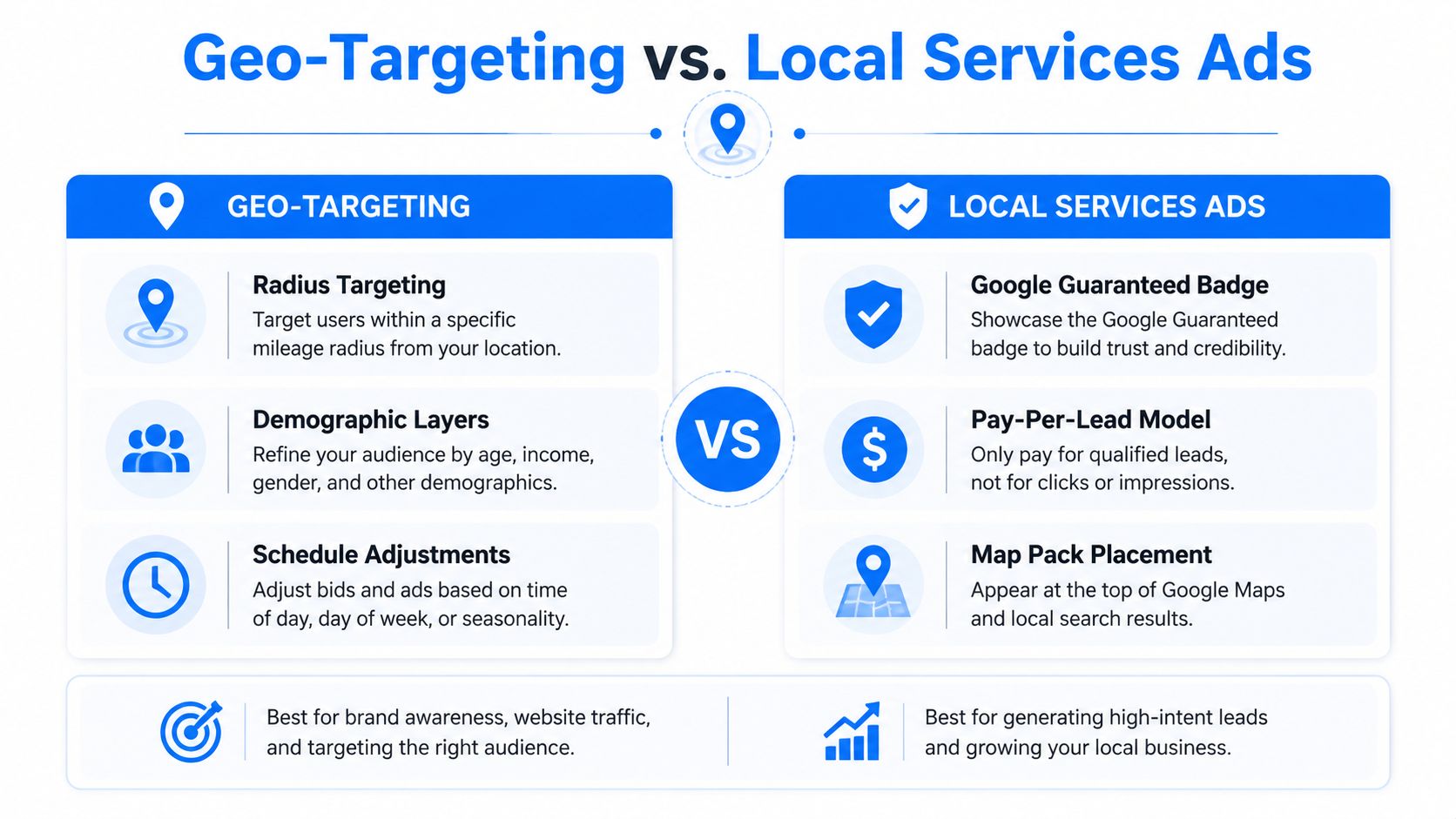
Set location targeting around the cities, neighborhoods, and service zones your crews can reach. Exclude areas you don't serve, review location reports regularly, and use city-specific copy where the market justifies it. “Emergency plumber in [city]” should lead to a page that confirms service in that city, not a generic homepage.
Google says local results depend on relevance, distance, and prominence, as summarized in this explanation of Google Maps ranking factors. Paid targeting can't override a weak local presence. Your business information, service coverage, reviews, and website must reinforce the same geographic story.
Search ads and LSAs serve different roles
Google Local Services Ads changed local plumbing advertising by placing map-style ads above standard search results and charging for leads rather than clicks in many cases. Independent 2026 plumbing benchmarks report LSA CPL ranges of about $30 to $100, compared with about $183 for non-branded Google search leads, according to the plumbing SEO statistics benchmark.
That doesn't make LSAs a replacement for search campaigns. LSAs provide prominent local placement and a lead-based buying model. Standard PPC gives you more control over keyword themes, ad copy, landing pages, scheduling, and service-specific messaging. Google Maps and local organic visibility can also produce lower acquisition costs, so the strongest plumbing PPC services use paid search to capture immediate demand while building the local assets that reduce dependence on every paid click.
Transactional searches often trigger map-based results. Independent local-search coverage notes that local packs appear for more than 90% of simple local queries, according to Search Engine Land's local search coverage. That makes “plumber near me” a map optimization priority as well as a PPC keyword.
Build the paid and map strategies together, then use Google Local Services Ads for home services as part of a broader local acquisition plan. The objective is not to win one placement. It's to occupy the customer's decision window across ads, Maps, and organic results.
Landing Pages and Call Handling That Convert Urgent Searchers
A plumbing ad can't rescue a slow or vague landing page. The page must confirm the service, location, urgency, and next step before the visitor has time to reconsider or call a competitor.
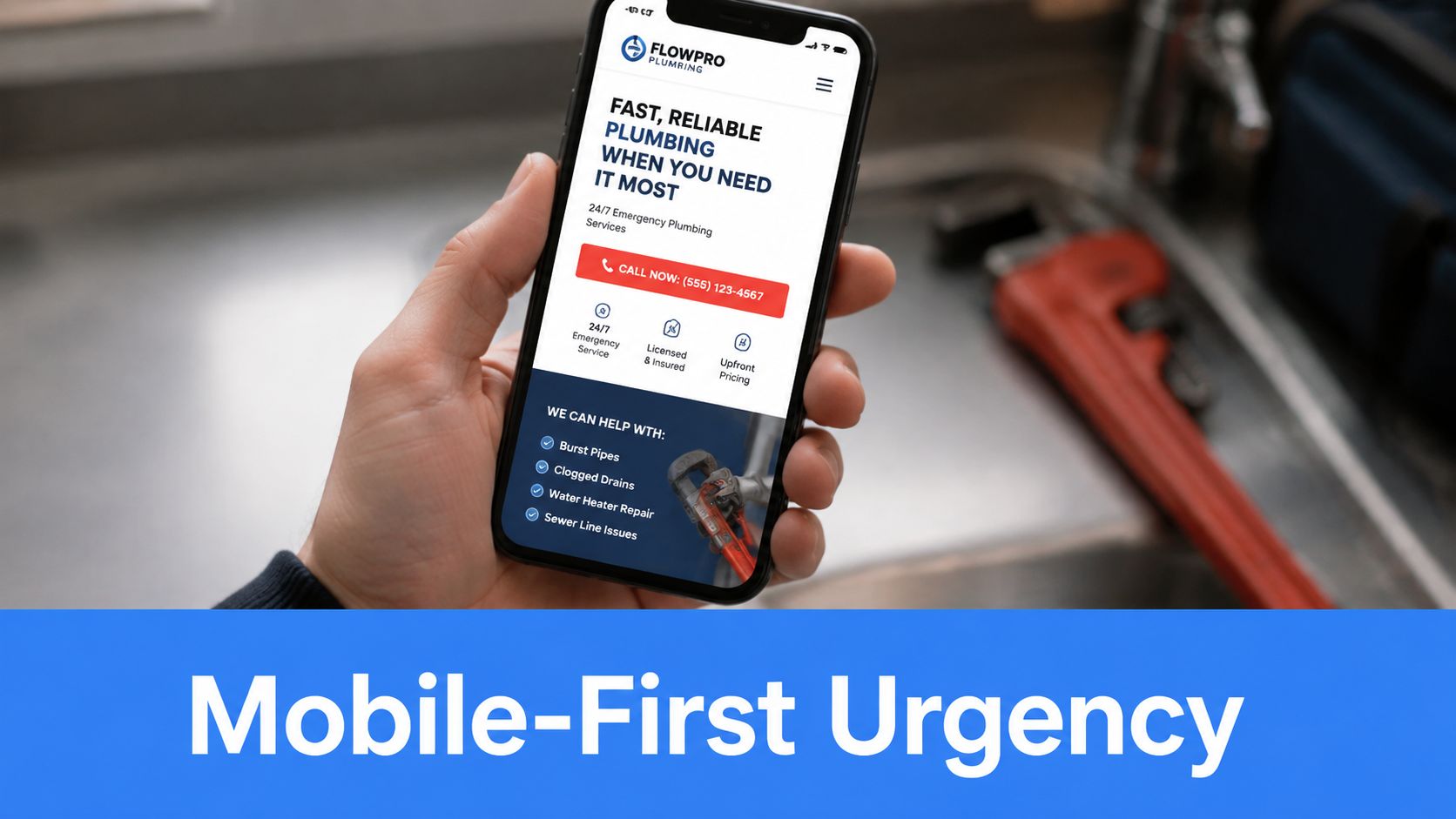
Send emergency traffic to an emergency page. Send water heater traffic to a water heater page. Put the phone number and click-to-call button where a mobile visitor can use them immediately, and keep the form short enough for a stressed homeowner to complete without searching for paperwork.
Make the first screen do the work
The first screen should state the service and service area, show a direct call action, and provide enough trust to reduce hesitation. Use real reviews, licensing information where applicable, clear operating hours, and concise details about what happens after the customer calls.
Call-only or call-focused mobile experiences fit urgent searches well. Short forms can capture customers who can't call, but forms shouldn't replace a visible phone path when the problem is actively damaging a home.
The home services benchmark found plumbing conversion performance above the broader category average, with plumbing at 15.61% versus 10.22% for home services search ads, as reported in the same home services benchmark. Use that category strength properly by removing friction rather than adding more copy.
Operations are part of conversion rate
A lead becomes revenue only when somebody answers, qualifies the request, and schedules a viable job. Track missed calls, after-hours coverage, service-area fit, job type, and dispatch outcome. If the phone rings while your team is underwater, route calls to a trained backup instead of letting paid demand disappear.
Call recordings and source attribution can reveal whether ads are producing genuine service requests or low-quality inquiries. The guide to tracking phone calls provides a useful framework for connecting call activity to campaign performance.
Booked-job standard: A campaign isn't successful because the phone rang. It succeeds when the right call was answered and turned into work.
AI Optimization and Structured Data for Local Discovery
Plumbing marketing now extends beyond the traditional search results page. A homeowner may ask an AI assistant to recommend a nearby emergency plumber, compare local providers, or identify a company that handles sewer repair. If the business information is incomplete or inconsistent, the system has less reliable material from which to form an answer.
AI optimization starts with machine-readable basics. Maintain a complete Google Business Profile, keep the business name, address, and phone information consistent across the web, and use schema markup such as LocalBusiness and Service. Industry guidance on LLM SEO for local businesses emphasizes these structured signals because they help systems interpret who you are, what you do, and where you work.
Build one consistent business identity
Your website service pages, Google Business Profile, directory listings, review profiles, and local citations should describe the same business. Service names should be specific. Locations should reflect actual coverage. Contact details shouldn't change from one platform to another without a clear reason.
This structure supports Google Maps visibility as well as AI discovery. Relevance helps systems match the service, distance helps them assess local suitability, and prominence helps them evaluate authority. Reviews and independent mentions add context that a single business page can't provide.
Publish for questions with buying intent
AI-focused content shouldn't become a library of generic plumbing articles. Create pages that answer commercial questions and identify the next step, such as emergency leak response, drain cleaning service areas, water heater repair options, and when to call a licensed plumber.
Search Engine Land's local AI search optimization playbook recommends maintaining website and Google Business Profile signals while strengthening reviews, brand visibility, and citations across the web. That approach supports the same transactional goal as PPC. When someone asks an AI system for a nearby plumber, the business needs to be understandable, credible, and geographically relevant.
For implementation details, review schema markup for service businesses. Structured data won't replace strong service pages or customer experience, but it gives search systems clearer information to process.
Tracking Performance and Understanding Pricing Models
PPC reporting should connect ad spend to booked jobs, not stop at impressions, clicks, or form submissions. Install call tracking, preserve source and keyword attribution, import qualified call conversions into the ad platform, and match each lead to the eventual dispatch and job outcome.
The essential dashboard includes cost per lead, cost per booked job, answer rate, qualified-lead rate, dispatch efficiency, and revenue by service line. CPL tells you what the platform acquired. Cost per booked job tells you what the business paid for a scheduled opportunity. Revenue-per-lead analysis shows whether a campaign attracts profitable work or merely creates activity.
Compare agency pricing structures
Agencies commonly use a percentage of ad spend, a flat monthly management fee, or performance-based pricing. Each model can work, but the contract must define what the fee includes, who owns the ad account, how reporting works, and whether landing pages, tracking, creative, and optimization are included.
| Pricing Model | Typical Fee Range | Best For | Key Risk |
|---|---|---|---|
| Percentage of ad spend | Varies by agreement | Businesses scaling media budgets | The agency may benefit when spend rises, even if booked-job quality doesn't |
| Flat monthly fee | Varies by scope | Predictable management costs | A low fee may cover limited optimization or reporting |
| Performance-based pricing | Varies by outcome definition | Operators with strong attribution | Poorly defined leads can create disputes over what counts as performance |
Don't accept a report that hides missed calls or unqualified leads. Require a clear trail from search term to call, from call to appointment, and from appointment to completed work.
Choosing an Agency or Running Plumbing PPC In-House
Running campaigns in-house gives you control, but it also makes the plumbing company responsible for keyword research, negative keyword maintenance, ad testing, location settings, landing pages, conversion tracking, budget pacing, and reporting. An owner or office manager can learn the platform, but learning while spending on expensive transactional searches creates a costly margin for error.
An agency makes more sense when the team lacks time, conversion tracking is incomplete, or lead volume has outgrown manual management. The right partner should understand emergency service economics, separate campaigns by service intent, report booked-job outcomes, and explain exactly where the budget goes.
Use a practical decision test
Choose in-house management when someone on staff can consistently own the account, review search terms, monitor calls, update landing pages, and coordinate marketing data with dispatch. Choose outside management when those responsibilities compete with customer service and field operations.
Ask prospective agencies:
- Industry experience: Can they show plumbing campaign structure organized around emergency, drain, sewer, water heater, and general repair intent?
- Measurement discipline: Do they track qualified calls and booked jobs, or only clicks and forms?
- Local capability: Can they coordinate Google Ads, Local Services Ads, Google Maps, and service-area pages?
- Contract terms: Can you leave without a long lock-in period, and do you retain ownership of your accounts and data?
- Operational understanding: Do they know that an unanswered emergency call is a lost opportunity, regardless of how attractive the dashboard looks?
For a grounded example of how plumbing lead generation can be presented and evaluated, review the plumbing lead generation results from Queen City Digital. Look past headline claims and ask how results were measured, which services generated the leads, and whether the reporting reached booked work.
Transactional LLC offers paid campaign management, Google Maps optimization, industry-specific SEO, and AI-focused content for local service businesses. Visit Transactional LLC to discuss a plumbing demand-capture system built around transactional search terms, qualified calls, and booked jobs.