


Your crews can handle another water-heater repair, but the phone isn't ringing consistently. A homeowner standing in a wet basement searches water heater repair near me, opens a plumbing website, and calls the company that looks able to help now. If your page loads slowly or leaves dispatch availability unclear, that homeowner has little reason to keep looking.
That's the job of plumbing website optimization: connect ready-to-hire searches with a credible service promise and a working call button. At Transactional LLC, we focus on transactional searches because these customers aren't collecting DIY ideas. They have money in hand and are ready to hire.
Rankings only matter when they produce qualified calls. Your website, Google Maps presence, and AI-readable business facts should all support that moment.
Benchmarks for a Plumbing Website
Plumbing website optimization benchmarks
| Checkpoint | Target | What failure costs |
|---|---|---|
| Largest Contentful Paint | 2.5 seconds or less at the 75th percentile | Caller may leave before seeing the phone number |
| Interaction to Next Paint | 200 milliseconds or less | Sticky call button feels broken |
| Cumulative Layout Shift | 0.1 or less | Quote form or reviews jump under the thumb |
| Above-the-fold content | Visible well under 5 seconds | 70 percent of studied pages were slower than this |
| Full mobile load | Far below the old 15-second average | Bounce probability rose 123 percent from 1 to 10 seconds |
| Primary query match | Emergency, drain, water heater, or sewer intent on its own page | Homepage tries to rank for every job |
| Local pack eligibility | Accurate category, services, and real service area | Profile misses relevant plumber near me searches |
Google's mobile landing-page analysis found an average full-load time of about 15 seconds, with 70% of pages taking more than 5 seconds to display above-the-fold visual content; bounce probability increased 123% as load time rose from 1 to 10 seconds. Those are historical cross-industry benchmarks, not acceptable targets for an emergency plumbing page.
The practical question is whether a homeowner can identify your service, confirm coverage, and start a call before unnecessary page features get in the way. A polished animation doesn't compensate for a hidden phone number. A large technician photograph doesn't help if the visitor leaves before it appears.
Separate technical passes from customer passes
The speed thresholds measure loading, responsiveness, and visual stability. They don't prove that your message makes sense. A technically fast page can still fail because it advertises general plumbing without confirming whether you repair the customer's water heater.
Check the first mobile screen yourself. It should identify the service, show a tappable phone number, and state the relevant availability or coverage information. Don't make emergency customers open a menu to discover whether you serve their city.
Practical rule: A visitor shouldn't have to choose between understanding your offer and finding your phone number.
Keep contact information as ordinary page content rather than text embedded inside an image. Test the phone link, submit the short form, and check what happens when someone reaches you outside office hours. These are operational checks, not design preferences.
Score the pages that can produce jobs
Start with your emergency page, your main service page, and a representative city page. Assign pass or fail to every table row for each page. Use real-user performance evidence where available and a manual mobile check for contact visibility and service clarity.
Record the reason for every failure. “Slow” isn't an actionable diagnosis; “oversized hero image delays the emergency-service heading” is. Don't expand the website while the pages most likely to earn a call still have obvious failures.
How to Fix Speed Schema and Mobile Pages
Use a field-data loop, not a single impressive lab score. Your developer needs to know which templates fail for actual visitors, which component causes the problem, and whether the repair holds after deployment.
- Export affected URLs. Pull the available URL groups and example URLs from Search Console's Core Web Vitals report. Keep a record of the affected template and reported issue.
- Split templates and devices. Group emergency-service pages, location pages, and articles separately. Test mobile independently from desktop so office-computer performance doesn't hide phone problems.
- Fix the weakest template first. Start with the shared component affecting important service pages, rather than polishing an isolated article.
- Remove the specific obstruction. Compress the technician hero image, reserve space for review widgets and quote forms, defer nonessential chat and tracking, and simplify JavaScript attached to sticky call buttons.
- Recheck real-user results. Validate the deployment, then monitor fresh field data. A clean Lighthouse run is useful diagnostic evidence, not proof that every customer now has a good experience.
The workflow starts by separating URLs and templates before choosing a fix.
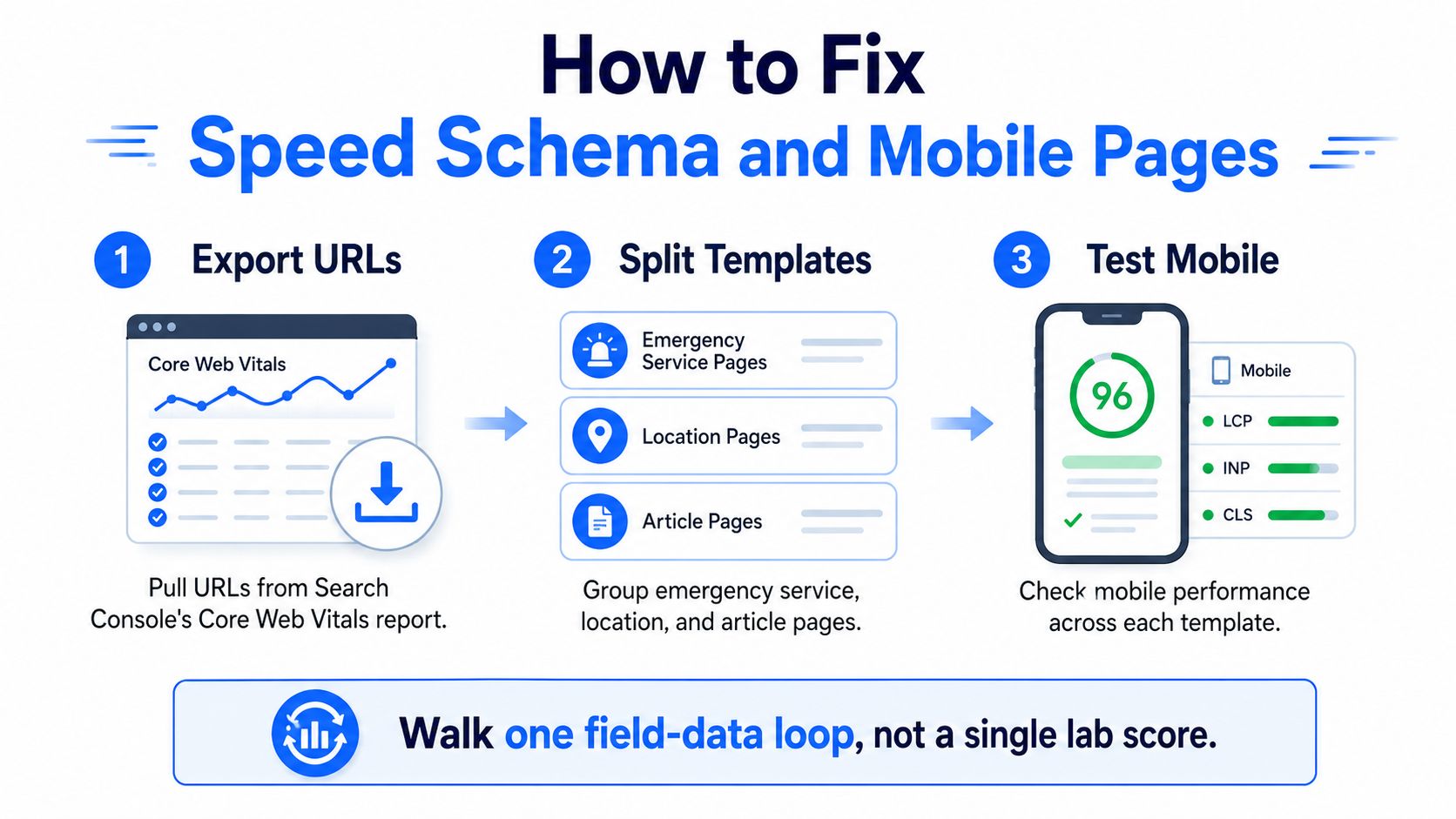
According to Search Console's Core Web Vitals documentation, Google evaluates URL groups using the weakest metric at the 75th percentile over the previous 28 days. That's the measurement basis for the scorecard thresholds, and it explains why a page can fail even when most visits feel fast.
Pages without enough real-user data may not appear in the report. Test those pages directly, but don't label missing evidence as a pass. The mobile-optimized website checklist is useful for reviewing the customer-facing side alongside technical testing.
Make business information machine-readable
Speed repairs and structured-data repairs belong in the same technical work queue. Both require checking the actual template rather than assuming a plugin has handled everything.
Add LocalBusiness JSON-LD for genuine physical business locations. Google's LocalBusiness documentation calls for business-address information and, when geographic coordinates are supplied, latitude precision of at least five decimal places; it also makes clear that structured data doesn't guarantee an enhanced search presentation.
For a home-based plumbing company, don't confuse structured-data implementation with permission to advertise a public storefront. Handle address information consistently with the business's actual operating model and applicable profile rules.
LLMrefs' guide to helping AI engines understand your content provides useful context for semantic markup. Use markup to describe visible, accurate facts, not to insert services or locations customers can't verify.
Validate before expanding
Check the rendered markup, canonical URL, indexability, and internal links. Confirm that the service page you want indexed is the page your navigation and sitemap support.
Don't clone city pages until the original template earns relevant impressions and qualified calls. A useful location page explains local availability, coverage constraints, and service expectations. Swapping city names across otherwise identical copy doesn't create that value, and inventing staffed offices creates inaccurate business signals.
Service Pages That Qualify Transactional Calls
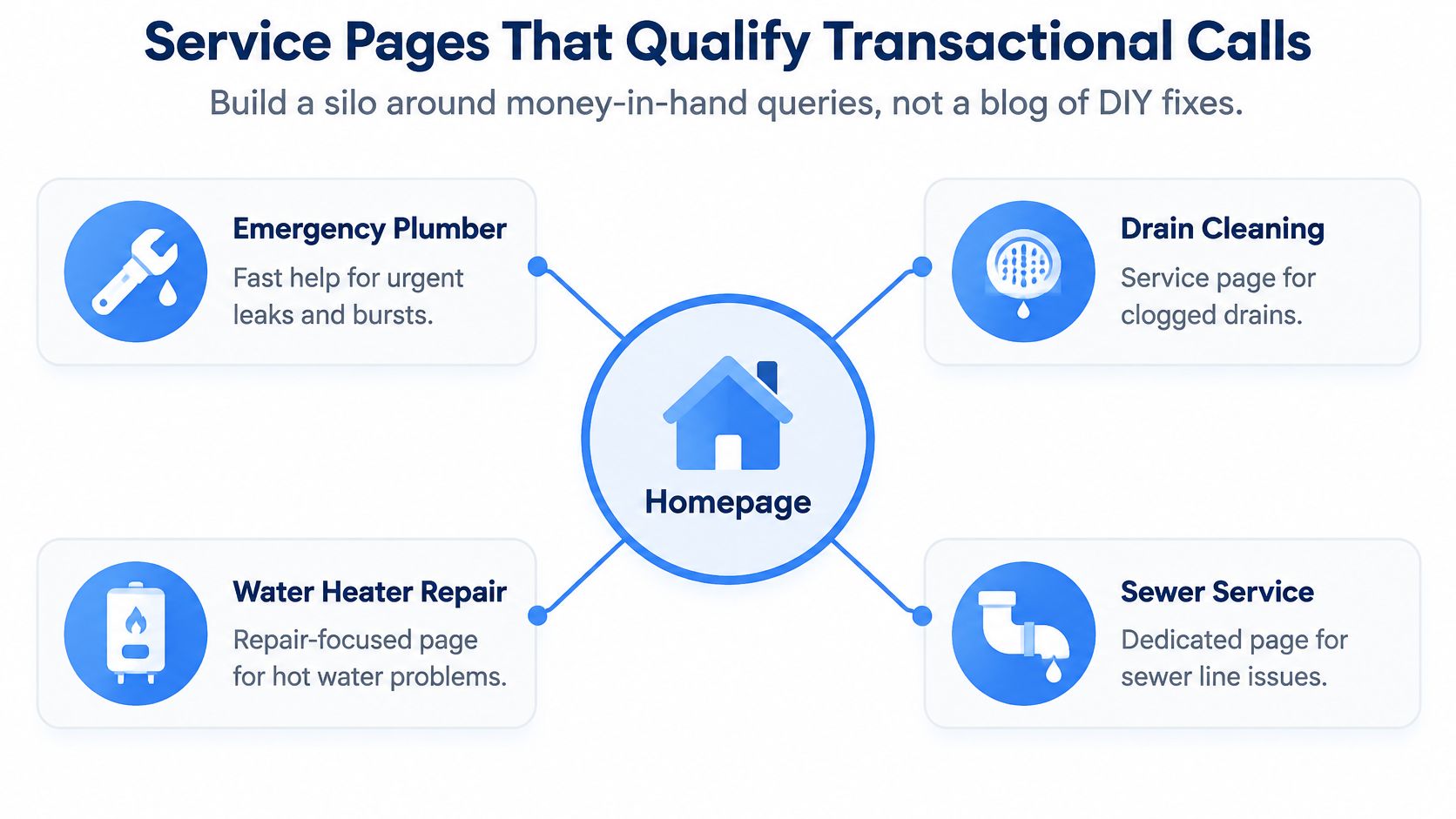
Build your website around emergency plumber, drain cleaning, water heater repair, and sewer service. Give each a dedicated page connected to the homepage. Match the actual hiring queries, including emergency plumber near me, drain cleaning near me, and water heater repair near me, without awkwardly repeating them throughout the copy.
This is a service silo, not a reason to publish endless DIY articles. Each page needs a distinct service promise, equipment qualifications, licensing and warranty information, and a clear availability note for the cities it serves.
The homepage should help customers reach the right service quickly.
Publish a dispatch qualification block
Put operational answers close to the opening service description. Don't bury them beneath company history.
| Customer question | What the page should state |
|---|---|
| Can you reach my property? | Current response area and coverage exclusions |
| Can someone help tonight? | After-hours rules and the closed-office escalation path |
| What does the visit include? | Diagnostic scope, dispatch charge, and fee conditions |
| When could someone arrive? | Dispatch-confirmed arrival-window options |
| How can I pay? | Available payment and financing arrangements |
| Will you repair or replace it? | Inspection criteria, equipment limitations, and warranty considerations |
Repeat the phone button after this block. Use a label that matches what happens next, such as Call to confirm availability, rather than implying a guaranteed immediate arrival.
A Seattle Web Design plumbing-marketing summary, citing Google research, says 76% of people who search for a local service on mobile contact a business within 24 hours. Your page should help that customer determine whether the call is appropriate, not merely encourage any call.
A dispatch promise is only useful if the person answering the phone can honor it.
Qualify the job before selling the price
A low headline price can attract calls that won't become profitable jobs. Explain what a diagnostic visit covers, which work requires a separate quote, and what assumptions apply to any published pricing.
For example, distinguish a straightforward accessible repair from work requiring equipment replacement or additional investigation. Name brands you don't service and areas you can't cover. Multi-location operators should identify the responsible branch or crew instead of displaying an identical availability claim everywhere.
Specific booking language matters too. Ring Hot Water's option to schedule a chilled water system service is a useful example of naming the requested service instead of relying on a vague contact invitation. Apply that specificity only to plumbing work your company performs.
Use the service landing-page framework to keep the service, proof, qualification details, and booking action connected.
This video provides additional context for service-focused website planning.
Clear service pages also support AI discovery. Google's guidance on AI features explains that its search experiences surface supporting links and rely on established search foundations. Retrieval-augmented generation connects generated answers with retrieved information, so crawlable service details and maintained business information remain relevant.
Publish the emergency page first, then the repair service with the strongest job economics, the city with demonstrated demand, and supporting proof. Assign someone to update availability copy whenever dispatch policy changes.
Google Maps Setup for Plumbing Calls
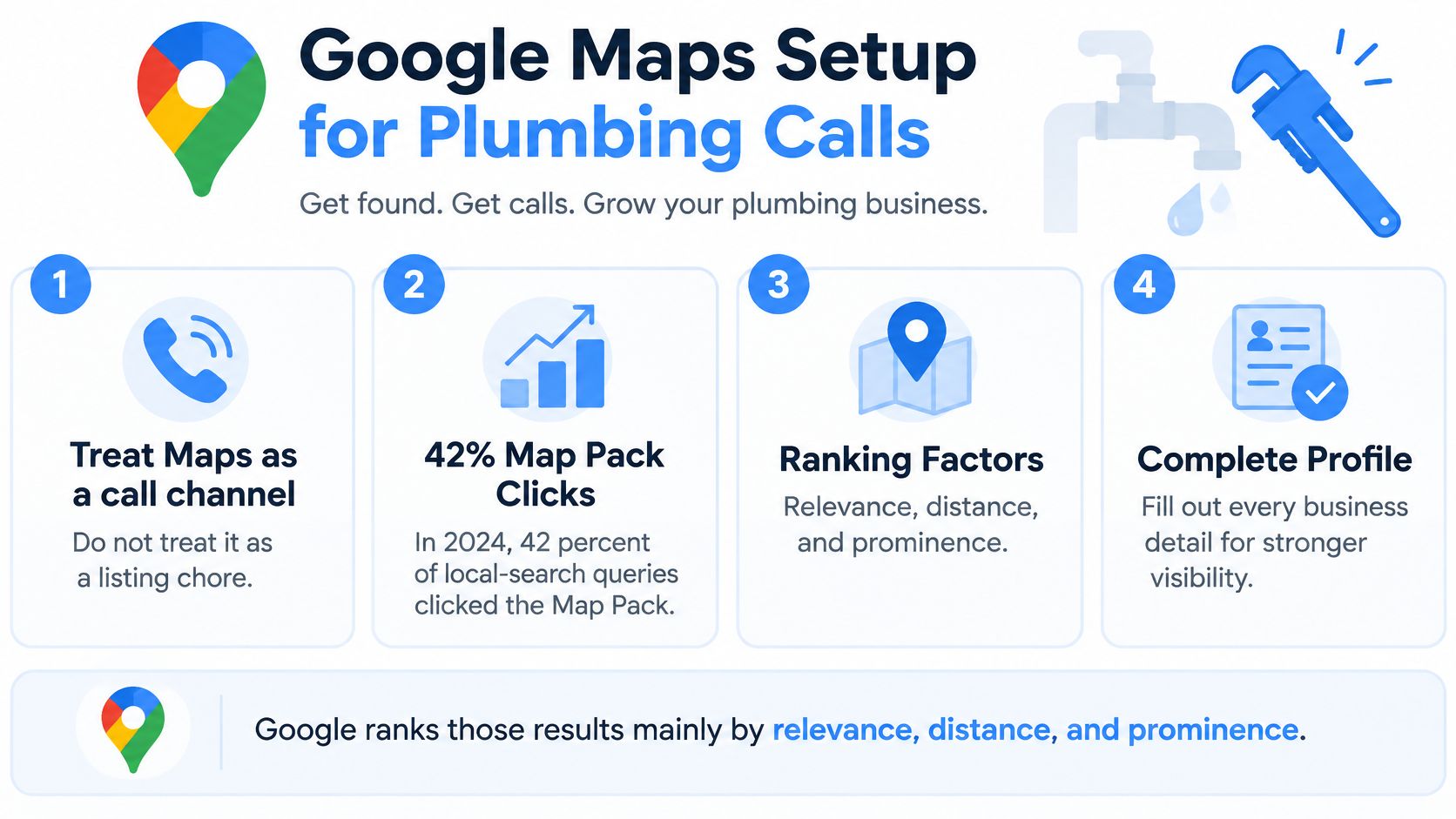
Treat Google Maps as a call channel, not an administrative listing. A plumbing local-SEO analysis citing Backlinko reports that 42% of local-search queries resulted in Map Pack clicks in 2024. That finding covers local search broadly, but it explains why a plumbing owner should pay attention to Maps visibility.
Start with an accurate operating location and territory. Don't try to compensate for weak visibility by opening profiles for every city you want to serve.
Google Business Profile rules for plumbers
The configuration limits below come from Google's business representation guidelines, including one profile for a service-area business's central location, up to 20 service areas, and coverage generally within approximately two hours' driving time of the base.
| Item | Rule | Plumbing example |
|---|---|---|
| Profiles | One profile for the real central location | Don't create a profile per city |
| Address | Hide a residential base | A home-based plumber isn't a storefront |
| Service areas | Up to 20 cities, postal codes, or defined areas | No adjustable radius |
| Coverage | Generally within about two hours' drive | Decline cities the on-call tech cannot reach |
| Relevance | Categories and services match the query | Emergency drain cleaning, not a generic contractor label |
| Prominence | Links, review count, and ratings | Genuine reviews describing completed plumbing work |
| Ranking payment | Cannot buy a better organic local rank | Ads don't replace organic Map Pack optimization |
Match the profile to the work you want
Google explains local ranking through relevance, distance, and prominence, and states that businesses can't request or pay for a better organic local ranking. Relevance concerns the match to the search, distance concerns the searcher's location or specified place, and prominence concerns how well-known the business is.
Choose accurate plumbing categories and complete the relevant services. Describe drain cleaning as drain cleaning, not home improvement. Keep the business name, phone, hours, and permitted address information consistent across the website and supporting listings.
Use this checklist when reviewing the profile with whoever manages local search.
Measure coverage rather than a favorite screenshot
A strong ranking beside your office doesn't tell you whether homeowners across your service territory can find you. Track visibility by service and city, then compare it with calls the dispatch team can accept.
At Transactional Marketing, we use before-and-after heatmap comparisons to evaluate changes in local visibility. Each month, we identify relevant keywords and optimize the Business Profile and other listings around them without inventing locations or changing the business name into a keyword list.
Our advanced plumbing Business Profile optimization guide offers a more detailed working checklist.
Ask customers for honest reviews after completed work, and answer complaints with useful, professional responses. Don't script praise or manufacture job descriptions. The objective is a credible local presence that helps a homeowner choose you, not an artificially decorated profile.
Citable Business Facts for AI Answers
AI optimization requires facts that an answer engine can attribute to your business. A generic article explaining clogged drains doesn't establish whether your company offers after-hours drain cleaning in a particular city. A clearly maintained service page can answer that question directly.
Pew Research findings summarized by Digital Shift found that Google users clicked a traditional result 8% of the time when an AI summary appeared, compared with 15% without a summary; summaries appeared in 18% of Google searches in March 2025. Those figures aren't plumbing conversion rates, but they show why measuring only conventional website clicks leaves part of discovery unexamined.
Don't respond by generating more interchangeable FAQs. Publish the information a homeowner would need before trusting an AI-generated recommendation.
Create an attributable business fact set
Maintain a source-of-truth document for the business and use it when updating your site, Business Profile, and directories. Keep factual wording consistent where practical, especially for service names, hours, and service areas.
- Service qualifications: Specify residential or commercial scope, equipment types, and brands serviced.
- Availability: Distinguish office hours, emergency phone coverage, and actual dispatch availability.
- Credentials: Publish verifiable licensing details and explain who performs the work.
- Costs and conditions: State diagnostic charges and pricing assumptions without hiding exclusions.
- Warranty terms: Explain what is covered and where customers can review applicable conditions.
Write complete answer sentences. A heading reading Emergency Availability followed by marketing copy is less useful than a direct explanation of when calls are answered and how dispatch is confirmed.
Add evidence that belongs to your company
A short technician-led explanation of a water-heater fault can provide more distinctive value than another generic troubleshooting article. Pair the visual with a transcript, an accurate caption, and a relevant service link. Explain what the technician can determine remotely and what requires an on-site inspection.
Don't encourage homeowners to dismantle unsafe equipment for a better photo. Ask only for images that can be taken safely, and explain that photographs don't replace diagnosis.
Editorial standard: Publish facts your dispatcher and technician would both be comfortable repeating to the customer.
LLMs, or large language models, can misstate business information. Treat AI mentions as something to audit, not an endorsement you control.
Run a recurring review using the same transactional queries and city names. Record which businesses appear, which sources support the answers, and whether the quoted services and availability are correct. Save the query wording and review context so comparisons are meaningful.
If the answer misrepresents your hours, repair the authoritative information and inconsistent listings. Don't assume adding more keywords will correct a factual contradiction. Keep a visible call button and short form available for visitors who follow a citation and want to act.
Measure Booked Jobs Then Decide
Rankings matter when they produce qualified calls and booked work. A screenshot showing a high position doesn't tell you whether the caller needed a service you perform, lived inside your territory, or accepted the diagnostic terms.
Build a monthly scorecard by service and city. Connect Search Console queries and landing pages with call outcomes, form submissions, and dispatch records. Keep organic search, Maps, and other channels distinguishable wherever your tracking allows.
Track the path from discovery to dispatch
| Measurement | What it helps you decide |
|---|---|
| Transactional query visibility | Whether relevant homeowners can find the service |
| Mobile performance | Whether technical problems obstruct contact |
| Map visibility by city | Whether local exposure matches useful territory |
| Calls and form submissions | Whether visitors attempt to contact the business |
| Qualified inquiries | Whether the offer attracts suitable work |
| Booked and completed jobs | Whether visibility contributes to the schedule |
| Reasons for lost bookings | Whether content, capacity, or phone handling needs attention |
Use call outcomes rather than button taps as the final measure. A tap doesn't prove that someone connected with your office. Our guide to tracking phone calls explains how to make those inquiries easier to attribute.
Speed belongs in this review because it affects the opportunity to convert. Findings summarized in Google's mobile-speed material associate a 0.1-second mobile speed improvement with average increases of 8.4% in mobile transactions and 10.1% in mobile conversion rate. Those are cross-industry findings, not a promised plumbing result.
Let booking outcomes choose the next repair
If calls increase but bookings don't, listen to the reasons. Customers may be outside your territory, requesting unsupported equipment, expecting an advertised price that excludes their job, or reaching an unanswered line.
Fix the relevant problem before publishing another city page. If the emergency template still fails mobile testing, repair it. If callers misunderstand after-hours availability, rewrite that promise and align it with dispatch.
A plumbing company's organic traffic rose from 1,200 per month to over 10,000 per month after joining Collaborate. That is a useful visibility result, but traffic alone doesn't establish booked-job growth. The operating scorecard still needs call quality and job outcomes.
Transactional provides local SEO, Google Maps optimization, and transparent reporting. By 3 months and beyond, our ongoing optimization leads to increases in rankings and organic traffic; those measures should be reviewed alongside the work your office books.
Start this week by scoring your emergency page and Business Profile. Give every failed item an owner, record the deployment date, and reassess when the user reporting window includes the changes. Don't add pages because publishing feels more productive than fixing the path to a call.
Transactional LLC offers plumbing website optimization, local SEO, and Google Maps optimization focused on searches from customers ready to hire. Visit Transactional LLC to start with an assessment of your emergency page, service-city visibility, and the business facts customers encounter in search and AI answers.