


You open Google Business Profile before the first call of the day and see it. A fresh one-star review. No context, no warning, and now it sits next to your business name where every future customer can read it.
Most owners treat that moment like reputation damage control. That's too small of a view. If you care about getting more calls from people searching "roofer near me," "dentist near me," "air conditioning repair near me," or any other high-intent phrase, responding to negative reviews is part of your SEO and AI visibility strategy, not a side task for the office manager when there's time.
Negative Reviews Are Transactional Search Opportunities
A bad review doesn't just threaten your image. It affects the exact moment a buyer compares local options and decides who gets the call. That matters most in transactional searches, where the searcher is ready to spend money now.
When someone searches for a local service, they don't just scan star ratings. They read how a business handles problems. That's why responding to negative reviews directly supports trust at the bottom of the funnel. According to a 2020 report by Bazaarvoice, 87% of consumers explicitly expect businesses to respond to negative reviews (Business News Daily).

A review response is public sales copy
A strong response does three jobs at once:
- It reassures the unhappy customer that you're paying attention.
- It signals professionalism to future buyers who are comparing providers.
- It gives search systems more context about your business, your service quality, and how you handle issues.
That's why a review reply isn't separate from marketing. It is marketing.
Practical rule: Every negative review is a public audition for the next customer.
This is even more important when a complaint starts spreading outside the review platform. If a review issue spills into comments, shares, or public discussion, a documented social media crisis response system helps keep your message consistent across channels.
Silence costs more than the review
Ignoring criticism tells buyers you disappear when something goes wrong. That's poison for local service businesses. Plumbing, HVAC, dental, roofing, pest control, chiropractic, med spa, and electrical companies all win or lose on trust before the first appointment is booked.
If you're actively building reviews, your response rate matters just as much as your review count. A better review acquisition system helps, but it only works if you manage what comes in. This is why a process like these proven strategies to get more reviews should always be paired with a response plan.
How Responses Fuel Local SEO and AI Visibility
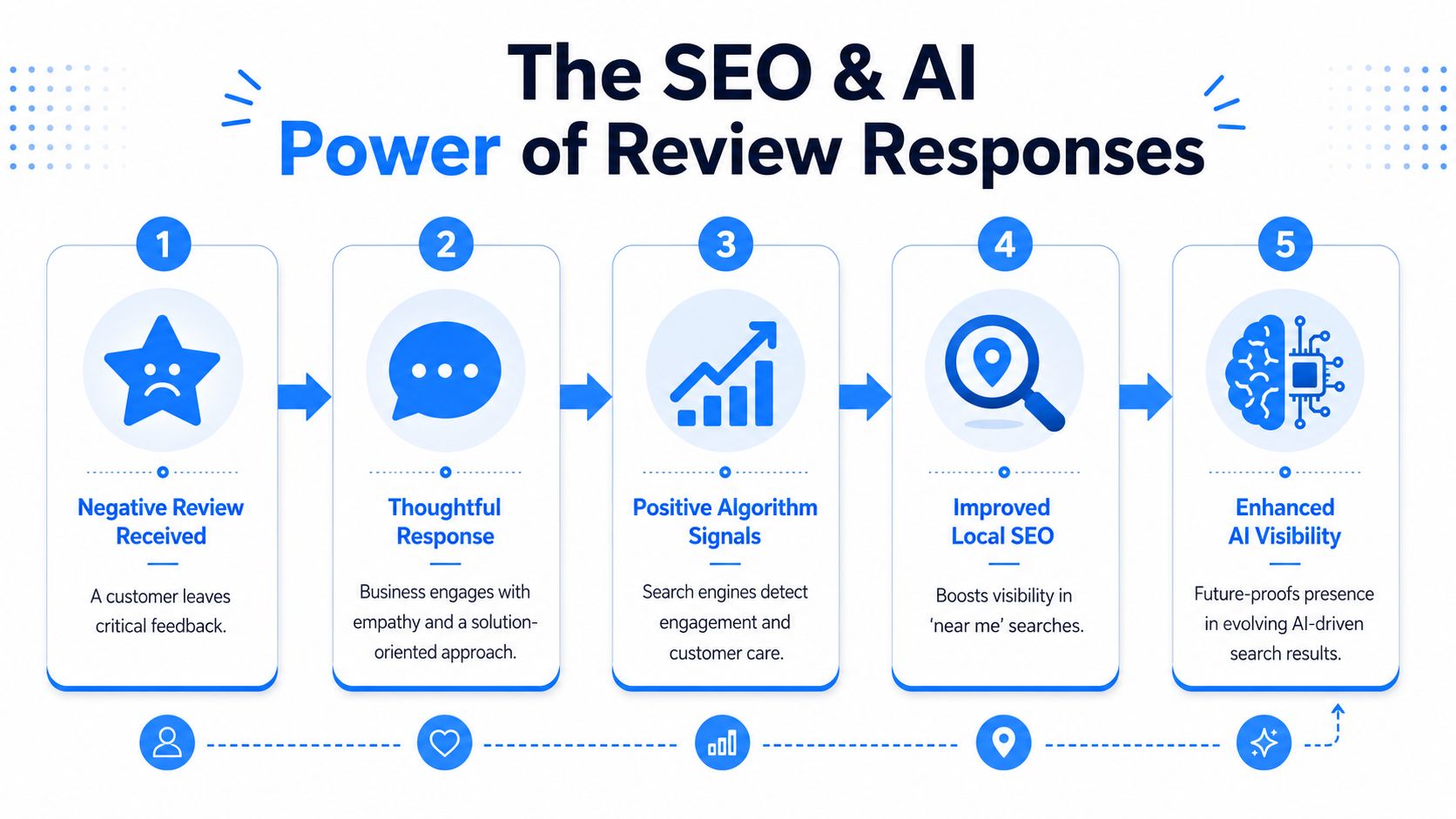
Review responses help you show up where the money is. That's local search, Google Maps, and the growing layer of AI-generated answers built on business signals, sentiment, and language patterns.
That shift matters because transactional keywords, including phrases like "near me," "buy," or "order," convert at 2–3x the rate of generic informational search terms (Facebook Local SEO post). If your business is trying to rank for local service terms that lead to booked jobs, you can't ignore a signal that buyers visibly inspect before they call.
What Google sees when you respond
Google Business Profile is not just a listing. It's a live local entity tied to relevance, prominence, and user trust. When you respond to reviews, you create fresh business-generated content directly on a high-visibility asset.
That matters for three reasons:
- Recency signal. Your profile doesn't look abandoned.
- Context signal. Your replies reinforce what services you provide and where issues occur.
- Trust signal. Buyers see that you engage instead of hiding.
A weak star rating with no replies looks unmanaged. A mixed review profile with calm, professional responses looks real and accountable.
What AI systems pull from review language
AI search and LLM-based discovery tools don't think like a traditional search engine results page. They synthesize language. They look for patterns in customer sentiment, business responsiveness, and repeated service themes.
If customers complain about scheduling, communication, or billing, and your responses clearly explain how issues are handled, that language becomes part of your discoverability footprint. That's one reason businesses need a real AI search engine optimization strategy, not just title tags and service pages.
For a deeper look at how machines interpret customer emotion and tone, this guide to sentiment analysis in AI search is useful background.
Buyers searching through AI tools want the same thing buyers on Google want. A provider who looks reliable, responsive, and easy to work with.
Why this matters for Maps visibility
Google Maps is often the final battleground for local service leads. A person searching "dentist near me" or "emergency electrician near me" is not browsing for fun. They're comparing who looks credible enough to contact now.
Review responses help reduce hesitation. They also support the broader quality profile around your listing. If your team wants more calls from local intent, then your review section needs to read like a business that solves problems fast, not one that goes silent under pressure.
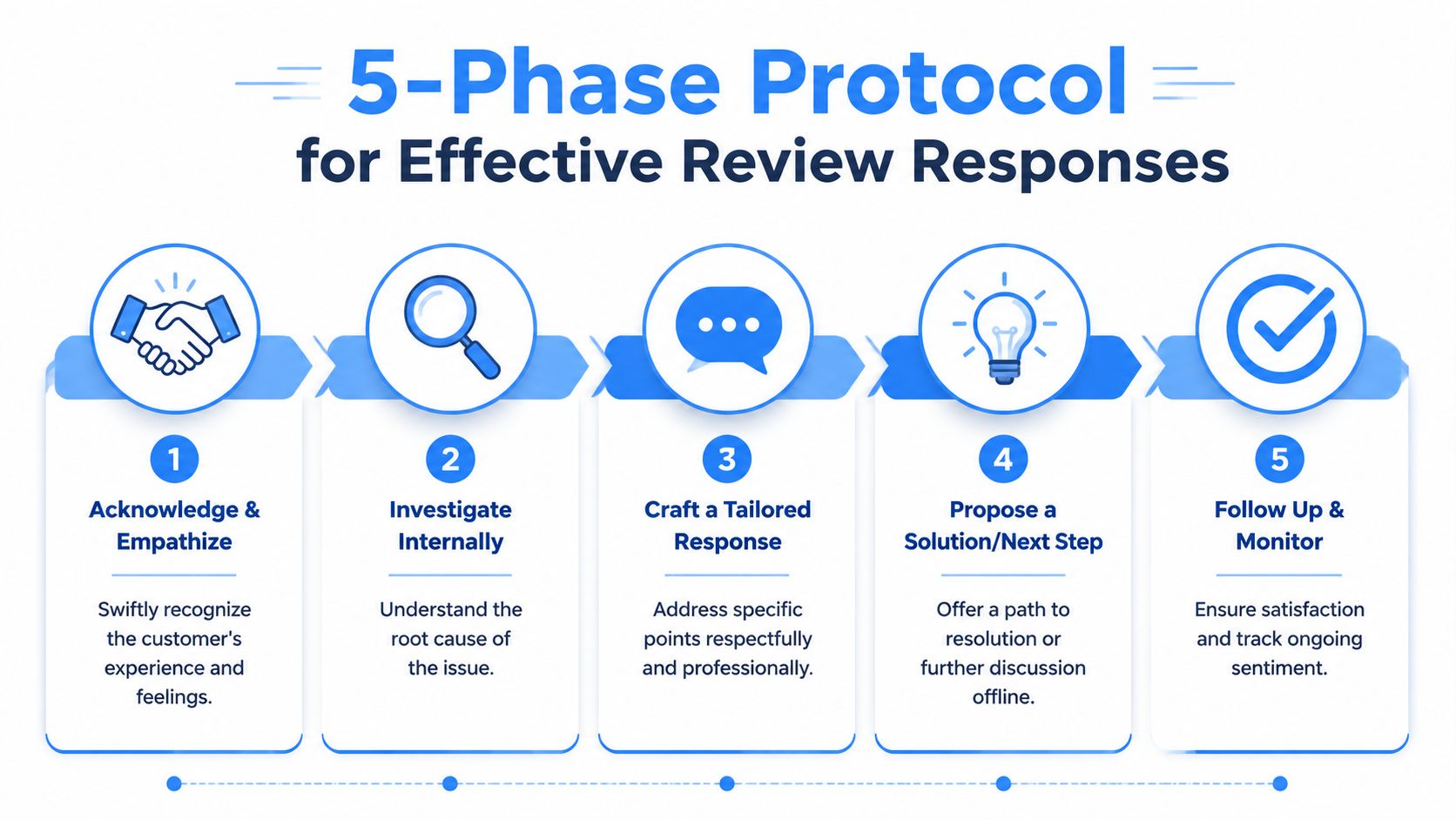
The 5-Phase Protocol for Effective Review Responses
Most business owners either respond emotionally or not at all. Both are bad strategy. You need a repeatable system.
A 5-phase triage and escalation protocol for responding to negative reviews has been tied to 21% customer expectation compliance and up to 35% recovery rates (Bazaarvoice). That's the right way to think about this. Not as improvisation, but as process.
Phase 1 Acknowledge quickly
The first job is speed. If the review is legitimate, acknowledge it promptly and show that someone is paying attention.
Don't launch into a defense. Don't explain your staffing issue. Don't argue facts in public. Start with recognition.
Good opening lines:
- "Thank you for sharing this feedback."
- "We're sorry to hear about your experience."
- "We appreciate you bringing this to our attention."
A quick acknowledgment reduces the appearance of neglect. It also tells future readers you're engaged.
Phase 2 Validate the frustration
People escalate when they feel dismissed. They calm down when they feel heard.
Use plain empathy. One of the strongest lines is simple: "I understand how this can be very frustrating." That kind of language lowers tension because it addresses the experience before the details.
The customer doesn't need a lecture. They need evidence that a competent adult read the complaint.
Keep this part human. If it sounds like a call center template, it fails.
Phase 3 Restate the specific issue
Now prove you understood the complaint. Mention the problem in your own words.
For example:
- "It sounds like the technician arrived outside the scheduled window."
- "I understand your concern about the final invoice being different from what you expected."
- "We're looking into the communication breakdown around your appointment."
Frequently, businesses make a critical mistake. They reply with "Dear customer, we're sorry you feel that way." That's not a response. That's a generic shield.
Phase 4 Move the resolution offline
Public replies are for accountability, not full dispute resolution. Give the reviewer a direct path to continue the conversation privately.
Use:
- A named contact
- A phone number or email
- A clear invitation to continue
Example:
- "Please contact our office at [phone] and ask for Sarah so we can review this with you directly."
That lowers public friction and creates a real chance to solve the issue.
Phase 5 Route it internally and fix the root cause
The public response is only half the work. The complaint needs to go somewhere inside your business.
Create a simple internal path:
- Scheduling issues go to front office leadership.
- Technician conduct complaints go to operations.
- Billing disputes go to finance or ownership.
- Recurring service complaints go to training and quality control.
If you don't feed review themes back into operations, you'll keep collecting the same complaints. That's why review management belongs inside a larger local visibility system like these reputation management tips to dominate local search.
Platform-Specific Tactics for Google Yelp and Facebook
A one-size-fits-all response strategy is lazy. Google, Yelp, and Facebook each reward different behavior, and each platform shapes how prospects interpret your response.
The first rule is emotional control. The "24 Hour Rule" for furious reviews matters because the cooling-off period prevents defensive replies that make things worse, and only 12% of major how-to articles include that timing guidance (Sara Does SEO).
Google needs clarity and local relevance
Google is the highest-value platform for most local service businesses because it sits closest to phone calls from transactional searches. Your reply should be concise, professional, and specific enough to show you're addressing a real issue.
On Google:
- Name the service context if appropriate, such as scheduling, diagnosis, estimate, or follow-up.
- Stay short because most readers skim.
- Show accountability without turning the response into a legal statement.
Good Google responses read like calm management. They don't read like courtroom testimony.
Yelp needs precision and restraint
Yelp users often read carefully. They're more likely to compare the tone of your response line by line. That means your wording matters even more.
On Yelp:
- Avoid long explanations that sound defensive.
- Use the public reply for acknowledgment, then move to direct message when appropriate.
- Don't challenge motives in public unless the review clearly violates platform rules.
If a review appears false or abusive, document the issue and use the reporting process. Don't get pulled into a public argument.
Facebook needs community awareness
Facebook reviews and recommendations are more conversational. They can also spread faster because they live inside a social environment where people comment, share, and pile on.
On Facebook:
- Respond like a person, not a press release
- Keep the tone warm but controlled
- Watch the comment thread after the initial reply
If a recommendation or review on Facebook crosses policy lines, use a removal process instead of escalating in public. This guide on removing reviews on Facebook is a useful operational reference.
Wait long enough to calm down. Not so long that the business looks absent.
Response Templates and Avoiding Common Pitfalls
Most bad responses fail for the same reason. The business writes to defend itself instead of writing for the next buyer who will read the exchange.
That's expensive. Defensive language and public blame-shifting reduce recovery rates by 50–60% and amplify negative sentiment, and saying "This isn't true" triggers a 60% increase in customer anger (Surefire Local).
Write for the audience behind the reviewer
The unhappy customer is one audience. The bigger audience is every future prospect reading your reviews before they choose a provider.
That means your reply should sound:
- Calm
- Specific
- Responsible
- Easy to continue offline
If you use AI to draft responses, train it carefully. Generic prompts create generic replies. This article on optimizing prompts for local models is useful if you're building repeatable review-response prompts for a local business team.
Effective vs. Ineffective Review Responses
| Complaint Type | Ineffective Response (Avoid) | Effective Response Template (Adapt) |
|---|---|---|
| Scheduling mix-up | "We were busy that day and you should have called back." | "Thank you for the feedback. We're sorry there was a scheduling problem with your appointment. We understand how frustrating that is when you're expecting service at a specific time. Please contact our office at [phone/email] and ask for [name] so we can review what happened and work toward a resolution." |
| Pricing dispute | "Our prices are clearly listed and nobody else complained." | "We appreciate you raising this concern. We're sorry the final price didn't match your expectations. We want to review the estimate and the completed work with you directly. Please reach out to [phone/email] and ask for [name] so we can go over the details together." |
| Poor communication | "You didn't answer when we called." | "We're sorry communication fell short during your experience. That's not the standard we want attached to our business. Please contact [name] at [phone/email] so we can look into the communication history and address the issue directly." |
| Quality of work | "This isn't true. Our team does great work." | "Thank you for bringing this to our attention. We're sorry to hear you're unhappy with the work performed. We'd like to understand the issue fully and see how we can make it right. Please contact [phone/email] and ask for [name] so we can review your project directly." |
| Staff behavior | "Our employee would never say that." | "We're sorry to hear about this interaction, and we appreciate you letting us know. We take concerns about professionalism seriously. Please contact [phone/email] and ask for [name] so we can investigate the situation and follow up appropriately." |
Three mistakes that keep hurting good businesses
Copy-paste language
If every response starts the same way, customers notice. It feels automated and insincere.Public fact battles
You rarely win these. Even if you're right, you look combative.No next step
A reply without contact information is just public theater.
A strong response doesn't try to win the argument. It tries to win back trust.
A Scalable Workflow for Review Management
Review management falls apart when it's treated like an occasional task. Busy service businesses need a workflow, not a reminder scribbled on a sticky note.
That system pays off. Businesses in hospitality that actively respond to customer reviews receive 12% more total reviews and an average rating increase of 0.12 stars (U.S. Small Business Administration). The industry is different, but the operational lesson holds up. Consistent response behavior improves the review environment around the business.
Assign roles before the next review hits
Don't wait for a crisis to decide who owns what.
Use a simple division of responsibility:
- Office manager monitors incoming reviews daily.
- Service manager investigates operational complaints.
- Owner or director handles serious accusations, legal risk, or repeated patterns.
- Marketing lead tracks recurring themes that affect search perception and conversion.
That keeps speed high without letting untrained staff post emotional replies.
Build a lightweight response pipeline
You don't need enterprise software to do this well. You need consistency.
A practical workflow looks like this:
- Monitor review alerts across Google, Yelp, and Facebook.
- Classify the review as routine complaint, serious service failure, possible fake, or policy violation.
- Draft a response using approved tone guidelines.
- Approve sensitive replies before publishing.
- Escalate issues internally to the right department.
- Track whether the issue was resolved, ignored, or flagged for removal.
A shared spreadsheet, project board, or help desk queue can handle this just fine if the team utilizes it.
Know when to respond and when to report
Respond when the review describes a real or plausibly real experience, even if it's unfair. Report when it appears fraudulent, abusive, or clearly violates the platform's rules.
That distinction matters. Some owners waste time arguing with spam and ignore legitimate complaints from real customers. That's backward.
If your business depends on local search visibility, then reviews are not a side issue. They are part of the machine that turns search impressions into calls, estimates, appointments, and booked jobs.
If your business wants more visibility for high-intent searches and stronger placement where local buyers click, Transactional LLC helps service companies build that system the right way. Their work focuses on transactional search terms, Google Maps visibility, local SEO, and AI-driven content strategies that help businesses get found when customers are ready to book.