


At 9 p.m., a homeowner hears a sharp snap from the garage. The door won't open, the car is trapped inside, and a referral from a neighbor is no help because nobody answers the phone. The homeowner searches “garage door repair near me”, scans the Google Map results, reads a few recent reviews, and calls the company that looks available and trustworthy.
That moment is the center of SEO for garage door companies. The objective isn't broad traffic or impressive ranking screenshots. It's earning visibility for transactional searches, then turning that visibility into answered calls, scheduled repairs, installation estimates, and booked jobs. Transactional Marketing focuses on those ready-to-buy searches, including “garage door repair near me,” “broken spring repair,” and “garage door installation.”
Why Garage Door Companies Live or Die on Transactional Searches
A homeowner researching how torsion springs work may not be ready to hire anyone. A homeowner searching “garage door stuck,” “broken spring repair,” or “garage door opener repair near me” has a problem that needs a solution. That person has money in hand and is comparing providers, not browsing for general education.
This distinction changes the entire marketing plan. Referrals, truck lettering, yard signs, and traditional advertising can support recognition, but they don't reliably intercept a homeowner who needs service in a specific neighborhood tonight. Google does. Local SEO is foundational for garage door companies because repairs, installations, and maintenance are geographically constrained services.
In 2024, 80% of U.S. consumers searched online for local businesses at least weekly, while 32% searched daily, and 72% used Google for local-business information, according to BrightLocal's local SEO statistics. For a garage door operator, that recurring behavior creates repeated opportunities to appear before a competitor gets the call.
The useful question isn't “How much traffic did SEO generate?” It's “Did the right homeowner see the right service and call a number that could dispatch?”
Transactional intent changes the page
A repair page should lead with the phone number, service area, hours, and a clear explanation of what happens next. A replacement page needs project photos, door options, installation details, and a quote path. Combining both into a generic homepage forces Google and the customer to guess.
That's why Transactional Marketing is built around transactional search terms. The strategy targets searches such as “garage door repair near me,” “garage door spring replacement [city],” and “new garage door installation”, rather than chasing unrelated informational visits. A garage-focused CMS platform such as VeloCMS can also help organize service content around the specific jobs a garage door company dispatches.
The two outcomes matter together. First, the business needs to appear in the top three Google Map results for genuine service-area searches. Second, that visibility needs to produce calls routed to a dispatch-capable number. Transactional Marketing combines local SEO, Google Maps optimization, and focused service pages to pursue both parts of the call-engineering problem.
How Google Decides Which Garage Door Company Ranks Locally
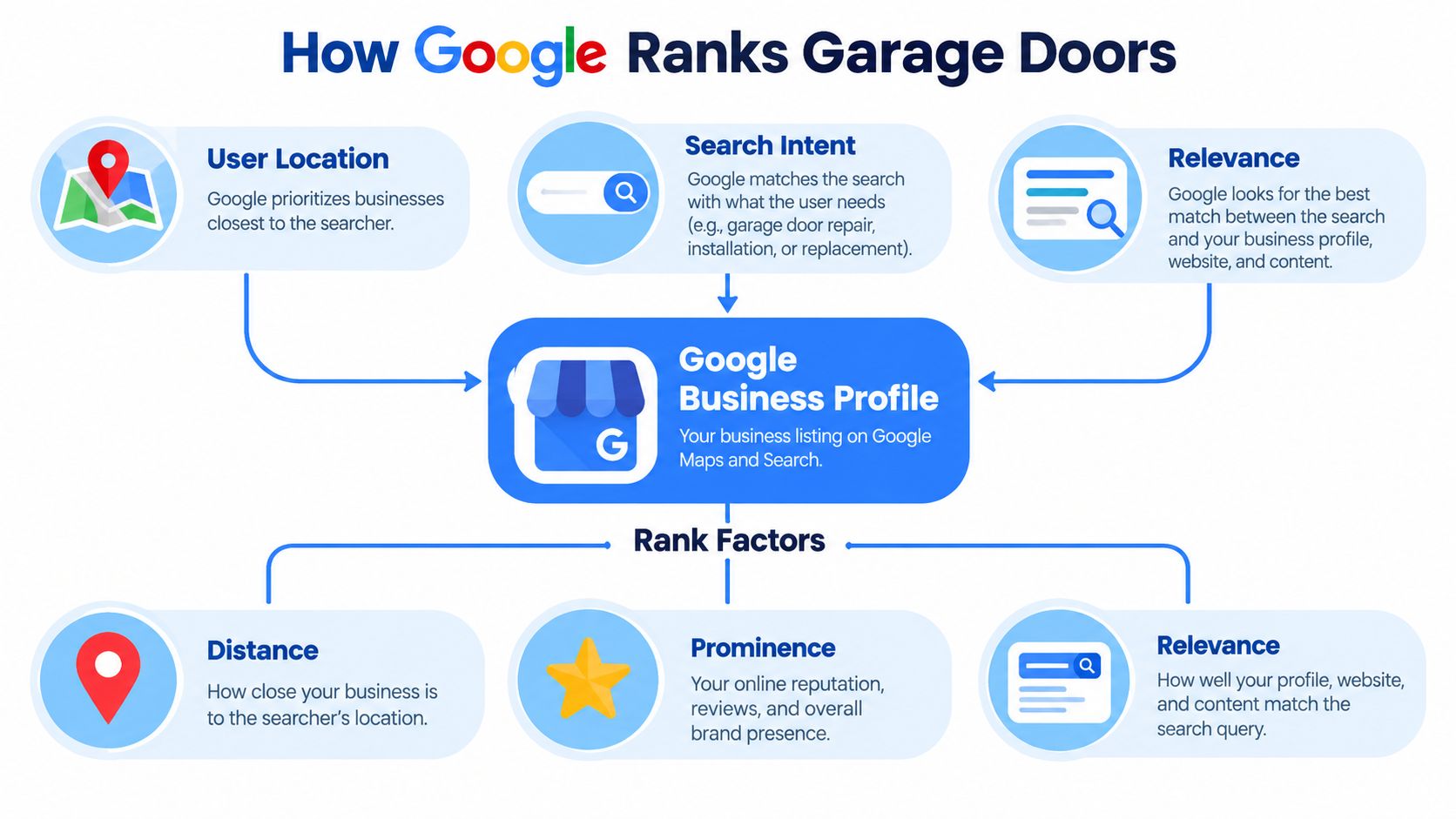
Google describes local visibility through three primary factors: relevance, distance, and prominence. The explanation appears in Google's documentation on local ranking, and each factor translates directly into garage door marketing decisions.
Relevance starts with accurate service detail
Relevance measures how closely a Google Business Profile matches the search. A profile that vaguely says “garage door services” gives Google less context than one that accurately lists garage door repair, broken spring replacement, opener repair, opener installation, emergency service, and new-door installation.
The website should reinforce that clarity. Separate, crawlable pages give each service a focused destination. A spring replacement page can discuss failure symptoms and safety. An opener page can address repair and replacement. An installation page can explain the buying process. The profile, website, and customer language should describe the same legitimate services.
Distance limits what broad targeting can accomplish
Distance reflects how far the business is from the searcher, or from the location included in the query. A service-area company that visits homes shouldn't pretend to be a storefront in every city it serves. Google distinguishes between businesses that operate from a customer-facing location and businesses that travel to customers, so the profile type and service areas must match reality.
Distance also explains why a company may rank well near its verified operating location but weaken farther away. A citywide average can hide that pattern. Map-grid tracking by neighborhood or ZIP code shows where proximity is helping and where service-page relevance or authority needs work.
Prominence reflects reputation and authority
Prominence reflects how well known and trusted the business appears across the web. Google says that review count and review ratings can affect local ranking, while links, articles, directories, and other references contribute to broader visibility.
Claiming a profile doesn't guarantee a place in the local three-pack. Google generates local results automatically from its ranking factors. The practical diagnosis is simple: weak service matching points to relevance, predictable geographic decline points to distance, and weak reviews or web references point to prominence.
Building a Transactional Keyword Map for Garage Door Services
Keyword research for a garage door company should begin with the dispatch board, not a generic list of high-volume phrases. Ask what customers say when they call, which jobs produce revenue, and which services the crew can provide in each market.
A useful map separates intent into service clusters:
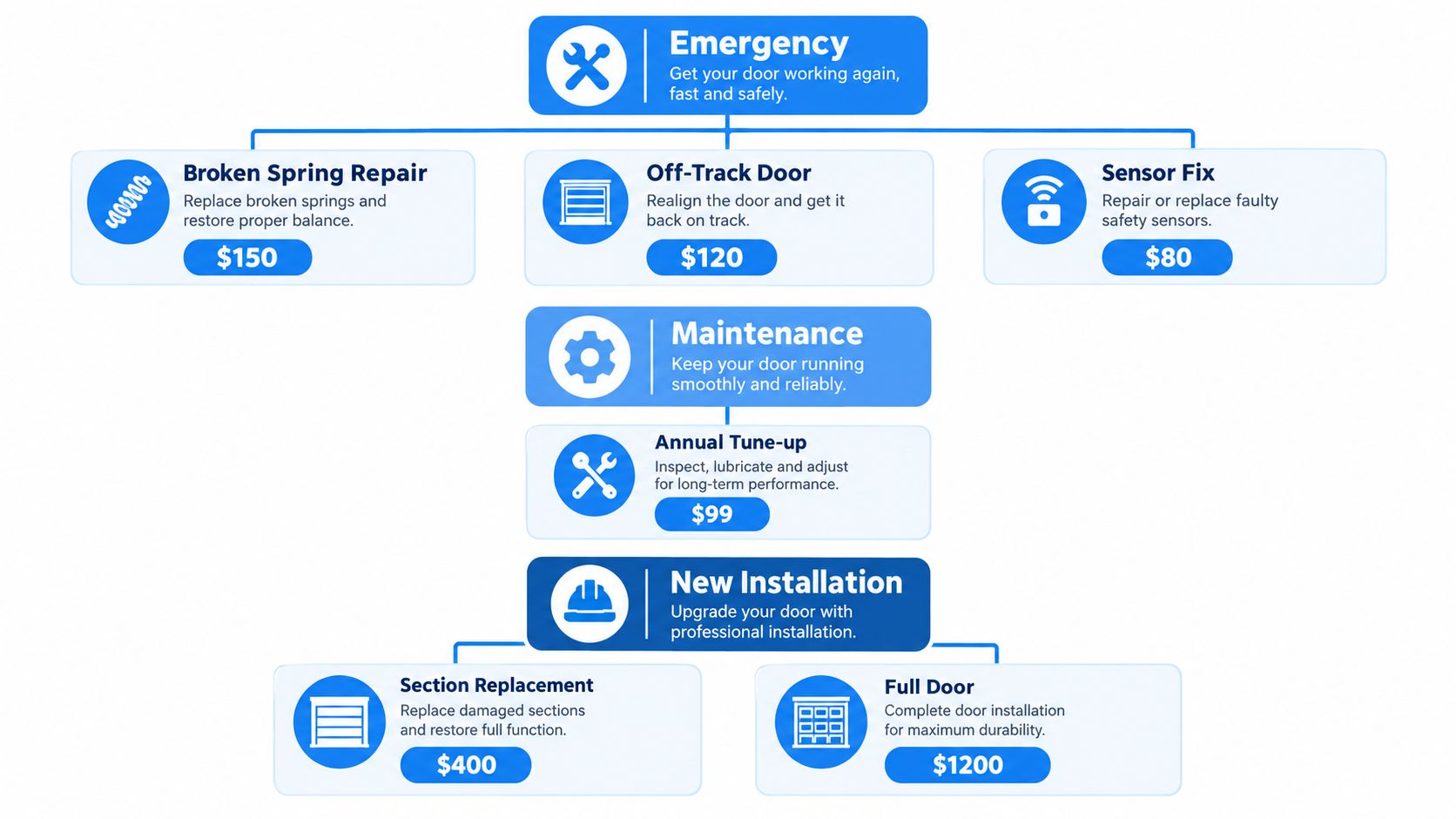
- Emergency repair: “garage door repair near me,” “garage door stuck,” “garage door won't open,” “garage door off track,” and “broken garage door spring.”
- Spring service: “garage door spring replacement” and “broken spring repair” paired with the cities the company serves.
- Opener work: “garage door opener repair,” “garage door opener replacement,” and legitimate brand-specific services.
- Installation: “new garage door installation,” “garage door replacement,” and planning searches such as “garage door replacement cost.”
- Maintenance: “garage door service near me,” safety inspections, tune-ups, and preventive service.
- Commercial work: rolling doors, warehouse doors, and commercial repairs, kept separate from residential messaging when those jobs are real offerings.
Assign one clear job to each page
A keyword map is useful only when it assigns a search cluster to a page. Put emergency repair terms on a repair page with click-to-call controls. Put spring terms on a spring page. Give replacement searches a page built around styles, materials, installation steps, and estimates.
Internal links should follow the customer's likely next decision. A repair page can link to spring and opener services. An installation page can link to the quote form and maintenance service. A commercial page should stay in its own operational and terminology lane.
For additional planning guidance, use this local keyword research resource to organize service terms by location and intent.
Validate the map against real demand
Search Console reveals the queries producing impressions and clicks. Call recordings and dispatch notes reveal how customers describe their problems in ordinary language. Those sources often uncover valuable symptom searches that a standard keyword tool misses, such as a door that “won't close halfway” or a remote that “flashes but doesn't move the door.”
Review the map regularly, but don't create a page for every phrase variation. A strong page can naturally address related symptoms when they share the same service and conversion path. The goal is not to publish the largest possible keyword inventory. It's to make every important transactional intent easy for Google to match with a useful page and easy for a customer to act on.
Service-Area Pages That Earn Rankings Without Doorway Penalties
A page titled “Garage Door Repair in [City]” is not automatically local SEO. If the page swaps the city name into identical paragraphs, offers no local proof, and targets a place the company rarely serves, it adds little value for customers and can create service-area risk.
Recent local-search commentary reports that proximity became more influential in 2025, with rankings varying substantially by search location. It also warns that claiming areas a company doesn't genuinely serve can create ranking risk, making verified service-area pages and neighborhood-level reporting more useful than dozens of thin city pages. The commentary is available from local ranking analysis on proximity and service areas.
Build pages around operating reality
A credible service-area page should answer questions a homeowner has:
- Coverage: Which neighborhoods, suburbs, or ZIP codes receive service?
- Dispatch: Does the crew offer same-day visits, and what happens after hours?
- Cost logic: Are trip fees or geographic limitations explained clearly?
- Local proof: Are there real project photos, reviews, or completed jobs from the area?
- Service match: Does the company repair springs, openers, off-track doors, and other jobs listed on the page?
The page should also link to the relevant service URLs. A neighborhood page can point to spring replacement, opener repair, emergency service, and installation pages. Those pages should link back when the connection helps the reader choose a service.
Choose depth over geographic sprawl
Start with the locations the company dispatches to and where completed work can be documented. Mention local housing or door-type considerations only when they reflect actual experience. A page for an older neighborhood might discuss common repair situations, while a page for a newer development might focus more on opener troubleshooting or installation support. Don't manufacture local details.
A neighborhood-by-neighborhood rank grid is more actionable than one citywide number. If the business ranks near its base but disappears at the edge of its real radius, the response may involve service-area clarity, local authority, or realistic expectations about distance. Publishing more city pages won't solve a distance problem.
A genuine service-area page helps a customer decide whether to call. A doorway page only tries to make Google see a location that the business hasn't earned.
Google Business Profile Optimization That Pushes You Into the Top Three
A Google Business Profile is often the first landing page a garage door customer sees. Before visiting the website, the searcher may evaluate the category, hours, service list, photos, reviews, directions, and call button inside Maps.

Match the profile to the actual business
Start with the most accurate primary category available in the market, then add relevant secondary categories without stretching the business description. A company that installs and supplies doors should represent those services accurately. A repair-only operator shouldn't select categories that imply work it doesn't perform.
Populate the services section with real customer language:
- Garage door repair
- Broken spring replacement
- Garage door opener repair
- Opener installation
- Off-track door repair
- New garage door installation
- Emergency garage door service
Set service areas to places the team genuinely serves. Keep the name, address, phone number, website, and operating hours consistent across the profile and website. If emergency service is available, publish accurate emergency hours. If calls go to an answering service that can't confirm availability, don't present it as direct dispatch.
Google's guidance on improving local ranking connects accurate service representation with relevance, while reviews and links contribute to prominence.
Use photos and questions as conversion assets
Real images usually do more work than polished stock photography. Add completed repairs, installed doors, technicians, branded vehicles, hardware, and before-and-after work when the customer has authorized publication. Photos should help a nervous homeowner identify a legitimate local operator.
Posts can highlight seasonal maintenance, current service availability, or an installation process. Questions and answers should address practical concerns such as emergency coverage, service areas, opener brands, and what customers should do when a door is stuck. Keep every answer accurate and consistent with dispatch.
A focused Google Business Profile optimization guide can help turn these elements into a repeatable operating process. The profile should receive updates from completed work, not random filler designed to create the appearance of activity.
Reviews, Citations, and Schema as a Unified Reputation System
Reviews, citations, and structured data support different parts of the same reputation system. Reviews show customers how the company performs. Citations help search engines reconcile the business across directories. Schema gives the website a clearer technical description of the organization and its services.
BrightLocal's 2024 survey found that 75% of consumers always or regularly read online reviews, while 81% used Google to read local-business reviews. The figures appear in BrightLocal's 2024 Local Consumer Review Survey. For garage door companies, that makes review management part of conversion work, not a task to complete once during profile setup.
Ask for useful, honest feedback
Request a review after a completed repair or installation, while the customer can still describe the work accurately. The request can invite details about the service and location without scripting praise or pressuring the customer. A review that naturally mentions spring replacement, opener repair, or installation gives future customers more useful context than a generic compliment.
Respond to negative reviews with facts and a path to resolution. Don't argue about private details in public. A professional response can show that the business takes missed appointments, pricing confusion, or workmanship concerns seriously.
Citations should match the actual business identity across major directories and relevant home-service platforms. Correct old phone numbers, duplicate listings, inconsistent names, and outdated addresses. Industry directories such as Angi and HomeAdvisor can be useful references when the company maintains accurate profiles, but directory quantity matters less than consistency and relevance.
Use schema to clarify, not exaggerate
LocalBusiness, Service, FAQ, and Review structured data can help search engines interpret the business and its pages. Mark up only information visible on the page and supported by the actual business. Don't use schema to claim ratings, services, locations, or availability that customers can't verify.
For a practical overview of SEO structured data strategies, focus on implementation that matches visible content. Schema won't replace strong service pages or real reviews. It can, however, reduce ambiguity when the website clearly identifies the company, phone number, service areas, and legitimate offerings.
Why Answer Speed Matters More Than Map Position
A company in the third Map Pack position can outperform the first result if it answers quickly and books efficiently. A first-place listing that sends calls to voicemail has visibility but no dependable revenue path.
Industry marketing data reports that 78% of local mobile searches lead to a purchase within 24 hours, while 40% of home-service consumers who call from search ultimately make a purchase, according to Invoca's home-services marketing data. Those figures make the handoff from search to phone a central SEO concern.
Engineer the first contact
Emergency pages need a persistent mobile tap-to-call button, a phone number that matches the Google Business Profile, and a short backup form. The number should route to a person or dispatch workflow that can identify the service area, ask the right intake questions, and explain availability.
A general answering service may protect the appearance of coverage while losing the job if it can't confirm an appointment. Make after-hours handling explicit. If the business offers genuine emergency response, say what that means. If it only returns messages later, don't imply immediate dispatch.
Ranking earns attention. Answering the call earns the appointment.
Text-back workflows can help when a customer can't talk, but they shouldn't become a substitute for staffed phones during urgent demand. The website, profile, ads, and tracking numbers should all identify the source without creating confusion for the customer.
Report what happens after the click
A monthly report should place rankings beside operational metrics:
- Qualified-call rate: How many calls came from genuine service prospects?
- Answer rate: How many calls reached a person or approved response workflow?
- Booked-job rate: How many qualified calls became scheduled work?
- Revenue per organic call: What revenue did organic search calls produce?
Segment the reporting by emergency repair, spring work, opener service, installation, and maintenance. A ranking gain that produces unhandled calls is an operational warning, not a marketing victory.
Measuring Garage Door SEO by City, Call, and Booked Job
A single ranking for “garage door repair” doesn't show how a service-area company performs. Track the query by service and search location, using consistent map-grid points and the same Search Console property over time.
Search Console can show which service and city combinations earn impressions. Call tracking can connect Google Business Profile, organic pages, and other sources to qualified conversations. The booking system then confirms whether those conversations became scheduled jobs.
Use a report that exposes the bottleneck
| Metric | What It Measures | Source | Target Direction |
|---|---|---|---|
| Map position by city | Local visibility from consistent geographic points | Map-grid tracker | Improve in genuine service areas |
| Organic service queries | Search demand and page relevance | Google Search Console | Increase qualified impressions and clicks |
| Qualified-call rate | Percentage of calls that match offered services | Call tracking and recordings | Improve |
| Answer rate | Percentage of calls reached by a person or valid workflow | Phone system | Improve |
| Booked-job rate | Percentage of qualified calls that scheduled work | CRM or dispatch software | Improve |
| Revenue per organic call | Business value from organic phone leads | CRM and call attribution | Improve |
If rankings improve but calls don't, check the page's phone visibility, service match, location wording, and mobile experience. If calls rise but bookings don't, inspect answer quality, availability, pricing expectations, and dispatch follow-up. If the website performs while Maps does not, review profile categories, service areas, reviews, citations, and geographic distance.
Transactional Marketing's garage door lead tracking approach should connect service city, landing page, call source, and booked outcome instead of reporting rankings in isolation. A dashboard can then show whether a weak result comes from relevance, prominence, distance, or conversion handling.
Review the first month for tracking accuracy and technical gaps. By the second month, compare service pages and map visibility by location. By the third month, keep expanding only where impressions, qualified calls, and booked jobs support the decision. Transactional Marketing's system is designed to focus on specific transactional terms and local cities, with the stated aim of getting customer websites onto the first page of Google within 30 to 60 days. Actual outcomes still depend on market competition, site condition, profile health, and service-area legitimacy.
Transactional LLC offers industry-specific SEO, Google Maps optimization, Google Business Profile management, AI-assisted content planning, and call-focused reporting for garage door companies targeting transactional searches. Visit Transactional LLC to discuss service-area visibility, Map Pack optimization, and a measurement system built around qualified calls and booked jobs.