


Forty-six percent of Google searches have local intent, and industry-compiled data reports about 3.9 billion local searches every day. For a painting contractor, that means homeowners and property managers are already searching for nearby help. The question is whether they find your company in the Google Map Pack, or call the contractor listed above you. (painting contractor local SEO data)
SEO for painting contractors isn't a branding exercise built around vague awareness. It's a system for capturing transactional search terms, the searches made by people who are ready to request an estimate, compare painters, or book work. Transactional Marketing focuses on searches such as “interior house painter [city],” “exterior repaint near me,” and “cabinet refinishing cost,” rather than traffic that never becomes a phone call.
The playbook below puts the work in the order that matters: Google Business Profile signals, service-plus-city page architecture, reviews and reputation, and local authority. You can also use this local SEO guide for contractors as a practical reference while building the system.
Why Local Search Decides Jobs for Painting Contractors
The first three Google Map Pack positions capture 44% of local-search clicks, while organic position one receives 24.4%, position two receives 13.3%, and position three receives 8.6%, according to Webtonic. A painting company that ignores the Map Pack hands high-intent prospects to competitors with stronger local visibility.
Transactional local intent appears when the search includes a service, a location, and a likely project timeline. “How to choose paint colors” supports early research. “House painters near me,” “interior painters in Austin,” and “commercial exterior painting contractor” signal a buyer comparing providers or preparing to request an estimate.
Search demand exists before you spend on ads or outreach. “House Painters Near Me” averages 135,000 monthly U.S. searches, while “Painting Contractors” and “Painting Company” each average 60,500 monthly U.S. searches, according to the same painting search demand analysis. Broad terms create visibility, but revenue comes from connecting them to specific services and service areas.
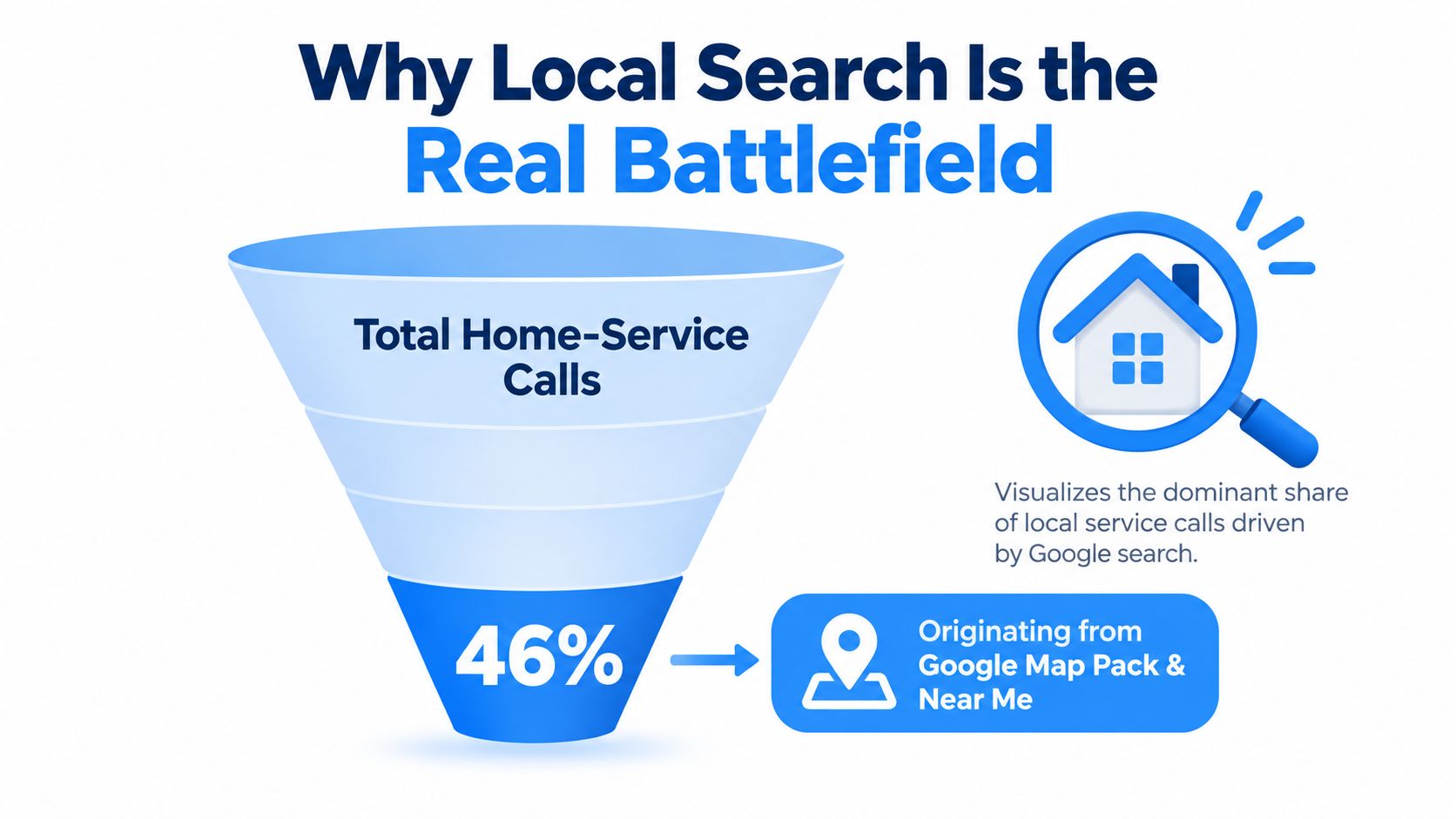
Build around the four signals that create calls
In competitive metros, a small group of contractors often controls the visible local results. Generic blog posts and a city name added to the homepage will not displace them. Build the search system in this order:
- GBP signals: Keep the profile relevant, complete, active, and easy to trust.
- Service-plus-city architecture: Give interior, exterior, cabinet, commercial, and repair searches useful dedicated destinations.
- Reviews and reputation: Request and respond to reviews consistently after completed work.
- Local authority: Earn relevant citations, partnerships, mentions, and links from organizations connected to your market.
Use this local SEO guide for contractors to organize the transactional search map before building pages. The Expressify AI trade playbook is another planning resource for connecting search visibility with broader operational marketing. Neither replaces pages and profiles built around the exact services you sell.
The sequence matters. Map transactional keywords first, then align the profile and build service-plus-city pages. Increase review velocity and local authority after the core destinations are live. Track calls and estimate requests, not only impressions or sessions. SEO is producing business when a homeowner searches for a painter in a city you serve, sees your company, calls, and reaches someone who can schedule the estimate.
How Google Decides Which Painters Show Up on the Map
Google identifies three primary local-search factors: relevance, distance, and prominence. Google's framework, summarized in this Google local pack guide, gives painting contractors a useful diagnostic because each factor points to a different operational task.
Relevance starts with clear service signals
Relevance measures how closely a Business Profile matches the search. A painter who lists only “painting services” gives Google less context than a contractor with accurate service entries for interior house painting, exterior repainting, cabinet refinishing, deck staining, and commercial painting.
The website must reinforce the same signals. If the GBP emphasizes cabinet painting but the site has no dedicated cabinet page, the profile and website aren't supporting one another. Align the primary category, services, page titles, headings, copy, and calls to action with the work you perform.
Distance requires honest service-area choices
Distance reflects proximity to the searcher. A contractor working from a legitimate commercial location should keep the business address accurate. A service-area business that doesn't receive customers at its home address should configure the profile around its service areas rather than publishing an address that misrepresents the business.
Don't create fake locations to appear closer to every neighborhood. That creates trust and compliance problems, and it gives your team inaccurate data about where the business is positioned.
Prominence comes from reputation and recognition
Prominence reflects how well-known the business is online. For painters, that includes review quality and activity, citation consistency, relevant links, project evidence, and signs that customers engage with the listing.
Use this Google Maps ranking factor guide when auditing the profile, then ask three questions:
- Relevance: Does the profile clearly describe the painting services people search for?
- Distance: Does the address or service-area setup accurately reflect how the company operates?
- Prominence: Do reviews, citations, links, and project assets establish the company as a real local provider?
| Ranking Factor | What Google Measures | Painter-Specific Action |
|---|---|---|
| Relevance | The match between the profile and the search | Select the most accurate category, list real services, and align the website |
| Distance | Proximity between the searcher and business location or service area | Use an accurate address or service-area configuration |
| Prominence | Online recognition, reputation, and engagement | Build reviews, consistent citations, relevant links, and project proof |
A profile can have a strong website and still miss competitive map results if the local signals are incomplete. Fix the factor that is weakest before adding more content.
Optimizing Your Google Business Profile the Right Way
A complete profile isn't enough. The order of optimization matters, especially for a painting company competing for “house painter near me” and service-specific searches.
Start with the category and service vocabulary
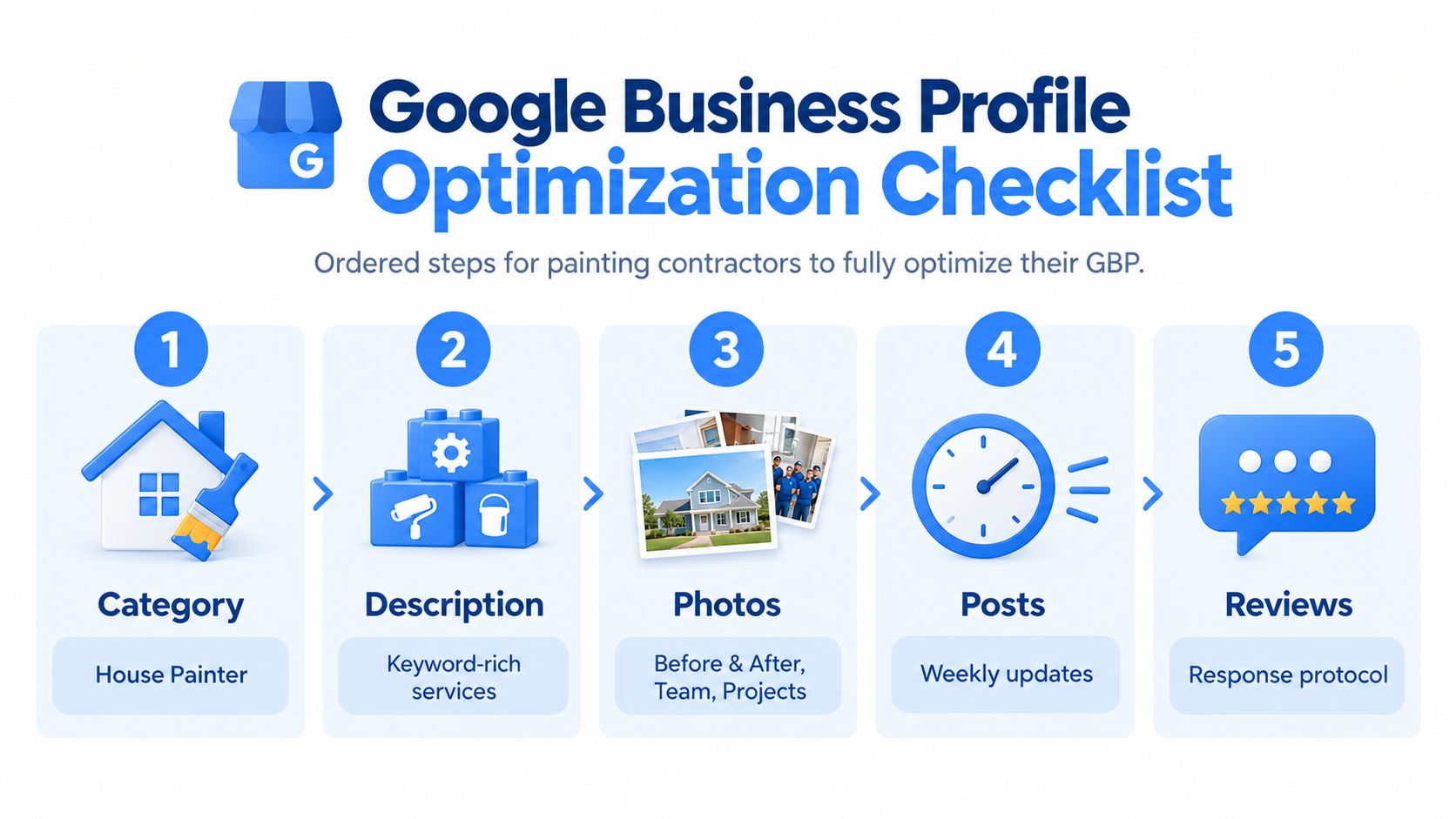
Choose the most precise primary category that accurately describes the core business, such as House painter or Painting, depending on the available and appropriate option in the profile. Add secondary categories only when they describe legitimate work, such as interior painter, commercial painter, or drywall contractor. Don't add categories for services the crew doesn't provide.
Next, build the services list in buyer language. “Interior house painting” is clearer than an internal phrase such as “residential coatings.” Add short descriptions that explain the scope and outcome:
- Interior house painting: Wall, ceiling, trim, and room repainting.
- Exterior repainting: Surface preparation and exterior coating work.
- Cabinet refinishing: Kitchen and bathroom cabinet updates.
- Deck staining: Staining and protective finishing for outdoor wood.
- Popcorn ceiling removal: Removal, preparation, and repainting where appropriate.
- Drywall repair: Patching, smoothing, priming, and painting damaged areas.
This service vocabulary gives Google and prospective customers a consistent understanding of what the company does.
Add proof, activity, and conversion paths
Choose a service-area setup that reflects the operating model. If customers visit a staffed location, publish the legitimate address. If the business travels to properties and doesn't receive customers at its address, configure it as a service-area business. Accuracy beats manufactured proximity.
Photos should show real work: branded trucks, the team preparing a room, completed interiors, exterior transformations, cabinet projects, and recognizable local properties when appropriate. Add GBP posts for completed jobs, seasonal offers, and city-specific campaigns. Keep the updates tied to real business activity rather than generic filler.
The Q&A and appointment sections are often neglected. Seed useful questions only when the information is accurate, monitor customer questions, and provide direct answers about estimates, preparation, scheduling, and service areas. Configure calls and appointments so map leads can be connected to booked revenue. This Google Business Profile resource for contractors provides additional operational guidance.
Here's the implementation sequence:
- Verify ownership and correct the core business information.
- Select the most specific primary category.
- Add legitimate secondary categories, services, and attributes.
- Configure address and service areas accurately.
- Upload project and team photos.
- Publish useful updates consistently.
- Manage Q&A, appointments, calls, and review responses.
For a visual walkthrough of a related optimization process, watch this video after reviewing the profile fundamentals.
Service Pages, City Pages, and the Hybrid Structure That Wins
Painters commonly choose between service pages and city pages. Both can work, but each fails when used as the entire architecture.
A pure service structure might include interior painting, exterior painting, cabinet refinishing, and drywall repair. Those pages explain the work well, but they may not satisfy a searcher looking for “interior painters in Denver.” A pure city structure might produce pages such as “painters in Denver,” “painters in Aurora,” and “painters in Lakewood.” Those pages can match local wording, but thin, near-duplicate content gives visitors little reason to trust one location over another.
Use one page for one transactional intent
The stronger structure is service plus sub-service plus location, with one primary keyword target per page. Build a core service page for each major revenue line, then create local variants where the market supports a useful page. Each variant should contain local proof, the services available there, project imagery, service-area details, and a clear estimate action.
Don't let similar pages compete. “Interior painting Denver” and “house painters Denver” might deserve separate pages only when their intent and content are meaningfully different. Residential, commercial, and HOA work can also require distinct pages because the buyer, decision process, and proof requirements differ.
| Structure | Best Target Query | Strength | Weakness | When to Use |
|---|---|---|---|---|
| Service page | Interior painting, cabinet refinishing | Explains the work clearly | Lacks strong location relevance | Every core revenue service |
| City page | Painters in a city | Captures broad local intent | Can become thin or repetitive | When the page has unique local value |
| Hybrid page | Interior painting in a city | Matches service and location together | Requires more production effort | Priority services in competitive markets |
There is no universal search threshold that should trigger a city page. Use actual keyword data, competition, sales priorities, and the ability to add distinct local proof. Where a standalone page isn't justified, strengthen the main service page with service-area evidence instead. This service-area page guide covers the structure in more detail.
Your estimating workflow should support the same page strategy. A tool such as Exayard painting estimating software can help organize the estimate process while your SEO system directs qualified transactional searches to the right service destination.
Content Silos That Feed Your Money Pages
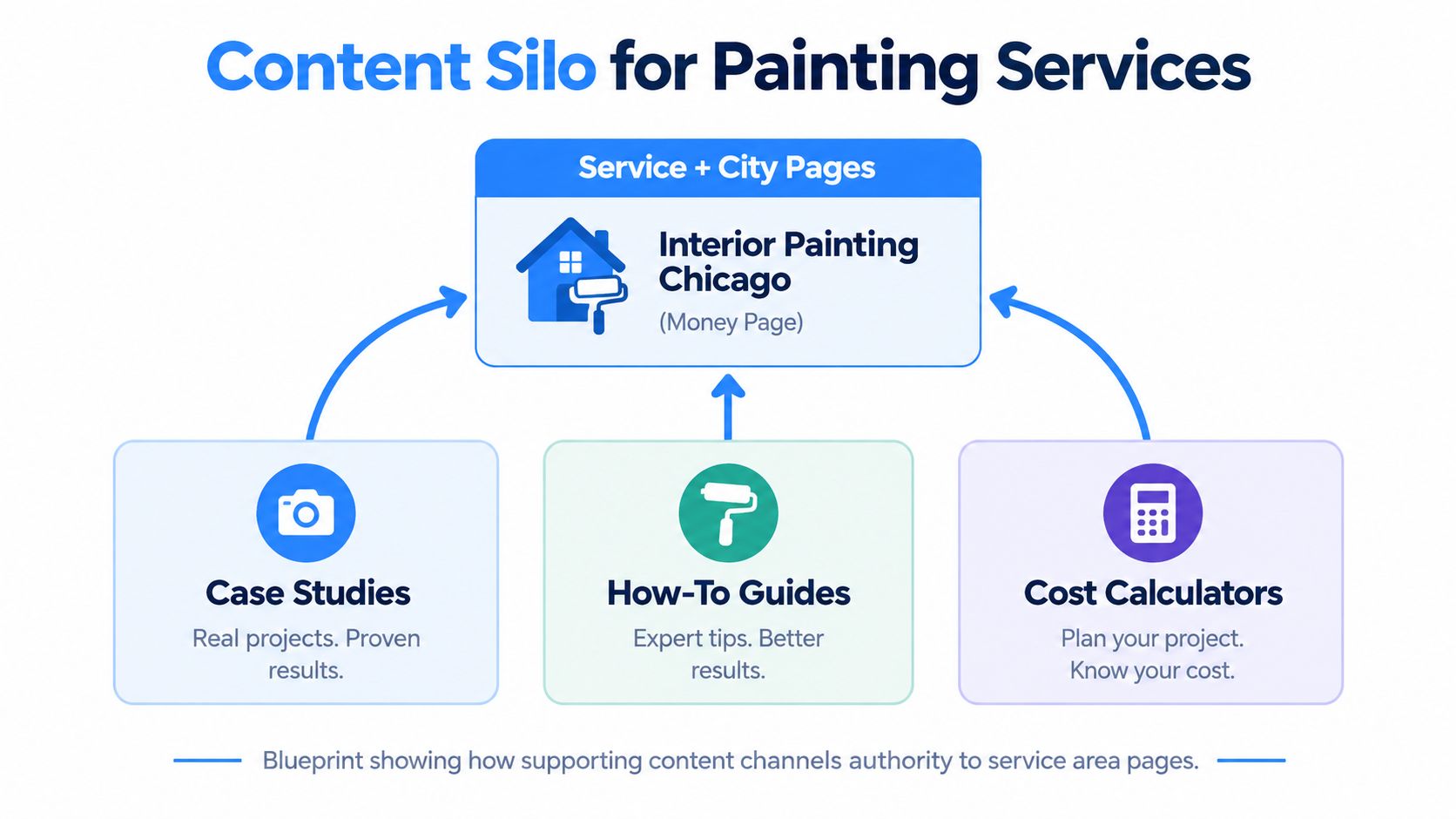
A painting website should make its strongest service-plus-city pages easy to identify. Supporting content earns its place by sending relevant context and internal links to those pages, not by filling a blog calendar.
Build the silo from proof outward
Start with project case studies. A useful case study describes the property type, surfaces, preparation work, products used, color or finish decisions, and the completed result. Where the customer permits it, include before-and-after images and local context. A page about an exterior repaint on stucco in Lakeland can target a specific long-tail intent while demonstrating competence to a serious buyer.
Organize galleries by service type rather than dumping every project into one portfolio. Interior, exterior, cabinet, deck, and commercial galleries should have descriptive captions and alt text that explain what the image shows. Avoid stuffing city names into every image field. Use location cues where they accurately describe the work.
Supporting articles answer questions that appear before the estimate:
- Lead paint safety: Explain when testing and professional handling may matter.
- HOA color approval: Describe how homeowners can prepare for review requirements.
- Paint sheen selection: Compare practical considerations for walls, trim, kitchens, and high-use areas.
- Surface preparation: Explain why cleaning, patching, sanding, and priming affect the final result.
Each supporting asset should link to one primary money page with natural anchor text. The money page should link back to its strongest proof, such as a relevant case study or gallery. This keeps the hierarchy understandable.
Make internal links answer the next question
A homeowner reading about cabinet preparation should reach the cabinet painting page, not a generic homepage. A property manager reading about commercial coatings should find the commercial painting service page. That path supports transactional intent without forcing every article to sell aggressively.
Practical rule: Every supporting page needs one clear destination, and every money page needs visible proof that answers why the visitor should call this contractor.
This structure also helps AI search systems interpret the business. Consistent service names, locations, project details, and relationships make the company easier to understand when large language models generate recommendations or summaries.
Reviews and Reputation as a Transactional Growth Lever
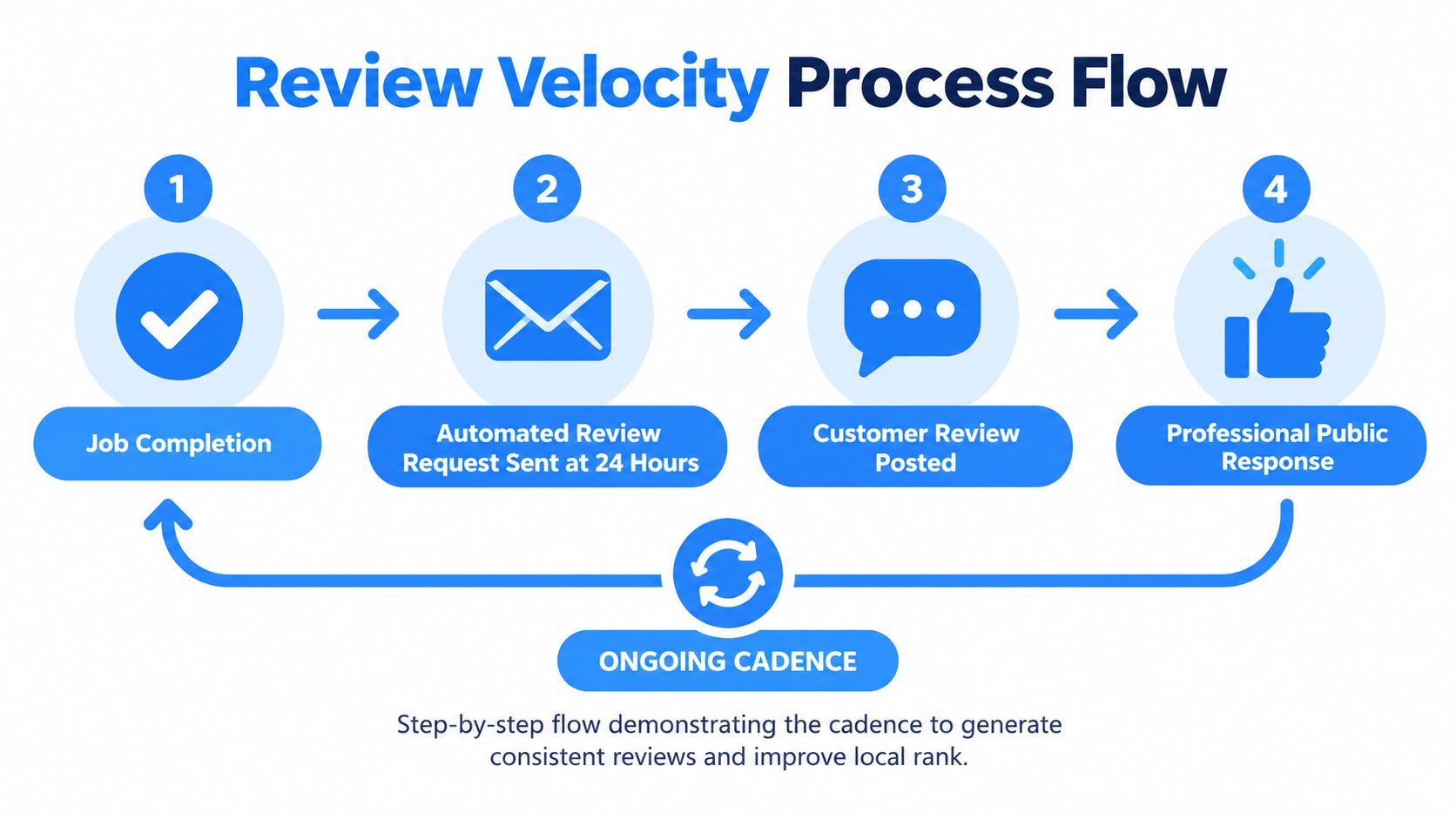
Review count alone isn't the operating objective. A painting contractor needs a repeatable review velocity process that begins when the customer has just seen the completed work and still remembers the crew's preparation, communication, and cleanup.
Google reviews support Map Pack trust. Yelp helps comparison shoppers evaluate providers, while Nextdoor recommendations can create neighborhood referrals. Ask for honest feedback without offering incentives or pressuring customers to submit only positive comments. A review request should make the next action simple and direct.
Run the request immediately after completion
Use a consistent crew workflow:
- At job completion: Confirm the work is finished, then send the review request when the crew leaves.
- Follow-up: If the customer hasn't responded, send one polite reminder seven days later.
- Past-customer outreach: Contact previous customers during slower periods with a genuine service update or review invitation.
- Public response: Reply to every review professionally and address the actual project.
The response should sound like a human business owner. Mention the service and city naturally when those details fit the customer's comment, but don't repeat keywords mechanically. “Thank you for trusting us with your kitchen cabinet refinishing in Plano” is useful because it identifies the work. A string of forced service phrases isn't.
Connect reputation activity to booked work
Tag every estimate source in the CRM. Record whether the lead came from a Google review click, a Map Pack call, Yelp, Nextdoor, a referral, or a service page. Then compare those sources against scheduled estimates and completed jobs.
A review is not the final asset. It's part of a loop: completed project, request, public response, profile engagement, new search visibility, and another call. A contractor that measures that loop can invest time in the channels producing real opportunities instead of chasing empty review totals.
Local Links, Citations, and Tracking What Actually Moves
Off-site authority should be relevant to painting and relevant to the market. A generic directory blast creates administrative clutter, not a credible local footprint. Prioritize relationships that a customer or search engine would reasonably associate with a legitimate painting contractor.
Potential sources include:
- Suppliers and manufacturers: Ask local paint stores, Sherwin-Williams partners, Benjamin Moore retailers, and material suppliers whether they maintain contractor pages.
- Property relationships: Build connections with HOAs, neighborhood associations, real estate agents, interior designers, and property managers.
- Industry communities: Look for trade schools, local contractor organizations, and home-service publications that feature useful project work.
- Business profiles: Maintain accurate listings on Apple Maps, Bing Places, Yelp, Nextdoor, Houzz, BBB, Angi, and Facebook when those platforms fit the business.
Citations need consistent name, address, and phone information. Audit them monthly, especially after a rebrand, move, phone change, or service-area adjustment. Don't create multiple profiles for one business to occupy more listings.
Track visibility and revenue separately
Map rank varies by searcher location, so a single rank check can mislead you. Use a geo-grid tool such as Local Falcon or BrightLocal to see how visibility changes across the service area. Use CallRail or WhatConverts to attribute calls to GBP and city pages, and use Search Console to monitor movement for service terms.
Keep the weekly dashboard small enough that the owner and marketing team will review it.
| Metric | Source | Target / Cadence |
|---|---|---|
| Map visibility by area | Local Falcon or BrightLocal | Review weekly across priority service zones |
| Calls and call source | CallRail or WhatConverts | Review weekly and tag qualified opportunities |
| Form fills | Website analytics or CRM | Review weekly by service and city page |
| Service-page queries | Google Search Console | Review weekly for emerging transactional terms |
| Review activity | Google Business Profile and review platforms | Check after every completed job and summarize weekly |
| Citation accuracy | Manual audit or listing platform | Audit monthly |
AI optimization belongs in this measurement system, but it isn't a separate excuse to publish generic AI-themed articles. AI search visibility means a brand or location appears in AI-generated answers, and recent industry coverage says AI systems respond to long-term data correctness, editorial mentions, reviews, and photos (BrightLocal's local AI visibility resource). For a painter, that means keeping the business name, services, locations, reviews, project evidence, and contact details consistent everywhere.
Transactional LLC offers contractor-focused local SEO, Google Maps optimization, service-area pages, Google Business Profile management, and AI-driven content planning. Its reporting can combine service-city keyword timelines, map-ranking heat maps, Search Console queries, traffic, and lead tracking into a regular dashboard.
Transactional LLC can build a transactional SEO and AI visibility system for your painting company, including service-plus-city pages, Google Maps optimization, review workflows, and lead attribution. Visit Transactional LLC to discuss which painting services and local markets should become your next source of booked estimates.