


The first sign you need SEO for a plumbing company is usually not a report, it's a phone that won't ring enough. A burst pipe, a dead water heater, or a slow drain doesn't give a homeowner time to comparison shop for long, they search, tap a result, and call the plumber who looks closest, fastest, and most trustworthy. That's why the winning strategy is built around transactional searches, the kinds of queries where someone already has a problem and is ready to spend.
For plumbing, local discovery is the whole game. One 2026 industry compilation says 46% of all Google searches have local intent, “near me” searches exceed 200 million per month globally, and those searches can drive a 76% mobile-to-store visit rate within 24 hours (WebTonic plumbing SEO statistics). The same source puts organic SEO cost per lead around $0 to $100, with plumbing SEO often cited at $10 to $40 per lead over the long run, which is exactly why organic visibility matters once the campaign stabilizes (WebTonic plumbing SEO statistics). If you're still leaning on paid traffic alone, you're paying for every click while a competitor's map listing and service pages keep compounding.
Why Plumbing SEO Starts With the Phone Call
The plumbing buyer isn't browsing. They're standing in water, looking at a failed unit, or trying to keep a small problem from becoming a costly one. That means every keyword, page title, Google Business Profile field, and review request should be judged by one question, does this create a call or a booked job?
The adoption gap makes that opportunity bigger. A 2026 playbook says 74% of plumbing companies were reported not to actively invest in SEO, so only 26% are competing seriously for much of the organic traffic (WebTonic SEO for plumbers). The same source says independent plumbers often spend $1,500 to $5,000 per month with a boutique agency, while enterprise multi-location accounts can reach $12,000 to $25,000+ per month (WebTonic SEO for plumbers). That's not a reason to overspend, it's a reason to stay disciplined and build the right assets first.
Practical rule: if a page doesn't help a person call faster, it's probably not pulling its weight.
The highest-leverage asset is the Google Business Profile. Most plumbing profiles lose map visibility because of avoidable field mistakes, not because the business is inferior. The profile should use the business name with no keyword stuffing, the primary category should be Plumber, secondary categories should only fit when they're relevant, service areas should include every city and neighborhood served, hours should reflect emergency availability if that service exists, the phone number should be local rather than toll-free, and the profile should include at least 10 high-quality photos (Ambs Call Center plumber SEO marketing). Those fields help Google understand relevance, distance, and prominence, which is why they matter more than generic branding language.
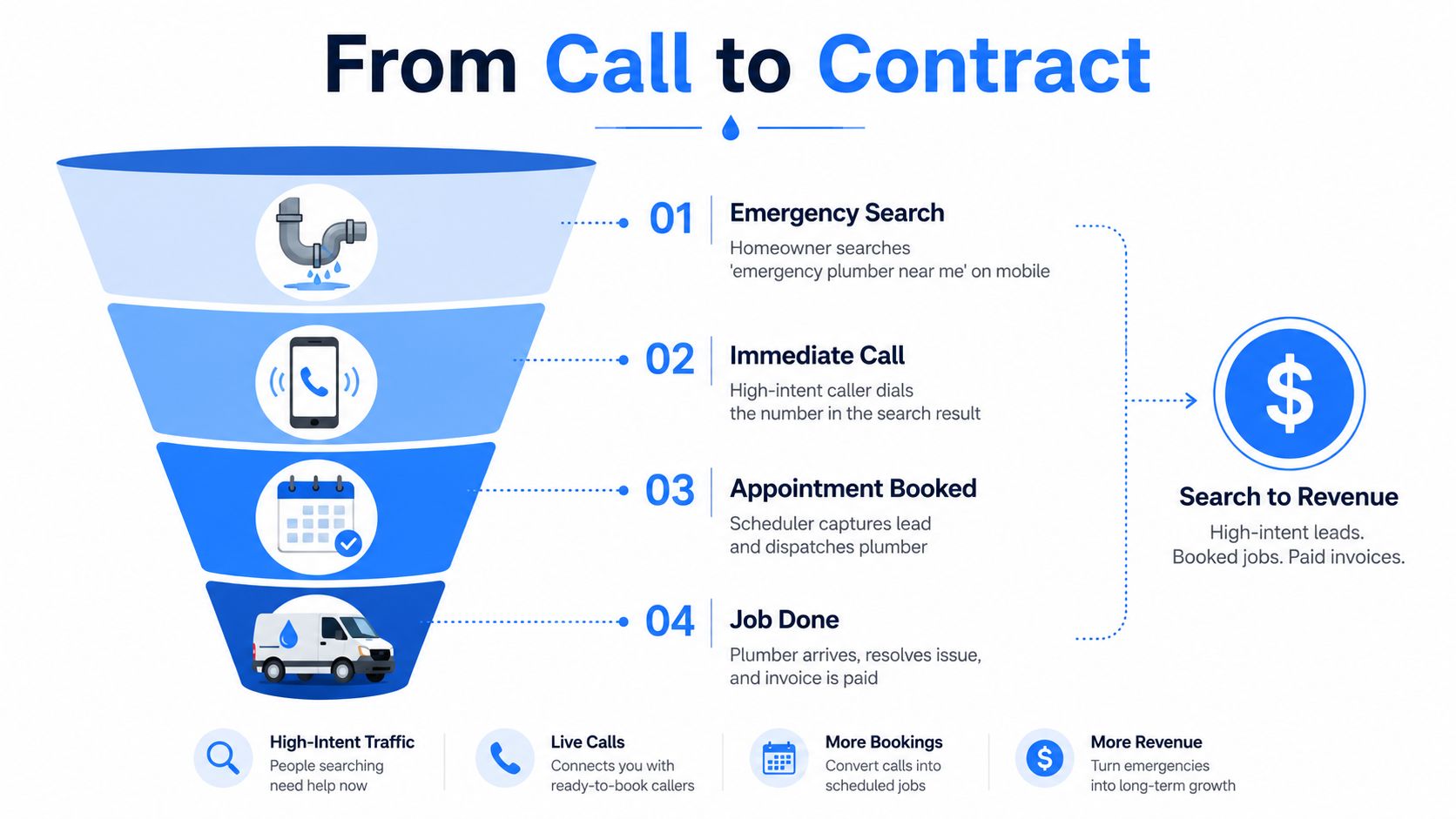
A good operator also treats call handling as part of SEO, not a separate department. If the map listing drives the call but no one answers, the lead is wasted. A useful companion resource on automatic call recording software guide can help teams audit how those calls are being answered, routed, and converted once the searcher dials.
You can also use phone number on website best practices to make sure your number is easy to find in the header, footer, and contact path. That sounds basic, but basic is often what separates the companies that capture the lead from the ones that let it disappear.
Building the Site Architecture Plumbing Companies Actually Need
A plumbing site doesn't need a giant maze of pages. It needs a clean structure that mirrors how people search, then gives Google a clear map of what each page is for. That starts with a homepage, a services hub, 8 to 15 individual service pages, a service-areas hub, and 5 to 30 city pages only for legitimately served locations. Add an about page, reviews page, contact page, and blog, and you've got a site that can rank without turning into a pile of duplicate pages.
Start with the money pages
The first pages to build should be the ones tied to booked work, not the ones that sound broad. That means separate pages for drain cleaning, water heater repair, leak detection, sewer line repair, emergency plumbing, toilet repair, pipe installation, and commercial plumbing when those are real revenue services. A service hub can organize them, but it shouldn't replace them.
A real service-area page earns rankings because it says something specific about the place and the work. A thin doorway page just swaps the city name in and repeats the same copy. That kind of page usually helps no one, and it can make the site feel mass-produced instead of local.
Keep the structure simple enough to maintain
The easiest way to plan the sitemap is to document business truth first. That means the exact business name, one primary phone number, the address or service-area designation, hours, every city and ZIP served, and the core revenue services. From there, each page should have a clear purpose, one service, one location, one conversion path.
If you want a visual reference for the sitemap shape, use website sitemap examples for local service businesses as a guide and keep the structure lean. The goal isn't volume. The goal is making it obvious to both users and search engines where the plumbing company works and what it does best.
One more rule matters here. Don't create city pages for places you don't serve. That's not scaling, that's bait, and it usually leads to messy rankings and bad calls.
Writing Service Pages That Match Transactional Intent
Generic copy doesn't rank well for plumbing services because the search intent is too specific. A person searching emergency plumber in Dallas doesn't want a philosophy essay, they want proof you can solve the problem, fast, and that you handle the exact issue they're facing. Every service page should be built to answer that kind of urgent, transactional query.
Use a repeatable service-page template
One source recommends 400 to 600 words per service page, with the service description, how the problem presents, diagnosis, treatment options, approximate cost ranges, and a direct CTA, plus 3 to 5 FAQs at the bottom using FAQ schema markup (HiAgency plumber SEO). That structure works because it answers the questions the caller already has before they click.
A solid page for water heater repair, for example, should cover the signs of failure, what the plumber checks first, what repair vs replacement looks like, and when same-day service makes sense. A sewer replacement page needs a different story, because the customer's concern is usually bigger, slower, and more expensive. Separate pages let each one speak directly to the searcher's problem.
Write for intent, not for decoration
Transactional phrases belong in the copy when they fit naturally. Terms like licensed plumber, 24/7 emergency service, and residential and commercial plumbing help the page match the language people use when they're ready to hire. The same local SEO guidance recommends keeping Google Business Profile descriptions within the 750-character limit, title tags under 60 characters, and meta descriptions under 160 characters so the target keyword and location can fit in the snippet (ALMCorp local SEO for plumbers).
Use those limits carefully. If the title tag runs long, the location may get cut off. If the description is stuffed, the page sounds spammy and the click rate usually suffers.
A service page should make the caller think, “This plumber handles my exact problem,” not “This company probably does plumbing.”
That's the difference between a page that earns traffic and a page that books work. The best service pages feel specific enough to trust and direct enough to convert.
Using AI and Content Silos to Win Both Google and LLMs
AI-driven search rewards sites that are organized like a real knowledge base. Large language models don't need a pile of loosely related blog posts, they need structured, entity-rich content that makes the business easy to understand. For a plumbing company, that means building content silos around services, service areas, and the core entities behind the work, like plumber, emergency service, water heater, sewer line, repipe, and drain cleaning.
Build one silo per revenue cluster
A practical silo starts with a hub page, then branches into the pages that support it. Residential plumbing can sit under one branch, emergency plumbing under another, and commercial plumbing under a third. Under those branches, specific pages like drain cleaning, water heaters, repiping, grease traps, backflow testing, burst pipes, and sewer backup carry the detail.
The value of that structure is simple. It gives Google and AI systems a clean set of relationships. A water heater page links to the residential hub, the emergency page links to burst pipe or no-hot-water support content, and the city page links back to the relevant service pages. That web of links tells the system what's important.
Publish for the money pages, not for noise
Blog posts should support the pages that make money. A post about a failed water heater should link to the water heater repair page. A post about sewer odor should reinforce the sewer service page. That way, the content doesn't drift away from the core offer.
The same structure helps with LLM-style queries such as “who is the best plumber in [city].” Those systems prefer clear entities, obvious service coverage, and pages that answer the question directly rather than dancing around it. For a plumbing company, the win is not just being found in Google, it's being legible to the tools people increasingly use to summarize local options.
A useful reference for that broader approach is AI search engine optimization for service businesses, especially if the site needs to be built for both search engines and answer engines.
When the silo is built well, each page reinforces the next one. That's what creates topical authority without relying on keyword stuffing or endless content production.
Generating Reviews That Move Rankings and Convert Callers
Reviews do two jobs at once. They help the business show up better in the map pack, and they make callers trust the company before anyone answers the phone. Plumbing is one of those services where reputation matters fast, because people are often inviting a technician into their home, sometimes during a stressful or messy situation.
Run reviews as a process, not a hope
The easiest system is the one the office can repeat without thinking. The technician asks in person after the job is done, the dispatcher sends a short follow-up message with the review link, and the office manager keeps the cadence steady. The point is not to beg for reviews, it's to make it normal.
A simple workflow works better than an occasional push. If the customer is happy at the door, ask them directly. If they don't leave one right away, the follow-up text or email gives them a second chance when the experience is still fresh.
Reply like an operator, not a debater
A strong response to a good review should sound human and specific. Mention the service, thank the person, and keep moving. A response to a bad review should stay calm, acknowledge the issue, and invite the customer to continue offline so the team can fix it.
Negative reviews also tell you where the operation is breaking down. If the same complaint shows up more than once, it's probably not a marketing problem. It's a dispatch issue, a communication issue, or a service quality issue that needs to be corrected.
If you want a practical system for tightening the review process, getting more reviews is a useful reference for the kinds of follow-up steps that make the ask more consistent. The same review stream also reinforces the service pages when customers mention the work they received, which helps the site feel more credible to both visitors and search systems.
Not every backlink is worth chasing, either. Citations and local mentions that help a plumbing business usually come from sources that confirm the company is real and active, like data aggregators, HomeAdvisor, Angi, BBB, trade groups, supplier pages, chamber sites, and neighborhood organizations. A few relevant local links beat a pile of weak guest posts every time.
Technical SEO Issues That Quietly Kill Plumbing Rankings
Plumbing sites usually don't fail because of one dramatic mistake. They fail through a pile of smaller issues, thin city pages, mismatched business details, missing schema, bad mobile performance, and title tags that don't fit the location or service. Fixing those problems doesn't feel glamorous, but it's often the difference between a site that ranks and a site that disappears under competitors.
The problems show up in predictable places
The most common technical issue is inconsistency. If the website, Google Business Profile, and directory listings don't use the same NAP details, Google has a harder time trusting the business. Another common issue is weak page structure, where service pages are too thin or city pages are duplicated across locations.
Photos cause trouble more often than owners realize. Large, uncompressed images slow mobile pages, and plumbing sites rely heavily on mobile traffic because emergency searches happen on phones. Title tags and meta descriptions can also undercut the site if they go too long or leave out the service area.
Use the right fix for the right symptom
A developer doesn't need a vague request to “improve SEO.” They need a short, accurate punch list. Add schema where it matters, compress images, fix broken links, make every service page unique, and tighten page titles so the city and service appear early. For plumbing, the point is clarity, not complexity.
Here's a practical comparison for the most common issues.
| Issue | Symptom | Fix |
|---|---|---|
| Thin city pages | Pages look duplicated and don't convert | Write only for real service areas with local detail |
| Inconsistent NAP | Google sees conflicting business details | Match the name, phone, and address everywhere |
| Missing schema | Search engines miss page context | Add LocalBusiness, Service, and FAQ markup |
| Large photos | Slow mobile pages | Compress images before upload |
| Long title tags | City or service gets cut off | Keep titles under the standard snippet length |
| Weak call tracking | Leads can't be tied to a page | Use unique tracking numbers and source tagging |
If you want a parallel example from another link-building world, effective SaaS SEO link building is a useful reminder that authority comes from relevant placements and consistent signals, not random volume. The same logic applies to plumbing, just with local sources instead of software blogs.
Track the numbers that matter
Rankings alone don't pay payroll. The dashboard should focus on calls from organic and GBP, calls tied to specific service pages, booked-job rate by source, and cost per booked job. Add keyword timelines by service city, map ranking heat maps, Search Console queries, and call tracking tied back to individual pages, and you've got a view that helps the owner make decisions instead of guesses.
The 90-Day Plumbing SEO Plan in the Right Order
The first 30 days should clean up the assets that affect calls fastest. Start with the Google Business Profile, NAP consistency, the top service pages, and the phone path on the site. If the basics are broken, more content just gives you more places to be inconsistent.
Weeks three through six should add the review system, core citations, and the first city pages for legitimately served locations. That's where a lot of plumbing companies finally start seeing their local footprint become clearer to Google. The work is unglamorous, but it compounds.
Weeks seven through twelve should layer in the content silos, local links, and the reporting stack. At that point, the business has enough structure to measure what's driving calls and what's just taking up space. That's when SEO starts behaving like an asset instead of a guessing game.
If your plumbing company needs a cleaner search strategy, Transactional LLC builds local SEO programs around transactional search terms, Google Maps visibility, service-city pages, and AI-ready content structures that are designed to produce calls, not just rankings. Visit Transactional LLC to see how the team approaches plumbing SEO, Maps optimization, and conversion-focused site work for service businesses.