


A Tuesday morning starts with two missed calls. An HVAC owner sees both inquiries in the call log, then notices that the competing contractor sits above the map pin for the same service area. The dashboard looks healthy, with impressions rising and map exposure holding steady, but the dispatch board doesn't show new jobs. Visibility is present. Revenue isn't.
That gap defines service area business SEO. Contractors, dentists, pest-control companies, roofers, plumbers, and electricians don't need traffic for its own sake. They need to appear when someone searches “air conditioning repair near me,” “dentist near me,” “roofer near me,” or another service-and-location phrase that signals immediate buying intent. These are transactional searches. The person searching often has money in hand and is comparing providers who can respond.
Why Most Service Area Businesses Lose Calls They Should Be Winning
The owner in that Tuesday scene usually doesn't have a traffic problem. The business has a Google Business Profile, a website, and perhaps several service pages. The problem is that the local search journey leaks before the searcher calls.
Local search has become part of the normal path to purchase. BrightLocal reported that 98% of consumers used the internet to find information about local businesses in 2022, compared with 90% in 2019, and 87% used Google to evaluate local businesses in 2022. The same survey found that 76% regularly read online reviews while browsing for local companies. Those findings explain why a contractor can appear in search and still lose the job during comparison. (BrightLocal's 2023 Local Consumer Review Survey)
Four leak points appear repeatedly:
- The profile looks like a storefront. A mobile roofer displays an address customers can't visit, uses vague services, or lists an oversized territory. Google and the buyer receive conflicting information.
- City pages cannibalize one another. Several pages use the same introduction, identical testimonials, and swapped city names. None gives Google a strong reason to rank it for a specific service-plus-city search.
- Reviews lack local and service context. A review saying “great company” gives less useful commercial context than authentic feedback that describes the service performed and the area served. Businesses must never script or fabricate customer language, but they can make it easy for satisfied customers to leave honest feedback.
- Reports count exposure instead of outcomes. Impressions, clicks, and map views matter as diagnostic signals. They aren't booked jobs.
Practical rule: If the report can't connect a searcher to a qualified call, submitted form, estimate, and booked job, it measures visibility rather than marketing performance.
BrightLocal's more recent reporting illustrates the danger. Service businesses saw search views rise 15.4% and map views rise 7.7%, while phone calls fell 1.1%, website visits fell 1.9%, and driving-direction requests fell 5.5%. (Rio SEO's local search behavior reporting) A contractor should therefore optimize for the complete path from “near me” discovery to profitable job, not for a dashboard screenshot.
How a Google Business Profile Works for a Service Area Business
A service-area business doesn't operate like a shop with a public address. Google's model is based on the business entity, its base, and the places where it travels. Google says local results are primarily influenced by relevance, distance, and prominence. Relevance connects the profile to the query, distance considers the searcher or named location, and prominence reflects broader recognition through reviews, links, directories, articles, and ordinary web results. (Google's explanation of local ranking)
A roofer based 12 miles outside a target town, with no customer-facing shop, should verify the actual business address with Google, hide that address from public view, and define the service area with named cities, postal codes, or other geographic areas. Google's guidance says the overall territory should normally remain within approximately two hours of driving time from the business base. A P.O. Box isn't a substitute for an operating location, and a virtual office can't create legitimate proximity.
The profile should use one geographic method consistently. If the business defines service areas with postal codes, don't create a confusing parallel list of city tags to insert more locations. Adding distant places doesn't manufacture relevance. It can dilute the profile and create a mismatch between the territory shown in Google Business Profile and the areas the company can serve.
Profile setup that matches the business
Start with the primary category that best describes the main operation. A multi-trade operator should avoid turning one profile into a catalog of unrelated businesses. If the plumbing and electrical divisions are separate eligible businesses with distinct operations, assess their profile structure carefully. Never create duplicate profiles just to occupy more map results.
Then make the customer-facing details precise:
- Business name: Use the-world name, not a string of cities and services.
- Services: Describe actual offerings, such as emergency roof repair or AC installation.
- Hours: Publish the hours when staff can receive calls or dispatch work.
- Phone: Keep the primary number consistent with the website and major listings.
- Photos: Add authentic job-site and team images that demonstrate the work.
- Questions and answers: Address genuine buyer concerns, such as emergency response, accepted payment methods, and service limitations.
Reviews should also reinforce the operation without manipulation. Complete profiles matter to buyer perception. BrightLocal summarizes Google-sourced findings showing that customers are 2.7 times more likely to consider a business reputable when they find a complete profile, while complete profiles are associated with customers being 70% more likely to visit and 50% more likely to consider purchasing. (BrightLocal's local SEO statistics)
For a practical cleanup, use a resource that helps you fix service area listing errors, then compare the corrected profile with the website and directory listings. The Google Business Profile guide can also help a team document ownership, categories, services, and operating details before making changes.
The video below offers an additional visual walkthrough of service-area setup.
Building Service Pages and City Pages That Earn Rankings
A service page and a city page solve different search problems. The service page establishes topical authority for one offering. The city page proves that the business serves a particular place and gives a searcher a relevant next step.
A page about emergency roof tarping should explain the problem, inspection process, materials, dispatch limitations, estimate logic, safety considerations, and reasons to trust the company. It should remain the canonical hub for that service rather than being duplicated across every town. A city page for emergency roof tarping in a specific town should focus on local access, realistic response information, local project evidence, neighborhoods served, and a service-specific call to action.
| Element | Service Page | City Page |
|---|---|---|
| Main purpose | Explain and sell one core service | Match one service to one real service town |
| Keyword focus | Emergency roof tarping | Emergency roof tarping in the target town |
| Proof | Process, expertise, materials, trust signals | Local project details, service constraints, area relevance |
| Internal links | Links to relevant cities and supporting questions | Links back to the core service page |
| Conversion | Call, estimate, appointment, or dispatch request | A location-specific call or estimate request |
| Map reference | Business context and service coverage | Embedded map or profile reference that matches the real business |
The usual failure is a single page titled “Roofing Services in Every City We Serve.” It tries to rank for the service, every location, and every variation of “roofer near me” at once. That page becomes broad but not useful. The opposite failure is a folder of near-identical city pages with only the town name changed. Those pages compete with one another and give buyers no local reason to choose the company.
A page-level publishing checklist
Before publishing a service page, confirm that it has:
- One clear offering: Don't mix roof repair, gutters, siding, and insurance claims into an indistinct page.
- A useful process: Explain what happens after the call and what information the customer should prepare.
- Commercial proof: Use authentic qualifications, project evidence, warranties, and review references where appropriate.
- A focused CTA: Ask the reader to call, request an estimate, or book the relevant service.
- A logical URL and title: Keep the page understandable to users and search engines.
Before publishing a city page, confirm that the company serves that town, the content contains unique local evidence, and the page doesn't make an unsupported promise about response time or coverage. Include a map embed pointing to the actual Google Business Profile context when appropriate, but don't create a fake branch address.
A clean internal-link structure matters. Each city page should link to its core service page with natural wording, and the service page should link to the cities that belong to its coverage. The service-area page framework provides a useful reference for separating location relevance from repetitive city-name insertion.
Citations, NAP Consistency, and LocalBusiness Schema
A service business can gain “near me” map impressions while calls decline when listings disagree or send searchers to the wrong contact details. Citations, NAP consistency, and structured data work together as an entity-consistency layer. The objective here is entity consistency: the same company, phone number, service set, and operating base should appear across the website, Business Profile, and authoritative listings. Track calls and booked jobs alongside visibility so citation work can be tied to revenue, not impressions alone.
A mismatch on Yelp, the BBB, an industry directory, or an aggregator creates uncertainty. One old phone number will not automatically erase visibility, but unresolved conflicts make it harder for systems to reconcile the business and can send ready-to-buy searchers to a dead end. Start with the strongest profile and the company website, then correct important directories and downstream data sources.
Consider a two-truck HVAC company auditing its presence across 12 core directories. The owner should record the exact business name, base address, service-area wording, phone number, website, hours, categories, and duplicate listings. Make corrections in order of trust and influence rather than updating directories randomly.
| Tier | Directories | Weight |
|---|---|---|
| Primary | Google Business Profile and the company website | Highest operational priority |
| Core mapping | Apple Business Connect, Bing Places, and major map databases | High consistency value |
| Industry | HVAC associations, licensing references, and reputable trade directories | High relevance value |
| Broad local | Yelp, BBB, chamber, and established regional directories | Supporting trust value |
| Cleanup targets | Aggregators, duplicate profiles, and obsolete listings | Correct when conflicting |
Structured data that matches the actual entity
Google's LocalBusiness documentation covers the business type, required fields, and geographic coordinates through geo. Choose the most specific valid subtype available, such as an HVAC-related or dental subtype, when it accurately describes the company. Keep the canonical name and telephone number aligned with visible page content and the Business Profile. (Google's LocalBusiness structured data documentation)
Useful fields include serviceArea, areaServed, geo, openingHours, and sameAs, but every value must describe something that exists. A service-area company should not create fictional branches or assign the business to a target town solely to pursue a ranking. City pages can explain local coverage in visible content while the organization markup continues to represent the actual company.
Validate the markup with Google's Rich Results Test, inspect rendered HTML, compare schema values with the page, and monitor Search Console for parsing issues. Structured data cannot compensate for thin city pages, keyword-stuffed descriptions, or contradictory NAP data. Follow this local SEO citations resource for a practical citation workflow.
Local Link Building That Actually Moves the Map Pack
A generic backlink can improve a website's authority, but relevance usually gives a local service business a more useful signal than an impressive metric from an unrelated site. A link from a nearby building-material supplier, neighborhood association, trade school, or complementary contractor can establish geographic and industry context that a generic blog comment can't.
That doesn't mean every local link will move a map result. Google's local prominence signals include links, directories, articles, and reviews, but proximity and relevance still matter. A hidden-address roofer won't become locally relevant by buying a pile of unrelated links.
| Tactic | Relevance | Map Impact |
|---|---|---|
| Supplier co-marketing page | High industry and local relevance | Potentially useful supporting signal |
| Chamber or neighborhood sponsorship | High geographic relevance | Useful when the organization is genuine |
| Trade-school or apprenticeship feature | High topical relevance | Supports legitimacy and local authority |
| Complementary contractor referral page | High service relevance | Can strengthen local relationships |
| Generic guest post | Variable | Usually indirect for map visibility |
| Cheap directory bundle | Low to variable | Often weak unless each directory is trusted |
| Blog comments or private blog networks | Low or manipulative | Risky and rarely a sound local strategy |
For roofers, supplier co-marketing can take the form of a project education page or manufacturer referral listing. Dentists can build relationships with local professional groups, schools, and community organizations without disguising advertising as editorial endorsement. HVAC companies can participate in trade-school programs, equipment education, and neighborhood initiatives that produce authentic mentions.
The best local link is usually attached to a real relationship, a real event, or a real piece of useful information.
A warning list belongs in every link plan:
- Don't buy a city-page link package that creates dozens of low-quality listings with identical descriptions.
- Don't use a virtual office to create artificial local proximity.
- Don't treat domain authority as local relevance.
- Don't publish fake sponsorships or invented community projects.
- Don't expect links alone to repair an incomplete profile or weak service page.
A reputable directory submission provider, such as StartupSubmit backlink services, may be useful for researching legitimate listing opportunities. Review every placement for business relevance, editorial quality, and consistency before submitting.
Content Silos and Internal Linking Around One Service
A tight silo around one money service gives every page a job. For an emergency roof repair campaign, the core service page targets the commercial intent. Supporting pages answer the questions that arise before the call, while city pages connect that service to real coverage areas.
A workable structure contains one core service page, three to five supporting city pages with unique proof, and two to four supporting buyer-question articles. Those supporting counts are an editorial framework, not a ranking formula. The right number depends on the company's actual services, towns, and available evidence.
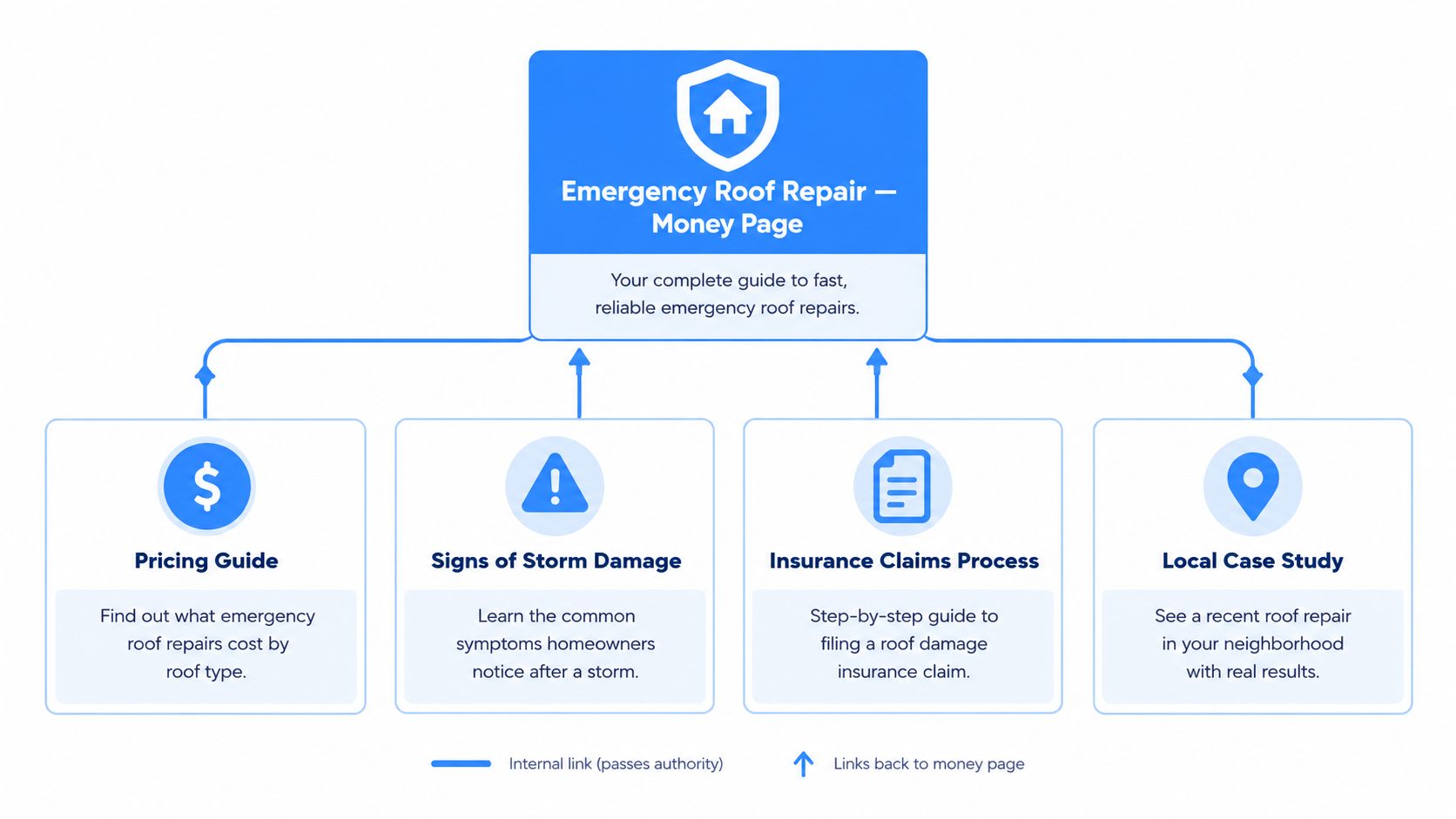
The hub should link to relevant cities and useful questions. Each city page should link back to the hub in a contextual sentence, not through a repetitive footer stuffed with exact-match anchors. Supporting articles should link upward when they identify a natural next step, such as moving from storm-damage symptoms to an emergency inspection.
Keep each page distinct
A city page for one town might feature a documented storm repair, local permitting considerations, or a service limitation that applies there. Another city page might focus on a different roof type, neighborhood pattern, or customer question. Use authentic photos and project details only where the business has permission and the facts can be supported.
Vary anchor text naturally. Use “emergency roof repair,” “our storm-response service,” or “roof damage inspection options” where those phrases accurately describe the destination. Don't repeat the exact city keyword in every sentence or every link.
Before publishing, check:
- Intent: Does the page answer a real buyer question?
- Evidence: Is the local or service proof specific and authentic?
- Links: Does every page have a useful path to the hub and related resources?
- Conversion: Is the next action visible and service-specific?
- Duplication: Would a reader notice if the city name were removed? If not, the page needs more substance.
Tracking Map Rankings and Multi-Location Reports That Match Reality
A map ranking is a location-dependent observation; treat it as a diagnostic, and let booked jobs tell the revenue story. A roofer may appear prominently in one part of a city and poorly in another because distance changes with the searcher's position. A rank checked from the office cannot represent an entire service territory, especially for transactional “near me” searches where the caller expects a nearby provider who can take the job.
Run a grid scan in a tool such as Local Falcon or BrightLocal to see how visibility changes across target towns. Track the percentage of grid points in the top three rather than reporting one favorable pin. Then connect each city and service to actions that can be verified.
Use UTM-tagged profile URLs to separate Business Profile traffic from other visits. Call tracking can identify the source and landing page, while CRM records connect inquiries to a service city, job type, eligibility, and outcome. Call recordings help the team separate a genuine estimate request from a wrong number, sales call, or unqualified inquiry. This matters when map impressions rise while calls fall, because the report must show whether the problem is weak intent, poor conversion, or faulty attribution.
The per-city KPI stack should include:
- Top-three map visibility: Record the grid pattern and scan date, not one flattering pin.
- Branded search behavior: Watch whether searchers look for the company after discovering the service.
- Calls lasting more than 60 seconds: Use this as a qualification signal, not an automatic sale.
- Qualified leads: Record the requested service, city, eligibility, and source.
- Booked jobs: Tie the lead to the completed scheduling event.
- Revenue tracked: Use the business's CRM or accounting value, not an SEO estimate.
A completed report can look like this:
| City | Top-3 Map Rank | Monthly Calls >60s | Booked Jobs | Revenue Tracked |
|---|---|---|---|---|
| Round Rock | 41% of grid points | 18 | 7 | $14,200 |
| Priority city two | Current grid share | Qualified call count | CRM booking count | Closed-job value |
| Priority city three | Current grid share | Qualified call count | CRM booking count | Closed-job value |
| Priority city four | Current grid share | Qualified call count | CRM booking count | Closed-job value |
| Priority city five | Current grid share | Qualified call count | CRM booking count | Closed-job value |
The first row shows the level of detail the owner needs. For every other row, replace the instructions with the same five inputs from the scan, call system, booking records, and CRM. Keep city and service together when a business serves different offerings across its territory. A strong overall ranking for roof replacement can hide weak emergency-repair visibility, while a high call count can hide jobs outside the service boundary.
Report impressions separately from outcomes. A rise in map views can reflect zero-click exposure, repeat searches, or low-intent discovery. BrightLocal reported that 46% of consumers often or always add “near me” to local queries, while 67% often or always look at reviews after a local search. (BrightLocal's 2025 Local Consumer Review Survey) For contractors, that makes review visibility and call quality more useful decision signals than exposure alone.
Set a consistent attribution window and document unanswered questions, such as missed calls, duplicate leads, untracked phone numbers, or jobs booked after an initial inquiry. Do not claim SEO revenue when the CRM cannot connect the lead to a source and completed job. If call tracking changes the number shown on the profile, test that setup carefully so customers and citation data are not confused.
A Monday report should show city, service, scan date, map pattern, qualified calls, booked jobs, revenue, and open attribution questions. Teams that need a repeatable way to organize these inputs can use this local SEO reporting tools guide without making the owner decode an SEO dashboard.
Putting It Together on a 30 to 60 Day Priority Plan
A practical service area business SEO plan starts with the transactional phrase, then works backward from the call. If the target is “air conditioning repair near me,” the profile must describe real HVAC services, the website must explain the service clearly, the relevant cities must have useful pages, and the reporting must show whether those signals produced qualified work.
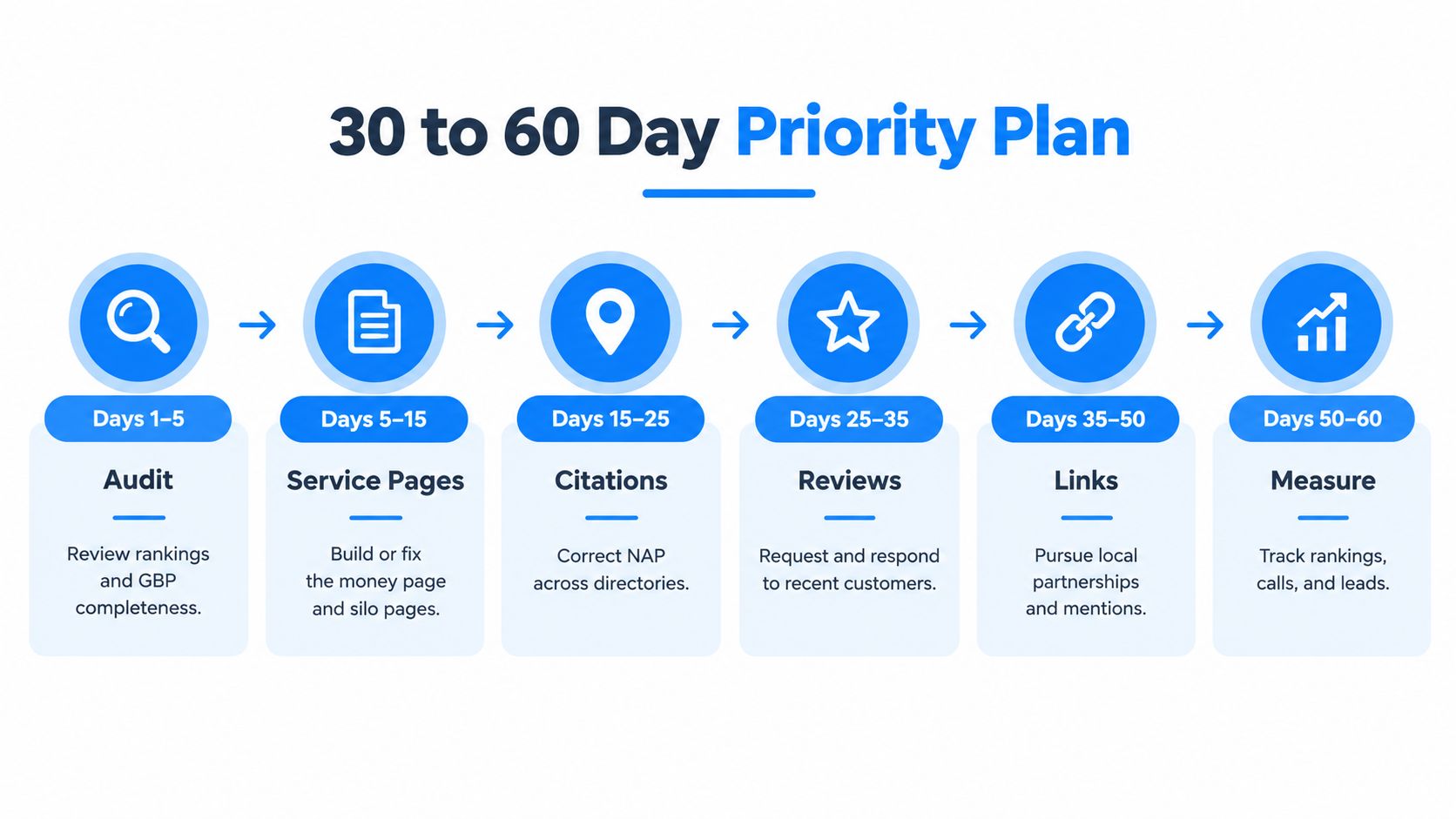
The sequence below keeps the work staffed and measurable.
Days 1 through 30
Week one should cover the Business Profile audit, category cleanup, service review, address visibility, service-area verification, hours, phone number, photos, and review-response process. Remove duplicate or misleading location signals rather than expanding the territory blindly.
Weeks two and three should publish or repair two focused service pages and two genuine city pages. Link each city page to the relevant service hub, add local proof that can be verified, and create a service-specific CTA. Don't publish a city page merely because a keyword list contains that town.
Week four should standardize the business name, address, phone, hours, and website across core listings. Add accurate LocalBusiness schema, validate it, and compare the markup with visible content. Begin a review request process that asks real customers for honest feedback without offering incentives or scripting sentiment.
Days 31 through 60
The next phase should prioritize industry-specific citations and a small set of relationship-based outreach opportunities. A roofer might work with a materials supplier or neighborhood organization. A dentist might build legitimate local professional and community relationships. An HVAC operator might pursue trade and education partnerships. The value comes from relevance and authenticity, not from purchasing a fixed quantity of links.
By the measurement phase, each target city should have a baseline for map visibility, profile actions, qualified calls, forms, booked jobs, and revenue attribution. Review the report at a cadence the owner can defend without an SEO specialist in the room.
Decision rule: If a tactic doesn't improve a per-city call, qualified lead, or booked-job measure within the review window, cut it or change the hypothesis. Don't protect it because impressions look impressive.
Google's documentation for AI features reinforces the same discipline. Websites don't need special AI-only schema to appear in Google's AI features. They need to be crawlable, indexable, technically accessible, useful to people, and supported by structured data that matches visible content. (Google's documentation for AI features) For local businesses, that means making services, coverage, operating details, and expertise explicit so search engines and AI systems can identify the entity accurately. No markup guarantees inclusion or a particular position in an AI-generated answer.
The strongest plan is therefore not “rank everywhere.” It's rank for the right transactional service searches in the cities the company can serve, then prove which visibility becomes revenue. A map pin, city page, review, link, and AI mention only matter when they help a real customer choose the business.
Transactional LLC offers service-area SEO, Google Maps and Business Profile optimization, conversion-focused service and city pages, and reporting that connects local visibility with calls and booked work. If your business wants to target searches such as “roofer near me,” “dentist near me,” or “air conditioning repair near me,” visit Transactional LLC to discuss a focused local search strategy.