


A plumbing company serves the metro area, but its phone rings mostly from the same handful of neighborhoods. An agency recommends publishing dozens of city pages. By Monday, the site has a page for every suburb, each with the same headline, the same paragraphs, and one swapped city name. Weeks later, the pages produce little visibility, fewer calls, and no clear explanation of where the company sends trucks.
That isn't a service area pages SEO strategy. It's a location-name swap.
A useful page should help a real customer decide whether to call, help Google understand the service and geography, and give an AI system enough clear evidence to identify the business as a credible answer for a transactional search such as “air conditioning repair near me,” “dentist near me,” or “roofer near me.” Transactional Marketing focuses on those searches because the person making them is usually looking for a provider now, not browsing casually.
Why Most Service Area Pages Fail Before They Start
Most weak city pages fail before anyone writes the first sentence. The business starts with a spreadsheet of towns instead of a map of actual dispatch zones, then treats every location as an excuse to duplicate one page.
Google has warned against doorway-style pages, including substantially similar pages created to target specific cities and funnel users toward the same destination. Search Engine Journal documents how Google has devalued low-quality near-duplicate city pages over time, while more useful localized pages have appeared more often for local-intent searches in recent years. The practical lesson is straightforward: a city page needs a customer reason to exist.
Operator rule: If the dispatcher can't explain why customers in that city need a dedicated page, the SEO team shouldn't publish one.
The four patterns that damage city pages
- Templated thinness: The page changes “Raleigh” to “Cary,” but the service explanation, proof, FAQs, and calls to action remain identical.
- False service claims: The site lists cities the business rarely or never serves. That creates a poor customer experience and weakens trust.
- NAP drift: The business name, address, phone number, hours, and service-area wording conflict between the website and Google Business Profile.
- Cannibalization: Several URLs target the same service and overlapping geography, leaving search engines uncertain about which page deserves visibility.
Internal linking often makes the problem worse. A footer may point every city page to every other city page, while service pages fail to link naturally to the markets that generate the most calls. A better service landing page structure connects one service, one meaningful market, local proof, and one clear next action.
Build from dispatch reality
Start with completed jobs, route density, technician coverage, and the cities named in customer reviews. A page for a distant suburb isn't valuable because the suburb has a name. It's valuable when the company serves it consistently, can describe the customer experience there, and can turn that visit into a booked job.
The historical shift is important. Google increasingly moved local search away from “more pages equals more reach” and toward more useful local pages equals more visibility. Fewer pages with original evidence, accurate coverage, and a clear service path beat a mass-produced directory of interchangeable URLs.
The Strategic Case for Service Area Pages SEO
A homeowner searching “emergency plumber in Plano” is already naming the service, the market, and a likely next step. A general plumbing article reaches a broader audience, but it does not answer that immediate buying question. A service area page exists to convert transactional local demand. Vanity impressions are a byproduct, not the goal.
Local search behavior supports that priority. Industry summaries report that 46% of Google searches have local intent, while 76% of people who search for something nearby visit a business within 24 hours, and 28% of nearby searches result in a purchase. These figures appear in local search statistics for 2026. They are directional evidence, not a promise of results for every business, but they show why city-plus-service pages deserve attention.
The page should give the searcher four clear answers: whether the company serves the area, what work it performs, how to contact it, and why local customers trust it. That same focus gives search engines a useful URL for organic visibility while supporting discovery through Google Maps.
Transactional intent beats generic traffic
| Metric | City-Modified Queries | Generic Non-Local Queries |
|---|---|---|
| Search meaning | Combines service need with a defined market | Describes a broad topic or service |
| Likely visitor | A nearby customer comparing providers | A researcher, student, or general browser |
| Page requirement | Local proof, service boundaries, contact path | Educational depth and broad topical coverage |
| Conversion path | Call, booking form, estimate request | Research, later consideration, or no action |
| SEO role | Captures high-intent local demand | Builds awareness and topical support |
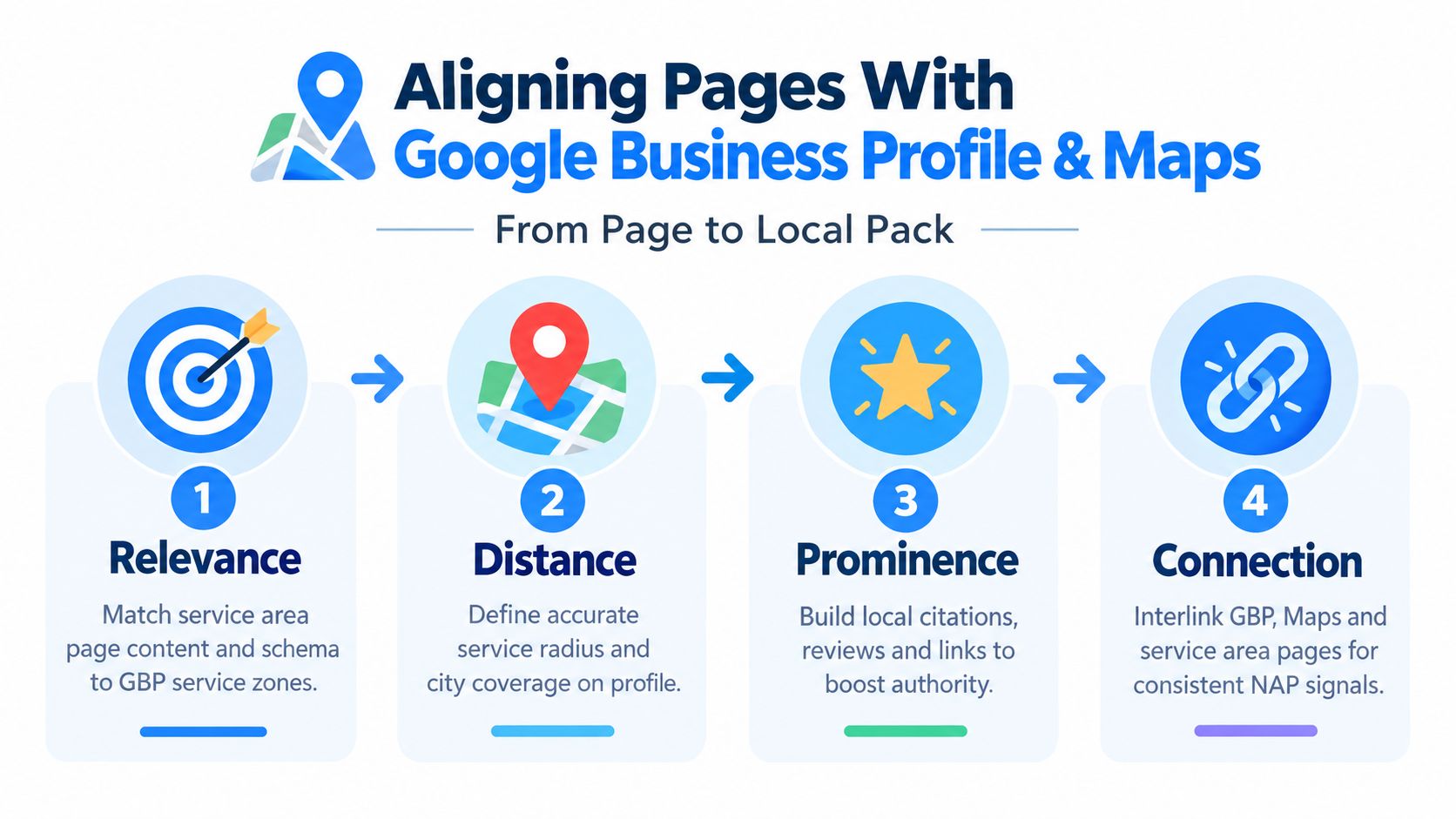
Map visibility adds another reason to connect the page to real operations. Google commonly evaluates local results through relevance, distance, and prominence. Relevance measures the match between the business and query, distance reflects proximity to the searcher, and prominence reflects the business's broader reputation. A page can strengthen relevance, but it cannot remove the physical-distance factor.
That boundary keeps the strategy realistic. A well-built page can support organic visibility in a target city. Google Business Profile optimization, reviews, citations, and links also influence map prominence, so the website and profile should reinforce the same service coverage rather than run as separate campaigns.
For a contractor, each URL should map to a real dispatch zone, an accurate business profile, and a phone path that fits the stated service. This multi-location local SEO approach follows the same service-plus-location logic, connecting pages with searches that can become calls and booked work. The result is a conversion asset grounded in dispatch reality, with every city claim backed by the ability to serve and prove that market.
Qualifying the Cities Worth Building Pages For
Not every nearby city deserves its own URL. Publishing a page should be a business decision backed by service history and customer evidence, not an automatic reaction to a keyword list.
Use the prioritize-then-build framework
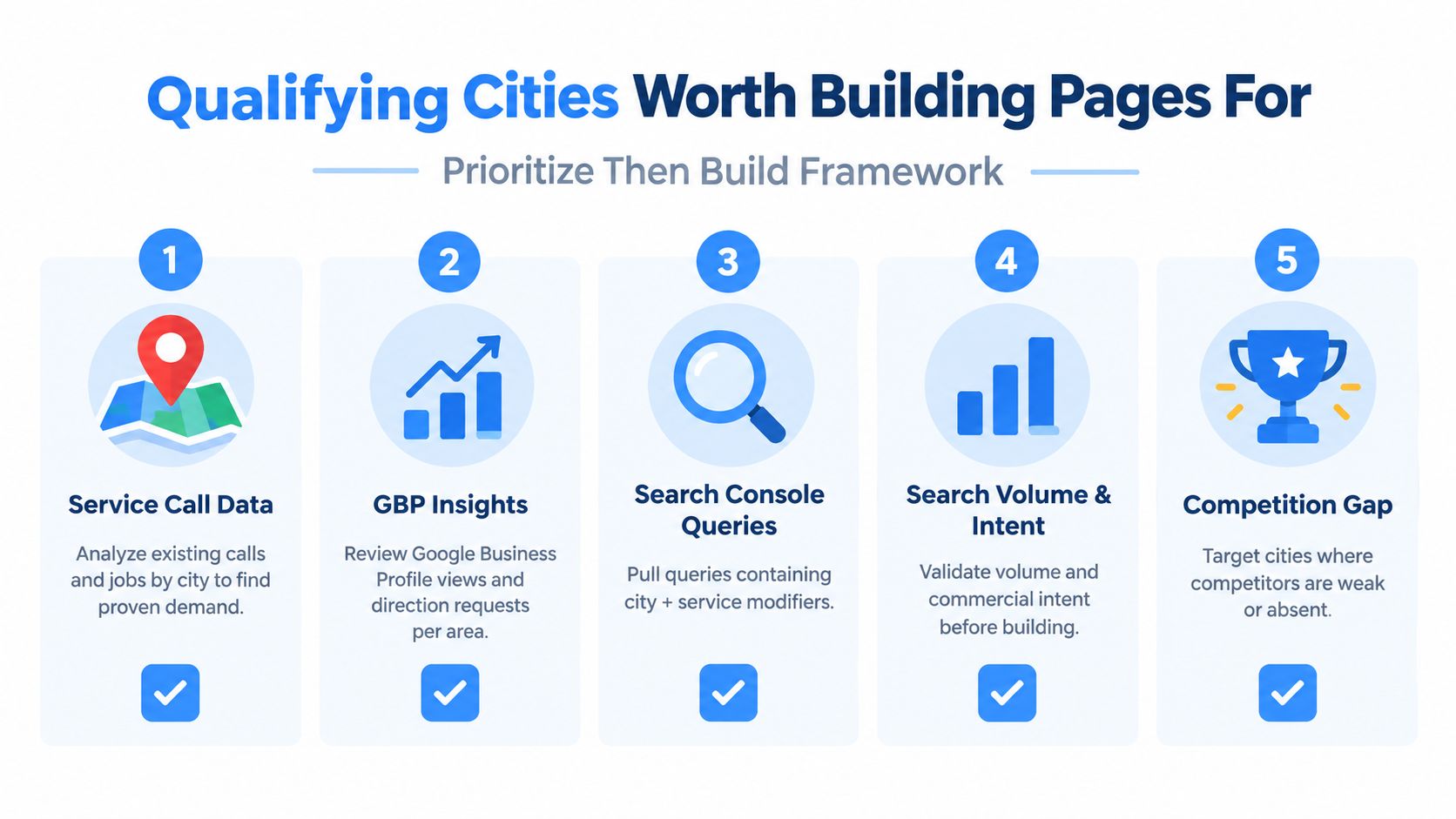
Begin with a ranked candidate list. Pull the business's service-call records, Google Business Profile insights, and Google Search Console queries. Look for cities that already send calls, direction requests, impressions, or service-related searches. Then add nearby markets at the edge of the dispatch territory where the company has a credible operational reason to expand.
Score every candidate against four practical criteria:
- Actual service history: Has the team completed work there, and does it still accept jobs there?
- Route density: Can technicians reach the city efficiently as part of normal dispatch patterns?
- Local trust evidence: Do reviews mention the city? Are there project photos, local partnerships, or recognizable landmarks that the business can reference?
- Competitive density: Do competing providers have strong, specific pages, or is there a useful quality gap?
A city that fails two or more criteria shouldn't receive a standalone page yet. Consolidate it into a stronger regional or county page, or list it on a well-organized service-area hub. This prevents the common mistake of building a page for every place the owner can find on a map.
Log the decision, not just the URL
Create a simple record for every proposed page. Note the service history, evidence available, expected dispatch fit, competing URLs, and the reason the page should answer a distinct customer question. If that reasoning can't fit in a few clear sentences, the city probably needs more validation.
Use Google Maps heat maps to identify geographic visibility patterns instead of relying only on a single search from the office. A business may rank well near its address and poorly along the actual routes it wants to grow. That difference should influence which pages get built and which markets need stronger proof.
Prioritize the markets that combine revenue potential with evidence the company can serve well. One independent guide recommends focusing first on the top 5-10 revenue-generating markets and publishing only high-quality pages with original content, structured data, and strong internal linking, as outlined in service area page SEO guidance. The exact shortlist depends on the business, but the principle is firm: quality and operational truth come before geographic coverage.
Page Template and On-Page Structure That Ranks
A high-converting page should feel like a local service desk, not a paragraph with a city name inserted into it. The structure needs to answer five questions quickly: what service is available, where is it available, why should the visitor trust the provider, what happens next, and how can the visitor make contact?
Start with a precise page identity
Use an H1 such as “Air Conditioning Repair in Mesa, Arizona” or “Emergency Plumbing in Naperville, Illinois.” That city-plus-service format matches the query language customers use and gives the page a clear subject for search engines and AI systems.
Build the rest of the page around the same identity:
- Title tag: Combine the primary service, city, and a useful differentiator.
- Meta description: Address a local objection, such as coverage, scheduling, emergency availability, or estimate requests.
- NAP block: Place the business name, address or service-area explanation, phone number, and hours where visitors can find them without hunting.
- Opening copy: Confirm the city, explain the service, and include a real local detail or dispatch confirmation.
- Service modules: Describe the specific jobs customers request, with benefits and next steps rather than keyword lists.
LocalBusiness structured data should align with the visible page. Include the relevant areaServed and serviceArea properties for the city, and keep the business name, phone, hours, and service wording consistent with the Google Business Profile. Transactional's schema markup guidance for services provides a useful reference for connecting structured data to service content.
Add proof that a template can't fake
The strongest differentiators are operational details. Use a technician introduction when the same team serves the market, a project note from the city, a review that names the area, a local landmark near common routes, or a clear explanation of how appointments are dispatched.
A page should also include a service-area map embed, a city-specific FAQ, and a prominent call button. Questions might cover whether the company serves a particular neighborhood, how emergency requests are handled, whether estimates are available, and what information the customer should provide before booking.

Don't let plugins dictate the content strategy. WordPress teams comparing technical SEO options can review WP Triage's SEO plugin comparison while keeping the important distinction clear: a plugin can help implement titles, canonicals, sitemaps, and schema, but it can't create genuine city evidence.
The page should lead with the customer task. If the searcher needs “air conditioning repair near me,” the first screen should make service coverage and contact options obvious. Transactional searches reward clarity because the visitor isn't looking for a lecture. They're looking for a provider who can help.
Canonicalization, Duplication, and Internal Silos
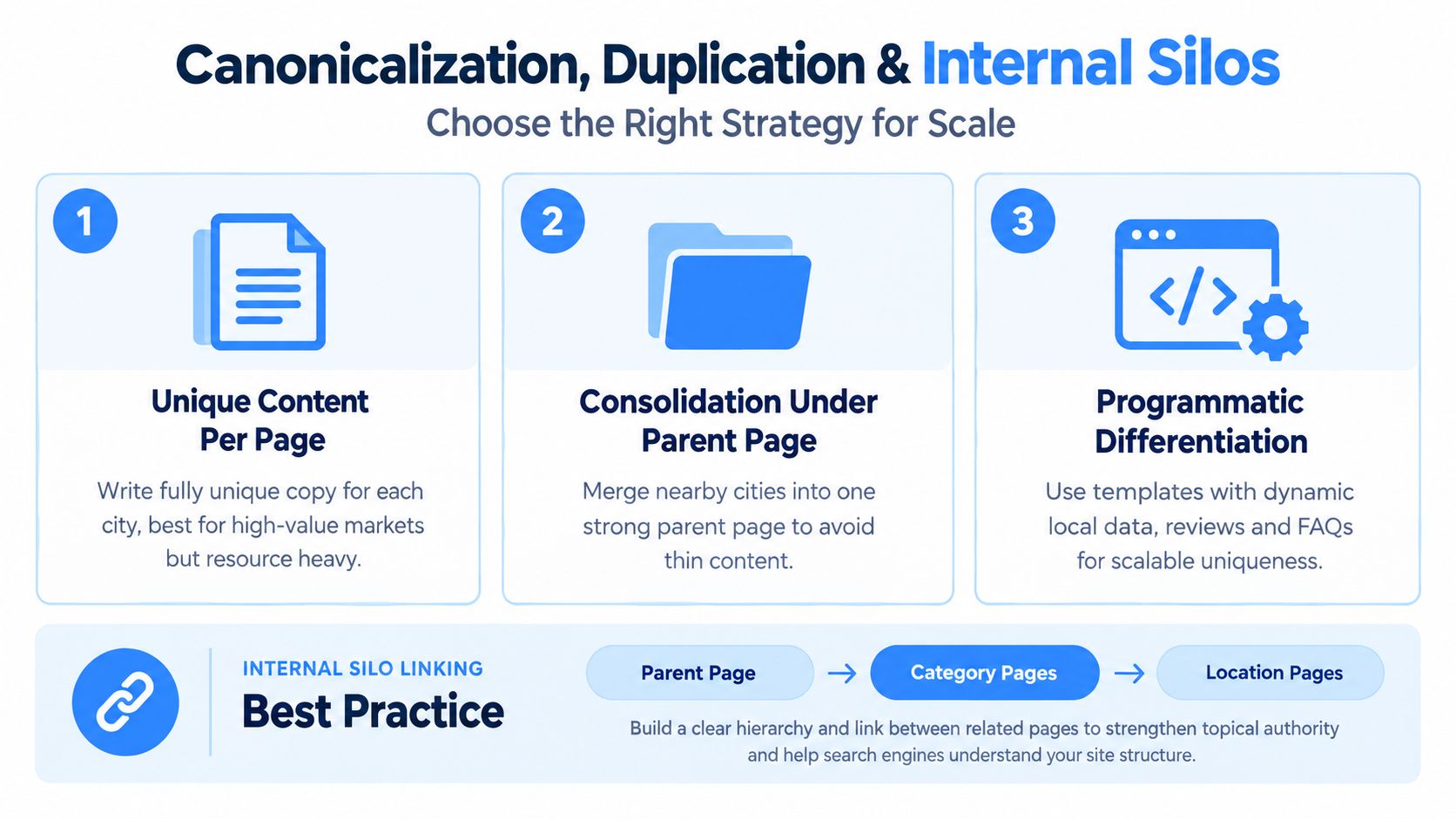
There are three sensible ways to manage location-page scale. The wrong choice is publishing every possible city and hoping a canonical tag will rescue weak content.
Choose the right duplication strategy
Unique content per page works for priority markets where the business has enough proof to create a useful destination. Include local reviews, project details, neighborhood references, staff coverage, service constraints, and FAQs that reflect the city. This is the strongest option, but it requires real editorial work.
Consolidation under a parent page is better when nearby cities share the same dispatch pattern and lack distinct evidence. A county, region, or broader service-area page can explain coverage clearly without splitting limited proof across several thin URLs. Link to that parent from the service hub and make the coverage easy for customers to understand.
Programmatic differentiation can support scale when the data is real and maintained. A template may assemble city-specific reviews, service availability, frequently asked questions, project records, and route information. It fails when the system only swaps a place name into generic paragraphs.
Use technical controls deliberately
A self-referencing canonical is appropriate when a page is the preferred version of its own distinct content. It doesn't make duplicate pages valuable. If two URLs overlap heavily and one is clearly the stronger destination, consolidate them or use a canonical relationship that reflects the preferred URL. Use noindex for pages that must remain accessible to users but shouldn't compete in search, such as thin utility variations.
Audit parameter URLs, tag archives, filtered city lists, and store-locator paths. Make sure important pages have crawlable HTML links and aren't available only after a visitor interacts with a search widget. An XML sitemap can support discovery, but internal links should still communicate the site's hierarchy.
Build a controlled hub-and-spoke silo
A service hub should link to the strongest city pages. Each city page can link to relevant service variants, such as /plumbing/garbage-disposal-repair/ or /hvac/furnace-repair/, when those URLs answer separate intent. Use contextual anchors that describe the destination, not a repetitive block of city names.
Keep footer links restrained. Every city page shouldn't point to every other city, and every service page shouldn't dump a full geographic index into the body. A focused internal silo helps search engines and AI systems understand which page represents a service, which represents a market, and which URL should answer a specific transactional query.
Aligning Pages With Google Business Profile and Maps
A service area page should match a real dispatch zone in the Google Business Profile. The wording does not need to be identical, but the operational story must agree. If the site promises service in a city the business rarely reaches, the page becomes a weak conversion asset and creates a mismatch with local search signals.
Apply the relevance-distance-prominence model
The relevance, distance, and prominence model covered earlier still governs the relationship between the page and Maps. On-page content mainly clarifies relevance by matching a genuine service with a genuine location. Distance depends on the searcher's position, while prominence reflects reputation signals such as reviews, citations, backlinks, and the business's overall standing.
A city page cannot manufacture proximity or replace the profile's reputation. It can confirm that the company serves the area, explain what technicians handle there, and give visitors a direct path to call or book.
Align the profile with actual coverage
For a service-area business, configure service areas around the cities or regions the company dispatches to. Google service areas are not a radius-based ranking control, so broad claims about serving “everywhere nearby” do not create a reliable geographic strategy. Keep the profile's city list, service descriptions, hours, phone number, and business category consistent with the site.
Use the same standard for page creation. Build a city page only when the company can accept work there, send a crew there, and support the claim with useful local details. Do not create Google Business Profile listings for cities where the company lacks legitimate business presence or service capability. One accurate profile supporting several defensible city pages is stronger than a group of questionable listings.
Track the map, not just the website
Use a local rank grid or geoheat map to compare visibility across the markets that matter. A practical workflow can examine a 3-mile and 9-mile radius, then compare the primary service query with close variants. These radii are measurement settings, not universal ranking rules.
Connect the profile to the page that best matches the searcher's intent. Someone finding a city-specific plumbing page should reach a page that confirms coverage, explains the relevant service, and offers a direct booking path. That alignment reduces friction and gives a Map discovery a better chance of becoming a call. Review weak zones against actual dispatch capacity before creating more pages.
Tracking, Measurement, and Iteration
A service area page isn't finished when it gets indexed. It becomes useful when the business can identify which queries produce visibility, which pages generate calls, and which markets deserve another round of proof.
Filter Google Search Console by each page URL. Log clicks, impressions, click-through rate, and average position over time, then review the queries that caused the page to appear. Independent local SEO guidance recommends this page-level monitoring because aggregate website traffic hides which city pages are doing useful work.
Connect rankings to revenue actions
Every phone call, form submission, chat, and booking should carry an originating page where the system can capture it. Use UTM parameters for forms and campaign paths, and use dedicated call-tracking numbers or dynamic number insertion when appropriate. Keep the primary business number consistent wherever NAP accuracy matters, and make sure tracking doesn't create confusing public variations.
Build a simple dashboard with one row per city page and separate organic and Maps fields. Track the main service query plus three close variants, and record map visibility by grid location rather than one manually checked search.
| Metric | Source | Target Threshold |
|---|---|---|
| Page clicks | Google Search Console | Set a baseline by city and improve it through relevant refreshes |
| Impressions | Google Search Console | Look for sustained visibility across service-plus-city queries |
| CTR | Google Search Console | Improve title and description when impressions rise without action |
| Organic calls | Call tracking and analytics | Tie calls to the originating page and landing experience |
| Form submissions | CRM, analytics, and UTM data | Identify pages producing qualified inquiries |
| Map position | Local rank grid or heat map | Compare coverage across the selected service area |
| Booked jobs | CRM or scheduling system | Prioritize pages tied to profitable dispatch zones |
Refresh pages sitting in positions 8-15 before rewriting pages that have no search demand. A small improvement near the first page can create more useful exposure than expanding into another unqualified city. Review cost per lead across pages on a regular business cycle, and retire a page that has produced no tracked conversion in nine months, unless the market has a documented strategic reason to keep it.
Transactional Marketing's model centers on transactional search terms, including “roofer near me,” “dentist near me,” and “air conditioning repair near me.” Its local SEO and Google Maps work is designed around service-city visibility, page-level reporting, and the connection between search exposure and customer action. If your pages don't help the dispatcher fill real routes, the strategy needs another iteration.
Transactional LLC builds service area pages around meaningful service-location combinations, local proof, conversion paths, Google Maps optimization, and AI-readable content structure. Visit Transactional LLC to discuss which cities deserve dedicated pages and how to turn transactional searches into more calls and booked jobs.