


A homeowner searches “AC repair near me” after the system stops cooling. Another types “roofer near me” after a storm. A third searches “dentist near me” with an appointment decision already forming. If your contractor website answers broad questions but your competitor owns the service page, Google Business Profile, and map result for that exact search, your content is educating the buyer while someone else gets the phone call.
That's the central problem with most content marketing for contractors. Owners publish articles, collect impressions, and watch competitors with fewer posts appear in the local pack. The fix isn't more filler. It's a content system built around transactional searches, Google Maps visibility, and pages that AI systems can understand and answer.
Why Contractor Content Has to Chase Transactional Searches
A roofer can spend thousands creating a large library of generic articles and still lose the map pack to a competitor with fewer pages. The reason is simple. Homeowners don't hire the company with the biggest blog. They hire the business that appears when the problem becomes urgent, the location matches, and the next step is obvious.
Content marketing for contractors should capture transactions, not collect attention. Every service page, city page, FAQ, Google Business Profile update, and project post should support one of three actions: a phone call, a quote request, or a booked estimate.
The three intent buckets
Transactional intent is the money-in-hand category. Searches such as “water heater replacement Gilbert AZ,” “AC repair Tampa,” “plumber near me open now,” and “roofer near me” indicate that the searcher is looking for a provider. Local transactional searches are built around immediate hiring intent, not casual research.
Commercial-investigation intent appears in searches such as “how long does a roof last” or “best water heater replacement option.” These users are comparing choices, timing, and risk. The content matters, but it should lead to a relevant service page rather than ending as an isolated educational article.
AI-overview intent includes questions such as “signs of a slab leak.” A concise answer may appear directly in an AI-generated result, reducing the need for a click. That doesn't make this content useless. It makes the page responsible for answering the question clearly, proving local expertise, and directing the reader toward the transactional parent page.
Operating rule: T1 pages pay the bills. T2 and T3 content should feed T1 pages, not compete with them.
The mainstream adoption of B2B content marketing reinforces the point. Industry compilations report that 91% of B2B organizations use content marketing, while another benchmark reports 92% of B2B marketers include it in their marketing mix. Those benchmarks also identify lead generation and brand awareness as major objectives, but contractors need a narrower implementation: connect each asset to a local service, a service area, and a conversion path.
Transactional Marketing's model follows that logic. The business name reflects the target: searches such as “air conditioning repair near me,” “dentist near me,” and “roofer near me.” The work should be organized by industry, service, and city, never as one generic article about every trade.
Mapping Local Keywords That Carry Money in Hand
Don't write the first post until the keyword map is finished. A local map tells you which URL should rank for the buyer ready to call, which page should answer a comparison question, and which article should support AI-overview visibility.
Start with the T1 transactional core:
- HVAC: AC repair Tampa, air conditioning repair near me, emergency AC repair Tampa, AC replacement Tampa.
- Plumbing: plumber near me open now, emergency plumber Gilbert, water heater replacement Gilbert AZ, same-day drain cleaning Gilbert.
- Roofing: roofer near me, roof repair Mesa, emergency roof tarp Chandler, roof replacement Gilbert.
- Pest control: pest control near me, termite treatment Mesa, same-day scorpion control Chandler, recurring pest control Gilbert.
- Dental: dentist near me, emergency dentist Tampa, family dentist Gilbert, same-day dental crowns Mesa.
Each phrase needs a page type. Service plus city usually belongs on a dedicated local service page. “Near me” terms should strengthen the service-area and Google Business Profile strategy rather than produce dozens of awkward duplicate pages.
Next, add T2 commercial modifiers such as cost, emergency, 24/7, same-day, financing, insurance, replacement, and repair. These terms reveal a decision that's getting closer. A pricing page, emergency service page, comparison guide, or quote-focused service page can address them.
The T3 ring captures questions that support topical authority and AI answers. Examples include “how often should you service an AC in Arizona,” “how long does a roof last,” and “what causes recurring drain clogs.” Use the local keyword research process to assign every query to a single URL and avoid cannibalization. For additional guidance on adapting messaging to specific locations, the Keywordme localization playbook offers useful context.
Local keyword map by trade and intent
| Trade | Transactional T1 | Commercial T2 | Informational T3 | Page type |
|---|---|---|---|---|
| HVAC | AC repair Tampa, AC replacement Tampa | AC repair cost, emergency AC service | How often to service an AC in Arizona | Service page plus supporting guide |
| Plumbing | Plumber near me open now, water heater replacement Gilbert AZ | Same-day plumber, water heater cost | Why does a water heater leak? | Emergency and service pages |
| Roofing | Roofer near me, roof repair Mesa | Hail damage insurance, roof replacement cost | How long does a roof last? | City service page plus price guide |
| Pest control | Pest control near me, termite treatment Mesa | Same-day pest control, recurring service | How do termites enter a home? | Treatment and plan pages |
| Dental | Dentist near me, emergency dentist Gilbert | Dental crown cost, same-day appointment | How long does a dental crown last? | Treatment and location pages |
Tag the map T1, T2, or T3. T1 gets measured by calls, forms, booked estimates, and map visibility. T2 gets measured by assisted conversions and clicks to the parent service page. T3 gets measured by qualified internal clicks and visibility in answer-oriented search.
Building Pillar Pages and Service Silos for One Trade
A contractor site needs a structure Google and homeowners can understand quickly. Give each industry its own silo. An HVAC company shouldn't bury AC repair, furnace installation, maintenance plans, and city coverage inside one general “services” page.
Start with one pillar page, such as “HVAC in Gilbert, AZ.” That page targets the trade and primary city. It should link to focused service pages for AC repair, AC installation, furnace service, heat pump service, and maintenance plans. It should also connect to carefully written city pages such as HVAC Mesa and HVAC Chandler.
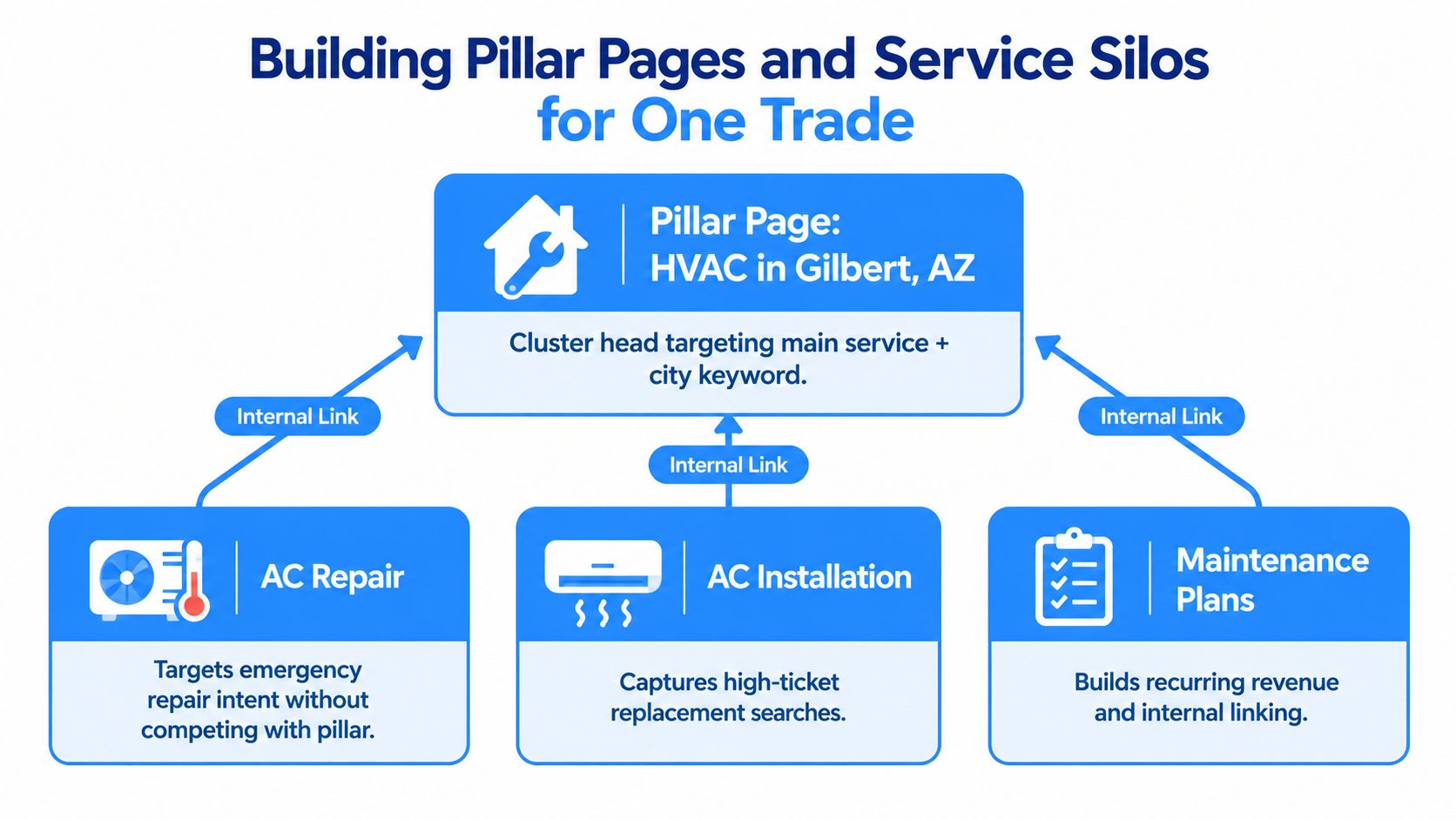
Use links to clarify hierarchy
The pillar links down to its children. Each child links back to the pillar. Sibling pages link to one another only when the homeowner's decision naturally crosses services, such as AC repair linking to AC replacement or maintenance plans.
Google Business Profile posts and city landing pages should support the same structure. A post about a failed compressor should link to the AC repair page. A project spotlight about a replacement should link to AC installation. A review page can reinforce the service and city combination, but it shouldn't become an orphan asset with no connection to the relevant silo.
Thin city pages create noise. Publish a city page only when you can provide at least 500 words of locally specific content, including details such as permits, climate conditions, common system brands in that ZIP code, housing patterns, and service constraints. The 500-word requirement comes from the operating standard for this architecture, not a universal Google rule. If you can't make the page local, don't publish it.
Keep the industry separation strict. Roofing gets a roofing pillar. Dental gets a dental pillar. HVAC gets an HVAC pillar. This makes it easier to match the page to a transactional search and prevents a generic “local services” article from diluting the business's relevance.
Writing Posts That Beat the AI Overview Funnel
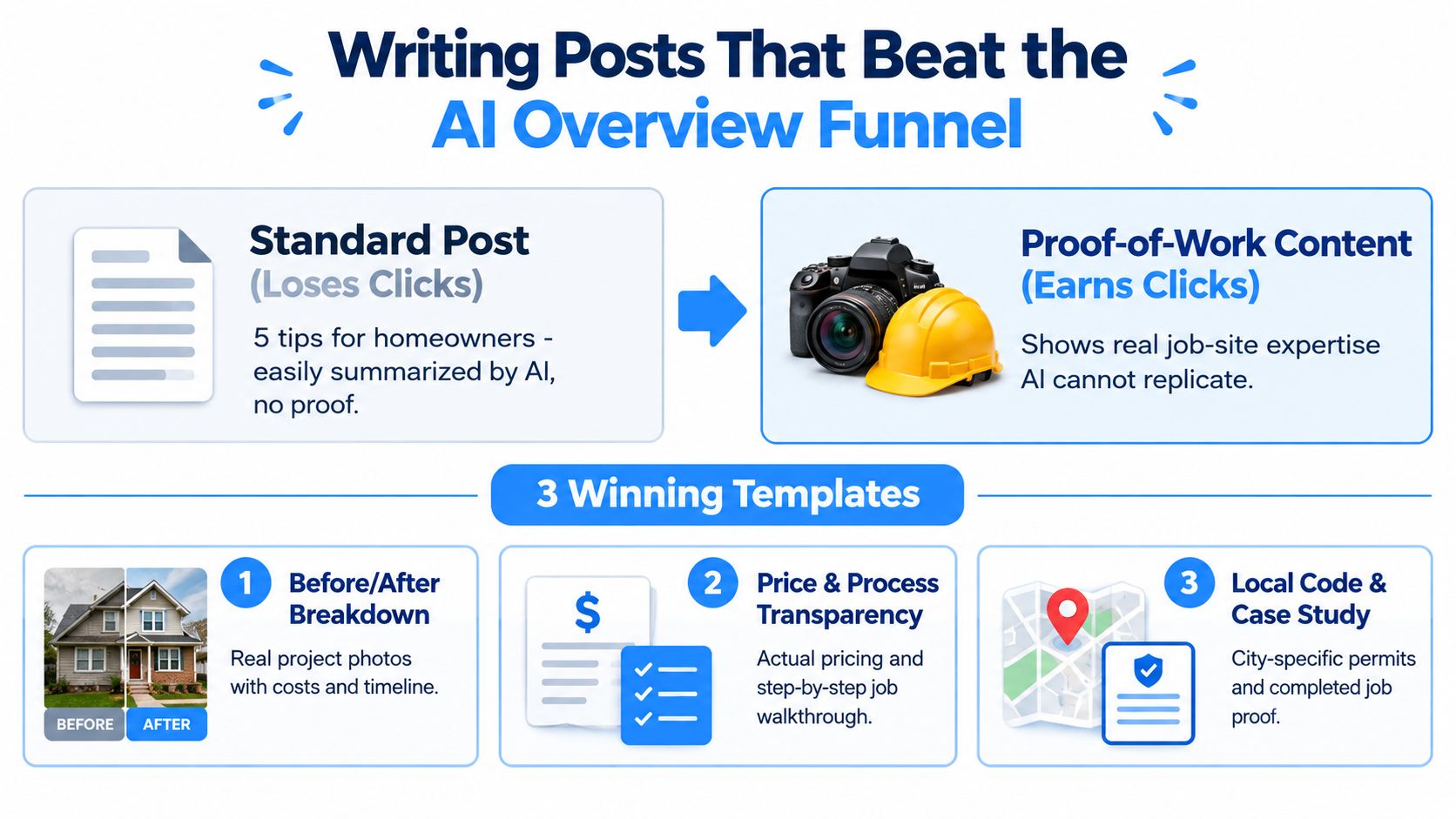
Generic homeowner advice is easy for an AI system to summarize. A post titled “5 tips for maintaining your AC” may be useful, but it rarely gives the searcher a reason to choose your company. Proof-of-work content earns attention by showing what your team does.
Use three repeatable formats.
Job Story posts
Document the problem, diagnosis, repair, and result. Name the city, explain what the technician found, include a realistic price range when the business can support it, and show the project with original photos. A roofing post might explain how hail damage was identified, which areas required replacement, what insurance documentation was prepared, and how the finished roof looked.
Price-Decision posts
Answer the question contractors often avoid. Explain cost ranges by scenario, the factors that move the price, and what a fair quote includes. For a water heater page, that might mean separating repair, replacement, equipment type, access difficulty, code requirements, disposal, and warranty coverage.
Local Proof posts
Show work that happened in a specific neighborhood or city. Mention the permit pulled, the local code issue addressed, the crew's process, and the completed result. This content gives an AI system concrete facts to interpret and gives a homeowner evidence that your team works in the area.
Field footage beats stock photography because it proves the crew, property, process, and result. A short walk-through can explain a technical decision more efficiently than a long explainer, provided the video includes a useful answer and a clear next step.
Score every post with four questions:
- City: Does it name the actual service area?
- Price: Does it explain cost or the factors that affect the quote?
- Crew: Does it identify the technician, team, or operating process?
- Next question: Does it answer what a homeowner will ask after reading?
Link every post to one transactional parent page. A Job Story about AC replacement should point to AC installation. A price guide about roof repair should point to the roof repair service page. The educational content creation framework can help turn customer questions into supporting content without letting those articles float away from revenue pages.
Treat Google Business Profile as a publishing channel
A complete profile supports local relevance and prominence. Google's local pack is commonly explained through relevance, distance, and prominence, which means profile fit, proximity, reviews, and citations all influence local visibility. Google local pack guidance provides the underlying local-search context.
Align the primary and secondary categories with real money services. Write service areas using clear city and service phrasing. Publish Google Business Profile posts weekly in a four-post rotation:
- Job: A completed repair, installation, or project.
- Offer: A legitimate seasonal or service-specific offer.
- Proof: A review, photo set, credential, or process explanation.
- Q&A: An answer to a question dispatch hears regularly.
Seed the Q&A area with the eight questions your office hears most often. Add original photos consistently, including a geo-tagged exterior, interior, job-site image, and team shot each week, with EXIF coordinates matching the service city.
Review activity should remain steady rather than arrive in one unnatural burst. A practical target is 8 to 12 new reviews per month, with service-specific language in the customer's own words and detailed owner replies. The review target and local prominence strategy should follow the business's actual capacity and compliance requirements.
Every GBP post should link to a relevant pillar or service page. Every pillar page should make the Google Business Profile landing URL easy to find. That connection turns field activity into a unified local search system.
Distributing Content Through Email Ads and Short Form
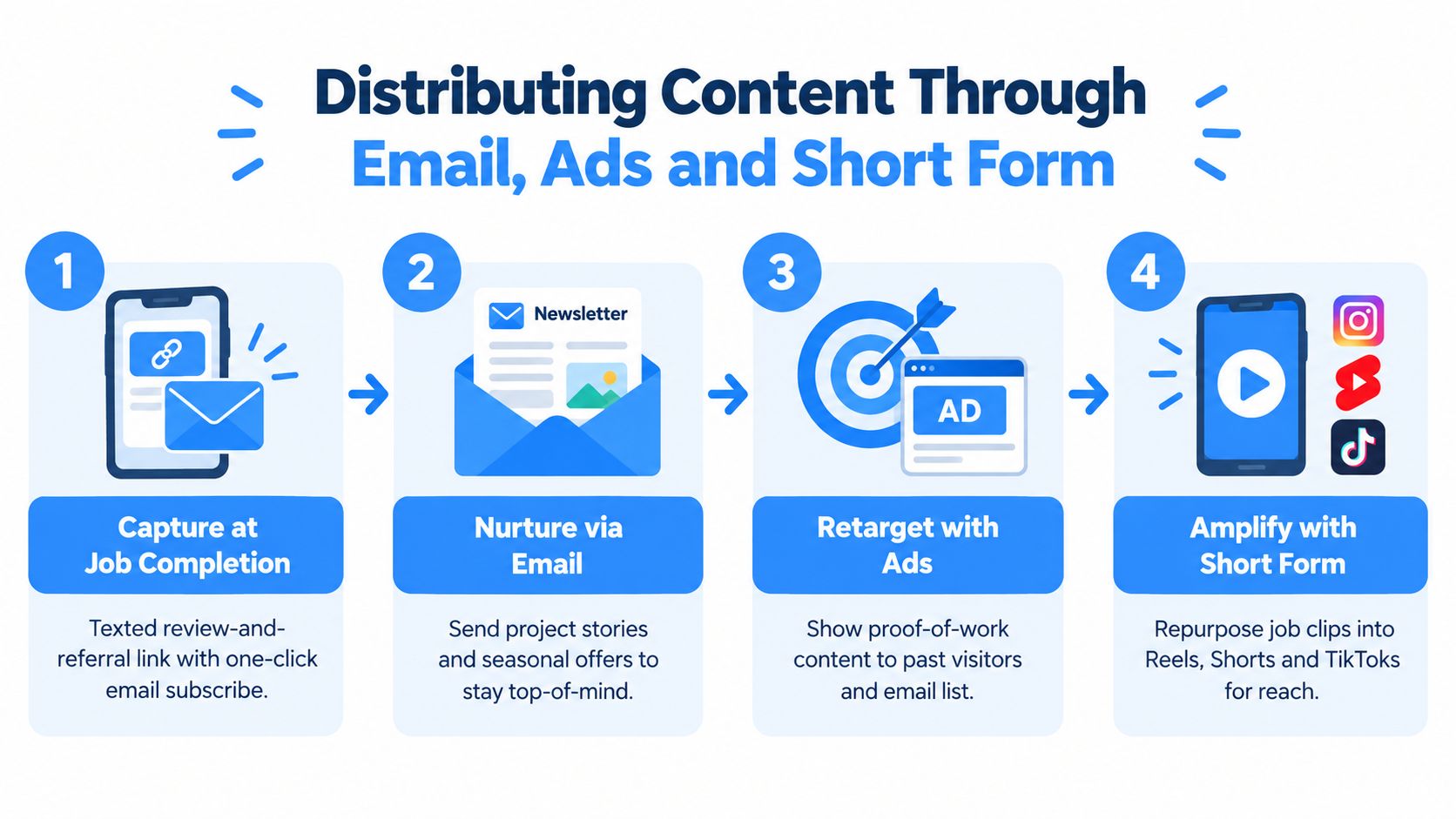
Distribution starts when a job ends. Contractors already have field footage, customer contact details, and service pages that can support follow-up. Turn those assets into repeatable touchpoints tied to the service pages that need Google Maps visibility and answers that AI overviews can use.
Send a texted review-and-referral link after completion, with a clear option to join a monthly maintenance series. Follow with useful email content, such as a seasonal checklist, project story, or preparation guide. Keep promotions occasional. The goal is to stay present until the next service need, not train homeowners to ignore every message.
Repurpose one job across three channels
One installation can produce a Job Story page, short-form clips, an email, and a GBP post. Cut the same field footage into three Reels and two TikToks, then direct each viewer to the matching service page. Preserve the diagnosis. A technician explaining why a component failed gives prospects a reason to trust the contractor and gives search systems specific material to understand.
Use social listening for contractors to find recurring customer language, objections, and local conversations. Turn those patterns into posts, FAQs, email subjects, and service-page sections.
Paid traffic comes after the landing page is ready, indexable, and aligned with one service and city. Before spending, review these paid media examples to see how narrow service-plus-city campaigns are structured. Send clicks only to a page that explains the service clearly and supports the same local intent as the ad.
Budget discipline: Bid on transactional service-plus-city terms, target the actual service radius, exclude branded competitor queries, and set the daily ceiling at 1.5 times the target cost per booked job.
For home services, Google Ads benchmarks report an average conversion rate of 7.98% and an average CPA of $66.02, while category landing pages average 4.10% conversion. The home-services benchmark supports a narrow funnel: one service, one city, one primary CTA, and close intent matching.
Build referrals into the same follow-up. Send a short homeowner email with the next seasonal maintenance checklist. Rework that checklist into an article, GBP post, and referral prompt. Paid media should amplify pages that already answer money-in-hand searches such as “roofer near me” and “dentist near me”, not rescue vague content.
Measuring What Actually Books Jobs and Phone Calls
Contractors don't need a complicated analytics meeting. They need a short weekly review that answers four questions: Which service-city searches are visible? Which profiles generate calls? Which pages attract buyers instead of browsers? What does each booked job cost?
Open the Google Business Profile call logs and review calls for the three highest-value services. Filter out calls under 90 seconds when those calls are unlikely to represent a real sales conversation. Then check a map-pack tracker scoped to one service city per trade. A wide, unfocused ranking report hides the actual problem.
Search Console should separate T1 transactional queries from T2 and T3 queries. If informational terms dominate, the content silo may be attracting researchers without directing enough qualified demand to service pages. Review the blended cost per booked job, combining GBP calls, organic calls, and paid calls into one operating number.
The owner-operator dashboard
| KPI | Healthy range | Action threshold | Move to take |
|---|---|---|---|
| Map-pack position | Top three for priority service-city searches | Below #3 after week 8 | Fix GBP content cadence before adding pages |
| Cost per booked job | Below the value the ticket can support | Above $120 for a $400 ticket | Pause ads and increase review velocity |
| Query mix | Transactional terms support the silo | Informational queries exceed transactional queries by 3 to 1 | Reassign content toward service and city pages |
| GBP call quality | Calls from priority services show buying intent | Repeated short or irrelevant calls | Refine categories, service wording, and profile messaging |
The thresholds should drive action, not debate. If the map position slips below the top three after week eight, publish more generic articles only after fixing the profile and local proof. If paid acquisition costs more than the job can support, pause the campaign instead of protecting a bad number.
Track calls with a system such as the phone call tracking setup and connect the data to the CRM. Record the service requested, city, lead source, booked status, and revenue where possible.
Ignore sessions, impressions, and follower counts unless they explain a business outcome. Those metrics can reveal reach, but they don't pay invoices. A contractor should scale content that produces qualified calls and booked work, repair pages that attract the wrong intent, and stop activities that create attention without demand.
A 30 60 90 Day Rollout You Can Hand to a Crew
The first three months should produce a working acquisition system, not a pile of posts. Assign ownership to an office manager, dispatcher, field supervisor, or junior marketer, then review progress against business outcomes.
Days 1 to 30 build the foundation
Lock the keyword map and classify each term as T1, T2, or T3. Publish pillar pages for the top two revenue services in the home city, fully build the Google Business Profile, and stage 10 service-area pages for the second month. Make sure every page has one service, one city, and one primary CTA.
Days 31 to 60 distribute proof
Start the review-velocity process after completed jobs. Pull the first email list from customers who have opted in. Film four proof-of-work posts in the field, including at least one Job Story and one Price-Decision post. Launch low-budget Google Ads only to the two strongest organic pages, targeting transactional service-plus-city searches.
Days 61 to 90 measure and expand
Review the dashboard weekly. Add the second service area's silo only after the first city has a clear structure. Scale ad budget only in cities where the business already has map-pack visibility and the landing page converts qualified traffic.
The content engine should remain trade-specific. A roofing silo supports roofing searches. An HVAC silo supports HVAC searches. A dental silo supports dental searches. Don't combine unrelated industries or services into one oversized article, because that weakens the match between the page and the transactional query.
Skip infographics created only to fill a calendar. Skip LinkedIn posts that don't reach the actual buyer. Skip podcast guesting when the service pages and Google Business Profile are unfinished. Skip broad awareness campaigns before the company owns the searches that produce calls.
For contractors, the objective is direct: show up when someone searches “air conditioning repair near me,” “roofer near me,” “plumber near me,” or “dentist near me,” then make the next action easy. Content supports that outcome when it strengthens the service silo, Google Maps presence, and AI-readable proof at the same time.
Transactional LLC offers industry-specific local SEO, Google Maps optimization, AI-driven content planning, service-area pages, Google Business Profile support, website management, and paid campaigns for service businesses. If you want your contractor content tied to transactional searches and booked-job tracking, visit Transactional LLC and review the available local growth services.