


Emergency, scheduled, and research are the three plumbing search intents, and emergency and near-me queries still convert almost entirely through the Google map pack and click-to-call, not through AI Overviews. Local searches represent 46% of Google searches, 64% of local searches happen on mobile, and 78% of mobile local searchers visit or call a business within 48 hours according to an industry benchmark summarized by Plumbing SEO Agency.
A homeowner with water spreading across the kitchen floor doesn't want a 1,500-word explanation of pipe materials. They want a nearby plumber, a trustworthy profile, accurate availability, and a phone number that works. That's the commercial reality behind plumber search engine optimization.
Transactional Marketing builds its strategy around those moments when a customer has money in hand and is ready to hire. The target isn't empty traffic. It's searches such as “emergency plumber near me,” “burst pipe repair in Gilbert,” “water heater replacement,” and “sewer line repair [city].” Rankings matter only when they create calls, quote requests, direction requests, and booked jobs.
Why Most Plumbing SEO Targets the Wrong Searches
Plumbing queries fall into three distinct groups:
- Emergency intent: “Burst pipe repair,” “water heater leaking,” “24-hour plumber,” and “emergency plumber near me.” These users need immediate help and usually convert from the map pack, Google Business Profile, and click-to-call.
- Scheduled intent: “Water heater installation quote,” “repipe estimate,” “drain cleaning,” and “sewer line replacement.” These searches need map visibility plus a convincing service page and an easy quote form.
- Research intent: “Water heater versus tankless,” “signs of a slab leak,” and “how to stop a leaking pipe.” These searches rarely produce an immediate booking, but they can build brand recall and support later conversions.
That hierarchy changes the budget. A generic article about how plumbing works may attract readers who aren't ready to hire anyone. A properly built page for “emergency plumber in Gilbert” reaches someone who has already identified the problem and is choosing a provider. A dedicated sewer line replacement page does the same for a planned, higher-consideration job.
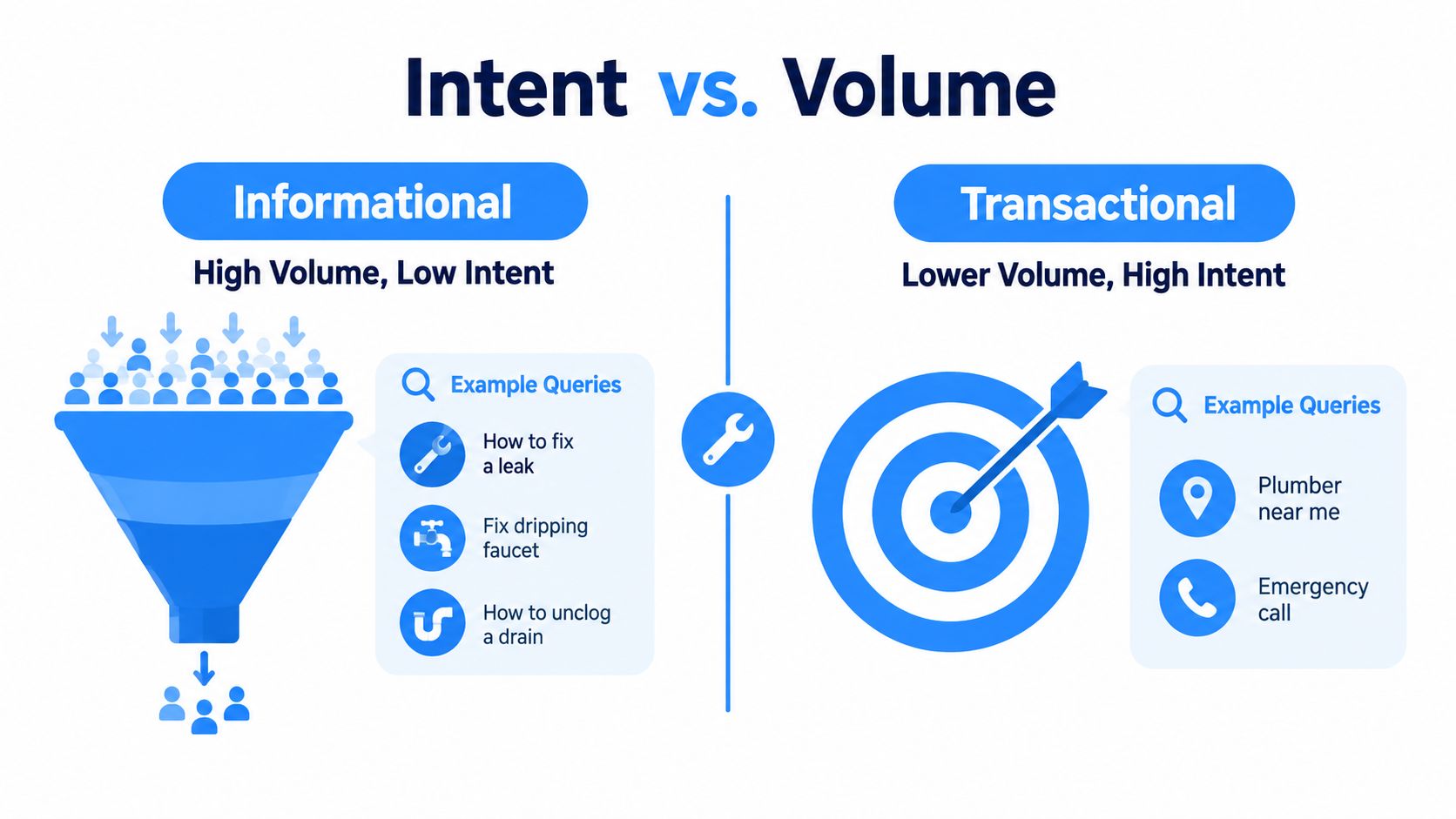
The map pack is especially important because 42% of local queries result in a click on the map pack in the same industry benchmark cited above. That doesn't mean every search produces a customer, but it does show why a plumber shouldn't treat Maps as a side project.
Practical rule: Build the page and profile for the job you want booked, not the topic that happens to have the largest apparent audience.
Use research content as supporting material. Link it to the relevant service page, include a clear next step, and measure whether it assists a call or quote request. Don't let informational traffic become the primary success metric. For most plumbing campaigns, transactional search terms are the asset that pays the invoices.
The Three Variables Google Uses to Rank Plumbers
Google describes local ranking through relevance, distance, and prominence. Its Business Profile ranking documentation doesn't publish fixed numeric weights, so any agency promising a guaranteed formula is selling fiction. Each variable still points to a specific action plan.
Relevance means the profile and website match the searcher's need. A profile categorized only as a general contractor sends weaker signals for “water heater repair” than a complete plumbing profile with accurate services, a clear description, and a dedicated water heater page. Use the language customers search for, including “clogged toilet repair,” “gas line repair near me,” and “emergency drain cleaning.”
Distance is largely determined by where the searcher is located. You can't move the business closer by stuffing cities into the business name or creating fake offices. Publish service-area pages only for towns where the trucks genuinely respond, and make those pages useful rather than swapping one city name for another.
Prominence is the lever a plumbing company can actively improve. Legitimate reviews, accurate citations, local mentions, supplier relationships, and relevant links help establish the business as a known provider. The quality of the profile and website still matters, but prominence gives a credible plumber more opportunity to compete with an established listing.
| Ranking Variable | What It Means for Plumbers | Primary SEO Action | Typical Impact |
|---|---|---|---|
| Relevance | The business matches the requested service and intent | Align categories, services, profile copy, and pages with real queries | Better matching for specific plumbing searches |
| Distance | The searcher is geographically close to the business or service area | Define realistic service areas and publish useful local pages | Determines which searches the business can realistically compete for |
| Prominence | Google and customers recognize the business as established and credible | Earn legitimate reviews, citations, links, and local mentions | Strengthens competitiveness within the relevant area |
Track these variables separately. If a profile appears relevant but sits outside the map pack, the problem may be prominence or distance. If it ranks for “plumber” but not “water heater replacement,” relevance is probably underdeveloped. That diagnosis is more useful than blindly publishing another blog post.
Winning the Map Pack With Google Business Profile
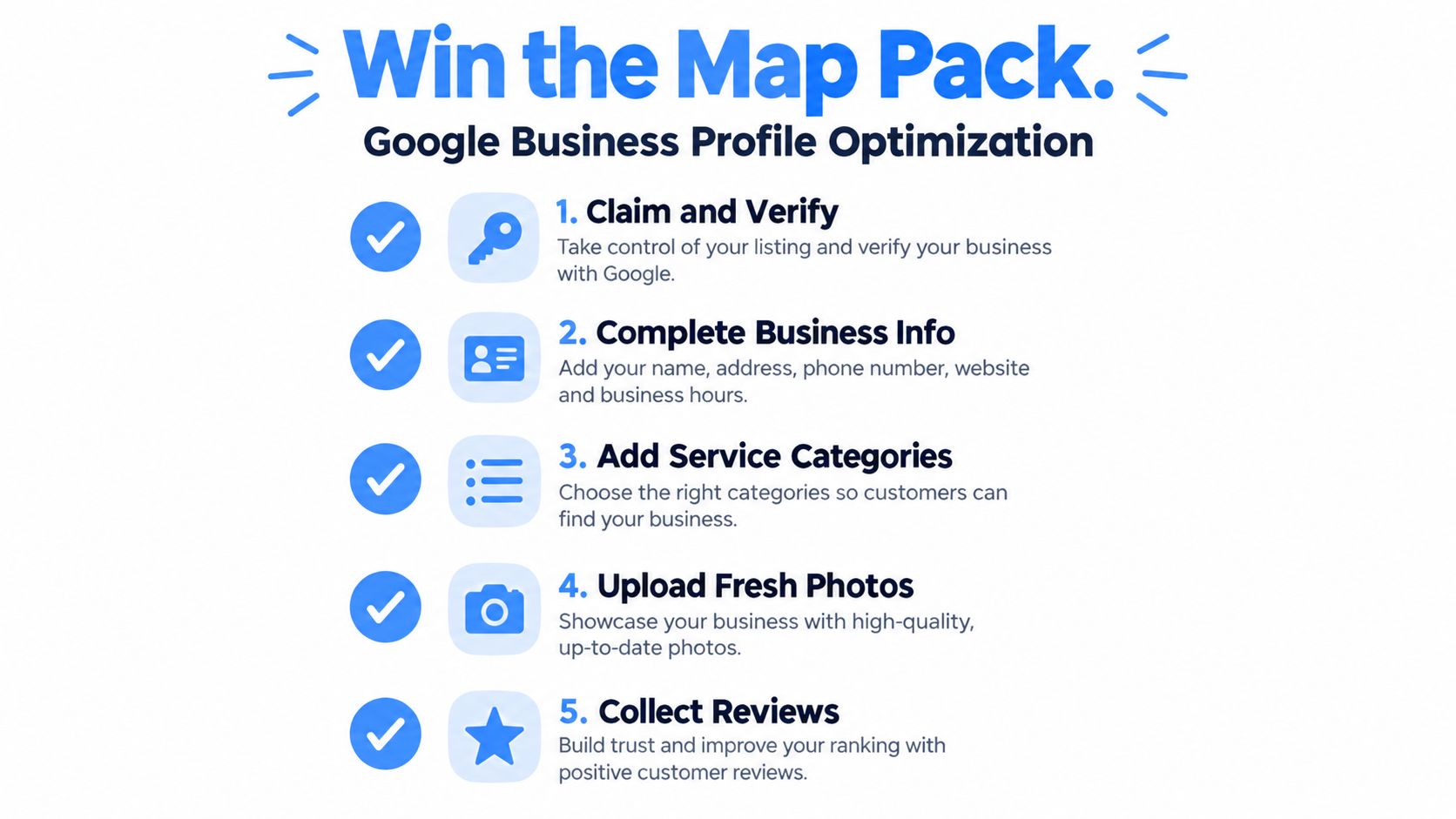
A Google Business Profile is the operating center of plumber search engine optimization. It feeds the map pack and local discovery, and it puts services, hours, reviews, directions, and the call button directly in front of a high-intent customer.
Start with the basics. Claim and verify the profile, use the actual business name, select Plumber as the primary category, and add relevant secondary categories such as Emergency Plumber, Water Heater Installation, Drainage Service, or Gasfitter where those categories accurately reflect the business and licensing permits the service. Don't add categories just because they sound attractive.
Complete every available field:
- Business details: Use the correct name, phone number, address, hours, holiday hours, and service-area information.
- Services: Add individual services such as leak detection, sewer repair, drain cleaning, and water heater installation.
- Description: Explain what the company does and where it operates without keyword stuffing.
- Photos: Upload real images of technicians, trucks, completed work, equipment, and the team.
- Contact paths: Enable messaging where it can be answered, use a trackable call process, and keep click-to-call prominent.
- Updates: Publish useful Google posts that support current service priorities and link to the relevant page.
Google's Business Profile performance documentation specifically covers profile views, searches, phone calls, and direction requests. Those actions are more valuable than an unexplained visibility score because they show whether local discovery is producing behavior that can become a job.
For a practical contractor-focused reference, review this guide by Northpoint Web and compare its local listing recommendations with your current profile. Then use this Google Maps optimization guide to audit the profile, local relevance, and conversion path.
Don't confuse activity with progress. Weekly photo uploads won't rescue a profile with the wrong phone number, missing hours, weak reviews, or an unanswered emergency call. Profile accuracy comes first, conversion tracking comes second, and publishing activity supports both.
Service Pages and City Pages That Convert
Build one focused page for each high-value plumbing service. A single “plumbing services” page cannot satisfy every search or convert every visitor. Create dedicated pages for water heater replacement, drain cleaning, sewer line repair, and emergency plumbing, then match each page to the job intent.
Emergency searches need speed and a direct phone action. Scheduled searches need scope, service areas, pricing factors, warranty details, and a quote path. Research searches need clear explanations that help someone choose a solution before they contact a plumber. Measure emergency pages by qualified calls, scheduled pages by calls and form submissions, and research content by assisted conversions and branded searches. AI visibility can help research content, but it does not replace a strong service page for an urgent repair.
Place the target service in the title tag, H1, URL, opening copy, internal links, and relevant structured data. Answer the questions that decide whether a visitor contacts the company:
- What problem does the service solve?
- What happens during the visit?
- What areas does the crew cover?
- What affects the price?
- What warranty or workmanship terms apply?
- What should the customer do while waiting?
City pages need proof, not swapped-out location names. Mention neighborhoods only when the company works there, show relevant project proof, and keep business details consistent across the page footer and profile. Use a service-area page framework to separate genuine local coverage from thin doorway pages.
Google's LocalBusiness structured data guidance covers details such as business hours and organizational information through supported markup. Validate the implementation with the Rich Results Test, inspect the URL in Search Console, and confirm that Google can crawl the page. Structured data clarifies page content. It does not guarantee rankings or a rich result.
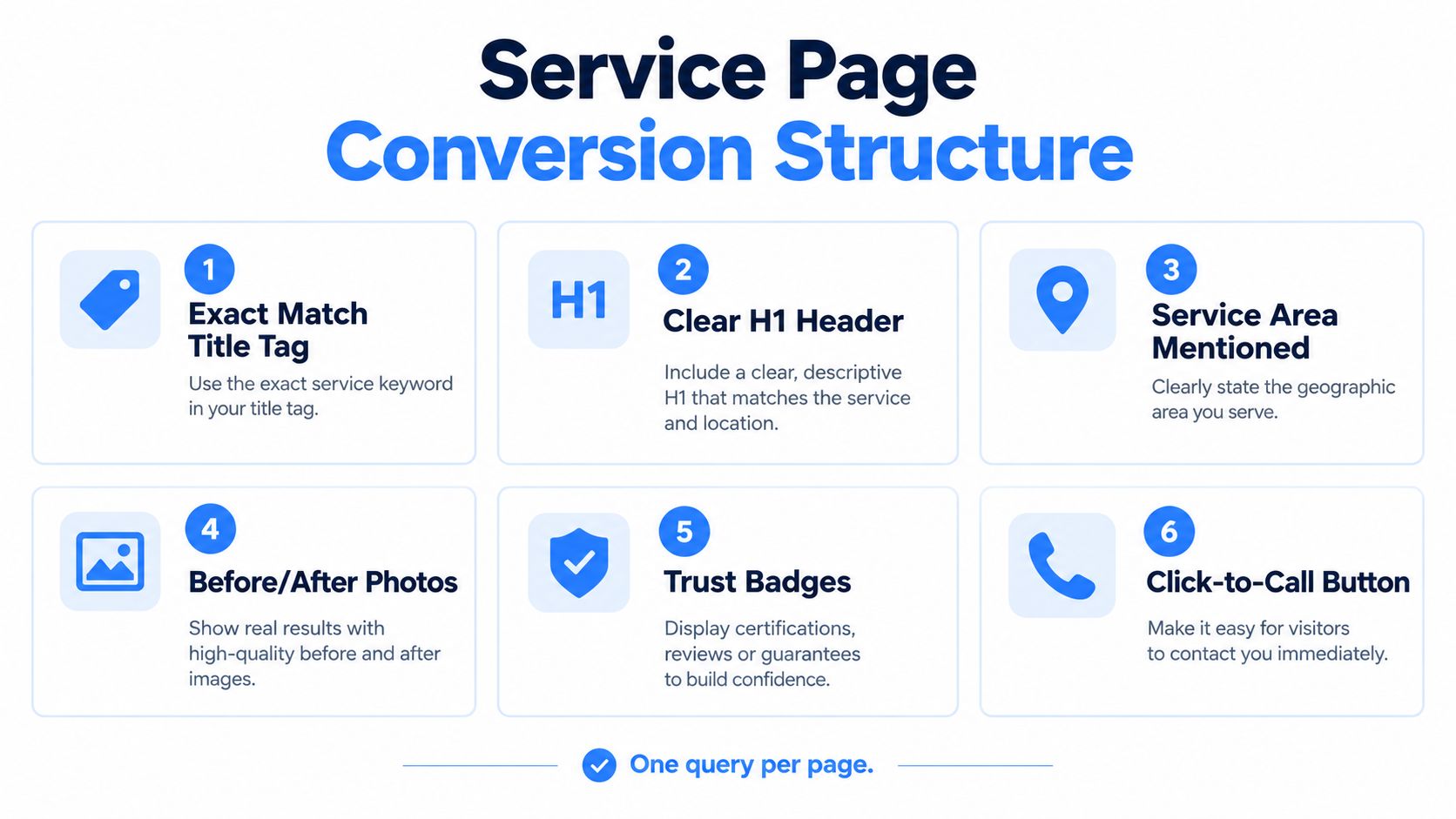
Use a clear internal-link structure. Connect emergency plumbing pages to relevant emergency city pages, link water heater articles to the water heater service page, and place a visible phone button above the fold on mobile. The page should make the next action obvious. If visitors must hunt for a phone number or question whether the company serves them, rankings are producing traffic without enough booked-job value.
Where AI Visibility Helps Plumbing Companies and Where It Does Not
AI visibility is useful, but it isn't a replacement for local search fundamentals. The difference comes down to intent.
Research and hybrid queries are more likely to trigger AI Overviews. Available 2025 local-search research reported AI Overviews for about 68% of local-business queries overall, compared with 15% of direct service-plus-location or near-me searches. Informational queries appeared at roughly 92%, and hybrid queries at roughly 97%, according to Minneapolis Made's analysis of AI and local search.
That distribution tells plumbers where to invest. An article explaining tankless versus tank water heaters may help an AI system summarize options and cite a credible source. A page targeting “burst pipe repair near me” needs proximity, availability, reviews, a strong profile, and a phone button. The map pack is usually the more direct commercial surface.
| Query Type | Example | AI Overview Present? | Conversion Source |
|---|---|---|---|
| Emergency | “Burst pipe repair near me” | Less likely than informational searches | Map pack, call button, direct phone call |
| Scheduled | “Water heater replacement in Gilbert” | Limited and variable | Map pack, service page, quote form |
| Research | “Tankless versus tank water heater” | More likely | Educational content, brand recall, later assisted conversion |
Google's documentation for AI search features states that websites don't need special schema markup specifically for AI features. There is no magic “AI ranking schema.” Clear business information, crawlable pages, useful content, and ordinary Search fundamentals remain the foundation.
AI optimization should follow the map pack and service pages, not compete with them. For a broader implementation view, see this AI search engine optimization resource. Track brand mentions and assisted conversions, but don't mistake an AI citation for a booked plumbing job.
Trust Signals That Turn AI and Map Views Into Booked Jobs
AI recommendations don't remove the need for verification. They increase it. A homeowner who sees a plumbing company mentioned in an AI answer still checks the Google profile, reviews, website, service area, availability, and phone number before allowing a technician into the home.
A 2025 consumer survey reported that 27% of respondents had used AI to find a local business during the prior week, while 57% didn't expect their local-search habits to change over the following six months. The same survey found that traditional search remained preferred for high-stakes decisions such as hiring contractors, as reported by Youtech's AI local search consumer report.
That makes trust verification more important than speculative AI tactics. Keep these facts aligned everywhere:
- Business identity: Use the same legal or public-facing business name across the website and profiles.
- Service coverage: List only cities and neighborhoods the company serves.
- Availability: State emergency hours accurately, including holiday coverage where relevant.
- Credentials: Display licensing, certification, and insurance claims only when they can be verified.
- Proof of work: Show real project photos, team images, warranties, and service-specific reviews.
- Contact information: Make the phone number, quote form, and response expectations easy to find.
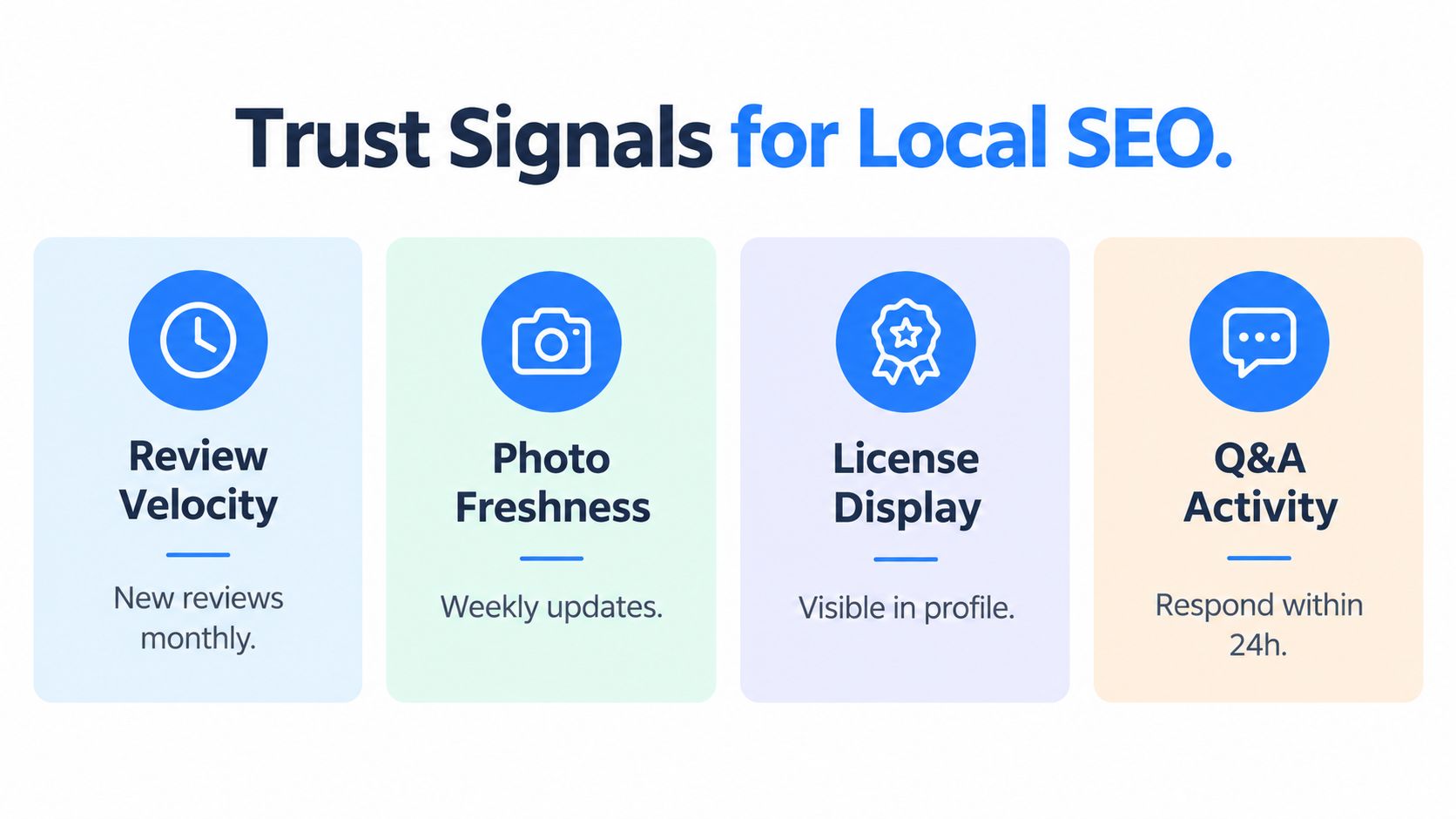
Reviews should mention real services and customer experiences, but never pressure customers to provide misleading language. Respond to positive and negative feedback professionally, answer profile questions accurately, and fix conflicting business details before chasing more links.
A strong profile can still lose the job if the website is slow, the mobile phone button is buried, or nobody answers the call. SEO creates the opportunity. Operations and trust signals decide whether the opportunity becomes revenue.
Content Silos Built Around Transactional Plumbing Searches
A plumbing content silo should match the reason someone searches, not just the service name. Separate pages and measurement for emergency, scheduled, and research intent. Each category has a different route to revenue.
Build pillars around booked jobs
Use Google Business Profile reporting and Search Console to group queries by service, city, and intent. Start with revenue-producing pillars such as:
- Emergency plumbing: Burst pipes, urgent leak repair, 24-hour plumbing, and emergency drain problems.
- Water heaters: Repair, replacement, installation, maintenance, and tankless comparisons.
- Drain and sewer: Drain cleaning, sewer line repair, camera inspection, and recurring blockages.
- Leak services: Leak detection, slab leaks, pipe leaks, and water damage prevention.
Give every pillar a primary service page. Support it with pages that answer objections and move visitors toward a call or quote.
Emergency searches need short paths, prominent phone actions, accurate availability, and call tracking. Measure answered calls and booked emergency jobs. Scheduled searches, such as replacement or installation queries, need service details, quote forms, and location relevance. Measure form submissions, qualified leads, and booked appointments. Research searches can support both groups through useful explanations, but they should not consume the budget before commercial pages work.
Build supporting pages with a job in mind
An article answering “How do I know if my water heater needs replacement?” should link directly to the water heater service page. A pricing article can explain quote factors without inventing a dollar amount. A local job story can describe a real sewer project in a service area when the company approves publication.
Use internal links deliberately:
- Link from the homepage to priority service pages.
- Link supporting articles to the relevant service pillar.
- Link each service page to genuine city pages.
- Connect closely related services when the customer benefits.
- Keep the phone path visible on every commercial page.
Add local proof and intent-specific calls to action
A city page earns a place in the silo only when it adds local evidence. Require a real service-area detail, a relevant project or team reference, operating information, and a clear next action before publishing it. If the page cannot pass that test without swapping the city name, do not launch it.
Keep city pages focused on distinct service demand rather than producing a page for every nearby place. Review them for impressions, calls, and quote activity. Remove or consolidate pages that attract no relevant engagement after a meaningful test period.
Google's LocalBusiness structured data documentation explains how to describe the business entity, but markup cannot make weak content useful. Add FAQs only when they answer genuine customer concerns and the answers appear visibly on the page.
AI visibility can help research searches and higher-consideration scheduled work, where customers compare options before contacting a plumber. For urgent leaks and burst pipes, the map pack, phone button, and fast response still matter more. Build the silo around the action that produces the job.
Measuring Calls, Directions, and Real Revenue From SEO
A ranking report can look impressive while the phones stay quiet. Measure the actions that connect search visibility to sales activity.
Google Business Profile reporting includes profile views, searches, phone calls, and direction requests. Google defines a call as a customer clicking the call button on the profile, while directions represent customers requesting navigation. The reporting can separate activity from Google Search and Google Maps, giving a plumbing company a useful view of high-intent behavior.
Set up measurement in a clean sequence:
- Track profile actions: Monitor calls, direction requests, and profile discovery by service and location where the data allows.
- Configure call attribution: Use call tracking and dynamic number insertion carefully so organic, profile, paid, and referral calls aren't counted twice.
- Track website actions: Record click-to-call events, quote forms, booking submissions, and contact requests in GA4.
- Use Search Console: Compare queries, impressions, clicks, and indexed pages before and after service-page changes.
- Connect outcomes: Mark whether the lead was answered, qualified, booked, or lost, then compare the result by source.
| Metric | Source | What to Watch | Action Trigger |
|---|---|---|---|
| Profile calls | Google Business Profile | Calls by service period and location | Improve hours, response handling, and service relevance |
| Direction requests | Google Business Profile | Areas producing navigation activity | Check address accuracy and local coverage |
| Organic click-to-call | GA4 and call tracking | Service pages generating calls | Strengthen pages with traffic but weak actions |
| Quote forms | GA4 or CRM | Completed forms by landing page | Simplify forms and clarify the offer |
| Search queries | Search Console | Transactional terms and page alignment | Create or revise a page for a clear query gap |
| Booked jobs | CRM or office records | Revenue by lead source | Shift attention toward sources producing real jobs |
Use a weekly operating rhythm. Review missed calls, compare profile actions with booked jobs, inspect new queries, and identify pages that attract visits without generating contact. A city page with direction requests but few calls may have a trust, availability, or phone-path problem rather than a ranking problem.
For a more detailed call attribution workflow, use this phone call tracking guide. The reporting system should help an owner decide what to fix next, not bury the business in charts that never influence scheduling.
Transactional LLC offers plumbing-focused local SEO, Google Maps optimization, service-area page strategy, AI-assisted content planning, Search Console reporting, rank tracking, and call measurement. Visit Transactional LLC to connect your plumbing services with the transactional searches that lead to booked jobs.