


50% of consumers who performed a local search on a smartphone visited a store within one day, according to Google's commissioned study with Ipsos MediaCT and Purchased, which analyzed more than 5,000 U.S. smartphone users. That finding puts Google My Business profile optimization in the right frame: you're not maintaining a directory entry. You're helping someone decide which business to contact when they're ready to act.
Why Your Profile Decides Who Calls First
An air conditioner fails at 9 pm, and the homeowner's next move is a search: air conditioning repair near me. They compare the businesses Google shows, check who is open, and tap a phone number. Nobody in that moment is researching cooling equipment. They want someone who can fix the problem tonight.
That query is a transactional search term, one that signals an immediate commercial need rather than general interest. Transactional Marketing focuses on helping local service businesses appear for the specific services customers search for in the cities where they are ready to buy. For an HVAC company, visibility to searchers inside its service area matters far more than exposure to people it can never reach.
The decision happens before the website visit
A profile with clear services, believable photos, accurate hours, and an answered phone gives that homeowner a usable next step. A listing that advertises emergency availability but routes callers to an unexplained voicemail creates friction at exactly the wrong moment, and the next competitor is one screen away.
Location-specific directories illustrate the same decision process. Someone comparing iPhone repair shops in Pennsylvania needs a nearby provider and enough practical detail to make contact. For an HVAC business, the equivalent questions are repair availability, service coverage, and whether a technician can help now.
Practical rule: Optimize for the customer's next action, not for the largest possible collection of keywords.
The name changed, but the job remains practical
Google renamed Google My Business to Google Business Profile in November 2021 and moved day-to-day management into Search and Maps, as described in Google's Business Profile announcement. Owners still say GMB, but GBP is the current abbreviation, and both refer to the same profile.
The practical work is field accuracy, eligibility, local relevance, and lead measurement. AI-assisted discovery gives you one more reason to keep business facts dependable, though it changes nothing about the fundamentals.
Restraint protects visibility better than volume. A business name that matches real-world signage, one listing per eligible location, and reviews earned at a natural pace keep a profile working. Keyword-stuffed names and duplicate listings are the edits most likely to cost a business its map placement, and recovering that placement takes far longer than the shortcut ever saved.
Every Profile Field and What It Controls
Use this working reference to separate fields that describe your business from fields that help customers take action.
Business Profile fields, their function and correct setting
| Field | What It Controls | Set It Like This | Common Mistake |
|---|---|---|---|
| Business name | Brand shown on Maps and in search results | Match real-world branding across signage, website, and business records | Adding city or service keywords to the name |
| Primary category | Which core searches the profile can match | Choose the closest category to the main business, such as HVAC contractor | Picking a vague label such as Business service |
| Secondary categories | Additional relevant searches | Add only categories representing work the business actually performs | Stacking unrelated categories to widen matches |
| Services | Specific jobs listed with descriptions | Use customer language, such as AC tune-up or furnace repair | Pasting a generic service list into every location |
| Service area or location | Geographic information used in local discovery | Use real offices or eligible service areas | Listing cities the business can't serve |
| Hours | Whether searchers can act right now | Maintain regular, holiday, and genuine emergency availability | Leaving seasonal or holiday hours outdated |
| Phone number | The call button and call routing | Use a business-controlled local number answered during stated hours | Sending callers to unexplained voicemail |
| Website link | The destination after a website click | Use the most relevant service-and-city page that represents the profile | Defaulting to the homepage regardless of visitor intent |
| Description | Plain-language business context | Explain core services, actual coverage, and supportable distinctions in concise prose | Publishing keyword lists that read as spam |
| Attributes | Available service and accessibility details | Select only true, verifiable attributes | Claiming features the business doesn't provide |
| Products | Visible items and eligible offers | Include only genuinely available items or offers where appropriate | Inflating the list without matching availability |
| Q&A and messaging | Pre-contact questions and available reply channels | Give accurate answers and monitor supported contact options | Leaving questions unanswered or advertising unavailable messaging |
Start with the name and primary category. Your name identifies the business; it isn't a place to append every profitable service. Choose the category that describes what the company is, rather than the broadest option available.
Secondary categories should explain legitimate additional capabilities. Services can then describe individual jobs more precisely. An HVAC contractor might list AC repair, furnace repair, and maintenance, but shouldn't add categories for work it merely refers elsewhere.
Make the action fields work together
Check the phone, hours, and website destination as a connected customer journey. Call the listed number from a phone that isn't already in your business contacts. Confirm that the greeting identifies the company and that the person answering can book the services shown.
A tracked number can help attribute enquiries, but it must remain under the business's control and route reliably. MD TECH TEAM's guide to track calls with Google Business analytics provides useful context for connecting profile activity with call measurement. Don't treat a tracking setup as complete until you've tested the actual call path.
For the website link, choose relevance without creating a dead end. A useful local landing page should explain the service, establish real coverage, and provide a clear contact option. If your proposed service-and-city page is thin or outdated, improve it before sending profile visitors there.
Keep the description readable and within the editor's displayed limit. Explain what you repair, where you work, and what customers can expect. Don't fill the space with repeated city names.
Feature availability isn't uniform. Check the controls your profile provides before planning Q&A, products, or messaging workflows. Don't promise customers a contact channel that isn't available.
Before editing, mark every field correct, incomplete, or unsupported. An unsupported claim needs removal or evidence, not more persuasive wording.
Avoiding Suspension and Policy Problems Before You Edit
A keyword-stuffed business name can look like a shortcut: add AC repair, emergency service, and the city, then wait for more calls. The problem is that you've changed the business's identity to chase searches rather than represent its real-world branding.
Eligibility comes before optimization. Google's suspension and appeals guidance addresses representation problems and the evidence businesses may need during recovery, including business licenses, tax certificates, and other proof of eligibility. A business must make in-person contact with customers during its stated hours, whether customers visit an eligible location or the business travels to them.
Decide what kind of location you actually operate
An HVAC business run from an owner's home isn't automatically a customer-facing storefront. If technicians travel to customers and nobody receives visitors at the home, configure the business accordingly and hide the address where required for its service-area setup.
A warehouse used to store equipment also isn't necessarily a public office. Don't present a virtual office, mailing address, or unsupported location as a staffed place customers can visit.
Run this audit before changing high-risk identity fields:
- Confirm the operating model. Record whether customers visit the location, technicians visit customers, or both.
- Check the public name. Compare the profile with signage, the website, invoices, and business documents.
- Investigate duplicates. Resolve overlapping listings instead of creating another profile to escape an access problem.
- Document the location. Retain evidence that connects the business to its legitimate operating address.
- Log proposed edits. Save the current information, the intended change, and the reason for it.
Treat recovery as an evidence problem
If the profile is suspended, stop making speculative changes. Identify the representation issue, correct it, and prepare documentation that supports the corrected information. Adding photos and posts doesn't substitute for resolving an eligibility problem.
Our guidance on a suspended Google Business Profile explains the recovery considerations owners should address before trying to rebuild visibility. Keep the appeal consistent with the business information customers and Google can verify.
Removing an unsupported claim can protect more business than publishing another promotional update.
Restraint doesn't mean leaving a profile incomplete. It means refusing changes that make the listing look more commercially attractive while making the underlying business harder to verify. Protect the existing lead channel before attempting to expand it.
How Maps Rankings Use Relevance, Distance and Prominence
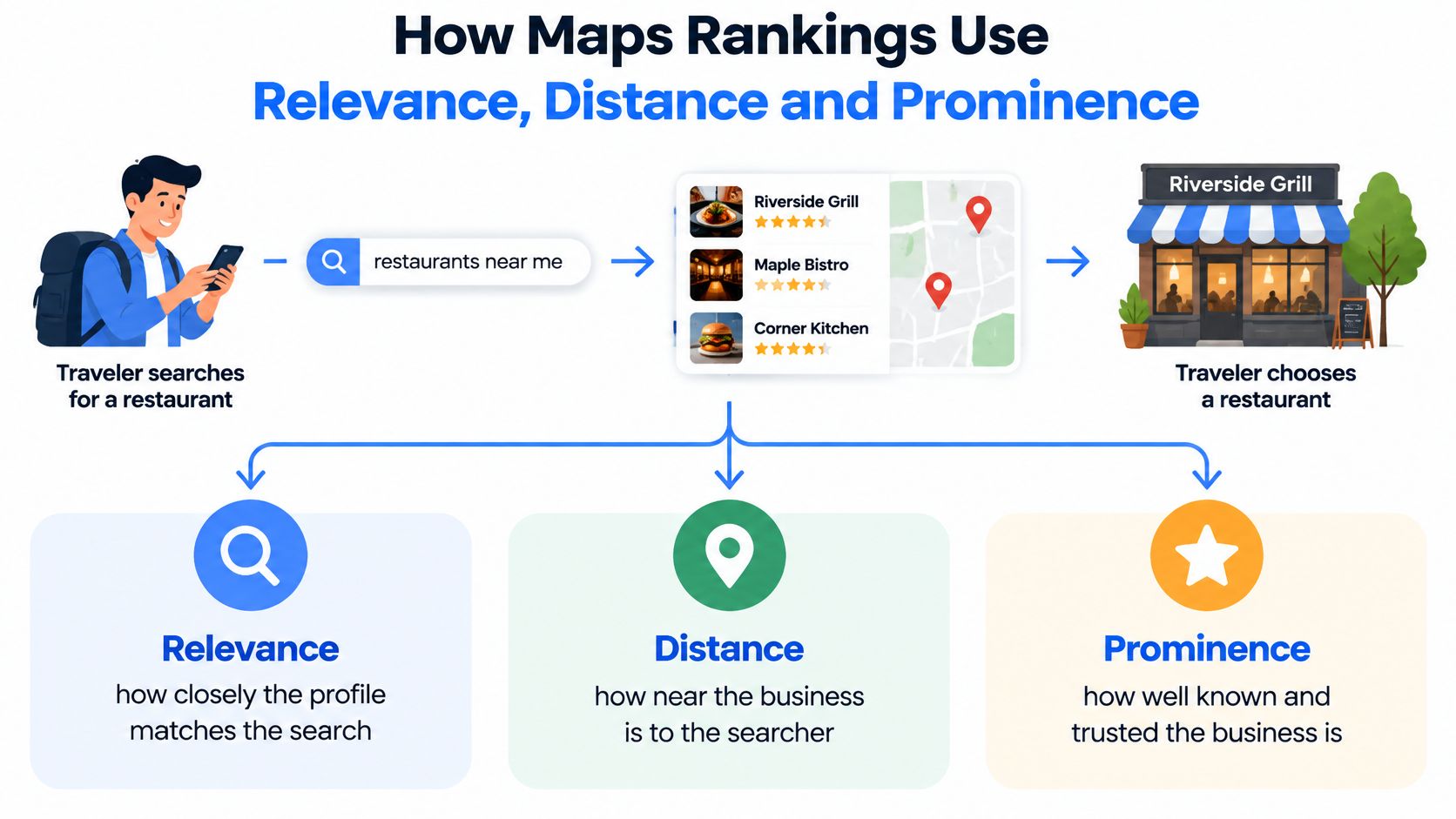
A traveller choosing a restaurant weighs what it serves, how far away it is, and how well known it is. Google uses a comparable framework for local results: Google's local-ranking guidance identifies relevance, distance, and prominence, with links, articles, directories, review quantity, and review sentiment among the information associated with prominence.
The diagram summarizes how those considerations shape a local choice.
Separate the settings you control from the geography you don't
Relevance asks whether the business matches the search. Accurate categories and a specific service list help establish that match. Repeating AC repair throughout every available field isn't a substitute for correctly describing the business.
Distance concerns the searcher's location or the location named in the query. Expanding a service-area list doesn't move your office or erase nearby competition. Build location relevance around real operations and genuine coverage, not invented branches.
Prominence concerns how well established the business is. Your website, independent mentions, directory presence, and customer reputation all contribute to the broader picture.
The practical order is to clarify the business first, align its public identity, build genuine customer feedback, and improve the linked website. TheBestReputation's explanation of on-page signals for local SEO is useful when checking whether the destination page supports the service and location represented by the profile.
For geographic testing, our explanation of Google Maps ranking factors provides context for interpreting visibility across a service area. A position checked from the owner's office isn't a complete account of what customers see elsewhere.
Apply the same factual discipline to AI discovery
Google's AI optimization guide identifies Business Profiles as a way to support local-business visibility in AI-generated responses and conventional search, and recommends keeping profile information current. That supports a practical approach to AI optimization: coordinate the business facts on your profile and website.
Maintain an accurate name, category, service list, coverage, hours, and contact details. On the website, use clear service pages and appropriate LocalBusiness structured data that reflects visible, accurate information.
This isn't proof that every LLM reads your profile directly or will recommend your business. Don't pay for an alleged secret field that guarantees inclusion in AI answers.
No profile setting guarantees a top-three Maps position. Rankings vary by query and searcher location. Fabricated addresses and manipulated reviews don't solve that underlying constraint, and they introduce risks that legitimate optimization doesn't require.
Photos, Posts and Services That Keep Searchers Engaged

A clear photo of a public-facing building with its sign visible helps customers recognize a real location. For an HVAC service-area business, customers never visit the office, so branded vehicles, equipment, and the actual crew provide more useful visual evidence than a storefront shot.
Photograph what customers need to understand
Prioritize a clean logo, technicians in branded uniforms, a company van, and work examples that show the service clearly. Check the background before uploading. House numbers, invoices, vehicle plates, and customer belongings can disclose information you didn't intend to publish.
Use before-and-after job photos only with the customer's written permission. Explain what changed without making claims the image can't establish. A photograph of a replacement unit can show workmanship, but it doesn't prove a particular energy-saving result.
- Choose recognizable subjects. Show the team, equipment, and work customers will encounter.
- Remove misleading assets. Retire photographs of former premises, outdated branding, or people no longer representing the company.
- Prefer original images. Generic stock photographs don't demonstrate your crew's capabilities.
- Assign collection responsibility. Have a named team member gather approved images after suitable jobs.
A small set of accurate photos protects the listing better than a large library of marginal ones. Every outdated or misleading image you leave up is a fact about the business you can no longer defend.
Give posts and services a useful job
I recommend a weekly photo batch and a weekly post as a manageable editorial routine, not as a ranking formula. Publish something a customer can act on: a pre-winter furnace reminder, a seasonal maintenance offer, or a clear explanation of an available repair service.
Use custom graphics in the business's branding. Keep the offer, landing page, and actual dispatch capability aligned. Don't advertise urgent appointments when the schedule can't accommodate them. A post that overstates availability generates calls you can't serve, and the disappointed searcher remembers.
The video below walks through the same profile decisions in another format.
Write short service descriptions using familiar terms such as AC repair and furnace tune-up. Where the interface allows pricing, a genuine starting price can help customers judge fit, provided you explain what it covers and what requires a separate estimate.
Say an AC repair searcher sees the actual crew and a clearly scoped diagnostic offer. They have a concrete reason to call, which a generic promotional line would never give them.
Review the services list monthly. Keep the publishing cadence steady, but skip an update rather than invent an offer or reuse an unsuitable customer photo. A profile stays strongest when every asset on it can be verified as accurate.
Citations and Reviews That Build Prominence Safely
The strongest review request is straightforward: thank the customer for the completed job and invite honest feedback through the business's review link. Don't suggest a star rating or hand the customer a paragraph to paste.
For an HVAC company, a customer's own description of a furnace replacement or AC repair is more informative than a generic compliment. You can invite customers to describe the work and their experience, but they should choose the wording.
Build feedback into the completed-job workflow
Send review requests after completed work, using the same eligibility rules regardless of whether you expect praise or criticism. Asking only satisfied customers while directing everyone else into a private complaint form creates a distorted process.
- Connect requests to real work. Use completed-job records to trigger invitations.
- Keep the request neutral. Don't offer rewards for positive sentiment or a particular rating.
- Retain supporting records. Preserve job completion and invitation records without publishing customer information.
- Keep vendors accountable. Reject purchased reviews, employee-authored customer reviews, and fabricated accounts.
- Respond thoughtfully. Address the substance of feedback instead of pasting an identical reply.
The downside extends beyond losing an individual review. Google's Fake Engagement restrictions guidance states that policy violations can prevent a profile from receiving new reviews, unpublish existing ratings, or cause a warning to appear to consumers.
Review standard: A slower flow of authentic feedback is preferable to a campaign you can't defend.
For multiple locations, centralize the rules but avoid manufacturing identical customer language. Investigate sudden bursts or repetitive wording rather than celebrating volume without checking its origin.
Make the business identity consistent elsewhere
Citations are mentions of the business's name, address, and phone details on sources such as directories, industry associations, trade listings, chambers of commerce, and local news sites. Start with relevant, credible sources rather than buying a large collection of unrelated listings.
Use a maintained master record for the business identity. Correct old phone numbers, former addresses, and conflicting business names. Minor formatting differences aren't the same operational problem as a number that reaches another company, so prioritize substantive errors.
Our guide to local SEO citations explains how to approach that consistency work. For a service-area company, keep public-address treatment appropriate rather than exposing a private residence merely to make every directory look identical.
Review replies also need restraint. Thank customers for positive feedback and respond to complaints without publishing job addresses, account information, private conversations, or other sensitive details. Move disputed specifics to an appropriate private channel.
During the monthly review check, assess authenticity, service detail, recency, sentiment, and source diversity, not just the average rating. Treat recency as a useful reputation-management signal rather than assuming a precise ranking weight. Track recurring complaints so the operations team can correct the underlying problem instead of asking marketing to conceal it.
Monitoring Calls, Directions and Search Queries
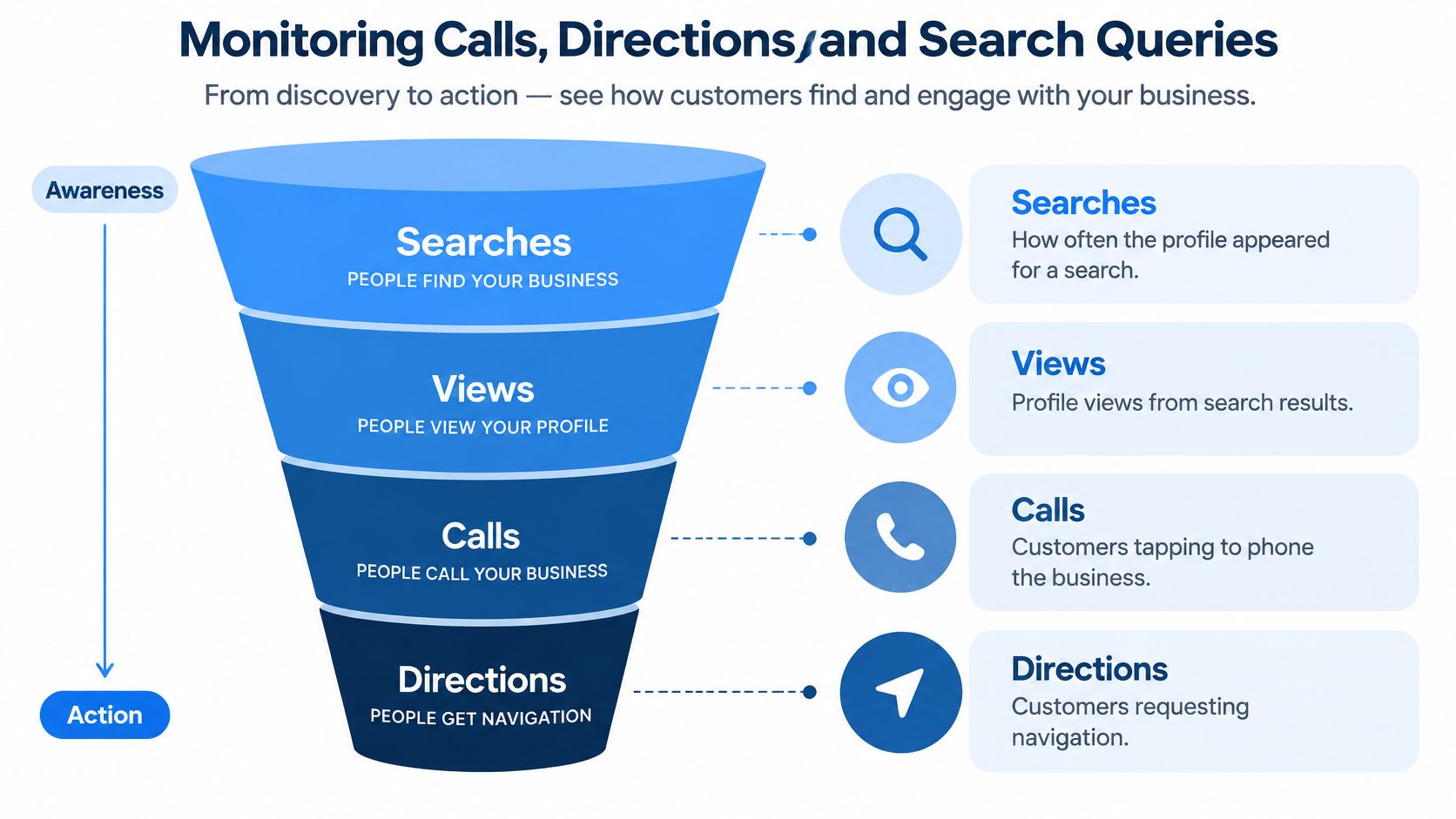
Treat profile reporting as a path from discovery to enquiry to booked work. Views can help you understand exposure, but they don't tell you whether dispatch received a qualified call or whether that caller became a customer.
Google's Business Profile performance documentation defines calls as clicks on the profile's call button and directions as navigation requests; it also says search-query data updates at the beginning of each month and can take up to five days to appear, while performance reporting can include activity from Google Ads. Those definitions matter when assigning credit for lead growth.
Google Business Profile metrics and how to use them
| Metric | What Google Counts | Best Used For |
|---|---|---|
| Searches | Searches through which people discovered the profile | Spotting demand patterns by service and location where query detail supports it |
| Views | How often the profile was viewed | Judging overall profile visibility trends |
| Calls | Taps on the profile's call button | Prioritizing phone-led service enquiries |
| Direction requests | Requests for navigation to the business | Understanding navigation interest for customer-facing premises |
The following diagram presents discovery and action in a simple reporting model. Calls and directions are alternative customer actions, not mandatory consecutive steps.
Reconcile profile actions with business records
For the HVAC example, calls deserve more operational attention than direction requests. Customers generally want a technician dispatched to them. An increase in navigation requests to a non-public operating base isn't necessarily a commercial improvement.
Export query and action data monthly after the query reporting has populated. Keep the original exports so you can distinguish genuine changes from later interpretation.
Use our guide to Google Business Profile insights to organize the reporting workflow, then reconcile the profile figures with your call system and CRM. A call-button click isn't proof that someone connected, qualified, or booked.
- Match call outcomes. Separate answered enquiries, missed calls, existing-customer calls, and irrelevant contacts.
- Check website enquiries. Review form submissions from tagged profile traffic alongside phone activity.
- Confirm booked work. Record the service requested, customer location, and final booking status.
- Separate acquisition channels. Distinguish paid and non-paid activity wherever your tracking permits.
- Annotate operational changes. Note altered hours, dispatch capacity, phone-routing problems, and seasonal service availability.
Don't manufacture service-and-city precision from aggregate figures. Search queries can suggest demand, but the CRM should establish where a customer needs service and what they booked.
Make the monthly report useful to the owner
Use a row for each meaningful service-and-city combination, with columns for enquiry source, call outcome, qualified leads, booked jobs, and notes. Keep profile-level totals in a separate summary rather than allocating them arbitrarily across markets.
Compare trends against dispatch capacity and customer demand. More calls during a seasonal spike don't automatically prove that a profile edit caused growth. Equally, steady enquiries with better booking quality may matter more than an increase in raw views.
For AI-assisted discovery, record identifiable referral information and customer-reported discovery sources without assuming you can attribute every visit. The reporting standard remains the same: distinguish observed enquiries from inferred exposure.
Run the Profile Audit This Week and Book a Review
Make the audit a scheduled operating task with a named owner. Save the existing profile information before editing, and distinguish immediate corrections from changes that require documentation or management approval.
The working sequence
- Record the operating model. Confirm whether the business is a storefront, a service-area operation, or an eligible combination.
- Check category and service accuracy. Compare the live settings with the work the business accepts.
- Resolve risky representation. Address keyword-stuffed names, duplicate profiles, and unsupported locations through the appropriate process.
- Establish ownership. Search for an existing listing before creating one, then complete the available claim and verification process.
- Prepare the publishing calendar. Schedule a month of approved photos and weekly posts around service availability.
- Activate neutral review requests. Invite every eligible customer after completed work without prescribing the response.
- Build the monthly report. Connect profile activity with call outcomes and booked jobs by service and city where the records support that detail.
You can complete this work internally or use an outside partner. Transactional Marketing helps clients set up a Google My Business listing when they don't have one. Our Google Business Profile packages optimize listings to attract customers and improve local search visibility, while the Enhanced Google Business Listing service targets high-value terms and broader visibility across eligible service areas.
Choose accountability over a ranking promise
Ask whoever owns the work to identify the current problem, proposed correction, supporting evidence, and measurement method. That makes a review productive whether your team handles implementation or delegates it.
The first measure of success is confirmed enquiries and booked jobs, tracked against the monthly report. Rankings help explain discovery, but they aren't the finished commercial outcome.
Transactional LLC offers local SEO, Google Maps optimization, Business Profile setup, and conversion-focused website optimization for transactional searches. Visit Transactional LLC to book a profile review and identify the eligibility fixes, service-targeting improvements, and call-tracking work your business needs next.