


Your schedule has gaps, your competitor two blocks away is filling consultations, and your website traffic report doesn't explain why. The phone rings, but not from the searches that matter most. Parents compare three practices on Google Maps in minutes, adults check reviews and financing on their phones, and the practice with the clearest proof gets the call. That's the practical problem orthodontic practice marketing has to solve. Visibility alone isn't enough. You need to show up for the local searcher who's ready to book, give that person a reason to trust you, and track whether the inquiry becomes a completed consultation and a treatment start.
Orthodontic Practice Marketing Order and Timelines
Do the work in this order, because each stage makes the next one measurable:
- Claim the map listing. Complete and verify your Google Business Profile.
- Map transactional terms. Assign each treatment and city term to one page.
- Build content silos. Publish treatment pages and trust pages with proof.
- Run reviews weekly. Ask, reply, and post updates on a routine.
- Add paid ads. Segment campaigns by treatment once organic pages exist.
- Track to starts. Tie every lead source to consultations and starts.
A transactional search comes from someone local, ready to act, and close to booking. It's the same intent behind air conditioning repair near me or roofer near me, applied here to orthodontist near me, braces consultation [city], and Invisalign provider [city]. That's why we're called Transactional Marketing. We target the terms a patient searches with money in hand, not broad awareness phrases that bring curious clicks.
Our stated target is page-one results within 30 to 60 days, and I would treat that as a target, not a promise. Competition, the number of cities you serve, and the condition of your current site change the timeline. No provider can buy a guaranteed local ranking.
| Stage | Action | Metric That Proves It | Typical Timeline |
|---|---|---|---|
| 1. Google Business Profile | Claim, verify and complete the profile | Calls, direction requests, profile views | 1-2 weeks |
| 2. Transactional search terms | Map treatment and city terms to dedicated pages | Local rankings by city and term | 2-4 weeks |
| 3. Content silos and trust pages | Publish treatment pages and a city hub | Organic visits and form fills | 2-4 months |
| 4. Reviews and Maps routine | Request reviews and post weekly updates | Review count, rating and map rank | Ongoing |
| 5. Paid ads | Run campaigns segmented by treatment | Cost per consultation and cost per start | 1-2 weeks to launch |
| 6. Source tracking | Tag every lead and review results monthly | Consultation-to-start rate | Monthly |
Start with the transactional term closest to a booking in your main city. For most practices, that's orthodontist near me on the home page, before you add a second city.
How to Set Up a Google Business Profile That Ranks
Your profile is often the first complete version of your practice a searcher sees. Set it up once, correctly, then maintain it weekly. If you're starting from scratch, our guide to setting up a Google Business Profile step by step walks through the account mechanics.
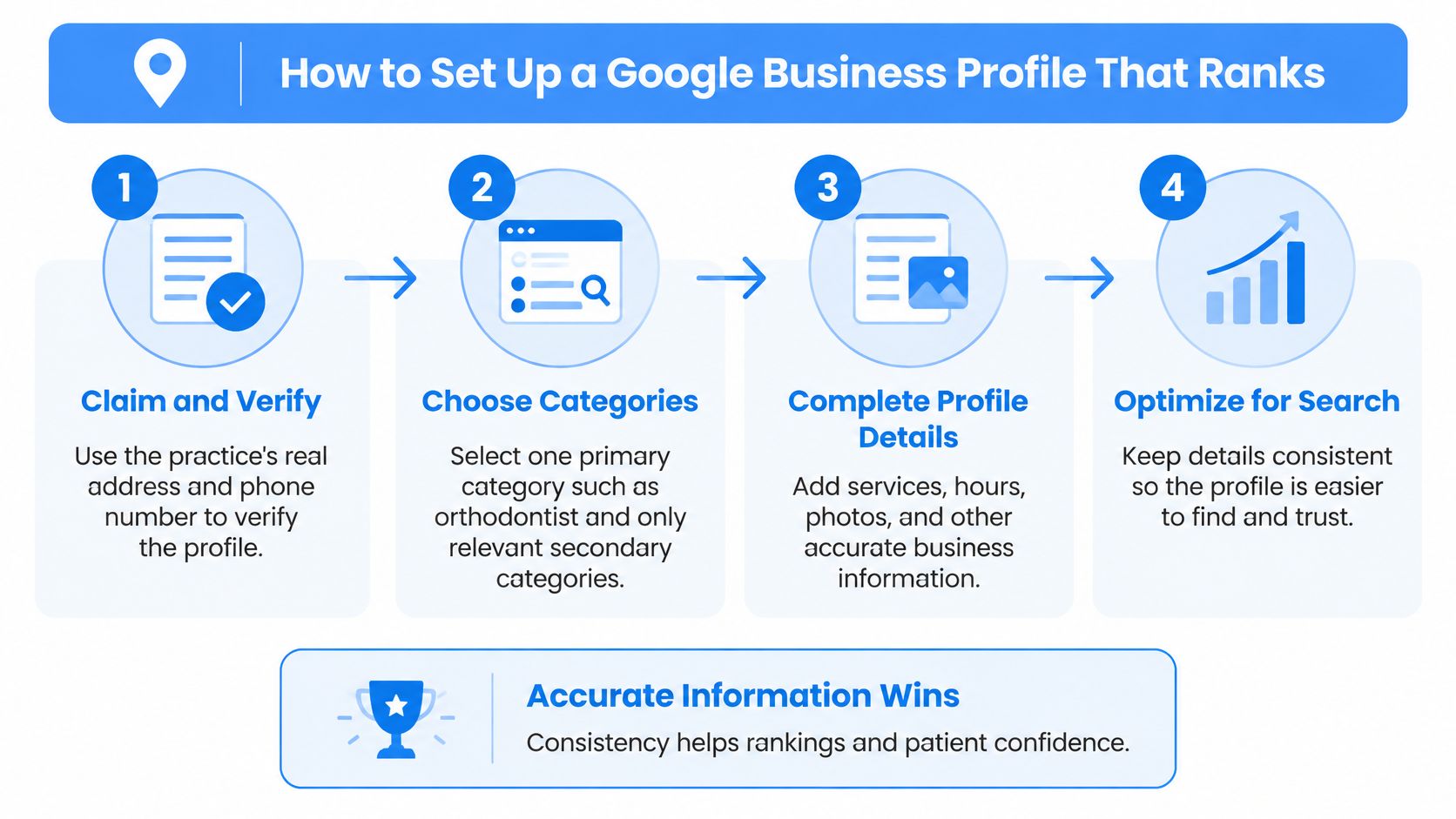
The eight setup steps
- Claim and verify. Use the practice's real address and phone number. Verification gives you control over what patients see in Search and Maps.
- Choose categories carefully. Pick one primary category, such as orthodontist, and add secondary categories only for services you offer. Extra categories dilute relevance.
- List treatments by name. Add braces, clear aligners, pediatric orthodontics, adult treatment, and retainers as individual services. Searchers query treatments, not departments.
- Match your core details exactly. Hours, phone, and address must match your website footer and every directory listing. Inconsistent name, address, and phone data confuses map results and the systems that build AI answers.
- Upload real photos. Show the clinic, team, and treatment rooms, then refresh them monthly. Stock smiles don't help a parent picture the first visit.
- Write a plain description. Name the city and main treatments in natural sentences. You're describing care for local families, similar in spirit to how practices present personalized smile care for local families in a way patients can quickly understand.
- Publish weekly updates. Show a treatment, a team member, or an open appointment slot. We publish weekly Google Business Posts using custom graphics with the client's branding, because a stale profile looks closed.
- Remove duplicates. Search your practice name and old addresses, then correct or merge wrong listings. Duplicates split reviews and calls.
Why this also prepares you for AI answers
Google's guidance, summarized in its LocalBusiness structured data documentation, says local-business information can appear in AI responses as well as conventional Search results, and identifies Google Business Profiles as a way to help services become visible in both environments. You don't need a special AI text file or new AI-specific markup. Google recommends foundational SEO, keeping profile information current, and ensuring structured data matches the visible text on the page. Publish consistent facts about services, locations, hours, and appointment options everywhere, and both systems can use them.
Don't stuff keywords into your business name. It breaks Google's guidelines and can get the listing suspended, which costs you the map presence you were trying to build. Finish with one check. Every service on the profile should have a matching page on your website. If aligners are listed on Maps but have no page, build the page before you chase the ranking.
Transactional Search Terms to Target in Each City
Transactional terms are queries from people who are local, ready to act, and close to booking. A parent searching pediatric orthodontist [city] isn't doing homework for next year. She's choosing where to call this week. Our case study for the keyword Orthodontist near me shows a 97% ranking growth over the last 3 months, which illustrates why we build around terms this close to a decision.
One term, one page
Give each treatment and city pair its own page rather than stacking every city onto one page, because relevance is judged page by page. Put the exact term in the page title, main heading, and opening paragraph, then make the body text support it with treatment details, proof, and a booking path. If you need help building the initial list, start with structured local keyword research for treatment and city combinations before you write anything.
| Search Term | Intent Signal | Landing Page | Priority |
|---|---|---|---|
| Orthodontist near me | Local, ready to book now | Practice home page | Highest |
| Braces consultation [city] | Treatment plus city | Braces page | High |
| Invisalign provider [city] | Brand aligner plus city | Clear aligners page | High |
| Clear aligners near me | Treatment plus proximity | Clear aligners page | High |
| Pediatric orthodontist [city] | Parent deciding for a child | Pediatric page | High |
| Adult braces [city] | Adult seeking discreet care | Adult treatment page | Medium |
| Orthodontist open Saturday [city] | Urgent scheduling need | Contact and booking page | Medium |
Priority follows proximity to a booking. Orthodontist near me sits on the home page and comes first. Core treatment pages come next, and adult or Saturday pages follow once the core pages are measured.
What the page must prove
Segment campaigns and landing pages by treatment intent, such as braces, clear aligners, pediatric orthodontics, and adult treatment, and display clinically credible proof on each one. In a 2024 peer-reviewed study of orthodontic marketing, 83.6% of respondents said website content influenced practice choice, 80.3% were influenced by discounts or special offers, and 67.2% considered recommendation volume important. That points to a simple standard. Show provider experience, technology, before-and-after cases, financing, and appointment availability, and track calls, forms, consultation bookings, consultations completed, and treatment starts by source. Technical credibility matters in adjacent decisions too, which is why resources such as dental lab advice from Prosth & Co. can help patients understand how lab work affects treatment quality. Generic cosmetic messaging without treatment-specific proof inflates traffic while hiding weak consultation yield.
Content Silos and Trust Pages That Convert Searchers
A silo gives Google and patients the same clear structure. Build a city hub, such as Orthodontic Treatment in [City], that links to braces, clear aligners, pediatric care, adult treatment, retainers, financing, and frequently asked questions. Our approach to building content silos for local SEO follows that hub-and-support pattern so each page has one job.
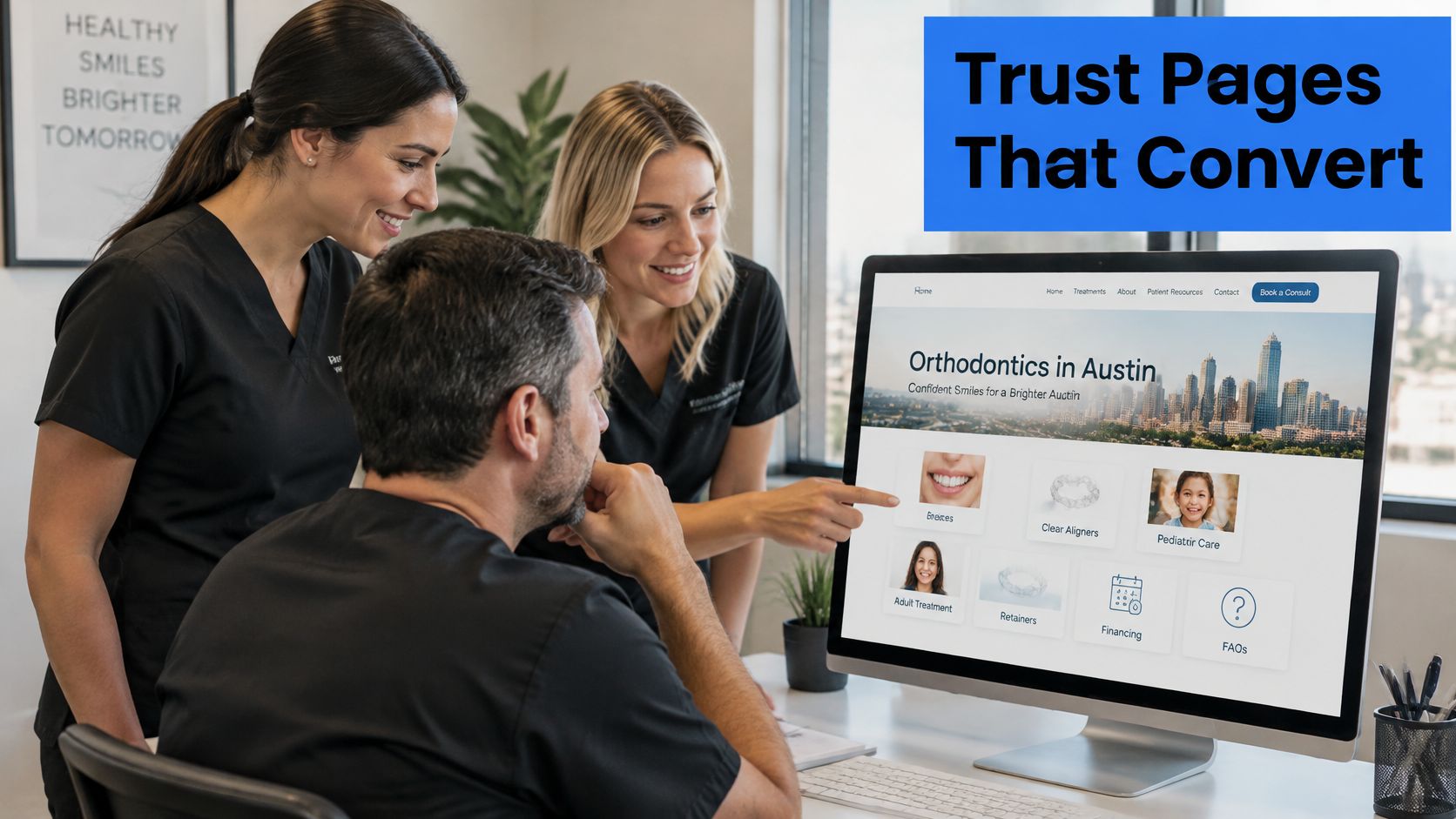
Each treatment page should carry clinician credentials, the technology used, before-and-after cases with patient consent, typical treatment durations, financing options, and current appointment availability. Make the consultation path visible with one clear booking button, a short form with few fields, and a phone number that's call-tracked. A page explaining orthodontic options for teens and adults shows the kind of treatment-level clarity patients expect when comparing providers.
Trust differs by audience
A 2026 Canadian survey of 290 participants found that word of mouth, online reviews, official orthodontic websites, and advertising from certified orthodontists were the most trusted channels, while social media appealed more to younger respondents. Don't treat social reach as treatment credibility. Build two distinct paths instead.
- Parent pages. Emphasize credentials, safety, treatment duration, and school-year logistics, including appointment frequency and what happens if a bracket breaks during term time.
- Adult pages. Address discretion, convenience, and workplace concerns. Adults want to know how visible aligners are in meetings and how often they'll miss work.
Every awareness channel must link to verifiable proof, such as clinician qualifications, transparent treatment expectations, and realistic before-and-after cases.
Encourage reviews that prompt detailed experiences rather than chasing raw volume, then measure whether trust content increases consultation bookings, not impressions. As one proof point from our dental work, Ridge Dental Care climbed to #1 on Google in 90 days after partnering with Transactional, with measurable patient opportunities within 3 months. Avoid generic best orthodontist content carrying no city, treatment, or proof. City-specific, evidence-led pages are what keep the work aimed at transactional searches.
Google Maps, Reviews and AI Answers Explained
Google's local ranking system is built primarily around relevance, distance, and prominence, as described in Google's structured data and local search documentation. Relevance measures how closely your Business Profile matches the query. Distance measures proximity to the searcher or the location named in the query. Prominence reflects how well-known the business is, and Google states it can be influenced by links from other websites and the number and quality of reviews.
What you can and can't control
Relevance is yours to fix. Your services list and description must name the treatments you want to rank for, in the words patients use. If clear aligners aren't listed, don't expect to appear for aligner searches.
Distance is not yours to fix. You can't move closer to every searcher. You can publish city-specific service-area content so the practice is relevant to the location named in the query. If you run several offices, give each one its own location page and its own profile. A single page claiming every suburb reads as thin to both patients and search systems.
Prominence is earned over time. Local links from referring dentists, schools, sports leagues, and community organizations help. So does a review profile that keeps growing after treatment milestones, not in one burst after a campaign.
Rankings are earned, not bought. A top-three Maps position comes from relevance, distance, and prominence working together.
Google states businesses cannot request or pay for a better organic local ranking. Anyone selling you a guaranteed map pin is selling something Google says isn't for sale. I would redirect that budget into reviews, local links, and complete service pages.
Reviews that support prominence
Ask every patient after a completed milestone, such as debonding or a successful first aligner check. Send a direct review link by text while the experience is fresh. Reply to every review within two days, including the critical ones, in calm and specific language. Ask for detail about what treatment involved and how the team handled scheduling, rather than chasing volume alone. Don't offer incentives and don't gate requests by asking only happy patients. Both distort the profile and put the listing at risk.
AI answers use the same facts
AI optimization for a local practice isn't a separate trick. Use the same consistent facts across your site and profile, answer common patient questions in plain sentences, and validate your LocalBusiness structured data with Google's Rich Results Test. Structured data can communicate hours, departments, and review information, and it improves your eligibility for enhanced displays. It doesn't guarantee a top-three Maps position, because Google still evaluates relevance, distance, and prominence. Keep the visible page text, the profile, and the markup saying the same thing about services, hours, and locations. When those three agree, conventional results and AI answers both have clean information to present. When they disagree, you're asking the system to guess which version is true.
Paid Ads and Referral Recall by Treatment
Paid search works when it mirrors your organic structure. Build each campaign around one treatment and one city, with its own landing page showing clinician experience, technology, before-and-after cases, financing, and appointment availability. Use the same segments as your search terms, braces, clear aligners, pediatric treatment, and adult treatment. Sending all four to your home page wastes the click, because the parent searching pediatric care has to hunt for the paragraph that applies to her child.
Track every click through to a call, form, booked consultation, completed consultation, and treatment start using source tags. Judge campaigns by cost per completed consultation and cost per treatment start, never by clicks alone. A cheap click on a broad term that never books is more expensive than a costly click that starts treatment. Set a budget cap for each segment, and move money only toward segments whose cost per start fits your chair capacity. If aligner starts are profitable but your schedule can't absorb more aligner checks, hold that budget and fund the segment you can serve. Our dental PPC advertising framework applies that same segment and cap discipline.
Run referral recall alongside ads. Ask existing patients and local dentists who send new families, track whether those referrals start treatment at a higher rate, and re-engage observation patients when clinically appropriate. Referrals often arrive with trust already established, so compare their conversion against paid leads before you raise ad spend.
Check jurisdiction rules before advertising teledentistry or remote consultations. Florida's 2026 dental telehealth statute requires advertising for dental telehealth services to include a prominent recommendation for an in-person examination before treatment, and it restricts beginning orthodontic treatment for a new patient without an in-person or qualifying teledentistry examination. Have your compliance adviser review ad copy in every state where you advertise, and publish FAQs that separate education, eligibility screening, consultation, and treatment.
Measuring Ads and Referrals by Cost per Start
Fix the funnel before you raise spend. Record every inquiry with its source, response time, appointment status, consultation outcome, and treatment-start status. Confirm appointments through more than one channel, contact unscheduled leads on a set schedule, and re-engage observation patients when clinically appropriate. Then review conversion each month by coordinator, provider, location, and lead source.
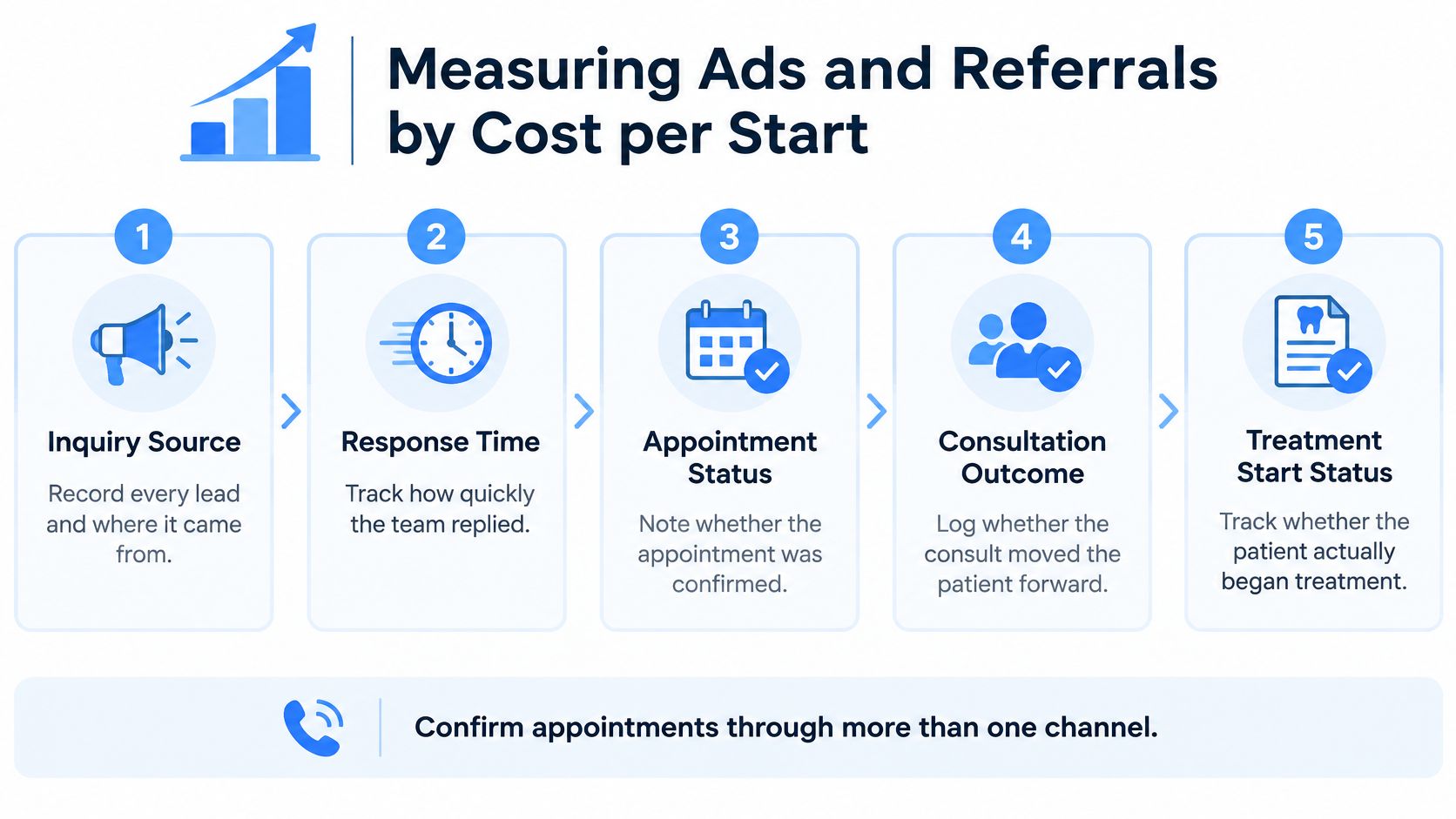
A benchmark orthodontic practice comparison report reported conversion from new-patient exams to starts at approximately 69.0% to 72.1% across listed practice groups, noting that strong conversion depends on marketing plus a well-managed recall system. Treat your consultation-to-start rate as a diagnostic. A weak figure may point to poor case presentation, financing friction, inadequate follow-up, or low-intent lead targeting, not necessarily too few leads.
| Metric | How to Calculate | Decision It Informs |
|---|---|---|
| New-patient exam to start rate | Treatment starts divided by new-patient exams | Whether case presentation and follow-up are working |
| Cost per completed consultation | Ad spend divided by completed consultations | Which treatment and city campaigns to fund |
| Cost per treatment start | Ad spend divided by treatment starts | Final budget decision by channel |
| Inquiry response time | Minutes from lead to first contact | Whether the front desk is losing leads |
| Map calls and direction requests | Counted from the Business Profile each month | Whether Maps visibility is turning into visits |
| Review count and rating | Count and average from the profile each month | Whether review requests are working |
Say a braces campaign produces plenty of calls but few starts, while referrals start at a high rate. The problem isn't lead volume. It's targeting or follow-up, and more ad spend would scale the wrong thing. Compare cost per completed consultation and cost per start against chair capacity and case mix each month. That tracking discipline is behind results such as Winn Smiles doubling its patient calls in 90 days with SEO, and The Dental Retreat TX in Katy, TX generating 188 measurable organic patient opportunities in 5 months. We collect client information through an intake form and then show clients how their company is doing in their service area, so the monthly review starts from the same baseline.
Confirm Your Map Listing and Search Terms This Week
You can establish your baseline this week without a redesign.
- Verify the profile. Confirm the Google Business Profile is verified and that the primary category and treatment list match the website. We offer Google Business Profile packages that optimize the profile to attract more customers and boost local search rankings, but you can check the basics yourself today.
- Search like a patient. Search orthodontist near me and braces consultation [city] from three or four spots across your service area, and record where you appear in each result.
- Map four term pairs. Assign the four core treatment and city pairs to existing or new pages, starting with the term closest to a booking.
- Set up call tracking. Tag each booking form by source so calls and forms can be counted against consultations and starts. For dental clients, the Patient Magnet Engine™ program pairs keyword targeting, Google Maps optimization, and on-site coding improvements for exactly this purpose.
- Log every inquiry today. Record source and response time, then schedule the first monthly funnel review. You can schedule an appointment using the calendar on the page, and we then collect your information through an intake form and show how your company is doing in its service area.
The goal is to be found by the patient who's ready to book. Each step above turns that search into a booked consultation.
If your practice is invisible for the transactional searches that fill chairs, Transactional LLC can build the local SEO, Google Maps, and AI-ready content system described here, targeted term by term and city by city. Visit us to see how your practice currently ranks in your service area and which orthodontic search terms we'd target first.