


GMB optimization is the work of making a Google Business Profile complete, accurate and relevant so it appears in local search and Google Maps for the searches that bring in customers. Google Business Profile is Google's current name for the platform formerly called Google My Business.
A polished listing isn't the finish line. The useful result is a qualified customer finding the right service, calling an answered phone and booking work your business can deliver.
What GMB Optimization Means for Local Searchers
In 2024, 80% of U.S. consumers searched online for local businesses at least weekly, according to SOCi's Consumer Behavior Index, cited in BrightLocal's local SEO statistics. That makes your profile a working customer touchpoint, not an online directory entry you can forget after setup.
Think of it as a shop window on a smartphone. Someone can assess your services, hours, reviews and location before visiting your website. Optimization makes that window useful, rather than merely filling it with keywords.
The customer's view starts with the information available on their phone.

A local search is a decision in progress
Say a homeowner notices that the air conditioner is running without cooling the house. They search air conditioning repair near me, not the history of refrigeration. They need a technician who serves their neighborhood and can explain the next step.
That's a transactional search: a query from someone ready to call, hire or book. The searcher has a problem and is prepared to spend money resolving it. Transactional Marketing focuses on these service-and-location searches because they connect visibility to an immediate business opportunity.
For that homeowner, a useful profile answers practical questions:
- Service fit: Does this company repair the equipment that's failing?
- Availability: Is someone available when help is needed?
- Coverage: Will the company dispatch a technician to this address?
- Next step: Can the homeowner call or request an appointment without searching elsewhere?
Practical rule: Optimize for the customer's decision, not for the appearance of a completed checklist.
The answer to what is GMB optimization therefore extends beyond editing a description. It involves matching real services to local demand, supporting those claims with credible business information, and removing obstacles between discovery and contact.
A business owner needs to distinguish ranking factors from editable fields, then connect reviews, transactional queries and reporting to booked work. Otherwise, an attractive listing can still produce little commercial value.
The Three Ranking Factors Behind Local Results
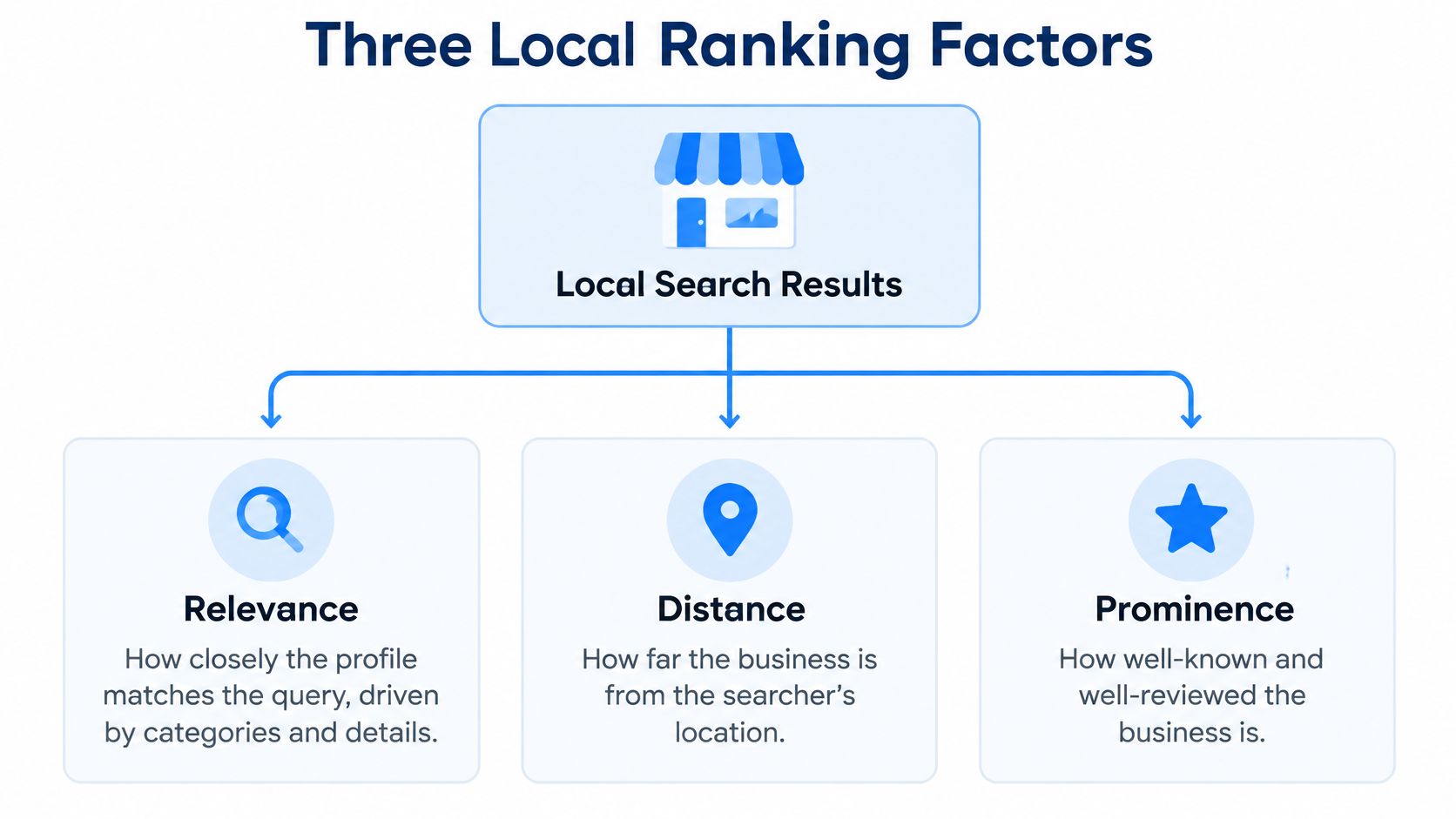
Google names relevance, distance and prominence as its primary local-ranking factors in its guidance on improving local ranking. They describe different problems, so improving one doesn't automatically solve the others.
The relationship is straightforward, even though the ranking calculation isn't public.
What each factor actually changes
Relevance concerns how closely your business matches the query. Categories, listed services and detailed business information help establish whether you're a suitable answer. A broad description that never identifies your repair services leaves important questions unresolved.
Distance concerns the relationship between the business and the searcher, or the place named in the query. Accurate location information matters, but selecting additional service areas doesn't physically move your business closer to customers.
Prominence concerns how well known the business is. Reviews, links, articles, directories and website visibility contribute to that picture. Google also identifies organic search position as a contributing consideration.
Local ranking factors and what you control
| Factor | What Google measures | What you control |
|---|---|---|
| Relevance | How closely the profile matches the searcher's query | Primary and secondary categories, services, business description, hours |
| Distance | How far the searcher is from the business or from a place named in the query | Accurate address, service areas and location pages; the location itself is fixed |
| Prominence | How well known and trusted the business is online | Reviews and ratings, citations, links, website visibility and organic search performance |
Why a polished profile can still lose
Consider a suburban plumbing company trying to appear for an emergency search downtown. Its profile may be more complete than a nearby competitor's, but the closer business can still appear ahead of it. You can't infer the precise cause from that result alone, but distance is a credible constraint, not evidence that every optimization failed.
Google doesn't publish fixed percentage weights or guarantee a position. Treat promises of universal map coverage cautiously.
For a practical review, use the local search ranking factors framework to assess your priority services. Ask whether each service is explicitly listed, whether the neighborhood is served, and whether your website and independent business records support the claim.
Fix relevance first, build prominence steadily, and plan around geography. Don't spend the entire budget polishing photos while the primary category is wrong.
This video offers another way to consider the local-search opportunity.
Profile Fields and Website Signals to Get Right
Start by confirming that the profile is verified and that the business controls its account. An unverified listing can't be fully managed, and outsourced work becomes difficult to oversee when nobody inside the business has reliable access.
Use this checklist to organize the essential fields.
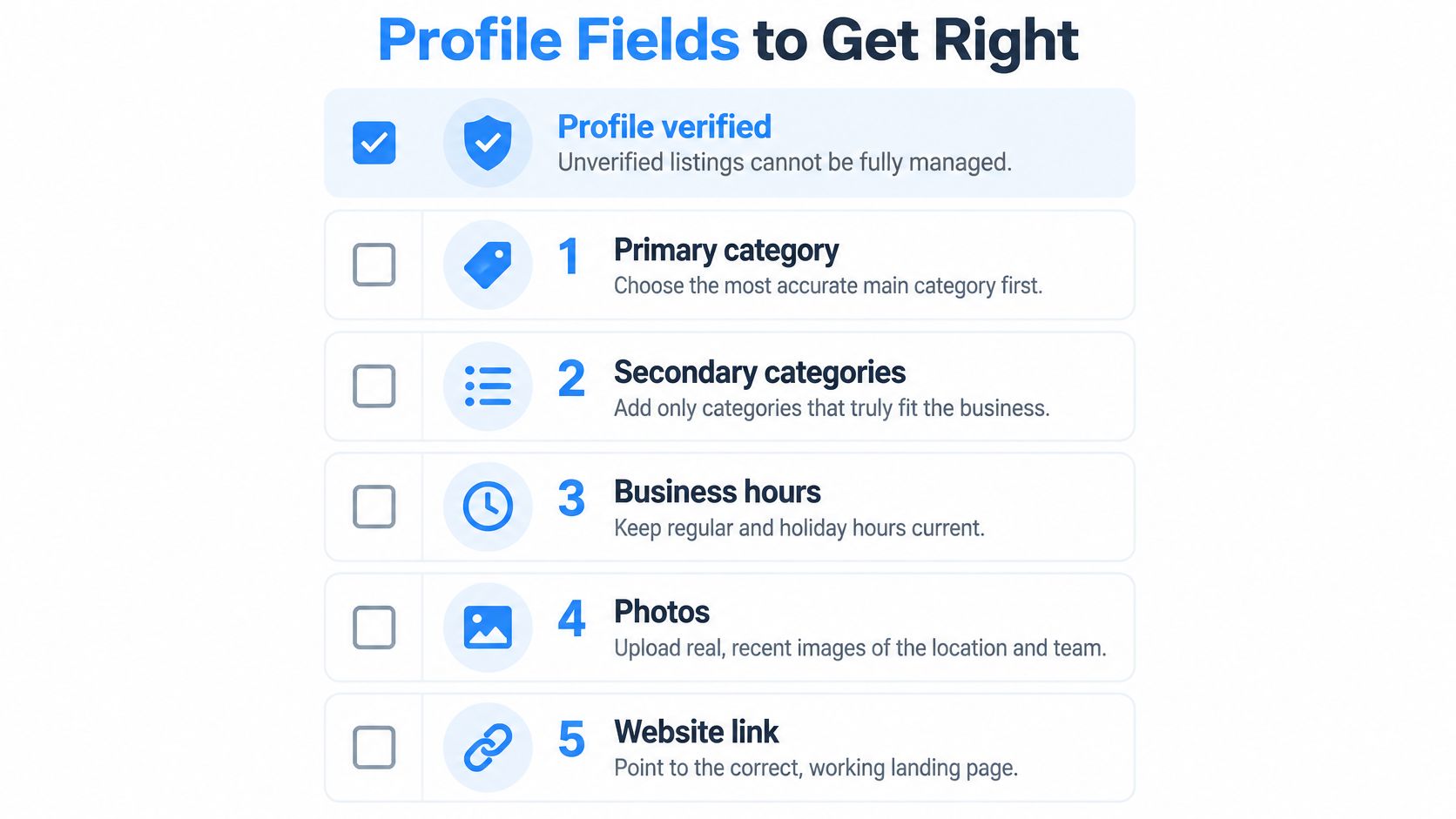
- Choose the primary category carefully. Select the closest available match to the core business, then add secondary categories only for services you provide.
- Describe individual services. Use plain language that explains the work, rather than repeating city names or inserting every possible keyword variation.
- Make contact details dependable. Write a clear business description, maintain regular and holiday hours, and use a phone number that staff answer. Test tracking arrangements before relying on them.
- Define real service areas. Identify the cities or postcodes you cover. Don't list distant towns because you'd like additional leads.
- Show the business. Add recent photographs of staff, vehicles, premises and completed work. Publish Google Business Posts with useful service updates, not recycled keyword lists.
- Reconcile business records. Match the business name, address and phone number across your website and main directories, correcting old addresses and disconnected numbers.
Connect the profile to the right website page
The landing page should continue the same service-and-location conversation. Don't send every visitor to a generic homepage when a relevant location page can explain coverage, availability and booking.
For an example of specific service-and-area communication, Life Primary Care's resource on in-home doctor visits for dementia patients gives readers a focused service topic in a defined location. The useful principle is specificity, not copying another business's content.
For businesses with multiple staffed branches, create a canonical page for each real location with unique local information. Include consistent contact details, visible hours and clear service-area disclosures.
Google's LocalBusiness structured-data documentation specifies geographic coordinates with precision of at least five decimal places and requires markup to reflect visible page content. Validate implementation with Google's Rich Results Test and inspect the page with URL Inspection in Search Console.
Structured data supports eligibility and helps search systems distinguish business entities. It doesn't guarantee rankings or rich results. For AI optimization, use the same discipline: clearly identify the business, services and locations, without assuming that markup guarantees recommendations from large language models.
How Reviews and Accurate Listings Build Trust
67% of surveyed consumers often or always read reviews after a local search, and 15% use Google Maps as their first destination for local searches, according to BrightLocal's consumer search behavior findings. Those readers are judging whether to call, not only whether the profile deserves a ranking.
Google decides how much a rating counts. You decide whether the listing they open is accurate enough to trust, and whether someone answers.
Wrong hours, a dead number, or a service you no longer offer wastes the visit. People often skip a business whose listing does not match what they find on arrival or on the phone. They also expect a prompt reply when they contact a brand. Fix the phone number, the hours, and a staffed response process before you add a heavier posting schedule. A weekly update cannot repair a number that rings the wrong office.
Build a routine that produces authentic feedback
Google confirms that review count and ratings can influence local ranking. The same program should show what the work is like.
Ask after a completed job with a plain invitation. Do not offer incentives, and do not write the customer's review. Reply to the specific compliment or complaint. Pasting one paragraph into every thread reads as if nobody looked.
Send scheduling, billing, or communication complaints to someone who can investigate. A smoother public sentence, with no change in dispatch or billing, leaves the next reviewer with the same problem.
A recurring complaint needs an operational fix, not a more polished reply template.
Keep private details off the public thread. Move them to a direct channel, and do not confirm treatment, appointment history, or other personal facts in the reply. For dental practices, med spas, and chiropractic offices, stay courteous without disclosing health information or claiming a treatment outcome. If the reviewer already shared those details, your reply still does not need to repeat them.
A prospective patient looking to find real patient experiences in LA can use Beverly Wilshire Aesthetics' review resource as part of their evaluation. Customer accounts should be easy to find and assess, rather than buried under promotional claims.
Treat accuracy as ongoing maintenance
Several mentions of late arrivals point to dispatch and appointment windows, not to the reply template. Callers who keep asking whether a service is offered are telling you the listing, or the page it sends them to, is unclear.
Run a monthly local SEO citations check against the website. Compare hours, holiday closures, services, and phone numbers, then correct the directories that still show the old record. You control those fields. Google still chooses which result appears, and an accurate profile only helps when the query matches a job you can book.
Transactional Searches and the Profile Signals That Win Them
A transactional search comes from someone ready to take a commercial action, such as hiring a technician or booking an appointment. The query may be short, but it can communicate a service need, local intent and urgency.
Transactional Marketing targets these specific service-and-city opportunities rather than treating general brand exposure as the main objective. The important distinction is commercial fit: a repair inquiry you can fulfill is more useful than unrelated traffic.
Match the information to the intended action
Transactional queries and the profile signals to prioritise
| Search query | Searcher intent | Profile signals to prioritise |
|---|---|---|
| air conditioning repair near me | Urgent repair, ready to book a technician today | Repair service listed, emergency or extended hours, service area covering the neighbourhood, call button |
| roofer near me | Leak or storm damage, ready to hire and pay | Roofing categories, service radius, project photos, recent reviews mentioning repairs |
| dentist near me | New patient booking or urgent dental care | Dental categories, accepting new patients, appointment link, reviews mentioning appointments |
| pest control near me | Active infestation, ready to schedule treatment | Pest control services, treatment photos, service area, accurate phone number and hours |
These examples represent separate targeting decisions, not a reason to combine unrelated industries on one service page. Each business needs content and profile details appropriate to its actual work.
An urgent repair needs an honest next step
Say a homeowner's air conditioning fails late in the evening. A profile advertising repair service, genuine extended hours and neighborhood coverage gives them a reason to make contact. Recent authentic reviews about cooling repairs can help them assess service fit, while the call button provides a direct next step.
But extended hours must mean something operationally. If the phone reaches voicemail and no technician is available, advertising emergency service creates an expectation the business can't meet.
Targeting boundary: Don't optimize for work you can't accept, locations you won't serve or availability you don't offer.
Avoid asking customers to insert prescribed keywords into reviews. Request honest feedback and let them describe the work in their own words.
Each service city also needs relevant supporting information. Explain actual coverage, local dispatch arrangements and available services on appropriate website pages, rather than duplicating a generic paragraph across town names. Don't create additional profiles unless they represent eligible business locations.
Measuring Calls, Directions and Booked Jobs
Discovery and action are different measurements. A profile view shows exposure; a phone-button click shows an attempt to contact the business. Neither confirms that staff answered or that a customer booked.
Google Business Profile's Performance documentation distinguishes search terms, Search and Maps views, website clicks, call clicks and direction requests; it also says search-query data updates monthly and can be available for up to six months.
Build a discovery-to-revenue view
Metrics that show whether optimization is working
| Metric | What it tells you | Where to check it |
|---|---|---|
| Search queries | The terms people used to find the profile | Google Business Profile performance reporting, updated monthly |
| Search and Maps views | Whether the profile is being seen in each channel | Google Business Profile performance reporting |
| Calls and direction requests | Whether discovery turns into contact or a visit | Google Business Profile reporting, supplemented with location and service-area records |
| Website clicks | Whether visitors move on to service pages | Google Business Profile reporting and website analytics |
| Booked jobs | Whether contacts become revenue | Booking system or CRM, matched to the same service and location |
Don't assume the profile dashboard supplies a complete breakdown by service or customer neighborhood. Collect that detail through inquiry handling and your CRM, then compare it with profile activity.
Diagnose the missing step
Many views with few contacts should trigger a check of hours, service fit, phone details and landing-page messaging. Few views suggest investigating relevance, location coverage and prominence before redesigning the booking form.
Contacts without bookings require a different investigation. Check unanswered calls, response delays, appointment availability and whether staff can explain the booking process.
For example, Grand Parkway Smiles' guide to how to schedule a dental visit illustrates the kind of practical booking guidance a visitor may need after clicking through. Sending traffic to a page isn't enough if the visitor still can't understand what to do.
Keep Search and Maps visibility separate in your Google Business Profile insights review. We provide regular reports tracking GMB profile performance, including customer actions, so reporting doesn't stop at rankings.
Concentrate effort where the business can fulfill demand profitably. Distant inquiries that rarely become workable bookings shouldn't dictate the next optimization priority.
Start With a Profile Audit This Week
Use a Google Business Profile audit to create a correction list with a named owner for each task.
- Reconcile identity: Compare the profile's name, address, phone and hours with the website and main directories.
- Check service fit: Confirm the primary category and write plain descriptions for the services you provide.
- Review coverage: Remove locations you can't reliably serve.
- Close the feedback gap: Invite recent completed customers to review their experience and address unanswered reviews.
- Inspect discovery: Export available query and call records, identifying transactional terms that already generate contact.
- Connect outcomes: Record inquiry source, service, city and booking result in your CRM.
Our Google Business Profile packages optimize profiles to attract more customers and improve local search rankings. Each month, we identify relevant keywords for the client's business and apply them to the profile and other listings.
Ongoing optimization builds rankings and organic traffic over time. Our expectation is improvement from around three months and beyond, not a guaranteed position or a fixed number of calls.
Transactional LLC offers local SEO, Google Maps optimization and conversion-focused website work to help businesses turn relevant local searches into customer inquiries. Visit Transactional LLC to discuss a profile audit, your priority service cities and a measurement plan tied to booked work.