


Four in five U.S. consumers have used a search engine to find local information, and 50% of the people who run a local search on a smartphone visit a business in person within one day, according to the Google-commissioned local consumer research compiled by BrightLocal. A cleaning company has no storefront to visit. It has a booking calendar, and the same one-day urgency lands on it: the homeowner searching at 9am on a Tuesday wants the house cleaned before the in-laws arrive on Friday.
That moment has a name. A transactional search is a query with money attached and a deadline behind it. "House cleaning near me." "Move out cleaning near me." "Deep cleaning near me." "Office cleaners in [city]." Nobody typing those words wants to learn about cleanliness. They have a date, an address and a card, and they will book one of the first three businesses they see.
Transactional Marketing is named for that moment because it's the only one worth building around. Every field, page and review request either feeds that search or wastes time.
Which Signals Decide Who Gets Booked Locally
Google's documentation on local ranking lists three factors that decide who shows in the map pack: relevance, distance and prominence. A cleaning company can move two of them directly. The third is managed by setting honest coverage and staying consistent everywhere the business is named.
| Signal | What it measures | What you actually control |
|---|---|---|
| Relevance | How closely your profile matches a query like "house cleaning," "commercial cleaning" or "cleaners near me" | Primary category, services list, page copy, service-area definitions |
| Distance | How far the business is from the searcher, or from the location named in the query | The boundaries you set and how closely they match territory your crews already serve |
| Prominence | How well known the business is, via links, articles, directories, review quantity, review scores and its position in regular web results | Reviews, citations, links, content depth, posting cadence |
Relevance is the cheapest of the three and the one most cleaners get wrong. A profile whose primary category reads "Cleaning Service" is a candidate for nothing in particular. A profile set to House Cleaning Service, with move-out cleaning, recurring cleaning and post-construction cleaning listed as separate services, gives Google four clean matches instead of one vague one. The same rule carries into the site: each service needs a page or section that says what is included, where it is offered and what affects price.
Distance is computed from where the searcher stands or the place they typed. That is why a crew based in one suburb can dominate that suburb and vanish three miles down the road. Inflating the service area to six counties you reach twice a year buys a wider map pin and weaker relevance.
Prominence is the long game. It is the part competitors cannot copy in a month, and it is where many cleaning companies quit early. Reviews, citations and links decide whether a listing looks established when three map results are compared side by side.
The volume behind the urgency
Local search is habitual: consumers look for nearby businesses every week, and a meaningful share do it every day. For a cleaning company, most of that volume is noise. The slice that pays sits at the transactional end: a service, a place, a date.
Order of operations: fix relevance this week, build prominence over two quarters, and stop fighting distance. Distance punishes effort spent on it.
The reason to sequence it that way is simple. Relevance changes produce map movement inside weeks because they are entirely under your control. Prominence takes months because it depends on other people writing about you and customers bothering to leave a rating.
A ranking is still not a booked job. The profile earns the comparison, the service page confirms scope, the review removes doubt, and the answered call turns the search into revenue. Keep categories, services, hours and service areas consistent wherever they appear, because those fields are the record search features reuse when they assemble local answers. When rankings start working, local lead support from CS Outsource covers the answering, booking and follow-up side so a map-pack surge does not turn into voicemail.
How to Set Up Your Google Business Profile for Cleaning Work
Setup fails when it's treated as a form to fill once. Treat it as the operational record Google reads every time someone searches, because that's what it is.
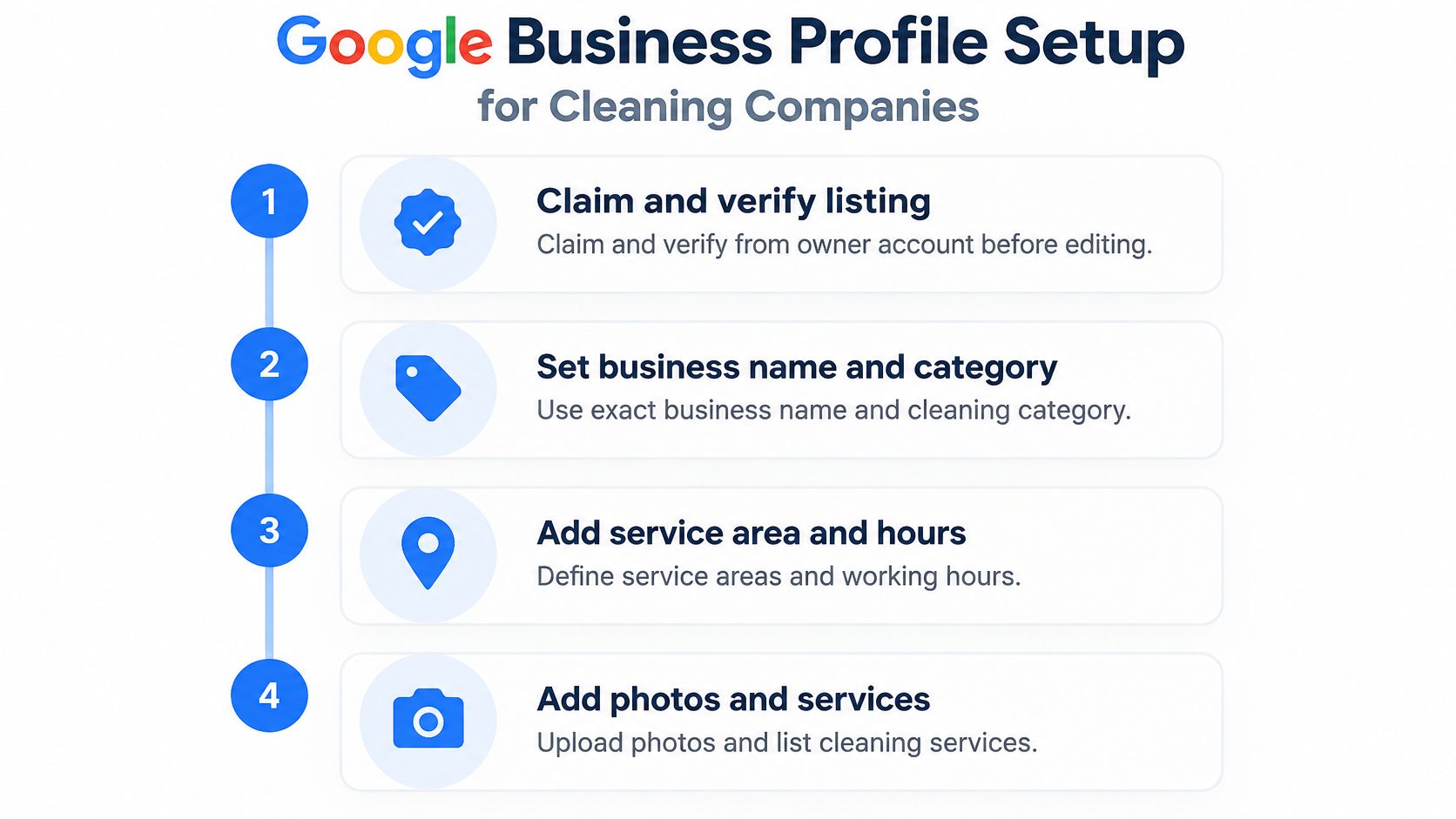
The setup order that works
- Claim and verify from the owner account before editing a field. An unverified listing can't be fully managed, and every edit made in the meantime risks being reverted or triggering a suspension review.
- Pick one primary category that matches the work you sell. House Cleaning Service for residential, Commercial Cleaning Service or Janitorial Service for offices. Add secondary categories only for services your crews perform, because a category you can't staff pulls in calls you'll turn down.
- Draw a service area you reach. List cities and ZIP codes where you already complete jobs. The usual slip is listing the whole metro in month one, which spreads thin signals across territory you can't convert.
- List each service as its own item with a two-sentence description. Deep cleaning, move-out cleaning, recurring house cleaning, office cleaning. One sentence on what's included, one on what qualifies the price.
- Enter accurate hours, a local phone number and a booking link. Then update holiday hours the week before every holiday. Stale holiday hours send people to a competitor who answered the phone.
- Upload photos of crews, equipment and finished rooms, and refresh them monthly. Stock imagery is the fastest way to look like a lead-generation shell. Before-and-after shots from real jobs do the selling.
- Publish one post a week. Spring deep cleaning, move-out season, holiday availability, a completed job worth showing. Weekly activity is a live-business signal and a second surface for location terms.
If you'd rather watch the sequence than read it, this walkthrough runs from an unverified listing to a working profile.
Complete, detailed profile information is what helps Google understand the business and match it to specific local searches, so a half-finished services list is a listing that gets skipped for the queries that matter. We offer Google Business Profile packages that optimize the profile to attract more customers and boost local search rankings, and the work starts with those seven steps because everything else compounds on them. When inquiries start arriving, turn Google Business Profile inquiries into bookings rather than letting them sit in a shared inbox until tomorrow.
The test takes two minutes. Search "house cleaning near me" from your own neighbourhood on your phone, then from a suburb at the edge of your service area, and write down where the listing appears in each. That baseline is the only honest starting point, and our Google Business Profile setup guide shows each field worth checking before you record it.
Service-Area Pages That Target Transactional Searches
One page per city with the town name swapped into the H1 is the most common way cleaning companies waste a year. Each core service needs its own page per location, written for the query a customer types.
| Service | Transactional search term | What the page must include |
|---|---|---|
| Deep cleaning | deep cleaning near me | Scope checklist, starting-price qualifier (say, a studio apartment), booking form |
| Move-out cleaning | move out cleaning near me | Deposit-focused checklist, timing, live availability calendar |
| Recurring house cleaning | house cleaning near me | Plan options, visit frequency, per-visit pricing qualifier |
| Office cleaning | commercial cleaners in [city] | Sample schedule, insurance details, contract terms |
| Post-construction cleaning | post construction cleaning near me | Debris removal scope, realistic timeline, before-and-after photos |
What separates a page that ranks from a page that's a copy
Google's guidance on improving local visibility explains that distance can be calculated from the searcher's location when no place is named, while a location term in the query shifts how distance is evaluated. That's the mechanical reason neighbourhood-level pages work for "near me" searches: the page and the profile both tell Google which ground you cover.
Three things separate a page that earns the booking from one that gets filtered out.
- A scope checklist: exactly what's included and what costs extra, because "deep clean" means six different things to six different customers.
- A pricing qualifier: a starting figure tied to a condition (beds, bathrooms, square footage), not a fake range that collapses on the phone.
- Local proof: a review from the neighbourhood, a street or building type mention, a photo from a job nearby.
The failure mode is a template with the city name rotated in and nothing else changed. Those pages carry almost no weight, and if the area isn't one you serve, they carry risk. Every place name on your site has to be a place your van goes.
Rankings also vary by device location and by neighbourhood, so no provider can promise a fixed position across an entire metro. Any agency that does is selling you something it can't control.
Our home service SEO applies industry-specific keyword targeting, technical SEO and content marketing to each service page, so the page is built around a query rather than around a brochure. Our service-area page build follows that same pattern, one query and one place per URL. Start with three services in your largest city, prove the ranking pattern, then repeat it.
Reviews That Build Trust Before the First Call
Reviews do work before a prospect ever dials. 67% of consumers often or always read business reviews after a local search, per BrightLocal's 2025 Local Consumer Review Survey, a study of 1,026 U.S. adults. But the same survey shows trust shifting: 42% trusted reviews as much as personal recommendations in 2025, down from 79% in 2020. Reviews open the door. Star ratings alone no longer close the sale.
The conversion details are just as instructive. 85% of consumers considered visible contact information and opening hours important when researching a local business, so a profile with a hidden phone number wastes the trust a four-star average earned. Recent volume matters too: a 2025 study reported through Businesswire's release on AI accuracy and reputation found 75% of consumers read at least four reviews before making a purchase decision. Steady, recent reviews beat one big campaign.
The review routine
- Ask within 24 hours of the job finishing, by text with a direct review link. Not a newsletter, not a survey, one link.
- Reply to every review within two days. Thank the specific job, address the specific complaint, stay calm, name no one.
- Mine the phrasing. If customers keep writing "pet hair" or "move-out deposit" or "eco-friendly products," those are your service-page headings, not your guesses.
- Turn complaints into process. A recurring gripe about arrival windows is an operations fix and a new FAQ entry.
Hard boundaries: never pay or reward for a review, never write a testimonial yourself, never filter unhappy customers out of the ask. A 4.6 with three honest complaints converts better than a 5.0 that reads staged.
A message that works, short enough that people finish it: "Hi Sarah, hope the house feels good today. If you have 30 seconds, a quick review helps other families find us. Here's the link. Thank you, and we'll see you on the 14th."
Our guide on how to get more reviews covers the follow-up sequencing if you want the full workflow.
How AI Assistants Find and Cite Cleaning Companies
AI visibility sits on top of map fundamentals, not in place of them. A business that can't keep its own service area straight won't be fixed by an assistant answering questions about it.
Google's generative AI optimization guidance describes how this works: Search systems retrieve relevant, current pages from the index and use them to compose an AI Overview or AI Mode response with clickable links. That guidance also notes AI responses can include local business information and that Business Profiles help services appear in both AI answers and ordinary results. There's no separate AI shortcut and no guaranteed placement. If the page isn't crawlable and accurate, it can't be retrieved.
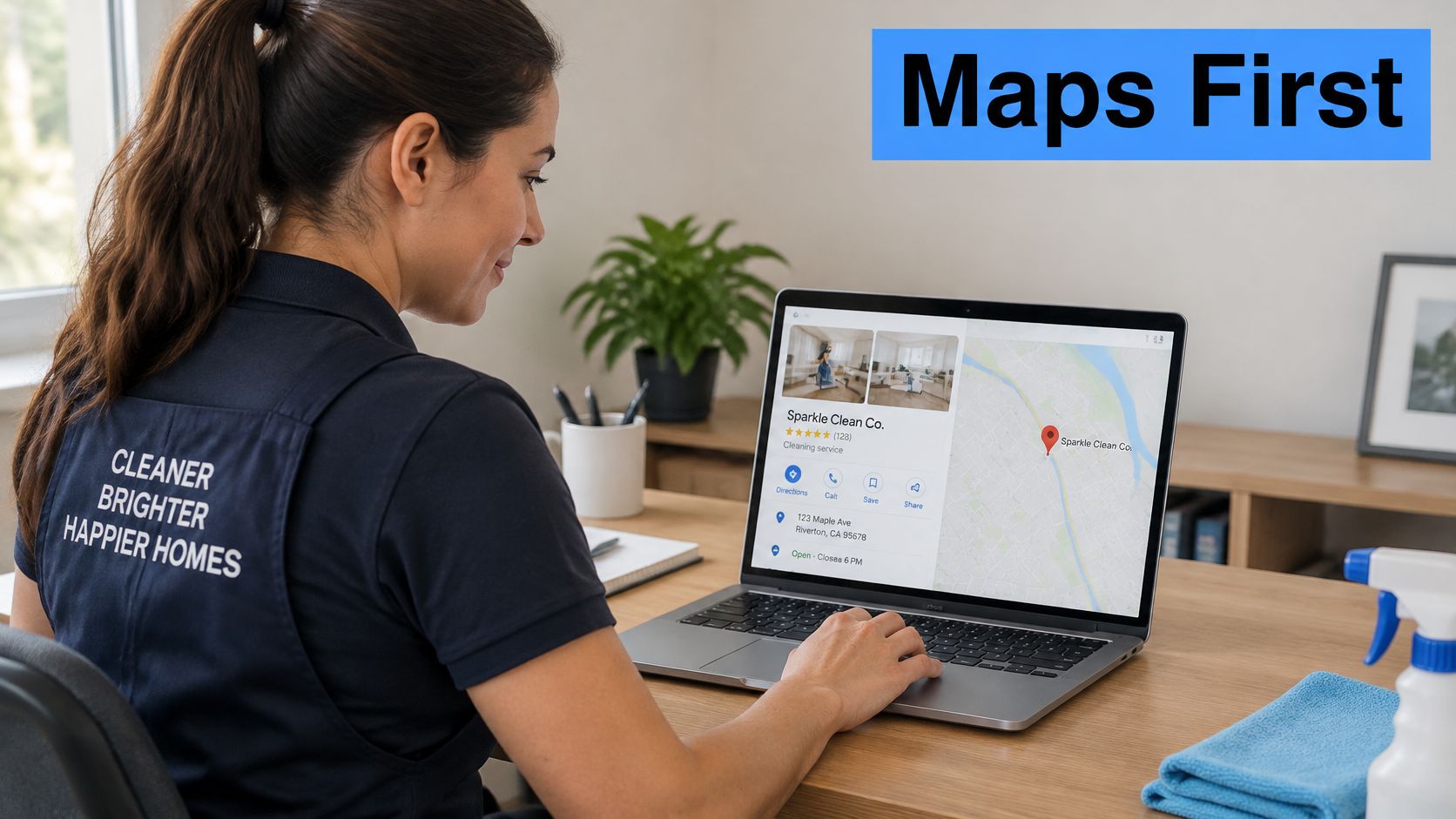
Demand is still mostly conventional. A 2025 Youtech survey reported by GlobeNewswire found 93.2% of respondents trusted Google more than AI for local discovery and 56.7% had never used an AI assistant to find a local business. What would change their minds? More accurate, up-to-date information (39.1%), better map integration (15%), and real-time booking, which 9% called a deal-breaker when absent.
The operating layer that makes you citable
Keep five things identical everywhere a machine can read them: service areas, pricing qualifiers, holiday hours, booking links and cancellation policy. Website, Business Profile, directories, Apple Business Connect. Any mismatch is a reason for an AI system to describe you vaguely, or not at all.
Then run the test. Ask an assistant for the best house cleaner near your address and check whether your name, services and booking link appear correctly. If they don't, the fix is almost never an AI-specific trick. For deeper coverage, AI search visibility for maid services walks through how retrieval-friendly pages are structured. Our own work on AI search engine optimization treats it as an accuracy layer over local search, not a replacement.
Start With a Local Visibility Audit Before You Hire
Before a provider is hired or a page is built, run one audit. It should check the Business Profile against the setup steps, match your service-page list to the transactional terms that matter, record review volume and recency, and confirm whether AI tools describe the business correctly.
Record the current map position for your top five transactional terms in every city served. Without that baseline, nobody can prove progress later. Transactional's SEO process starts with an initial SEO assessment for exactly this reason, and most businesses see ranking improvements within 3-6 months of ongoing work, so early movement usually comes from profile fixes and review velocity while service pages and content compound behind them.
Track four measures monthly, not rankings alone:
- Keyword positions by city, so a gain in one suburb isn't read as a region-wide win.
- Map position per service area, checked from a fixed location for consistency.
- Search Console queries per service page, which shows whether a page is earning the terms it was built for.
- Calls and booking requests from the profile, the only number that reports to the bank.
Ask any provider for the baseline, the terms tracked, the reporting schedule and the definition of success. Then finish one fix this week: complete the services list in the Business Profile, all of it, with a description for each item.
Transactional LLC runs local SEO and Google Maps programs built for transactional search terms, the "house cleaning near me" and "move out cleaning near me" queries where the searcher already has a date and a card out. That means Google Business Profile setup and optimization, service-area pages for each city you serve, industry-specific keyword targeting, an AI-driven content engine, and a results dashboard tracking keyword timelines by service city, map heat maps and Search Console data with biweekly reporting. Visit Transactional LLC to start with a visibility audit of your profile and your five most valuable search terms.