


Dental clicks cost about 47.6% more than the all-industry median, but dental leads cost only about 9.4% more. That ratio explains most of what goes wrong in dental paid search, because it says the auction is expensive while the buyer is unusually ready. The 2026 dental search benchmark, covering 13,474 U.S. campaigns run from April 2025 through March 2026, puts median cost per click for dentists and dental services at $8.00 against $5.42 across all industries, with cost per lead at $72.97 against $66.69. Strong intent absorbed most of the premium.
Most dental accounts are still judged on the wrong number. Cost per click says nothing about whether a practice made money. Cost per lead says nothing about whether the person who filled the form ever sat in a chair. The figure that decides whether a budget is working is cost per attended consultation, read against the gross profit of the treatment that follows it.
Two constraints shape everything below.
Procedures behave like separate markets, with cost per lead running from $7.64 on branded searches to $212.63 on Invisalign in one rolling account dataset (Delmain). A single account average blends those markets into a useless number. Healthcare advertising policy is architecture, not paperwork, because it decides which services can share a campaign, which claims can appear in copy and which landing pages survive review.
That lens changes budget decisions. It is why Transactional Marketing chases transactional search terms such as dentist near me rather than broad informational queries. Someone typing those words has an appointment to book and the means to pay for it.
Google Ads Cost Benchmarks for Dental Practices
Every dental plan should start from a measured baseline rather than a hunch. Here is what the 2026 benchmark of 13,474 U.S. search campaigns recorded for dentists and dental services against all industries (Skill Mammoth):
| Metric | Dentists and dental services | All industries |
|---|---|---|
| Median cost per click | $8.00 | $5.42 |
| Click-through rate | 5.66% | Not reported in this benchmark |
| Conversion rate | 10.67% | 8.18% |
| Cost per lead | $72.97 | $66.69 |
Read the rows as a pair, not individually. The dental conversion rate of 10.67% beat the all-industry 8.18%, and that is the entire reason a 47.6% click premium became a 9.4% lead premium. You pay more per click because the auction is crowded with practices chasing the same patient. You don't pay proportionally more per lead, because the person searching for a dentist is closer to booking than the average searcher across every other industry combined.
That gap is the case for dental paid search and also its trap. A benchmark that flatters intent will hide a broken landing page for months, because the lead volume still looks respectable while the booked appointments don't arrive.
Treat $72.97 as a reference point to beat or explain, not a target to hit. The study combines Google Ads and Microsoft Ads and covers U.S. campaigns only, so a practice in a soft market may buy clicks well below $8.00 while a saturated metro pays considerably more. Specialty, competitor count, landing-page quality and the honesty of conversion tracking all move the result.
The Budget Check to Run Before Launch
Benchmarks are most useful for sizing. At the $72.97 dental median, a $3,000 monthly budget models to roughly 41 tracked leads, derived from that figure. The question that decides everything comes next: what is a new patient worth in each service line? Forty-one leads that become eight implant starts is a different business from forty-one leads that become two hygiene appointments.
If you want a wider frame for how lead costs behave across accounts, this guide to cost per lead in Google Ads is a solid reference. For the auction mechanics behind these numbers, our own breakdown of what Google paid search costs goes deeper than a single median can.
Record three numbers before launch: your own cost per click, your own click-to-lead rate and your own cost per lead. A baseline you measured beats a benchmark you borrowed.
Cost per Lead by Dental Treatment Type
A single account average tells you a dental campaign works. It never tells you which procedure paid for the others. One rolling dental-account dataset split cost per lead by search type and produced a spread wide enough to change budget decisions (Delmain):
| Campaign type | Approximate cost per lead | What drives the cost |
|---|---|---|
| General dentist searches | $50.60 | Routine demand and broad competition |
| Emergency searches | $77.62 | Urgent need and time-sensitive intent |
| Implants | $107.63 | High treatment value and stronger competition |
| Cosmetic dentistry | $119.62 | High-value elective demand |
| Invisalign | $212.63 | Premium aligner competition and longer consideration |
| Branded searches | $7.64 | Prior awareness of the practice |
What Separates a $50 Lead From a $212 Lead
Two forces drive the range. High-value treatments carry stronger advertiser competition, since every implant and aligner case attracts practices and clear-aligner brands bidding on the same words. They also convert later, because someone researching implants at 11pm is gathering information rather than looking for a chair, so more clicks are needed before one becomes a lead.
Branded search runs the other way. A person typing the practice name already knows who you are and usually has a reason to call, which is why that figure sits so far beneath everything else. Invisalign is the extreme case at more than four times the general-dentist cost per lead and about 28 times the branded figure in that dataset.
The Comparison That Actually Decides Budget
Put an implant lead at $107.63 beside a general-dentist lead at $50.60. On cost per lead alone, general dentistry wins by a wide margin. On profit, it depends entirely on what happens after the consultation. If the implant case starts in four figures and a quarter of implant leads reach a consultation, the expensive lead is the better purchase. Reverse the picture for Invisalign at $212.63: if that campaign produces consultations but treatment plans that never start, the cheapest lead in the account is the only one making money.
A dedicated treatment page, the kind a practice builds for implant care for Milford-area adults, usually moves conversion further than a bid adjustment will. It answers the questions that separate a form fill from a booked appointment.
Cost per lead sorts campaigns into order. Only cost per attended consultation, read against treatment value, tells you which ones to fund.
Some procedure samples in that dataset were small, so treat each figure as directional rather than as a market rate. The structure of the lesson holds even where the specific number doesn't.
How to Structure Campaigns by Service and Location
Structure is where campaign economics get decided. A practice running one campaign called "Dentist" will always be guessing, because the account hands back one number to judge five different businesses. Build in this order and each service line earns its own verdict.
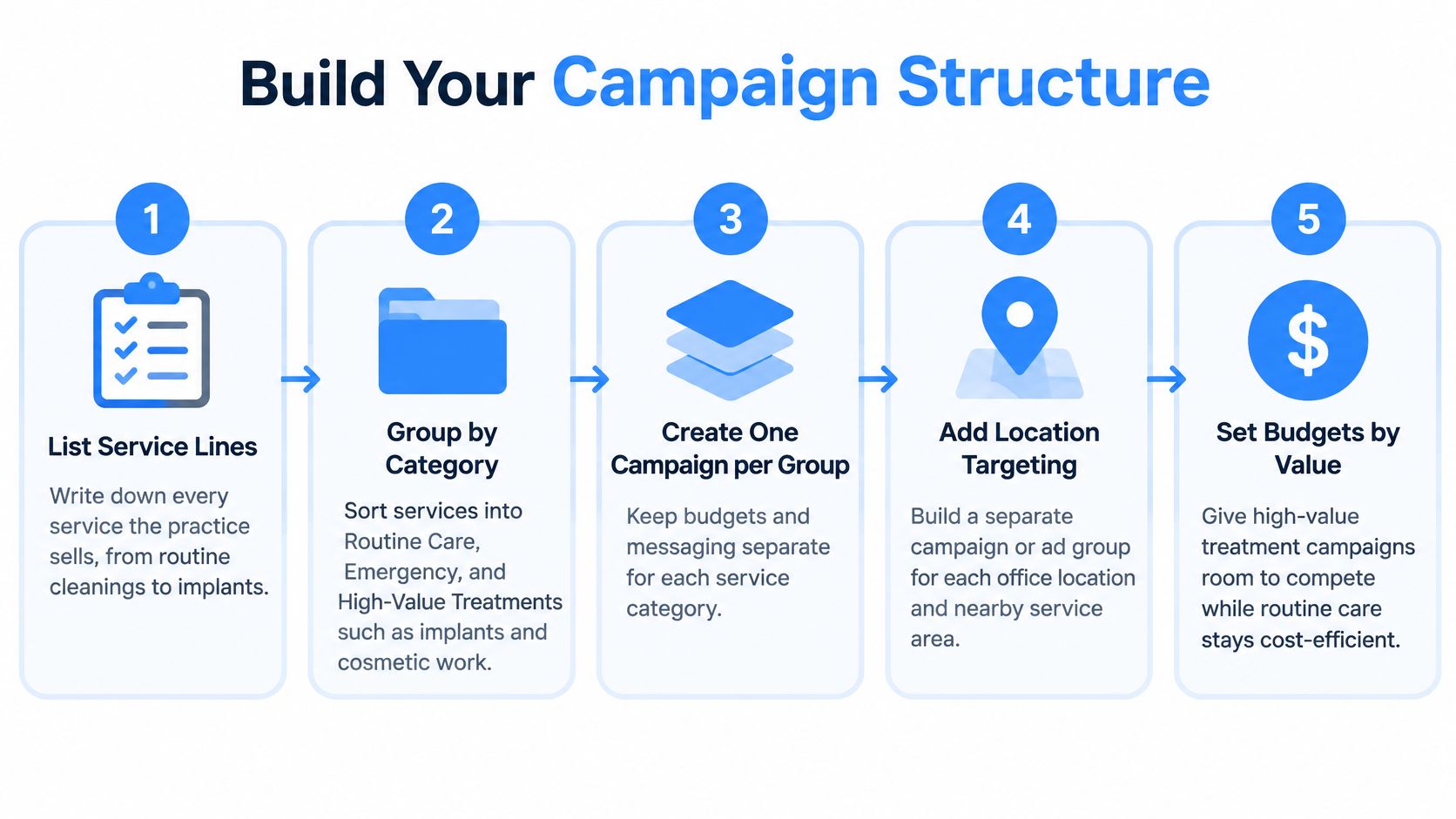
- List every service line the practice sells. Write down routine care, emergency work, high-value treatments such as implants, cosmetic and orthodontic cases, and branded search. This list is the budget map, and most practices discover two services they promote that they'd rather not perform.
- Give each family its own campaign, and each major procedure its own budget. Cost per lead differs by multiples between families, so a shared budget lets one service consume another's spend and hides which one is failing.
- Split by service area where competition differs. If one city costs twice as much per lead as the next, separate budgets stop the expensive market from draining a neighboring area that converts cheaply.
- Keep ad groups tight, and keep emergency terms away from cost questions. Someone with a swollen jaw and someone comparing implant prices need different copy, a different page and a different booking path. Mixing them wastes both clicks.
- Load negative keywords before launch, not after the first invoice. Job seekers, dental-school queries, insurance-plan research and free-care searches never become patients, and at dental click prices each one is a real loss. Most of that list is predictable within an hour of planning.
- Send every ad group to a page built for that treatment and that city. The page should name the procedure, the location and a booking option, because traffic that lands on a homepage has to hunt for the next step and usually leaves instead.
- Assign a conversion value to each service line and review cost per attended consultation weekly. Weekly cadence matters more than the report format. A monthly review hides which week a campaign broke and why.
If you'd rather see the structure applied to a live account, this walkthrough shows how the pieces fit together.
Keyword Themes and Match Types for Dental Ads
Keyword themes should come straight out of the campaign map, so each ad group carries one intent and one landing page:
- Routine care seeds: dentist near me, dental cleaning, teeth cleaning cost.
- Emergency seeds: emergency dentist, tooth pain dentist.
- High-value seeds: dental implants, Invisalign, cosmetic dentist.
- Branded seeds: practice name plus reviews, hours or city.
Keep cost-of-treatment queries in their own ad group, apart from urgent emergency terms, so the ad copy and the landing page can answer the question the person asked.
Match types are budget control. Use exact match for high-value procedures where every click needs to be on target, phrase match for service-plus-city queries that need room to breathe, and broad match only when smart bidding runs with a mature negative list behind it. Keyword-level reporting places the most common dental keyword costs between $5.00 and $10.00 per click, with "dentist near me" averaging $13.92 and some highly specific problem-related searches above $70 (Surfside PPC). At those prices a single-word term like "implants" can spend a day's budget on searches you never wanted.
Pull the search terms report every week, move productive queries into exact-match ad groups, and log the waste. Building that list is its own skill, covered in this guide to what negative keywords are and how to build them.
Local Targeting and Transactional Search Terms
Local intent is the most valuable asset a dental practice owns, and it's mechanical rather than mysterious. Google names three factors behind local results: relevance, distance and prominence (Google Business Profile help).

Relevance measures how closely the profile matches the query, so the listing should name emergency dentistry, dental implants and orthodontics in plain words rather than broad filler. Distance measures how far the practice sits from the searcher or the place named in the query, which is why "dentist near me" is location-sensitive by nature. Prominence reflects how well known the business is, shaped by links from other sites, directory information, review volume and review ratings. Google states that more reviews and positive ratings can improve local ranking.
Those factors explain why transactional search terms deserve the budget. A query is transactional when the person is ready to act and ready to spend. Informational queries can wait for an article. Transactional queries need an ad, a profile and a page that all say the same thing.
| Search type | Example | Intent | Targeting note |
|---|---|---|---|
| Emergency local | emergency dentist near me | Ready to book today | Point to a same-day booking page |
| Service plus city | dental implants in [city] | Comparing providers | Limit to the practice's city radius |
| Near me | dentist near me | Looking for the nearest office | Location-sensitive, so set the radius carefully |
| Branded | [practice name] reviews | Already aware of the practice | Lower cost per lead, protect with brand ads |
Broad country-wide targeting spends money on people who can't drive to the office. A practice forty minutes away isn't a lead, and no amount of ad relevance fixes geography. No provider can promise a top-three map placement either, because results depend on where the searcher stands and who else competes in that moment.
Local visibility now extends into AI answers. Google's documentation on AI features in Search says Business Profiles can help products and services appear in AI-generated responses as well as standard results, and that no special schema or dedicated AI markup is required. Keep structured data consistent with the visible page content and keep the profile's service list current, because that's what these systems read. For dental clients, we code both the website and the Google Maps listing for the same treatment-and-city terms, so the profile and the page reinforce each other instead of competing.
Conversion Tracking That Shows Real Patients
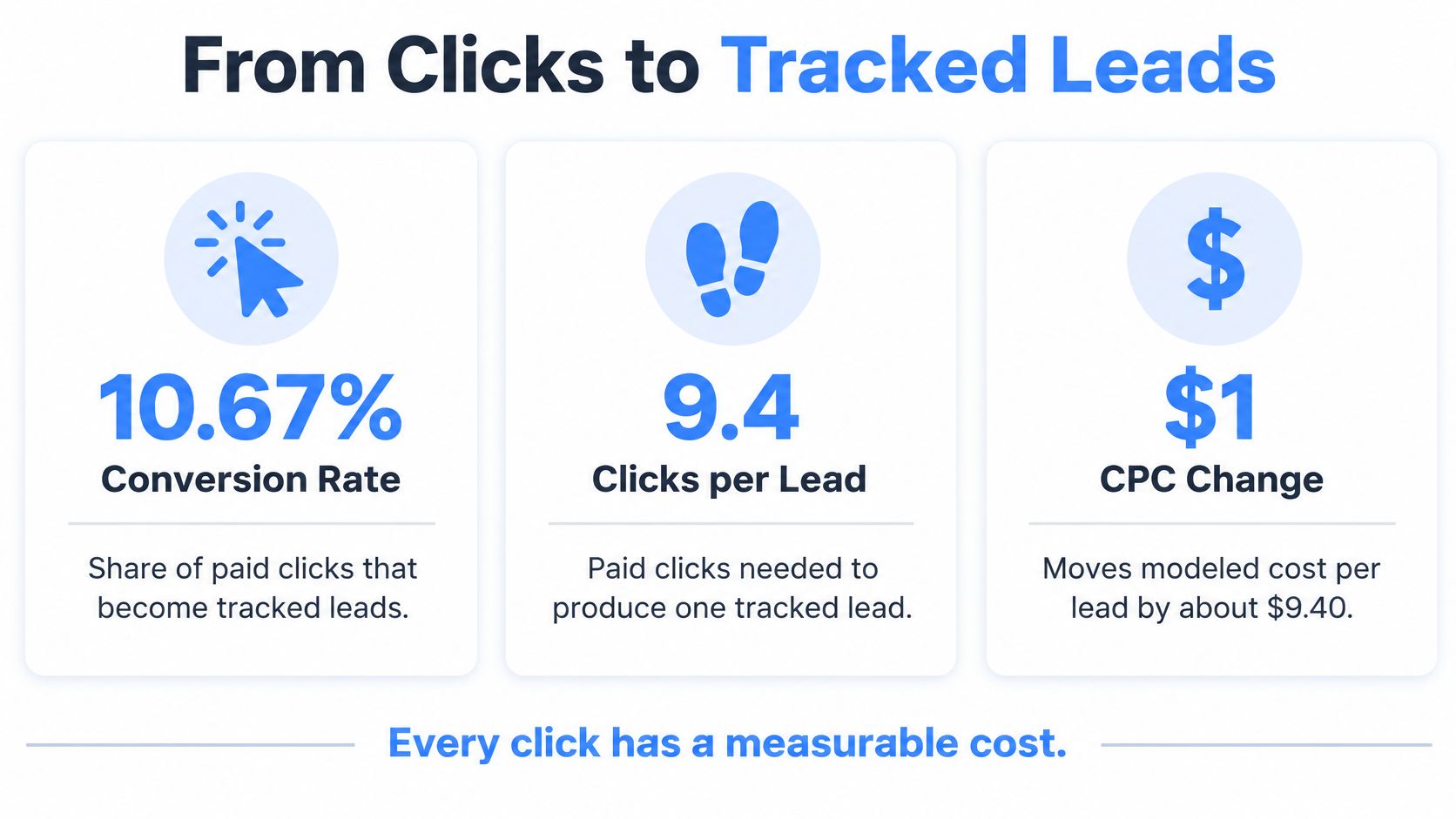
Tracking quality is a budget line, not a technical chore. At a 10.67% conversion rate, roughly 9.4 paid clicks produce one tracked lead, so each $1 change in cost per click moves modeled cost per lead by about $9.38 (Clever Zebo dental benchmark). Small account changes compound quickly in both directions.
Define a Lead the Way a Dentist Would
A form submission isn't a lead. It's a form submission, and a benchmark conversion might be a call that lasted nine seconds or a request for a Saturday appointment the office doesn't offer. Define the thing you're buying as a qualified appointment opportunity, then import qualified calls and booked appointments back into the account as offline conversions so Google optimizes toward outcomes a dentist would recognize.
Give Every Service Line a Value
Assign different values to emergency, new-patient, implant, orthodontic and cosmetic inquiries, and bid on those values. Without them, every inquiry looks identical and the system buys the cheapest contact available, which is usually the least valuable patient in the funnel. With them, bidding favors revenue-bearing outcomes over inexpensive noise.
Before you touch a bid strategy, audit the conversion signals in the account. Bidding harder on a broken signal just spends faster.
Calls need tracking on the website and on the Business Profile listing, because plenty of dental leads still arrive by phone and never touch a form. If calls are your main channel, this explanation of what call tracking does covers the setup. From there, follow the path from lead to attended consultation to treatment start, and close each month by comparing every campaign's cost per attended consultation against the treatment value it produced.
Healthcare Ad Policy Limits to Plan Around
Aggressive claims and broad targeting look like growth levers. In dental paid search they raise cost per attended consultation, because Google restricts healthcare content by location and limits some ads outright or holds them for approval before they serve (Google Ads healthcare policy). The policy also requires advertisers to follow local law and industry standards. That puts compliance on the practice.
Judge the account by attended consultations and expected treatment value, not by clicks or raw leads. A disapproved implant ad or a limited emergency ad does not just pause spend. It removes high value consultations from the schedule while lower value hygiene clicks keep spending.
Where Policy Changes the Architecture
Do not mix routine dentistry with anything involving medical claims, prescriptions, financing, or vulnerable patients in the same ad groups, copy, or landing pages. Each risk tier needs separate messaging, separate pages, and tighter keyword controls.
A cleaning offer can state the benefit and the booking step directly. A treatment claim that implies a clinical outcome needs restrained language and proof on the page. Merged together, the campaign becomes dull where it could persuade and risky where it needs care.
The account that survives review usually books more consultations over time than the loudest account in the auction.
When an Ad Is Limited
Read the stated reason first. Edit the flagged copy or landing page, then request review after the fix is live. Approval rules differ by country. That matters for multi location groups, where one shared structure creates avoidable disapprovals across markets.
Apply the same check to remarketing. Confirm that building an audience from patient site visits is lawful under local privacy rules before a list is loaded. Compliant copy can still convert. Keep the benefit and the call to book, remove the clinical promise, and let the landing page carry the detail.
Healthcare ad policies change over time and can differ by country, so practices should check the current rules for their market before relying on any exception. Build each service line so a policy shift changes one contained campaign, not the full account. Copy stays modular, pages stay specific to the claim, and budgets stay tied to consultations that attend and treatments that start.
Set the Budget From Patient Value
Budgets should follow patient value, not a preferred monthly spend. Take the average gross profit of a new patient in each service line from your own books, pair it with the cost per attended consultation you measured, and apply one rule.
- Multiply expected gross profit per new patient by the share of leads that become attended consultations, then by the share that start treatment, using your own numbers rather than a benchmark.
- Compare that result with the campaign's current cost per attended consultation to see whether the service line pays back.
- Fund profitable campaigns with enough test budget to collect a meaningful number of conversions inside the review period, and cap anything that stays above break-even.
- Move budget between service lines only after offline conversions are confirmed in the account, otherwise you're reallocating on incomplete data.
Illustration with invented figures: if an implant patient yields $2,000 in gross profit and a campaign books one attended consultation per $400 of spend, that campaign clears break-even with room to scale. Drop the gross profit to $300 and the same account loses money at the same efficiency.
Transactional terms such as emergency dentist near me justify the highest bids because the patient is ready to book today, which shortens the distance between click and chair. Tying bids to those values is the whole point of value-based bidding, and it's the difference between buying clicks and buying patients.
Transactional LLC builds the paid search and local visibility system that these numbers demand, pairing Google Ads management with Google Maps optimization and website coding for the transactional terms that bring in patients who are ready to book. For dental clients, the Patient Magnet Engine™ combines keyword targeting, Maps work and on-site improvements so a practice shows up for dentist near me and the treatment terms that follow it. Visit Transactional LLC to see how the plans fit together and what a realistic first 90 days looks like.