

You're staring at the same problem a lot of local owners hit every week. A competitor keeps showing up on your transactional searches, the calls are going somewhere else, and the ad itself looks polished enough that you can't tell whether it's working or just looking busy. Ad transparency Google gives you a way to inspect what's being run, who's behind it, and how much of the story Google is willing to show.
For service businesses, that matters because the money is in intent. Searches like roofer near me, dentist near me, and air conditioning repair near me are not casual browsing, they're buying signals, and the brands that appear there usually fight hard for visibility. If you're trying to win those searches, you need to know which competitors are active, what they're advertising, and where Google's transparency tools stop short.
Why Local Business Owners Are Suddenly Asking About Ad Transparency
A roofing owner looks at a search result and sees the same contractor name again, same city, same promise, same lead form. A dentist sees a competitor running the same emergency offer week after week and wonders whether the ad is converting or just taking up space. That's the moment most owners start asking a simple question, what exactly are these businesses running?
The answer used to be guesswork. Now there's a public record of parts of that activity, and that changes how local operators should think about competitor research. The point isn't curiosity for its own sake, it's figuring out which advertisers are persistent in the exact transactional searches that matter most.
What local owners are really trying to learn
Owners in HVAC, plumbing, pest control, med spas, chiropractic, and dentistry usually want four answers. They want to know who the advertiser is, what creative they're using, whether the ad is local or regional, and whether the message is changing over time. That's enough to spot patterns without pretending you can see everything.
Practical rule: use transparency tools to study market pressure, not to chase vanity. If an ad keeps appearing in your service area, it deserves attention even if you can't yet prove its return.
That's why the phrase ad transparency Google matters to local SEO operators. It's not a feature to admire, it's a reconnaissance layer for transactional search. If you're trying to show up when someone types a money keyword into Google, then the competition's public ad trail is useful whether you buy ads yourself or not.
The Core of Ad Transparency Google Tools and How They Fit Together
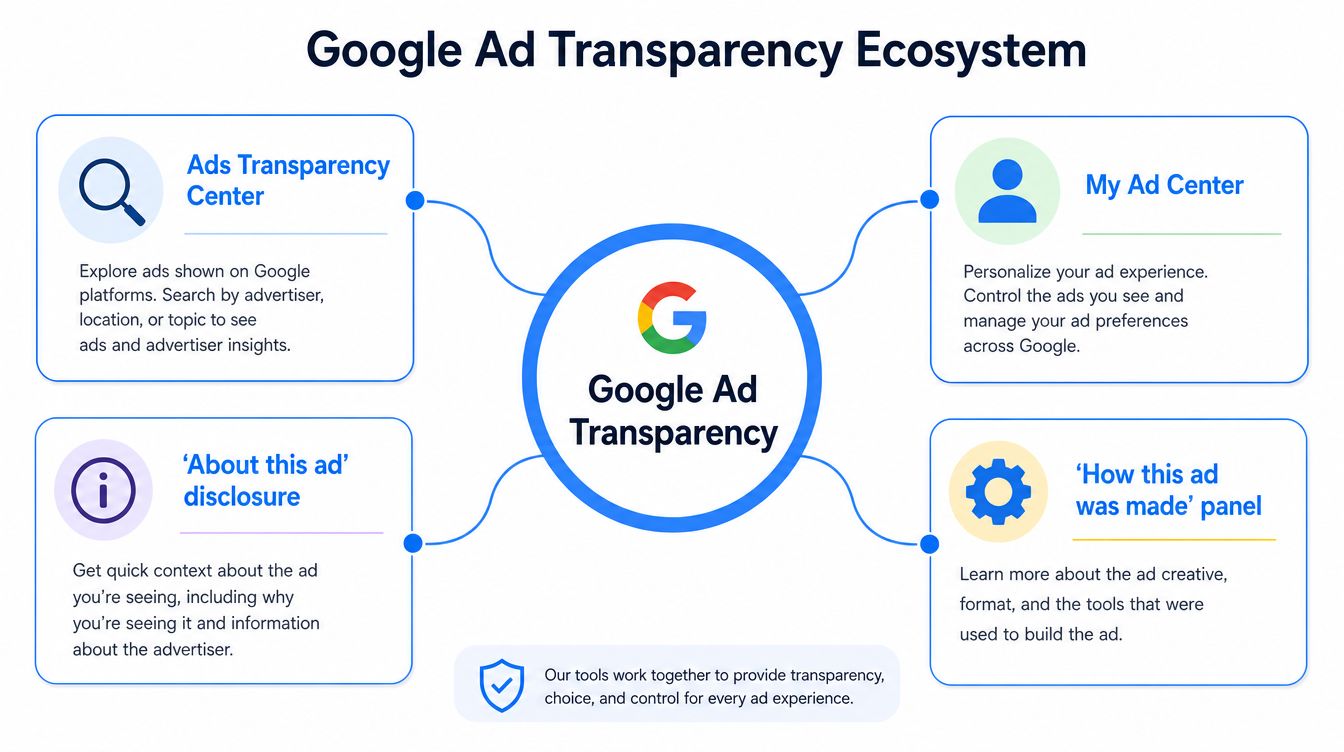
The system is easier to use once you stop treating every disclosure as the same thing. Google's Ads Transparency Center is the archive, My Ad Center is the user control panel, the About this ad flow is the disclosure entry point, and How this ad was made is the AI label layer. Each one answers a different question, and if you mix them up, you'll waste time.
The Ads Transparency Center is where you research advertisers. Google says it's a searchable repository of advertisers and ads for a defined time period, and you can inspect details like the advertiser's name, location, the ads served, and related fields in the downloadable dataset, including advertiser_id, creative_id, advertiser_verification_status, first_shown, last_shown, and region_stats Google's Ads Transparency Center support documentation, Google's launch explanation for the Ads Transparency Center. That makes it useful for local keyword audits, creative tracking, and geo-level checks.
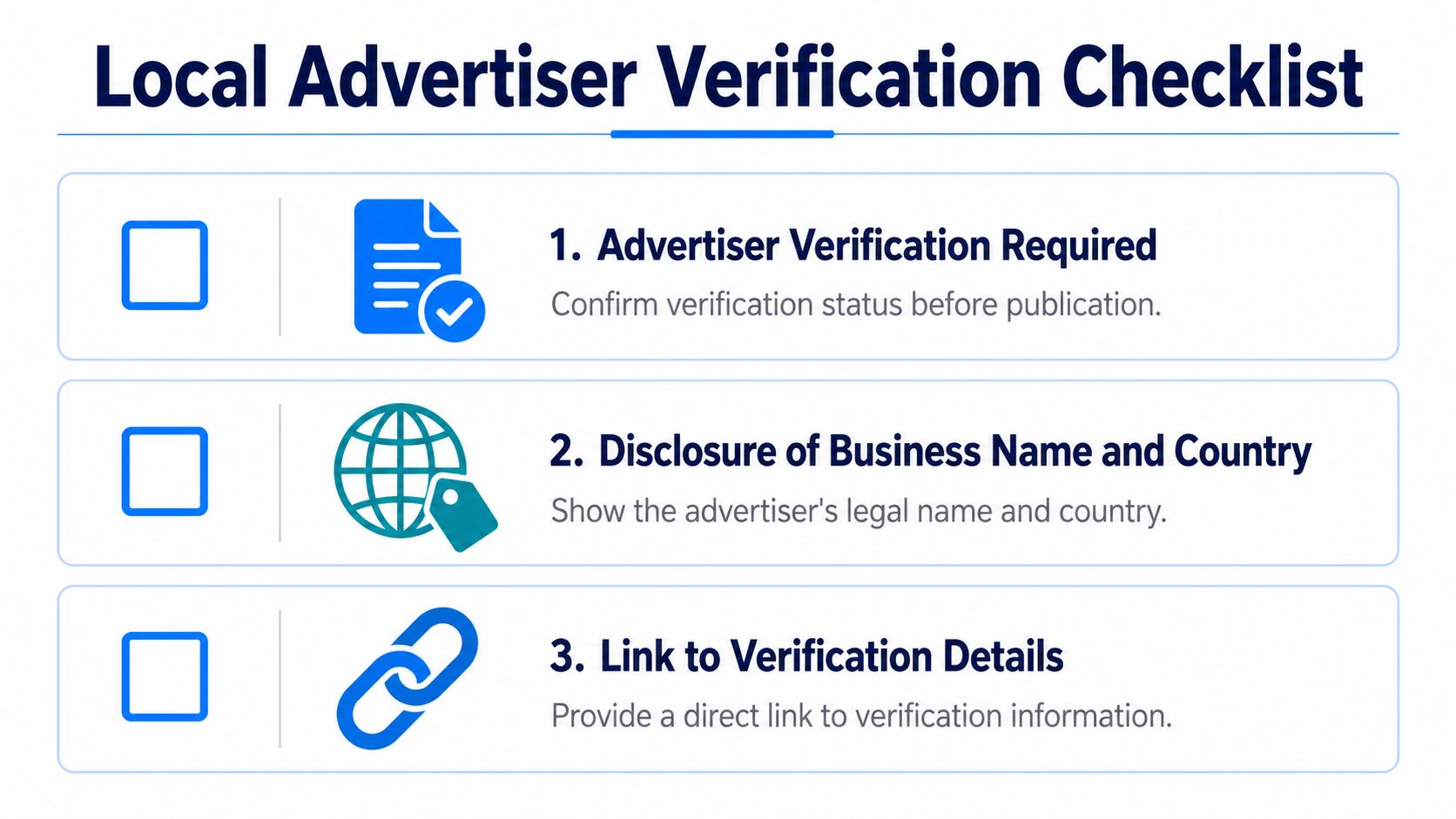
The About this ad disclosure is the fast lookup tool you'll see on served ads when you click through Google's disclosure flow. Google says advertiser verification is required, and after verification, the disclosure can show the name and country of the advertiser Google's advertiser verification support page. For local owners, this is the quickest way to confirm who's behind a promotion.
The newer How this ad was made panel sits inside My Ad Center and appears across Search, YouTube, and Discover. Google says it automatically discloses when its own generative AI ad tools were used, and advertisers can also self-identify AI use when ads were created elsewhere Google's AI transparency labels update. That matters if you're comparing ad creative quality in a market where competitors are leaning on AI-generated copy or images.
If you're setting up campaigns while you audit competitors, the practical companion is a clean build. A solid starting point is this guide on how to set up a Google Ads campaign, because transparency is more useful when your own account is structured well enough to compare against what you find.
Why Transparency Exists at All and the Scale Behind It
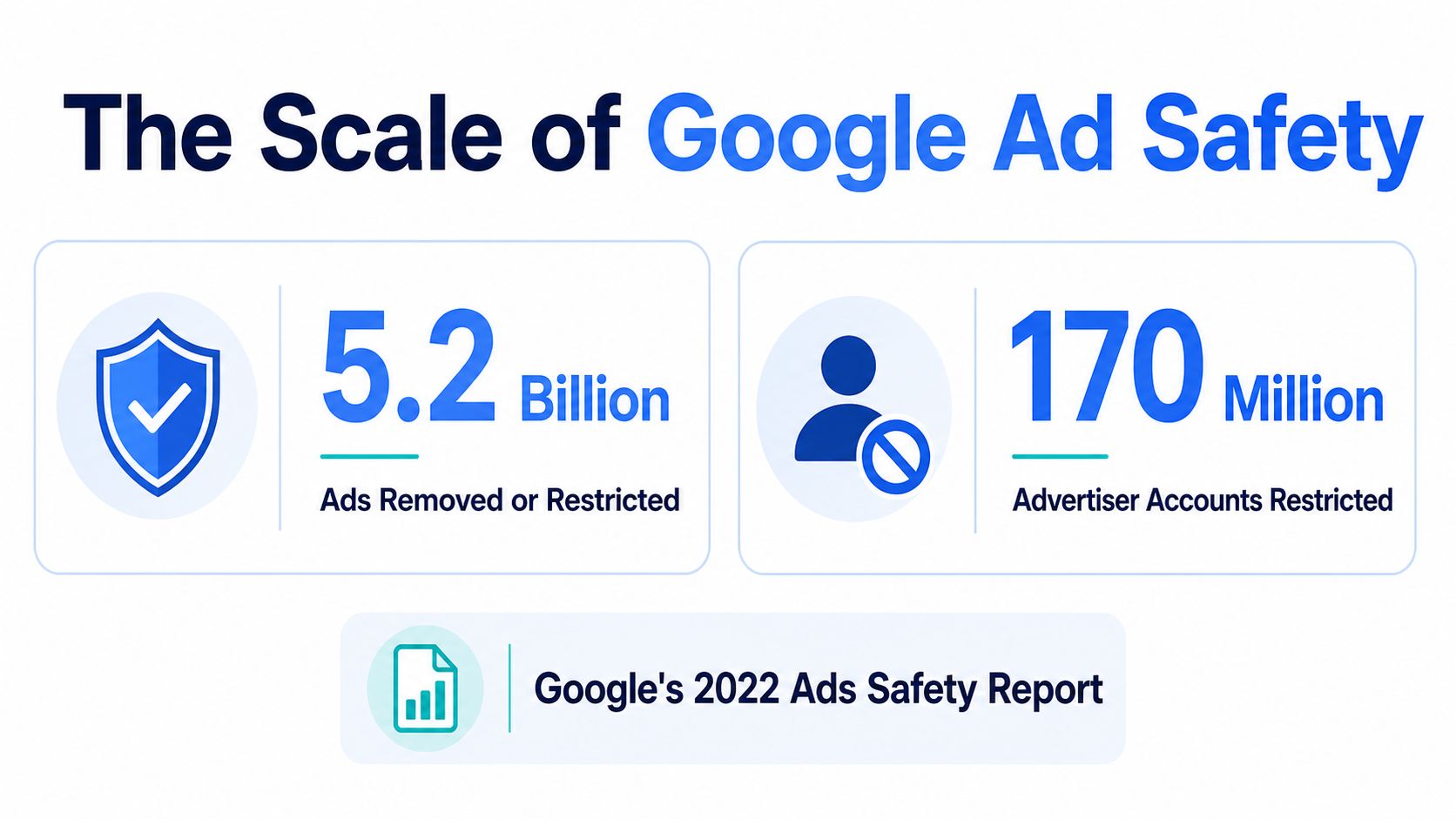
Google didn't build transparency because it wanted another menu item. It built it because moderation at Google's scale is impossible to ignore. In its 2022 Ads Safety Report, Google said it blocked or removed 5.2 billion ads, restricted 4.3 billion ads, and suspended more than 6.7 million advertiser accounts in that year alone Search Engine Land's report on Google's 2022 Ads Safety Report and Ads Transparency Center.
That report also said Google removed ads from over 1.5 billion publisher pages, took broader site-level enforcement action on more than 143,000 publisher sites, and added or updated 29 policies in 2022 Search Engine Land. Those numbers explain the logic. If a platform is policing that much inventory, it needs a public way to show who is advertising and what they're running.
Why the archive matters for local markets
The historical point is simple. Google paired that enforcement scale with the launch of a public transparency archive in 2023, so the public could inspect verified advertiser activity across its ecosystem Google's Ads Transparency Center support documentation. That doesn't make the system complete, and it doesn't tell you which ad is profitable, but it does create a public log of advertising activity at a scale that local owners can use.
For a roofer, a chiropractor, or a med spa, the practical value is accountability. If a competitor keeps buying your transactional terms, the archive gives you evidence that they're active, not just loud. If they're missing, it doesn't automatically mean they're inactive, which is why you should never overread a blank result.
Google moderates a firehose, and transparency is the public log of that firehose.
The right mental model is enforcement first, visibility second, and performance data nowhere in the product. That keeps your expectations realistic, which is exactly where they need to be.
Verification and Payer Name Rules Local Advertisers Must Get Right
If you run ads for a local service brand, the first thing to understand is that advertiser verification is not optional window dressing. Google says verification is required to buy ads, and once an advertiser is verified, that information can appear in disclosures and the Ads Transparency Center, including the name and country of the advertiser Google's advertiser verification support page. If your business details are messy, the public record will reflect that mess.
The second thing to watch is the payer name. Google's transparency update is rolling out in two phases. In May 2025, Google began showing the payment profile name as the payer name when it differs from the verified advertiser name, and for verified agency accounts it uses the client payment profile when applicable Google's payer name policy update. In June 2025, advertisers were allowed to edit the displayed payer name in the advertiser verification page under billing, and new Google Ads accounts default to the payment profile name unless changed during verification Google's payer name policy update.
What you should check before you spend another dollar
If your company name and billing profile don't match, fix the mismatch before you assume the transparency layer is wrong. If you're an agency, check whether the client payment profile is what Google will surface. If you've already verified, review the payer name in the verification flow and make sure it's the version you want public.
The reason this matters is simple. Local buyers click quickly, and trust breaks fast when they see a name they don't recognize. The more your ads look like a real local operator and less like a random payment artifact, the less friction you create.
A clean local profile also helps when you're setting up your broader presence. If you're tightening this side of the account, pair it with a clean Google Business Profile setup so your maps presence, paid presence, and disclosed identity don't fight each other.
What the Transparency Center Will Not Tell You About Competitors
The biggest mistake I see is treating the Ads Transparency Center like a full competitive-intelligence platform. It isn't one. You can see ads, formats, landing URLs, and verification details, but you cannot see conversion data, bidding strategy, audience targeting, or impression share and spend Pixis analysis of what the Google Ad Transparency Center cannot tell you. That means you can inspect the wrapper, not the economics.
That limitation matters a lot for local service businesses. A competitor can run a clean ad and still waste money. Another can look uninspired and still dominate leads. Without performance data, you can't tell which is which, so don't pretend the archive answers a question it wasn't built to answer.
Why missing results are not proof of inactivity
A blank search result can mean several things. The advertiser may be unverified, the listing may be incomplete, the coverage may be regional, or the business may not be running that ad at the moment Google's Ads Transparency Center. That's why local owners should be careful before declaring a competitor “not advertising.”
Practical rule: if the tool gives you no result, treat it as an ambiguity, not a verdict.
This is also where most agencies overpromise and under-deliver. They show a client a screenshot of a competitor's creative and call it competitive research. Real research asks better questions, including whether the ad is active in your region, how the message changes, and whether the public record is incomplete.
If you need a cleaner way to think about market visibility, a useful companion is this share of voice SEO framework. It won't fill Google's gaps, but it will keep you from confusing visibility with performance.
A Local Business Workflow for Auditing Ads and Tracking Competitors
Start with the advertisers that matter most to your revenue. Search the Ads Transparency Center for your top competitors, save the profiles you find, and check their creative in the exact service areas you care about. That gives you a repeatable baseline, not a one-time screenshot.
Next, use the public dataset fields Google exposes, including advertiser_id, creative_id, advertiser_verification_status, first_shown, last_shown, and region_stats, for geo-level creative analysis Google's launch explanation for the Ads Transparency Center. If the same message keeps surfacing in one city but not another, that's a local signal worth tracking.
Then watch the AI disclosure layer. If competitors are using Google's generative tools, the How this ad was made panel will show it in My Ad Center across Search, YouTube, and Discover Google's AI transparency labels update. That doesn't tell you whether the creative is good, but it does tell you whether the market is starting to lean on AI-generated ad production.
Finally, use your own browsing and disclosure settings to understand what a consumer sees. You can't force competitor behavior, but you can inspect how ad disclosure surfaces across placements and how much trust friction a searcher would face before clicking.
| Tool | Primary Job | Best For Local Service Businesses |
|---|---|---|
| Ads Transparency Center | Research advertiser activity and creative | Tracking competitors by city and service line |
| My Ad Center | Review ad disclosures and AI labels | Seeing how ads appear across Search, YouTube, and Discover |
| About this ad | Reveal advertiser identity on served ads | Quick verification of who's behind an ad |
| How this ad was made | Disclose AI involvement in creative | Spotting AI-generated or AI-edited ads |
If you want a broader operational check on how your sales and lead capture stack line up with this kind of market intelligence, an AI-powered GTM audit can be a useful reference point. Use it as a diagnostic lens, not as a replacement for your own local market review.
AI Disclosure, AI Search, and What This Means for Transactional Searches
Google's AI disclosure work changes how you should read competitive ads. The How this ad was made panel appears across Search, YouTube, and Discover, and Google says it automatically discloses when its own generative AI advertising tools are used. It also gives advertisers a way to self-identify AI use when they created the ad elsewhere, and in some jurisdictions, a label can appear directly on the ad itself Google's AI transparency labels update. That's disclosure, not performance, but it still tells you something important about the market.
The bigger shift is that buyers are increasingly starting with AI-shaped search behavior. People ask assistants for the best dentist near me, the fastest plumber, or the nearest roofer, and those transactional searches still need a visible brand, a verified profile, and a credible ad. If your business isn't set up to show up where that intent lives, someone else gets the call.
What local operators should do with that signal
Use transparency as an input to your content and maps strategy, not as a curiosity. If competitors are leaning on AI-generated creative, your edge may be sharper local specificity, better service-area coverage, and a stronger offer. If the search environment is getting more AI-mediated, then your own site structure and search footprint need to support that reality.
That's where a combined approach wins. AI-optimized content, Google Maps mastery, and verified Google Ads campaigns work together when the goal is transactional visibility, not just traffic. If you're building for that reality, this AI search engine optimization guide is the right kind of companion reading because it focuses on how AI changes discovery rather than treating it like a novelty.
For agents and service brands watching how AI search is shaping local discovery, ListingBooster.ai's 2026 guide is another useful reference. The point is not to copy every tactic, it's to understand how AI-friendly search behavior and disclosure rules are reshaping what a buyer notices first.
The takeaway is blunt. If you're in a transactional market, you need to know what's being disclosed, what's being hidden, and what still needs to be won through better local relevance. That's how you use ad transparency Google as strategy, not trivia.
Transactional LLC helps service businesses get found for transactional search terms, especially the searches that already signal intent and buying power. If you want your business to show up in Google Maps, local organic results, and the right Google Ads placements with a tighter local SEO strategy, visit Transactional LLC and see how their approach is built for service-area visibility.