


Your phone rings. The office gets busy. Then you listen to the calls and realize half of them are garbage.
One caller wants a free diagnosis over the phone. Another is shopping six plumbers for the cheapest price. Another asks a question they could've answered with a video search. You paid to generate that attention, but attention isn't the same as revenue.
That's the core mistake in advertising for plumbers. Too many companies buy visibility without filtering for transactional intent. They chase clicks, impressions, and random traffic when they should be chasing searches from people who need a plumber now and are ready to book now.
Stop Chasing Bad Leads Start Winning Transactional Jobs
Most plumbers don't have a lead problem. They have a lead quality problem.
If your marketing attracts people who are “just looking,” your team wastes time, your budget leaks out, and your booked jobs stay flat. A plumbing company doesn't need more eyeballs. It needs more homeowners searching terms like “emergency plumber near me”, “drain cleaning [city]”, or “water heater repair near me”. Those are transactional searches. The person typing them usually has a real problem, a deadline, and money in hand.
That's why I push a blunt rule. Every ad, page, keyword, and map listing should be judged by one question: Does this bring in someone ready to hire?
Transactional intent is the only metric that matters first
The plumbing market is large enough to reward focus and punish lazy marketing. The U.S. plumbing industry is a projected $191.4 billion market in 2026, with more than 132,000 businesses competing for jobs according to plumbing industry marketing statistics. In a market that crowded, broad marketing gets buried. Tight, buyer-focused marketing wins.
The wrong mindset sounds like this:
- “We need more website traffic.” Traffic from DIY searches won't keep trucks full.
- “Let's rank for plumbing tips.” Helpful content matters, but not if it crowds out service pages that drive calls.
- “Let's target the whole city.” Broad targeting sounds ambitious. It often just burns budget.
The right mindset is narrower and more profitable.
Practical rule: If a keyword sounds like someone wants to learn, research, or compare forever, it belongs below your money terms.
Stop paying for curiosity
There's a huge difference between “how to fix low water pressure” and “plumber for low water pressure near me.” One search suggests research. The other suggests a purchase decision.
That difference should control your entire advertising strategy:
| Search type | Intent | What you should do |
|---|---|---|
| Informational | Learning or DIY | Use for trust-building content, not aggressive ad spend |
| Commercial investigation | Comparing providers | Build proof, reviews, and strong service pages |
| Transactional | Ready to call or book | Prioritize in Google Maps, LSAs, PPC, and local SEO |
When I audit plumbing campaigns, the waste usually comes from ignoring intent. The campaign may be active. The ads may even get clicks. But the account isn't built around the searcher who wants service right now.
That's why value-based bidding matters. You're not buying traffic. You're buying the chance to win the highest-value jobs, and that requires a tighter strategy than most agencies ever build. If you want a better framework for that, study value-based bidding for local lead generation.
What winning looks like
Winning in advertising for plumbers is simple to define:
- Show up when urgent, local searches happen
- Look trustworthy immediately
- Make calling easier than comparing
- Filter out junk before it reaches your office
If your marketing doesn't do those four things, it's not helping. It's just making noise.
The Foundation Dominating Google Maps for Local Calls
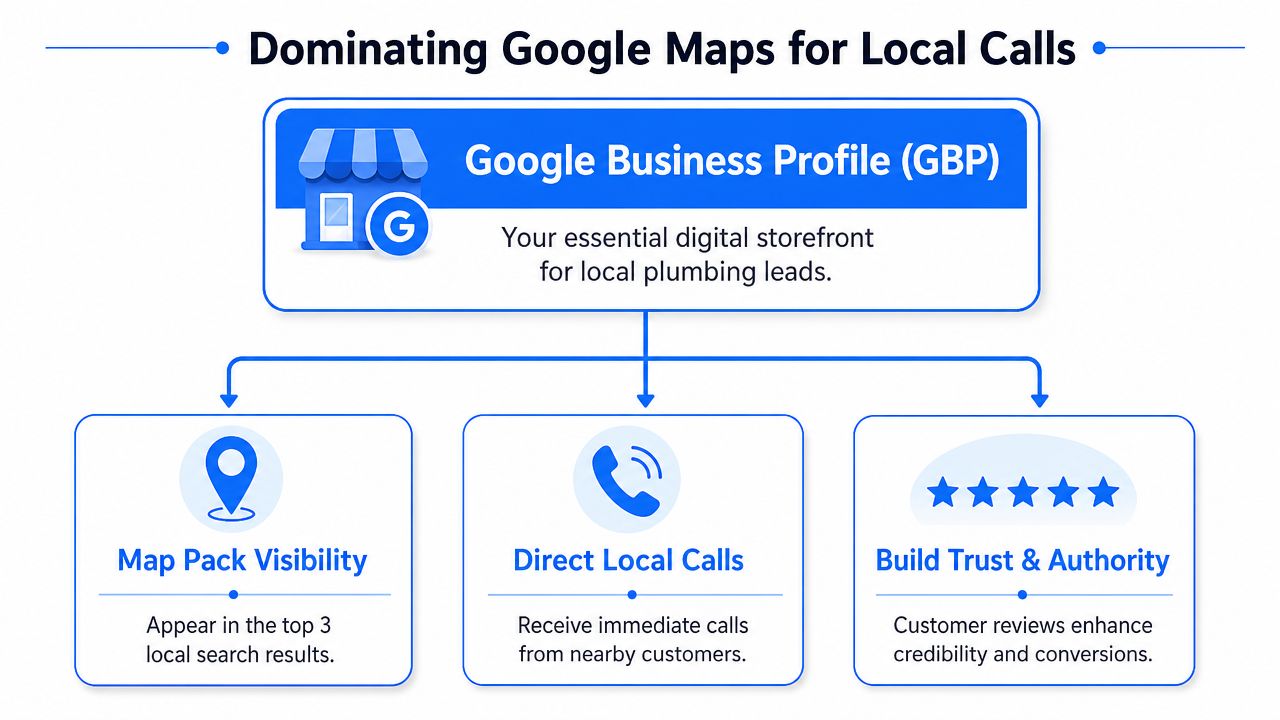
A homeowner's basement is flooding. They grab their phone, search “emergency plumber near me,” and call one of the three businesses in the map pack. That click does not go to the company with the nicest brand story. It goes to the business that looks closest, most credible, and easiest to contact right now.
That is why Google Maps matters so much for plumbers. It captures transactional intent at the moment the customer is ready to spend money.
Nearly 51% of consumers use Google Maps to look up local businesses, which makes map visibility one of the highest-value positions you can win for local service demand according to Search Engine Land's near-me optimization guide.
Build a Google Business Profile that converts
Your Google Business Profile should filter for buyers, not browsers.
Plumbers often fill out the profile once, then ignore the details that influence calls. That costs jobs. A strong profile lines up with transactional searches, proves you do the work, and removes hesitation fast.
Focus on five things first:
- Primary category: Choose the service you most want to sell. If drain cleaning is your profit driver, build around that relevance.
- Service area: Keep your coverage tight enough to serve fast. Broad coverage sounds impressive and often kills response time and conversion rate.
- Photos: Show trucks, techs, water heaters, drain jobs, repipes, and clean finished work. Real proof beats stock images every time.
- Service list: Add the services people search when they need help now, such as water heater repair, sewer line repair, leak detection, and emergency plumbing.
- Q&A: Pre-answer the objections that block calls, including hours, financing, emergency availability, and service area.
If you want another contractor-focused resource on tightening local relevance and conversion signals, this guide to local SEO for contractors is worth reading.
Review velocity drives map performance
Many plumbers treat reviews as a one-time task, but consistent review velocity is what drives map rankings.
A big batch of reviews followed by silence sends the wrong signal. A steady stream of fresh reviews does two jobs at once. It improves trust for the homeowner comparing options, and it helps your listing stay active in the local results. Beyond these, fresh reviews from real jobs reinforce the services and locations you want to rank for.
Ask for reviews at the end of completed work, while the customer is relieved and the result is visible. Do not leave this to chance or wait until the office has time to follow up.
Use a simple field script:
“Glad we got that fixed for you today. If you were happy with the service, would you leave us a quick Google review? It helps other local homeowners find us when they need a plumber fast.”
Consistency wins the map pack
The plumbers who win Maps treat it like an operating system, not a profile they set and forget.
Run this weekly:
- Upload fresh job photos.
- Respond to every review.
- Request reviews from satisfied customers every day.
- Check calls, direction requests, and profile activity by service area.
- Watch which services generate calls, then strengthen those signals in your profile.
Geography matters too. Many plumbing companies hurt themselves by trying to rank everywhere at once. Start by owning the zip codes closest to your shop, your best crews, or your highest close rates. That tighter footprint usually produces faster response times, better reviews, and more repeat exposure in the neighborhoods most likely to call.
For a stronger playbook on local visibility, study how to rank higher on Google Maps for local service searches. The priority is simple. Show Google and the customer the same thing. You are nearby, you do this work every day, and you can solve the problem now.
The Fast Lane Google Ads and LSAs for Immediate Leads
If Google Maps is your foundation, paid search is your accelerator.
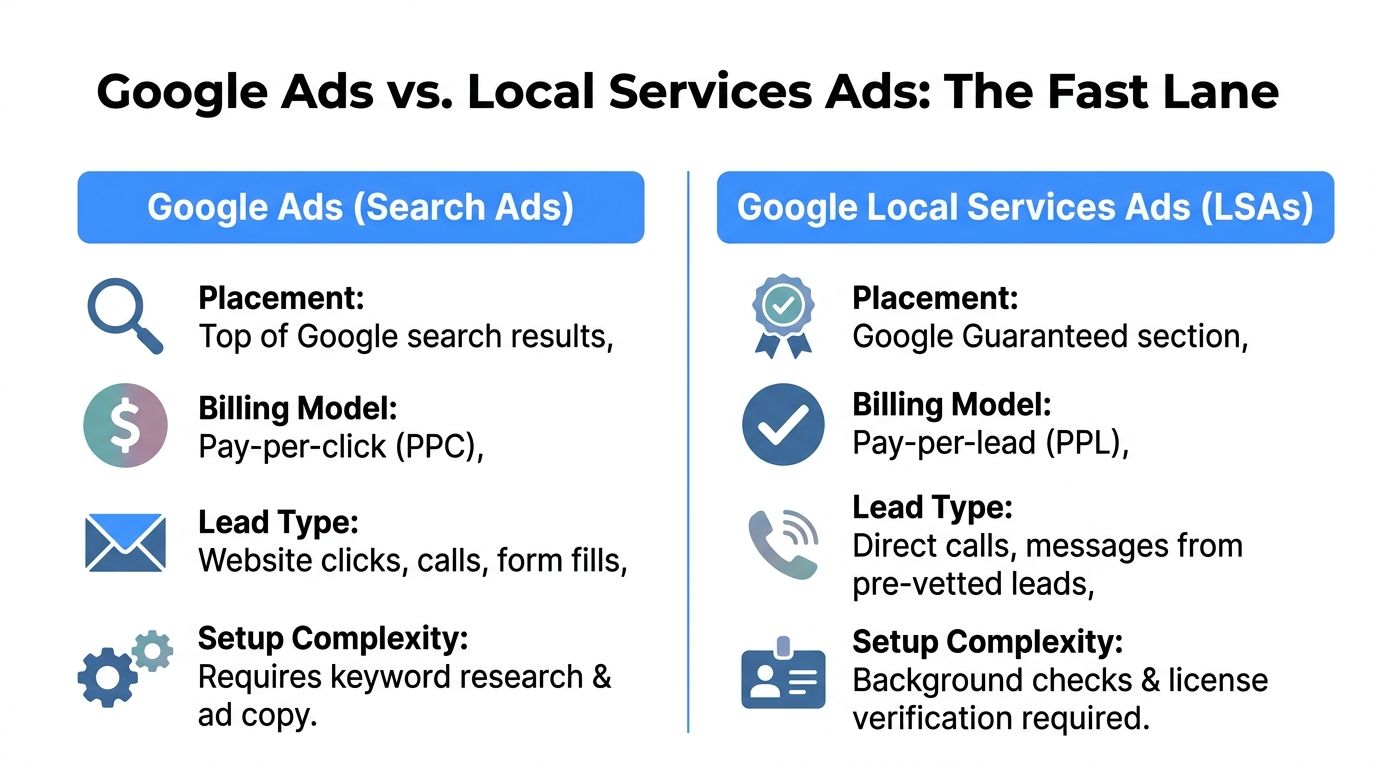
When you need leads now, two Google products matter most for advertising for plumbers: Local Services Ads and Google Search Ads. They're not interchangeable. They serve different purposes, and plumbers who understand the difference usually waste less money.
LSAs first if you want direct contact
Successful plumbing businesses often allocate 10–15% of revenue to marketing, with a focus on Google Local Services Ads because they appear above traditional ads and charge when a customer makes contact according to ServiceTitan's plumbing marketing overview.
That billing model matters. A plumber shouldn't love paying for curiosity clicks. LSAs reduce that problem because they're built around contact, not just traffic.
Here's the simplest comparison:
| Channel | Best use | Risk | Strength |
|---|---|---|---|
| Google LSAs | Immediate local lead capture | Requires setup, verification, and review discipline | High-intent calls and messages |
| Google Search Ads | Precision keyword targeting | Easy to waste spend without controls | Flexible targeting and landing page control |
LSAs are often the first paid channel I'd tighten for a plumber because they sit in premium real estate and align with transactional behavior. Someone sees the listing, sees the trust signals, and contacts the business.
Search Ads work when keyword control is strict
A lot of PPC accounts fail because they're built too broadly. The fix isn't mysterious. It's discipline.
The recommended way to start is a test budget of $30 to $50 per day so you can collect conversion data without overspending, then shift budgets seasonally and apply smart bidding like Maximize Conversions or Target CPA after you identify your stronger keywords, based on Housecall Pro's plumbing PPC guidance.
That doesn't mean you launch broad match chaos and hope for the best. It means you start narrow.
Use high-intent terms like:
- Emergency queries: “emergency plumber near me”
- Service plus city: “drain cleaning [city]”
- Problem-based buyers: “water heater repair [city]”
- Specific residential intent: “toilet repair near me”
Then filter aggressively with negative keywords. For plumbers, common waste terms include DIY, how to, and jobs. If you don't block those, you'll pay for people who don't want service.
Your landing page decides whether the click was worth it
Plumbing ads fail all the time because the ad is decent and the landing page is sloppy.
A homeowner with an urgent issue isn't going to read a manifesto. They want three things immediately:
- Fast mobile load speed
- A visible call button
- A page that matches the exact service promised in the ad
If the ad says “Emergency Plumber in Springfield,” the page should repeat that offer clearly. It should show trust signals, service area relevance, and a direct path to call or book. Anything else creates drop-off.
A useful walkthrough on the paid search side is Google Ads for plumbers, especially if you're trying to connect keyword targeting with actual job profitability.
For a visual breakdown of how these paid channels differ, this video is helpful:
My blunt recommendation
If you're a plumbing company with limited budget, I'd usually prioritize paid channels in this order:
- Local Services Ads
- Tightly controlled Google Search Ads
- Everything else later
Key takeaway: Paid search should put you in front of people who need help now. If the campaign can't separate buyers from browsers, it isn't ready.
The Long Game SEO and AI-Powered Content Marketing
Paid ads rent attention. SEO builds an asset.
Most plumbers hear “SEO” and think about blogging for the sake of blogging. That's not the job. The job is to build pages and content clusters that help your company appear for the phrases real buyers use before they call. That includes classic local search, service-specific search, and the newer layer of AI optimization, where large language models and AI search experiences decide which businesses get surfaced and cited.
SEO for plumbers should be built around transactional clusters
A strong plumbing site doesn't rely on one homepage and a few generic service pages. It builds out topic depth around services that make money.
For example, if you want to rank for water heater work, don't stop at “Water Heater Services.” Support it with content around:
- Repair intent: pages tied to urgent fixes and common symptoms
- Replacement intent: content for homeowners deciding whether to replace
- Buyer education: articles that help someone evaluate options before booking
- Local modifiers: pages aligned to city and neighborhood demand
AI optimization matters. AI-driven search systems don't just scan one page title. They look for contextual depth, consistency, and a clear relationship between services, locations, and supporting expertise. If your website has scattered pages with weak internal logic, it's harder to become the obvious answer.
AI optimization changes how plumbers get discovered
AI optimization for plumbers means structuring your site so search engines and LLM-driven systems can confidently understand:
- what services you offer
- where you offer them
- which problems you solve
- why your business is a reliable local choice
That requires cleaner entity signals, tighter topical coverage, and less fluff. It also means writing pages that answer the question behind the search, not just stuffing city names into headlines.
A lot of content in home services still misses this. It chases broad traffic while ignoring the larger pool of non-emergency opportunities. Industry analysis highlighted in Scorpion's practical plumbing marketing guide notes that 60-70% of plumbing leads are non-emergency, which is exactly why plumbers need content that captures maintenance, upgrades, inspections, and remodel-related searches instead of relying only on emergency demand.
Why the right content shortens the path to page one
Good SEO isn't random publishing. It's planned coverage of the exact phrases that sit closest to revenue.
That means your content should include topics such as service comparisons, cost-related questions, repair-versus-replace decisions, and local service pages written for real neighborhoods and cities. If your content engine is serious, it maps those terms into silos so each article strengthens a commercial page instead of floating around uselessly.
For plumbers trying to connect educational content with rankings that drive leads, content marketing for plumbers is the right model to study. The key is simple. Content should support transactional discovery, not distract from it.
Expanding Your Reach with Social Media and Offline Tactics
Most plumbers either overrate social media or ignore it. Both are mistakes.
Social media usually won't beat Google for urgent demand, but it can strengthen trust before and after the search. That matters because homeowners often check a business twice. First in search results, then through reviews, photos, and social proof.
Use social media for proof, not performance theater
You do not need dance videos, trend chasing, or polished brand campaigns.
Use Facebook, Nextdoor, and your basic local social presence to show that your company is active, clean, local, and professional. Post before-and-after photos. Show clean truck setups. Share short clips that answer common homeowner concerns. Highlight team members. Document work that looks reassuring to a cautious homeowner.
A simple weekly rhythm works better than random posting:
- One proof post: Finished job, clean result, happy customer context
- One trust post: Technician intro, process clip, or service explanation
- One seasonal reminder: Maintenance, weather prep, or upgrade timing
Homeowners don't follow plumbers for entertainment. They look for signals that your crew will show up, solve the issue, and respect the house.
Offline still works when it drives searches
Offline advertising still matters in plumbing because local memory matters.
Wrapped trucks, yard signs, clean uniforms, and neighborhood presence all create a delayed effect. A homeowner may not call the first time they see your truck. But when the leak happens later, they search your name or search “plumber near me” and recognize your brand in the results.
That's the key. Offline shouldn't live on its own. It should push people back into your digital ecosystem where your map listing, reviews, service pages, and call paths close the deal.
Here's where offline still earns its keep:
| Tactic | What it does | Best use |
|---|---|---|
| Truck wraps | Repeated local exposure | Dense residential service areas |
| Yard signs | Immediate neighborhood proof | Active jobs in visible locations |
| Referral cards | Prompt word of mouth | Existing happy customers |
| Local partnerships | Trusted introductions | Realtors, property managers, adjacent trades |
If a tactic doesn't create trust or send people back to your transactional search presence, cut it.
Your Action Plan Tracking KPIs and Quick Wins
A homeowner finds your ad, clicks, and calls. That only matters if the caller is in your service area, needs work now, and books. Transactional intent is the scorecard. Everything else is noise.
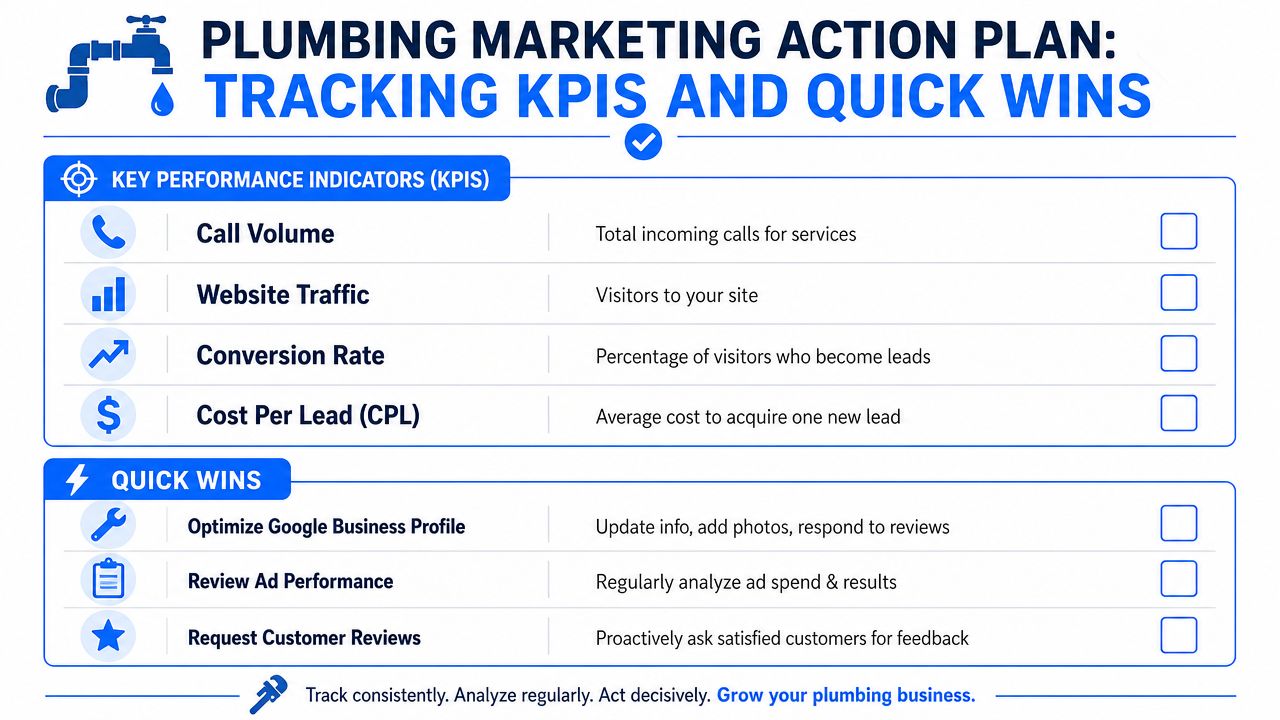
You do not need a bloated report. You need a few numbers that show whether your advertising is producing ready-to-buy plumbing jobs.
The KPIs that deserve your attention
Start with the metrics tied to revenue:
- Qualified call volume: Calls from local prospects with an actual plumbing problem
- Booked job rate: How many qualified calls turn into scheduled work
- Cost per qualified lead: What you pay for a real opportunity, not just a form fill or misdial
- Missed call rate: How many chances your team loses because nobody answered
- Map visibility for buyer terms: Whether you show up for searches that signal immediate demand, such as emergency repair, water heater replacement, or drain cleaning near me
That is enough to run the business side of marketing well. If a dashboard cannot show you which channels produce high-intent calls, stop looking at it.
Quick wins you can implement this week
These fixes produce results fast because they tighten the path from search to phone call.
Clean up your Google Business Profile
Rewrite your services around buyer intent. Use terms tied to jobs people book now, not broad labels that attract weak clicks. Add fresh jobsite photos and confirm your service areas are accurate.Set up a real review process
Review velocity matters, especially in local search. As noted earlier, steady new reviews send a stronger trust signal than occasional bursts. Give every technician a simple post-job script and send the request the same day.Cut junk from paid search
Add negative keywords for DIY, free, how to, jobs, salary, training, and parts-related searches. Those clicks drain budget and rarely turn into revenue.Fix the mobile call path
Open every core service page on your phone. Your number should be visible immediately, the page should load quickly, and the headline should match the exact problem the searcher wants solved.Prioritize the tightest service radius first
If budget is limited, win the neighborhoods where you can respond fastest and stack reviews fastest. Dense coverage usually beats thin coverage across a wide area.
One more metric belongs on the weekly scorecard. Speed to answer. A high-intent plumbing lead goes cold fast. If your team misses calls or waits too long to return them, your marketing did its job and your operation wasted the opportunity.
Operational advice: The fastest gains come from better intent matching, faster response, and tighter filtering. Adding another channel usually comes later.
The standard to hold your marketing against
Use this four-question test on every campaign, page, and ad:
- Are we showing up for searches from people ready to hire now?
- Are we easy to call from maps, ads, and mobile pages?
- Are we blocking low-intent traffic before it wastes budget?
- Are we turning qualified leads into booked jobs at a healthy rate?
If one answer is no, fix that before you spend another dollar.
If you want a partner that focuses on transactional search terms, Google Maps visibility, AI-driven SEO, and local lead generation that turns searches into calls, talk to Transactional LLC. They help service businesses build stronger local rankings, better map presence, and content systems designed to capture buyers when they're ready to book.