


1,255,000 monthly U.S. searches for dentist queries across 10 sampled terms, with a local pack on 100% of them (Signal Hill Strategies). Not ten blue links. A map, three pins, and a tap-to-call button.
That's the frame for any dentist SEO case study worth your time. Someone typing dentist near me isn't researching oral hygiene. They're choosing who to call, and the practice inside the three-pack takes the call.
This walkthrough treats a case study as patient-acquisition proof. It covers the evidence to demand, how to read a map grid by distance, what implementation moves, and why a ranking gain that never becomes a completed appointment isn't a result yet.
What a Credible Dentist SEO Case Study Shows
A practice owner reading a case study wants evidence that more patients will sit in the chair. Average rank, impressions, and green arrows don't pay a hygienist. Serious audits of healthcare map listings share a recognizable shape: they cover thousands of Google Maps listings, span multiple specialties and metro areas, and pair each ranking observation with the conversion elements sitting behind it. A vendor describing that kind of audit should be able to explain its sample, categories, and tools without notes.
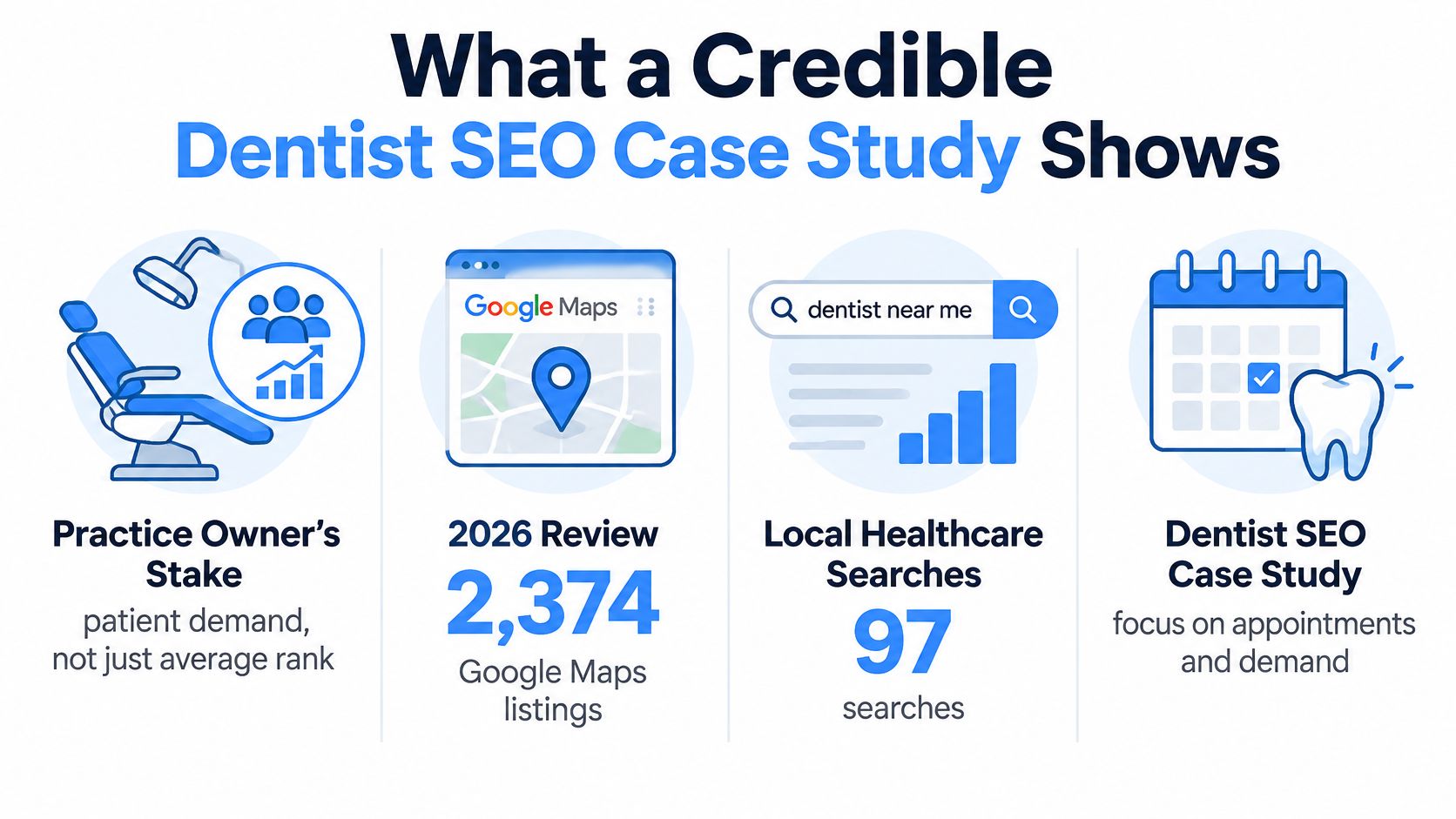
Those same audits find online booking or appointment links on a clear majority of top healthcare listings. That pattern matters because it puts conversion infrastructure inside competitive visibility. The practices holding those top spots aren't only ranking. They're the ones a searcher on a phone can schedule with.
The first question to ask: what was the starting map position, by service, in this city? A case study that can't answer that is a testimonial with charts attached.
Transactional searches are the ones that pay. Dentist near me is a patient ready to book. Roofer near me is a homeowner ready to hire. Orthodontist near me is a parent deciding on braces this month. Nobody in that group is looking for a general essay on flossing frequency, so a campaign built around top-of-funnel keywords has nothing to show at day 90.
Before work begins, a credible case study records:
- Map position by service and city, since emergency dentistry and implants rank differently from the same address.
- Review count and average rating, which feed prominence rather than rank alone.
- Primary category and service attributes, the fields Google matches against a query.
- Name, address and phone consistency between profile and website.
- Booking-link presence plus call and direction actions, the two taps that reveal intent.
Then it separates gains created by broader demand from gains created by optimization. Reporting how many keywords, locations, and map-grid points were tracked, alongside calls, booking clicks, and new-patient conversions, is what makes an outcome reproducible instead of a story.
One caveat on market data. Figures gathered in major U.S. metros shouldn't be copied onto a practice in another country, even though the local-pack mechanics travel fine. Practices that publish useful clinical resources, such as these clinical notes for dentists from PatientNotes, also give a link-building campaign something worth citing instead of a directory echo.
Named Dental Results in One Scorecard
Read the table before the argument, then judge the rest of this article against it.
| Practice or term | Market | Window | Reported outcome |
|---|---|---|---|
| Ridge Dental Care | City not named in the published case study | 90 days | Number 1 on Google and patient opportunities within 3 months |
| Winn Smiles | City not named in the published case study | 90 days | Patient calls doubled |
| The Dental Retreat TX | Katy, TX | 5 months | 188 organic patient opportunities |
| Orthodontist near me (keyword, not a single practice) | Keyword-level result across a tracked service area | 3 months | 97 percent ranking growth |
Ridge Dental Care climbed to number one on Google in 90 days, with measurable patient opportunities showing inside three months. That's a visibility result and an early demand signal stacked together. It is not a count of completed treatment plans.
Winn Smiles doubled its patient calls in 90 days. This row sits one step closer to revenue than a rank, because a phone ringing means a human picked the practice over the alternatives in the pack. Whether those calls became booked chairs is a separate question.
The Dental Retreat TX in Katy, Texas, generated 188 measurable organic patient opportunities in five months. Opportunities, not patients. An opportunity is a call, a form, or a booking click that can be tied back to organic search, and a fraction of them will fail to schedule. Read the number as pipeline volume.
A rank is visibility. A doubled call count is demand at the phone. 188 opportunities are chances. Three different things, and only the last two touch revenue.
The orthodontist near me row belongs to a keyword set, not to one of the three practices above. It shows 97 percent ranking growth over three months. Keep it in its own lane, because a keyword movement reported as a patient result is the most common sleight of hand in this niche.
Progress on transactional terms commonly shows up as steady movement within about 1.5 months, when keywords start climbing and organic traffic begins to grow. Broader ranking gains usually take three to six months of ongoing work, which is why a 90-day window and a five-month window deserve different expectations.
Use the table as a filter. If a case study can't name the practice, the city where known, the window, and either a rank or a patient action, it fails the standard set above. A screenshot gallery with no window and no action metric tells you what the marketing team chose to crop, nothing more.
The SEO reporting dashboard is the other half of that filter. If the numbers live only in a slide deck, you can't audit them at month three when the calls look flat.
Relevance Distance and Prominence for Dentists
Google names three inputs to a local result: relevance, distance, and prominence (Google Business Profile Help). Treat them as a three-part lock on one door. Every part has to turn before the pin appears.
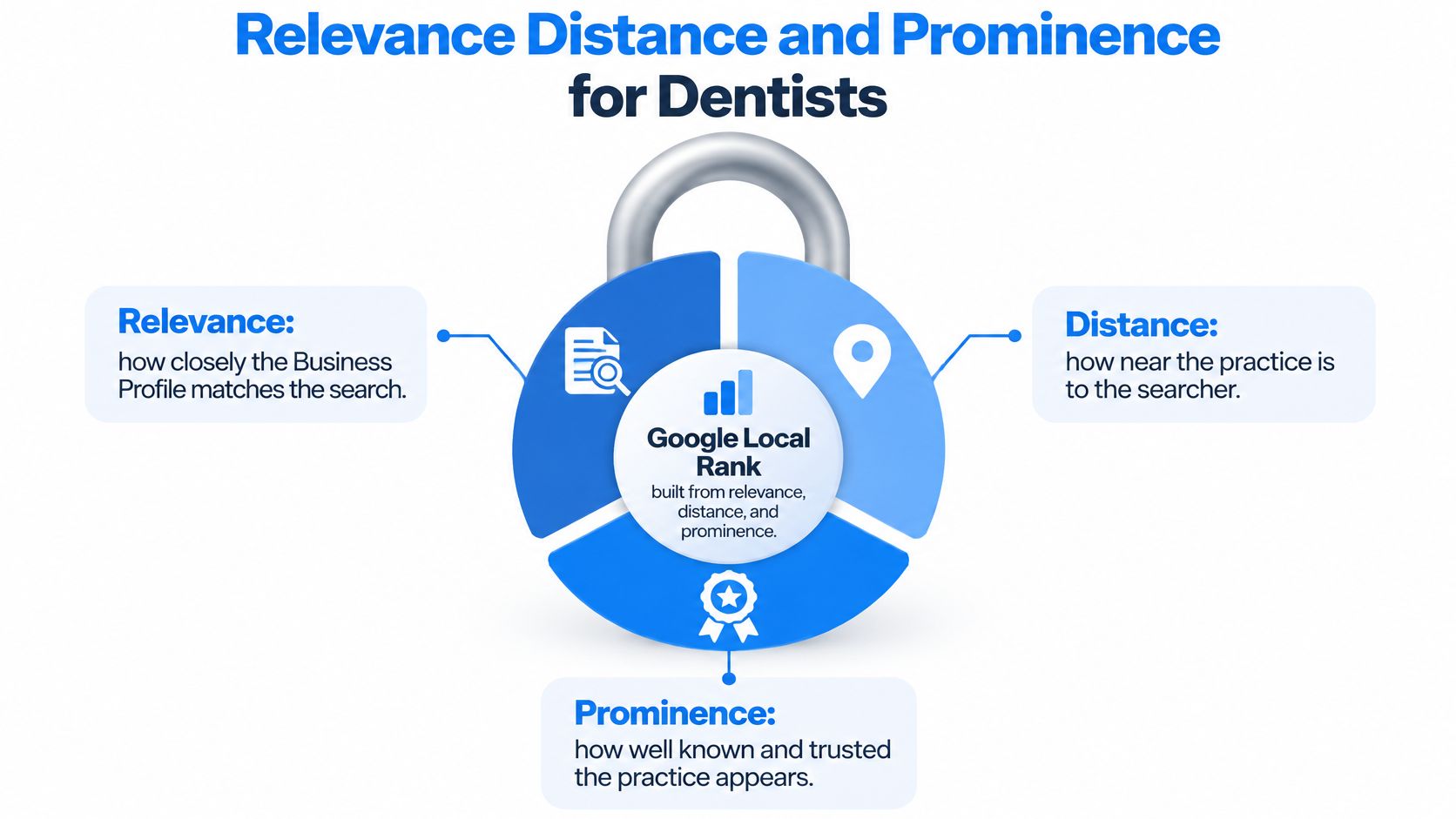
Relevance is how closely your Business Profile matches what was typed. A profile categorized as a general dentist, with no service attributes and one catch-all services page, competes badly against one that names emergency dentistry, implants, and family dentistry on separate, matching pages. Same building, different locks.
Distance is the gap between the searcher and your practice, or between the searcher and a place named in the query. It changes with every phone. A patient two blocks away and a patient four miles out get different packs for identical words, and no amount of on-page work overrides the phone's location.
Prominence is how well known you are beyond your own site. Google says information across the web, including links, articles, and directories, can influence it, and that review quantity and review ratings can affect local ranking too.
Picture two practices on a main road. The closer one has a plain profile and the farther one has 400 reviews and a newspaper feature. For dentist near me, the nearer practice often wins the pin anyway, while the famous one sweeps the suburb across town. That's the lock turning on both relevance and distance at once.
| Factor | What it measures | What the practice can change |
|---|---|---|
| Relevance | How closely the Business Profile matches the dental service searched | Primary category, service attributes, and one page per procedure such as emergency dentist, implants, or family dentistry |
| Distance | Gap between the searcher and the practice or the place named in the query | Nothing about the building; report rank at each grid point instead of one average |
| Prominence | How well known the practice is, including links, articles, directories, review count, and rating | Legitimate references and a steady review habit; a local rank cannot be purchased |
Here's a walkthrough of how the pack behaves across a service area when you look at it by query rather than by average position.
The limits are as useful as the levers. Google's guidance on how to improve local ranking states plainly that a business can't purchase or request a better organic local position, while complete and accurate profile information makes it more likely a profile appears for relevant searches. Reviews can help prominence. Nothing guarantees a top-three pin.
Close the loop on intent. The profile and pages should describe the care a ready-to-book patient is searching for, not general oral-health essays. Save the educational content for supporting the service pages, not for replacing them.
Reading a Dentist Map Grid by Distance
A claim of number one is a point on a map, not a market. Because distance shifts with the searcher's phone, the honest unit of measurement for a dentist near me campaign is a grid of points across the claimed service area, each one recording what the pack shows.
- List the transactional queries first. Dentist near me, emergency dentist, implants, Invisalign. One grid per query family, because a practice can lead for family dentistry and vanish for root canals.
- Lay a grid over the service area. If a result is stated in square miles, translate that into pin spacing that covers the footprint edge to edge rather than clustering pins around the office.
- Record pack position at every point, not an average. An average hides the edge, which is exactly where a competitor takes the patient.
- Log the distance from each grid point to the practice so a nearby number one is never reported as a citywide number one.
- Repeat the grid on a schedule. Before work, at the point where terms start climbing, and again at the scorecard window, whether that's 90 days or five months.
Attach a call count and a direction-request count to each grid run. That's what stops a hotter map from being reported as full chairs. A map can improve two months before the phone reflects it, and it can also improve while the front desk fails to answer.
Google Maps heat maps make the pattern visible in a way a table can't. You see the cluster of pins you own, the ring where you're second, and the pockets where you're absent, which is where the next round of page and profile work goes.
Practical rule: never accept a single pin as proof of a market. Ask for the grid, the date, and the call count from the same week.
The grid answers a question a ranking report can't. Not "are we number one," but "how much of our service area sees us first, and which streets are we losing."
How the Dental Campaign Was Implemented
Sequence carries as much weight as tactics. Ads pointed at a broken profile waste spend, and rewritten pages published before the category is corrected send relevance in the wrong direction.
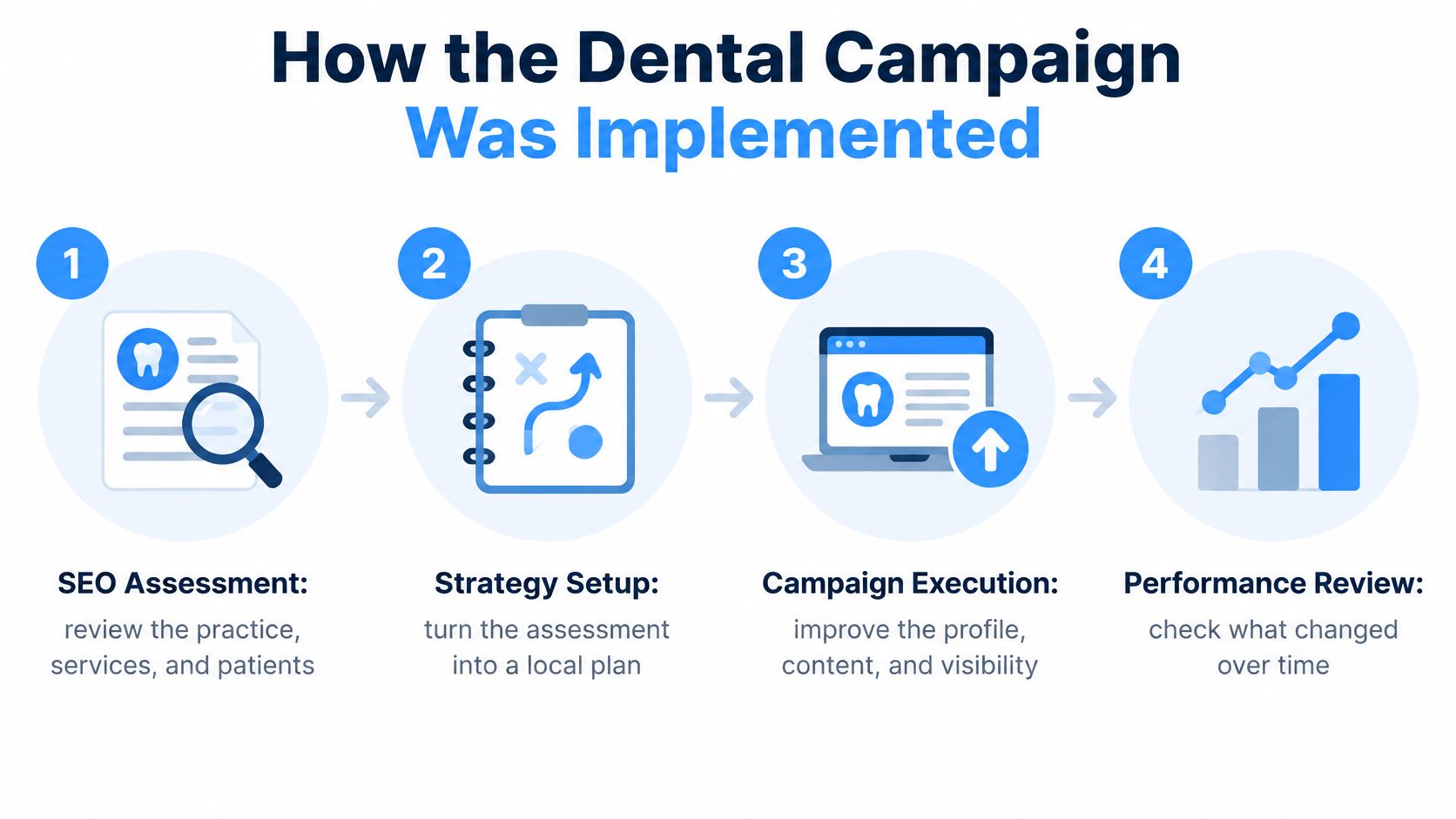
Start with an assessment, not a template. The engagement opens with an initial SEO assessment, and the team takes time to understand the practice, its services, and the patients it wants before building anything. A practice built on emergency walk-ins and a practice chasing veneer cases need different keyword sets, different page structures, and different proof on the page.
Choose transactional terms by procedure and city. Dentist near me, emergency dentist, dental implants, Invisalign. Educational queries can support a content plan, but they don't belong at the top of a 90-day report, because they don't book a chair.
Align the profile with those terms. Primary category, secondary categories, service attributes, hours, phone, photos, and the same name, address, and phone string on the website. Mismatched hours are the most common self-inflicted wound in dental local search, and they cost calls every weekend.
Give every procedure its own landing page. A homepage listing six services competes for none of them. Implants deserve a page about implants, with candidacy, financing context, and the questions patients ask before booking. Category work and page work reinforce each other, which is why we code both the site and the Google Maps listing for the same patient search terms.
Treat mobile speed as a conversion lever, not a promised lift. Faster mobile pages and stable layouts tend to convert better, but the only honest claim is a testable one. Compress hero images, cut render-blocking files, trim third-party scheduling scripts, and reserve fixed space for forms and booking widgets so the layout doesn't shift under a patient's thumb.
Build a review habit and earn real references. A weekly ask at checkout beats a monthly email blast. Directory consistency and earned mentions support prominence in ways a profile rewrite alone cannot.
Read the first checkpoint on schedule. Steady ranking progress typically appears within about 1.5 months, when keywords begin ranking higher and organic traffic starts to grow. Judge that checkpoint on calls and booking clicks. Position is the input. A scheduled patient is the output.
Most campaigns get misread at exactly this point. A keyword climbing into the top three is a leading indicator that the work is registering, and it says nothing yet about whether a single patient chose the practice.
From Map Visibility to Completed Appointments
The weakest line in most dental case studies is the conclusion. Clicks rise, "new patients" rise, and nobody shows the join between them. One published example reports Google clicks rising from 7.2 per day to 77.7 and new private patients increasing from 8 to 19 per month, then notes that the practice used its own records and that the SEO period coincided with other operational changes (Bollington dental practice case study). That caveat is more honest than most, and it's the one that should appear in every write-up.
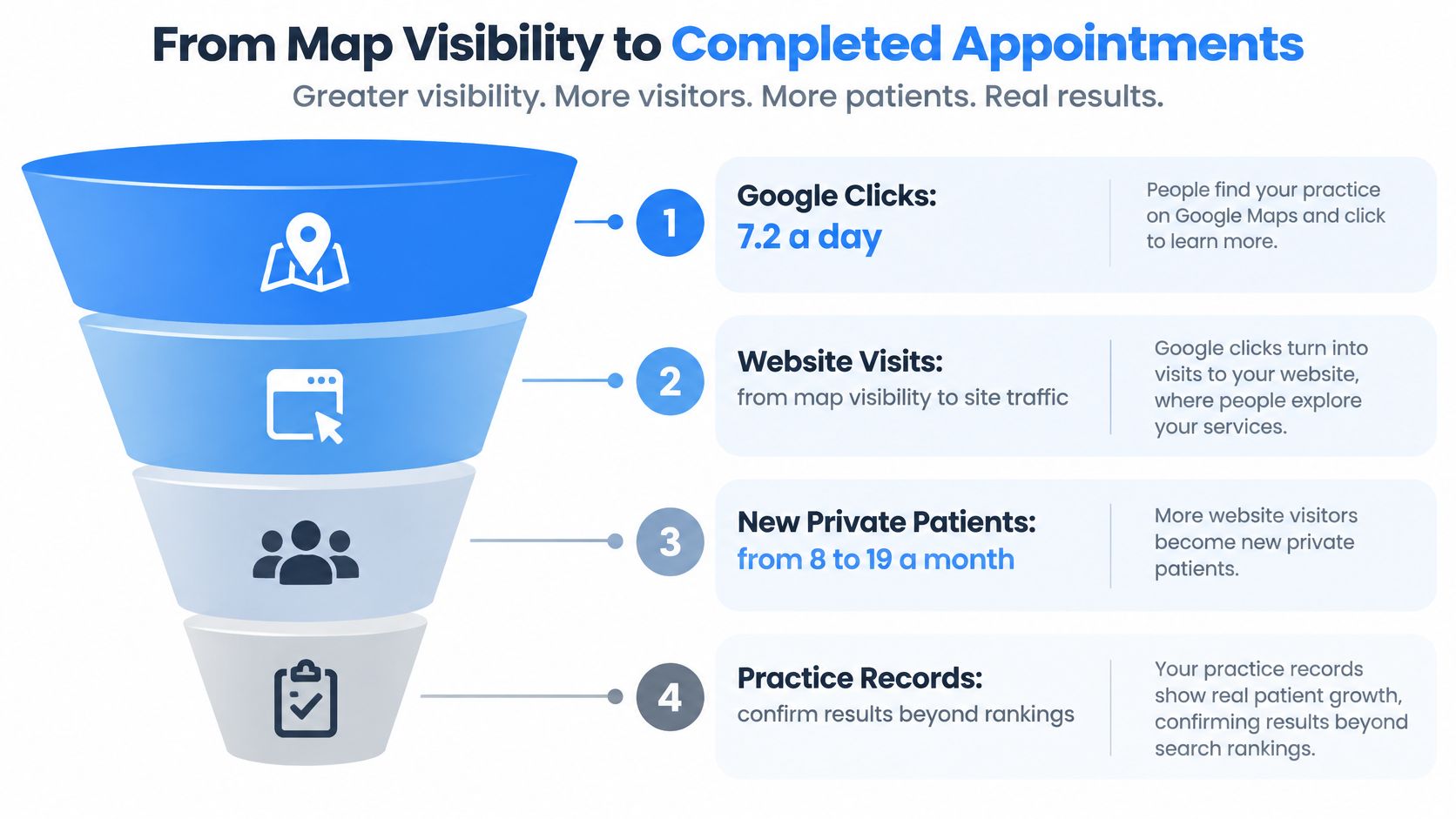
Another write-up blends SEO, referrals, and Google Ads into one growth narrative and credits "SEO and referrals" together, which leaves the channel unknowable. A practice owner can't budget against a combined number.
Demand a funnel with named stages and a named owner for each:
- Non-branded impression, owned by Search Console query data.
- Landing page visit, owned by analytics, segmented by procedure.
- Call or form, owned by call tracking with recorded source.
- Scheduled appointment, owned by the booking software.
- Completed visit and treatment acceptance, owned by the practice record.
- Revenue per acquired patient, reconciled against all of the above.
Then add the checks most galleries skip: lead quality, cancellation rate, cost per acquired patient, and days from first search to treatment. Those four turn a marketing report into an operations document.
Consider the doctor client who went from non-existent to number one across 36 square miles. That's a strong map outcome by any measure, and it's still only the top of the funnel. Until the call tracking, booking software, and completed-visit records line up behind it, nobody can call it new production.
The rule that keeps this honest: a ranking win belongs in the report. It doesn't become a patient engine until incremental completed appointments survive reconciliation.
Rival explanations need ruling out one by one. Branded searches from the radio spot. A referral from the orthodontist down the road. Google Ads running the same month. Seasonal demand. A review count that jumped. A new front-desk coordinator who answers on the second ring. Any of those can lift patient counts while SEO does nothing.
Once the funnel reconciles, the useful operational follow-through is scheduling discipline. Dental appointment reminder templates reduce the no-show rate that eats the gain between a booked slot and a completed visit, which is the leak a rankings report never shows.
AI Answers Beside the Local Three-Pack
AI answers didn't replace the map. They added a second surface where the same profile data gets judged. A 2026 study of 512 local searches in metro Atlanta found Google Business Profiles cited as sources in 57% of Google AI Overviews (Make It Loud research on AI Overviews in local search). The sample is one metro area, so treat it as a directional signal rather than a universal rule, but the implication is concrete. Profile accuracy now feeds both the pack and the answer.
Stability is the problem. A 2026 analysis of 200,085 localized searches across ChatGPT, Google AI Mode, and Google AI Overviews reported only 20% to 33% average overlap between repeated result sets, with 23% for ChatGPT, 21% for AI Mode, and 33% for AI Overviews (BrightLocal local AI visibility study). Geography stayed tight in the same data. About 5% of selected businesses in AI Mode and AI Overviews were within 1 kilometer of the searcher, while 53% of ChatGPT recommendations, 53% of AI Mode recommendations, and 59.3% of AI Overview recommendations were within 5 kilometers.
Read that as a practical warning. A practice can be recommended for dentist near me in one engine and absent in another on the same Tuesday, and a single screenshot of a "best dentists in your city" answer is not a result. It's a moment.
What a useful dental case study logs, per service, city, and platform:
- AI mentions and citations for tooth pain, insurance, cost, and emergency prompts, alongside map-pack presence for the same terms.
- Organic clicks and branded searches, because an AI answer can suppress a click while still driving a call.
- Calls and booked appointments, the only two columns that reconcile across engines.
The themes that recur in dental AI recommendations are worth watching as categories rather than as rankings. An analysis of 105 dental-related AI recommendations found clinical expertise, reviews and reputation, access, location, cost, and insurance surfacing repeatedly instead of simple keyword matches (DSO AI search visibility report). Those map onto content you can write and profile fields you can fill.
Watching several engines at once usually means pulling structured results programmatically, and a comparison of the best SERP API options from looot is a reasonable starting point for a team building that feed. Prompt outputs shift between runs, so a dated log matters more than a screenshot.
Treat AI visibility as a second column on the same transactional report, not a separate vanity metric. If the map grid improves and the AI column doesn't move, that's a finding. If the AI column moves and the phones stay quiet, that's a finding too.
Decide Whether the Case Study Is Worth Hiring
Score a dental case study in one sitting against artifacts you already know how to demand, and make the deciding evidence the booked patient; rankings are only the first exhibit.
- Names and windows. The practice, the city where known, and a timeframe such as 90 days or five months. Ridge Dental Care, Winn Smiles, and The Dental Retreat TX in Katy all clear that bar.
- Labels that hold. A map rank is visibility. Doubled calls are phone demand. The Dental Retreat TX's 188 organic opportunities count as patient chances before any treatment plan exists.
- A grid, not a pin. Dentist near me or a procedure term measured at several distances across the service area, so one strong cell cannot hide a weak edge of town.
- A reconciled funnel. Non-branded Search Console queries, landing pages, call tracking, booking software, and completed visits, plus cancellation rate and cost per acquired patient.
- An AI column beside the three-pack for the same service and city, dated, with the platform noted, so a Maps gain can be checked against the answer engines patients also see.
Dental work runs through Transactional Dental's Patient Magnet Engine™, which pairs keyword targeting with Google Maps optimization aimed at the top three in a service area and on-site coding improvements on the practice's own pages. Local SEO, Google Maps optimization, and transparent reporting run on every account. The credible expectation is steady keyword and organic traffic progress within 1.5 months, with broader ranking gains typically taking 3 to 6 months of ongoing work. If you're weighing providers now, this guide on how to choose a dental SEO company applies the same scorecard before you sign anything.
Transactional LLC builds local search programs for one industry at a time, and for dental practices that means transactional terms like dentist near me, emergency dentist, and implants rather than vanity keywords. The program includes Google Maps optimization across your service area, keyword-by-keyword timelines in a live dashboard, and heat maps that show which parts of your city see you first. Visit Transactional LLC to put your current map grid and call tracking side by side before you commit to another retainer.