


A 2019 study of how patients pick a dentist found that positive reviews and the dentist's qualifications tied as the most important factors, each chosen by 56.4% of participants. Awards mattered to 24.4%, and the number of social-media likes to only 25.9%, according to that PMC study on social media and dental choice. Likes don't fill the chair. Proof does.
Digital marketing for dentists works when it shows up for a transactional search term. Someone typing dentist near me, emergency dentist plus a city, or dental implants plus a city already has a problem and a way to pay. That's the search Transactional Marketing is built to win, on the map and on the page that takes the booking.
I wouldn't fund five channels at once. I'd treat three assets as one system: the Google Business Profile, the treatment page, and the booking path, checked on a phone, then judged by cost per attended new patient rather than clicks.
Where Dental Patients Find Practices First
In 2026, Google Business Profile organic listings were the top source of new patients for 15.6% of surveyed dental practices, according to MouthWatch's dental-practice marketing survey. A year earlier, 72% of surveyed practices said they used a practice website as a marketing channel, per Inside Dentistry's 2025 trends survey. Those two numbers do different jobs.
The profile wins the phone call and the directions tap while the patient is still on the map. The website wins the consultation once that person wants to know who treats implants, what an emergency visit involves, and how to book. A strong map listing with a thin site leaks the patient who needs more than a phone number. A beautiful site that never appears for dentist near me never gets the chance.
| Channel | Role for new patients | Metric to track |
|---|---|---|
| Google Business Profile | Top new-patient source for 15.6% of surveyed practices | Calls, direction requests, map views |
| Practice website | Used as a marketing channel by 72% of practices | Service-page visits, booked consultations |
| Paid search | Captures high-intent queries such as emergency dentist | Cost per attended new patient |
| Reviews | Shapes the choice at the moment of comparison | Review count, average rating, response rate |
| Social media | Builds credibility and patient education | Profile visits that lead to calls or bookings |
Google Business Profile is the map channel. If calls and direction requests aren't rising for the cities you serve, the listing isn't doing its job, no matter how many photos you added.
The practice website is the treatment library and the booking door. Service-page visits that don't become consultations mean the page answered the wrong question, or the form was too hard.
Paid search buys speed on high-intent queries such as emergency dentist. Judge it by cost per attended new patient, not by cheap clicks.
Reviews decide the comparison when two offices look similar on price and distance. Count, rating, and how fast you reply are the proof.
Social media earns credibility and teaches. A profile visit that never becomes a call is awareness, not acquisition.
Practical rule: For the next 90 days, fund one primary channel and one support channel. Map plus website is the pair I would start with for most general practices. Ads come after both can record a call.
A 90-Day Digital Marketing Plan for Dental Practices
A useful 90-day plan connects three things: the Google Business Profile, the treatment page, and the booking path. Check each on mobile, then measure how many new patients attend, not just how many people click.
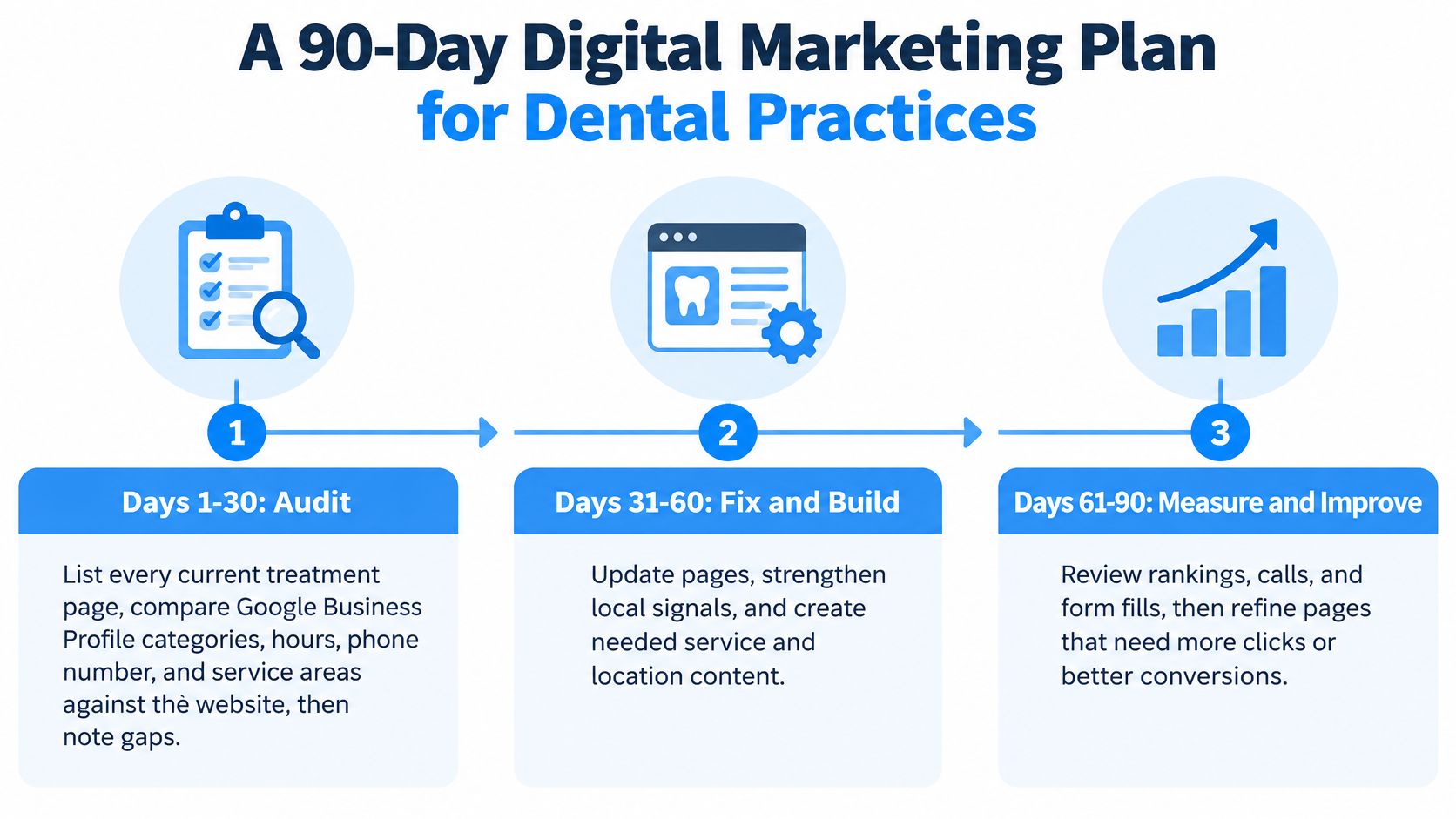
What each block must finish
| Timeframe | Action | Done when |
|---|---|---|
| Days 1-14 | Audit profile, website pages, reviews, and call data | Baseline sheet records rating, review count, calls, and map views |
| Days 15-30 | Correct profile categories, hours, phone, and service areas | Profile matches the website on every field |
| Days 31-60 | Fix citations, start review requests, publish the first city treatment page | Name, address, and phone match on core directories, and the highest-value service page is live |
| Days 61-90 | Launch intent-segmented ads, publish FAQ pages, and turn on the dashboard | Call tracking and booking forms record correctly, and one report shows attended new patients |
Use the first month to establish a reliable baseline. List live treatment pages, then compare the Google Business Profile with the website for categories, hours, phone number, and service areas. Record review count, average rating, calls, and map views. Without that starting point, a busy week can look like growth when it may be normal variation.
Days 31 to 60 are for building the foundation. Correct issues from the audit and make sure the business name, address, and phone number match across core directories. Start a review request for eligible patients without offering gifts or screening who receives one. Publish a treatment page for the highest-value service in the main city. Name the clinician and make the booking action easy to tap on a phone.
During days 61 to 90, add campaigns only when the booking path and tracking work. Separate paid campaigns by treatment intent and send each to a relevant landing page. Publish concise FAQ pages that answer patient questions, then use a report that separates visibility, calls, bookings, and attended visits.
Start paid spend only after call tracking and booking forms record the right source. Judge performance by cost per attended new patient, not clicks alone.
Transactional Dental's Patient Magnet Engine™ combines keyword targeting, Google Maps optimization, and on-site coding improvements. Its case studies offer concrete reference points: Ridge Dental Care reached #1 on Google in 90 days, while The Dental Retreat TX generated 188 measurable organic patient opportunities in 5 months. Results vary by practice, but the sequence remains practical: align the profile, treatment page, and mobile booking path, then measure whether marketing brings patients who attend.
Winning Map Results for Dentist Near Me Searches
A transactional search is a person ready to book. Dentist near me, emergency dentist [city], and dental implants [city] are not research queries. The profile has to win them before a blog post about flossing ever matters.
Google's local ranking guidance says local rankings rest primarily on relevance, distance, and prominence. Relevance is how well the Business Profile matches the query. Distance is how far the business is from the searcher or from the city named in the query, so the pin has to sit on the address. Prominence is how well known the business is, and Google says it can be influenced by links, articles, directories, and the number and quality of reviews.
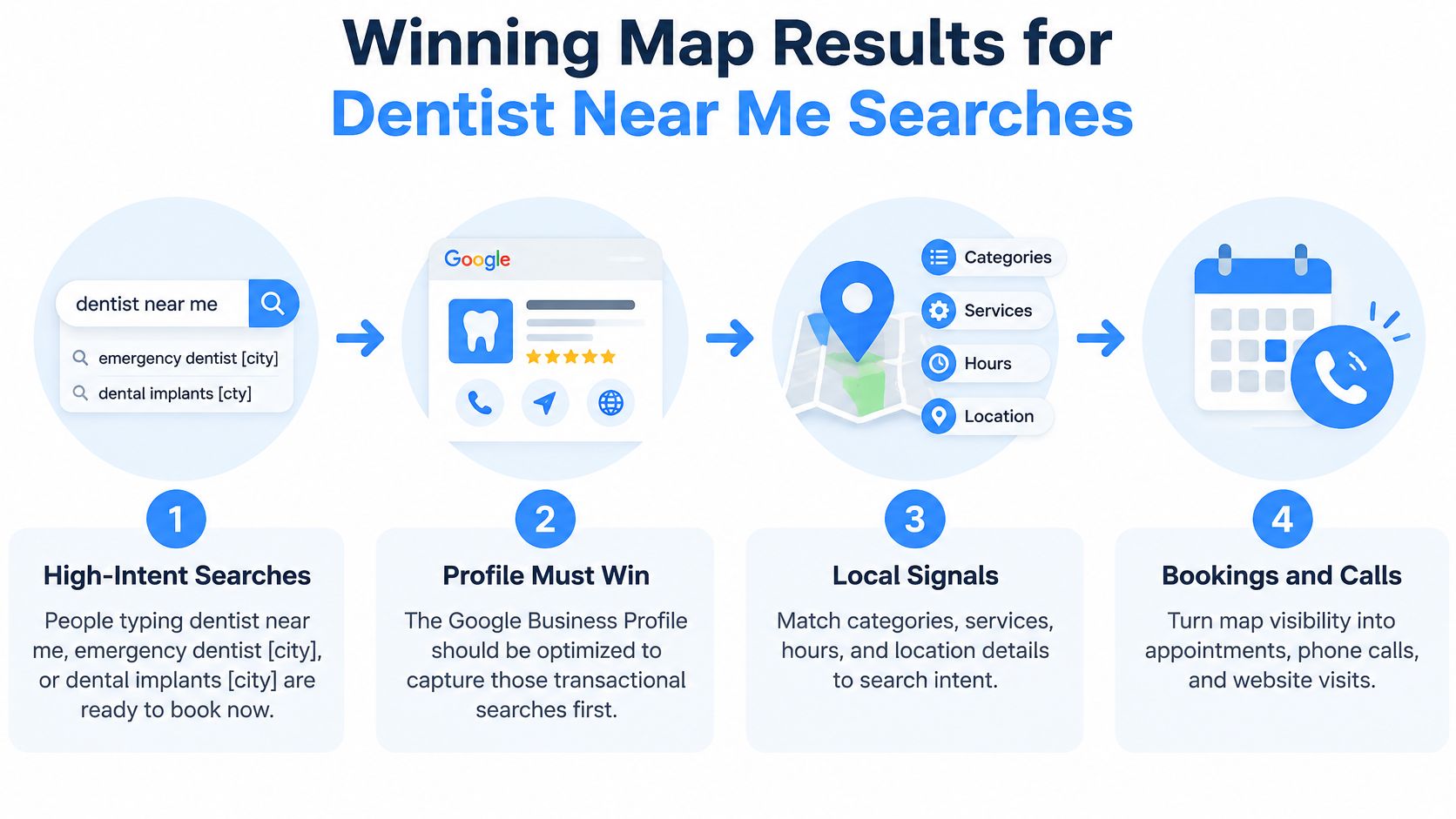
Seven profile steps
Pick categories that match revenue. Choose one primary category and secondary categories for the highest-value services. Categories are the strongest relevance signal Google has for what you do. A general dentist who also wants implant cases should not hide that service inside a generic description.
Write services in patient language. Name each service the way patients search, then add a short description. "Emergency dentist" and "same-day crown" beat internal chart codes. If the wording on the profile doesn't match the wording on the site, relevance gets split.
Set the service area and confirm the pin. Add every city you serve, and check that the map pin matches the address on the door. Distance is measured from the searcher or the city in the query. A pin on the wrong block loses dentist near me to a closer office.
Match hours, phone, and the booking link. Include holiday hours. Use the same phone number and the same booking URL as the website. A patient who calls a number that rings the old location doesn't become a new-patient count.
Build citations with one NAP format. List the practice on the core directories using the same name, address, and phone, including suite punctuation. Inconsistent citations weaken prominence because Google is comparing you across the web, not only inside the profile.
Collect reviews on a steady cadence and reply within a few days. Volume and quality both feed prominence. A burst of reviews in one week, then silence, looks less stable than a monthly rhythm tied to completed visits.
Refresh the keyword set every month. Each month we find the best keywords for the practice and then optimize the Google Business Profile and the other listings around them. Service wording should follow what patients typed last month, not what the brochure said two years ago.
The finish line is simple. The practice name, address, and phone number match everywhere the practice appears online.
Treatment Pages That Earn Clicks and AI Citations
AI tools cite pages they can retrieve. If the only clear sentence about emergency care sits inside a photo, neither Google nor an assistant can quote it, and the click goes to a competitor who wrote the answer in plain text.
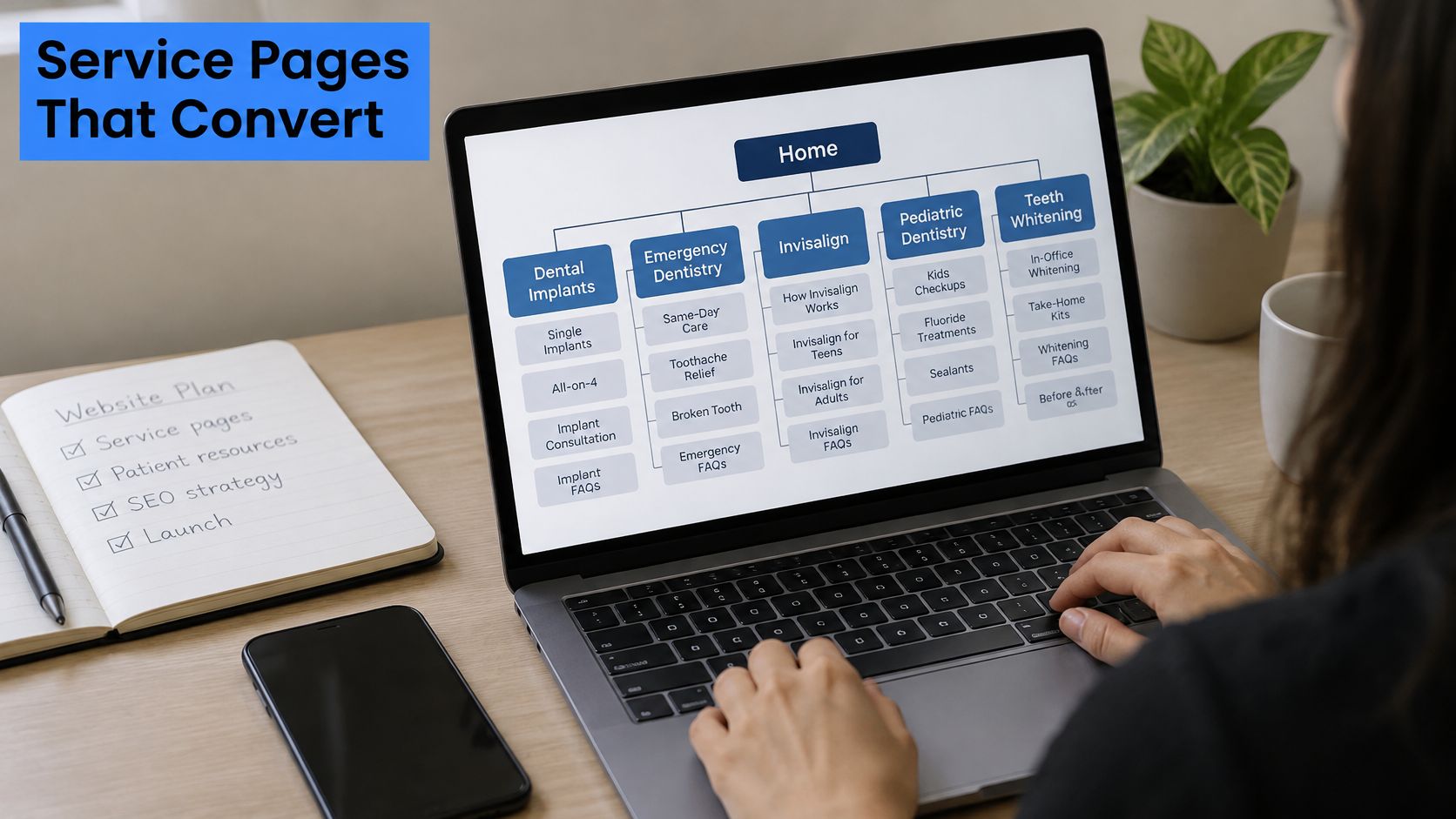
A service silo, not a blog pile
Build one hub page per core treatment: dental implants, emergency dentistry, Invisalign, pediatric dentistry, and teeth whitening. Under each hub, add short pages for the questions people ask. Recovery time, what changes the fee, how insurance is handled, and what to do after a broken tooth are better pages than another generic "oral health tips" article.
Each page should name the clinician and the qualifications, state the city and the service area, show a booking path without scrolling past a gallery, and explain risks and next steps in ordinary language. That same page is what a referring dentist's patient reads at 9 p.m.
Keep the technical layer boring and strict. Use crawlable text, not text baked into images. Make the mobile page load fast. Repeat the same practice name, address, and phone number in the footer that you use on the profile. Google's AI optimization guide says AI Overviews and AI Mode retrieve information from web pages, review it, and generate responses with prominent, clickable links. The same guide says foundational SEO still applies, and that a Google Business Profile can help a local business show up in AI responses as well as in ordinary Search. There is no separate submission form that guarantees a citation.
A monthly citation test
Once a month, ask an AI assistant for the best emergency dentist in your city. Record whether the practice, or a specific page, is cited. If the emergency hub should have been the source and wasn't, rewrite the opening so the city, the service, and the booking step are in the first screen of text. Do the same for implants and for the pediatric hub. Our content marketing for dentists work follows that silo pattern so each transactional query has one page to land on.
Then test the booking path with real people on a phone. A 2025 mixed-methods study of a dental-hospital portal, comparing 2,111 patients before implementation and 2,445 afterward, found younger users generally found it easy, while older patients and culturally and linguistically diverse patients were more often held back by design that wasn't inclusive. In a scenario test, only 3 of 17 participants could send a message to the clinic, and most needed help with one-time-password login, as reported in that SSRN usability study. Use plain labels, large tap targets, translated booking text where the service area needs it, and a phone number on every page.
Owned access matters after the first visit too. In a nationally representative U.S. survey of 1,022 adults, two-thirds wanted access to their dental records through a portal, though only about one in five had used one, according to the CareQuest Institute patient-portal brief. Among prior users, more than 90% were satisfied. A portal that can take an appointment request gives returning patients a reason to stay, which is a different job from winning a brand-new dentist near me search.
The short video below walks through how a service page should read when someone is ready to book, not when they're browsing.
Reviews That Build Trust Before the First Call
Reviews pull in the undecided patient and they also knock a practice off the list before anyone dials. Unanswered criticism is a cost, not a branding inconvenience. A 2020 review of healthcare reputation research reported that 59% of surveyed respondents considered patient-review websites important, 35% selected a doctor because of good ratings, and 37% avoided a doctor because of bad ratings. The same analysis looked at ratings covering more than 154,000 dentists and found that 75.55% had at least one rating or review, per that PMC healthcare reputation review. This isn't a problem only famous offices have.
The request workflow
Send the ask within 24 hours of a completed visit, by text or email. The visit is still fresh, and the patient hasn't moved on to the next errand.
Ask every eligible patient. No incentives, and no screening of who receives the link. Gating reviews toward only the happy visits is a fast way to create a rating you can't defend.
Use the direct review link from the Business Profile so the patient doesn't have to hunt through a search results page.
Track monthly count and average rating on the same baseline sheet you started in week one. A flat count means the front desk stopped sending the text.
Reply to every review within 48 hours. Future patients read the reply as carefully as the original comment. You can start from these review request templates and adapt the wording to your front-desk voice.
Positive reply: "Thanks, Maria. We're glad yesterday's visit went smoothly, and you're welcome back whenever you're due."
Negative reply: "We're sorry this visit didn't meet your expectations. We can't discuss care details here. Please call the office manager directly at [front-desk number] so we can look into it."
Don't confirm that the person was a patient, and don't share health details in public. The second template exists so the next reader sees a practice that owns the problem without turning a review into a chart note.
Tracking Calls, Bookings and Attended Patients
Clicks don't pay the associate. Attended new patients do. Split the numbers into three layers so a Monday meeting doesn't turn into a debate about impressions.
Visibility is whether the right people can find you. Track map rankings by service and city, heat maps of those map positions, branded versus non-branded queries, and the queries in Search Console. A rise in branded searches usually means the name is spreading. A rise in non-branded dentist near me variants means the transactional terms are working.
Intent is the moment someone acts. Calls, direction requests, form submissions, and booking actions sit here. A spike in direction requests with flat calls often means the pin is right and the phone path is wrong.
Revenue is what the dentist can staff for. Scheduled visits, attended new patients, cost per attended new patient, and new-patient source belong on this layer. A form that never becomes a kept appointment is not a lead you should celebrate.
Make the layers measurable
Put a call tracking number on the profile and on the site. Add UTM tags on every ad link. Put a source field in the booking system, and ask at intake how the patient heard about the practice. Our guide to tracking phone calls covers the handoff from the listing to the front desk so a map call isn't logged as "unknown."
The campaign KPI advice from Humantext is a useful cross-check when you're deciding which numbers deserve a monthly target and which are only diagnostic.
The monthly routine
Review ranking and heat map changes by service and by city. Note which transactional term moved and which city didn't.
Compare calls and bookings with the previous month, split by profile, organic pages, and paid.
Check the weakest paid segment and the lowest-rated profile if you run more than one location. Fix the laggard before you raise budget on the winner.
Decide one change to test. One. A new negative keyword, a rewritten first paragraph, or a faster review reply. Then wait for the next month's attended-patient count.
Report booked consultations and attended patients. Impressions alone don't tell a dentist whether to hire, extend hours, or cut a campaign.
Paid Search and Ads Segmented by Treatment Intent
Reported U.S. figures, summarized from LocaliQ healthcare campaign data by Rank and Rejuvenate, put general dentistry at a 7.74% conversion rate and $84.77 cost per conversion, emergency dentistry at 8.89% and $75.19, and orthodontics at 14.21% and $71.52. Treat them as planning baselines, not a promise for your zip code.
| Segment | Conversion rate | Cost per conversion |
|---|---|---|
| General dentistry | 7.74% | $84.77 |
| Emergency dentistry | 8.89% | $75.19 |
| Orthodontics | 14.21% | $71.52 |
The pattern in that table is the lesson. Orthodontics converts more efficiently than general dentistry in this dataset, even though a higher click price often scares practices off specialty terms. Landing-page relevance and intent can beat a cheap click. Emergency care sits in between, which fits a patient who needs a same-day answer and a page that offers one.
Build one campaign per intent
Create separate campaigns for general dentistry, emergency care, orthodontics, and high-value procedures such as implants. Point each campaign at its own treatment page and at the cities you serve. Track calls and form conversions from day one. Add negative keywords for jobs, training programs, and purely informational queries so the budget stays with patients.
A low cost per click is not a low acquisition cost. Dental campaigns can buy inexpensive traffic that never becomes a booked appointment. Track calls, qualified leads, scheduled visits, and attended appointments separately, then calculate cost per attended new patient for each segment. If emergency looks cheap on clicks but expensive once no-shows are counted, the landing page or the confirmation process is the problem, not the keyword.
Where the ad platform allows it, import offline conversions so bidding moves toward booked, attended patients instead of raw form fills. A form submit from someone asking about a job should never teach the algorithm to find more of the same.
Social ads have a narrower job. Use them for awareness, for education, and for retargeting people who already reached a treatment page. Measure them by booked consultations, not by likes. Our dental PPC advertising setup keeps those segments apart so a strong ortho campaign doesn't hide a weak emergency page.
These benchmarks come from a third-party summary of U.S. LocaliQ healthcare data. They are a starting budget conversation, not a guarantee in a competitive metro or a small town.
Choose Your First Move in the Next 30 Days
Match the audit sheet to one case. Don't run all three projects in the same fortnight.
Few reviews and a thin profile. Start with category, service, and hour fixes, then the 24-hour review request. Map visibility for dentist near me won't hold if the listing doesn't say what you do and almost nobody has described a visit.
A strong profile and no page for the main service. Build that hub first. Name the clinician, name the city, and put the booking path where a thumb lands. Ads pointed at a homepage won't fix a missing implants page.
The site shows up and the phone stays quiet. Check the booking path and call tracking before you add spend. Tap through the form on a phone the way an older patient or a non-English-speaking patient would. Usability failures block bookings even when the ranking looks fine.
For dental clients, the program we partner on is Transactional Dental's Patient Magnet Engine™, which combines keyword targeting, Google Maps optimization, and on-site coding improvements. Ridge Dental Care climbed to #1 on Google in 90 days after partnering with us, and that case study reports measurable patient opportunities within 3 months. Your timeline depends on the case above, not on copying someone else's city.
Write down the single change your sheet calls for. If you want a faster start, use the calendar on our page to schedule time. We collect your details through an intake form and show how the practice is doing in its service area. Finish the days 1 to 14 baseline first, then work the section that matches your case.
Transactional LLC helps dental practices show up for transactional searches such as dentist near me, with Google Maps optimization, treatment-page SEO, and reporting tied to calls and attended patients. If you want that system on your cities rather than another generic campaign, visit Transactional LLC and book a time to review your baseline.