


At 9 p.m. on a Thursday, the air conditioner quits. The homeowner types "air conditioning repair near me" into her phone, taps one of the first three businesses she sees, and calls. If nobody answers, she dials the next one. By Saturday the job is booked, and it went to a company that appeared in a spot she never had to scroll past.
Those searches pay your bills. They're transactional, which means the person typing has a problem, a location, and money ready to spend today. A ranking is only the mechanism; the ringing phone is the outcome you're buying.
We named the company Transactional Marketing for that reason. The eight questions below are the ones I'd ask any provider, including one you're weighing against us, covering keywords, Google Maps visibility, ranking proof, AI search, content, timelines, reporting, and ownership.
1. Which transactional search terms will you target for my business and service area?
A transactional search carries a problem, a location, and an intent to hire. "Air conditioning repair near me," "roofer near me," "emergency dentist near me," "plumber open now." Informational queries like "how often should I replace an HVAC filter" can support a content plan, but they won't fill a schedule on their own.
Ask for the exact phrase list in writing, with a city attached to each phrase, before any work starts. A provider who can't produce it in the first meeting either hasn't done the research or doesn't want you checking it later.

Build the list service by service, city by city
An HVAC company might run "AC repair [city]," "furnace replacement [city]," and "emergency air conditioning repair near me," each on its own page. A dental practice would split "dentist near me," "emergency dentist [neighborhood]," and "teeth cleaning [city]" the same way. Volume matters, but buying intent matters more, and one generic services page chasing forty phrases is the most common reason local sites stall.
The test I use: a term earns a spot on the list only if someone searching it could book a job this week.
Three checks before you approve anything:
- Margin, not just traffic. Your highest-value services belong on the list even when a cheaper repair pulls more searches. A roofer earns more from a full replacement than a patch.
- One page per service, per city. Ask to see the URL map that pairs each page with its target phrases.
- The volume and the tool. Ask which tool produced the monthly search figure and how recent that data is.
Our packages target 25+ keywords, with the Standard tier built for terms under 100,000 monthly searches and the Premium tier aimed at high-competition terms above that. Ask any provider how many phrases the plan covers and what happens when one of them starts producing calls.
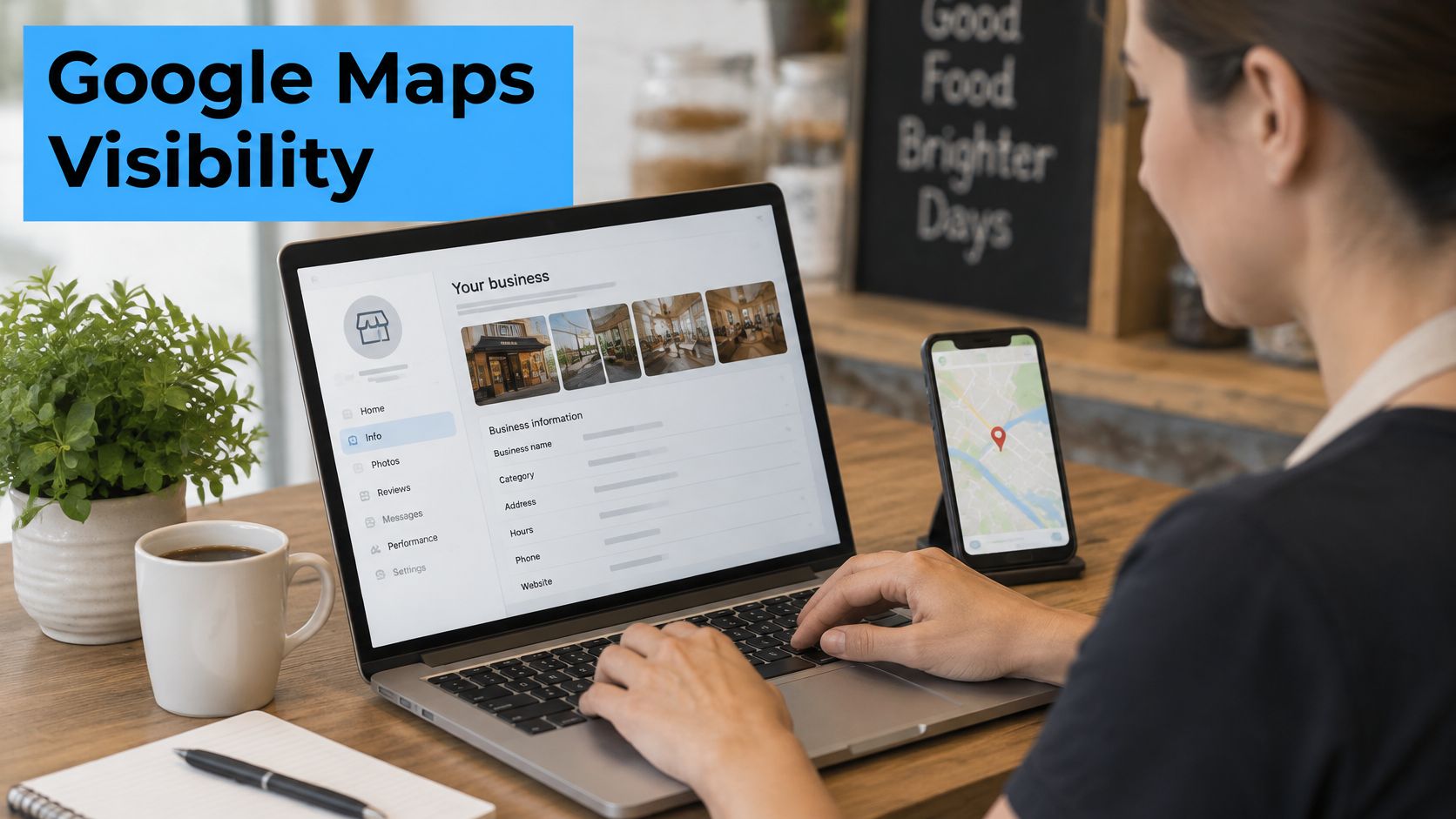
2. How will you optimize my Google Business Profile and move me into the Google Maps top three?
For most local service businesses, the map pack produces the bulk of the phone calls. Those three listings sit above the regular results, and a profile that's half-filled and updated once a year won't hold a spot there.
Google's local ranking guidance names three inputs: relevance, distance, and prominence. Relevance is how closely the profile and the site match what the searcher typed. Distance is how far the business sits from the location in the query. Prominence draws on links, articles, directories, review count and review score, and Google states plainly that more reviews and positive ratings can improve local ranking.
What to make them show you
Ask how they'll handle primary and secondary categories, service descriptions, service areas, hours, photos, and posts. Then ask who holds the manager role on the profile.
"Will my Business Profile sit under my email or yours?" Ask it out loud and watch the answer.
- Primary category first. That field carries more weight than any sentence in the description. A roofer filed under "Contractor" instead of "Roofing contractor" is handing relevance to a competitor.
- A review engine, not a review purchase. Requests should go out after completed jobs. Incentivized or fake reviews put the listing at risk of suspension.
- Service areas that match your trucks. Profile and pages should name the suburbs you drive to, not a fifty-mile radius you can't service.
Our Maps plan runs $1,200 a month and centers on exactly this work. Keep the profile under your own email even when someone else manages it, because review history and photos stay with the account, not with the agency.
3. How do you track map rankings, and what will the heat maps and results dashboard show?
Map rankings aren't one number. They shift block by block, so a provider reporting a single position for "plumber near me" is describing one point on the map, usually your address or theirs.
Grid tracking fixes that. Software drops a lattice of points across the service area, checks rank at each one, and renders the result as a heat map. A strong grid shows the business ranking across most of a city. A weak one shows a bright spot at the shop and nothing two miles out.
This walkthrough shows what a tracked grid looks like and how to read one before you commit.
What the dashboard needs to prove
Listing accuracy is part of the job, not a side task. Recent consumer research found that 85% consider accurate contact information and opening hours important when researching local businesses, while 53% are unlikely to visit a business with incorrect listings, as MacTech's coverage of a 2025 local search study reports. The same coverage notes that 20% of local searches now begin on Google or Apple Maps outside the traditional Google web-results journey, which means a Google-only dashboard can miss real discovery.
Ask for a sample before you buy:
- Keyword timelines by city. Rank for each target term over months, not a screenshot from a good week.
- Search Console queries. The actual phrases your pages appear for, including ones nobody planned.
- Call and form data. Attached to the same timeline so you can see which ranking move produced a ring.
- A documented baseline. Captured before the first change, or you'll never prove what worked.
We build Google Maps heat maps into client reporting, and I'd ask any provider to show you theirs before signing.
4. What is your plan for AI search visibility across ChatGPT, Perplexity, and Google AI Overviews?
People now ask an assistant for "the best HVAC company in [city]" or "a dentist near me taking new patients." The model assembles an answer from sources it can parse and trust: consistent business data, clear service pages, reviews, citations, and mentions elsewhere.
Google's guidance on AI search optimization says Business Profiles can help local businesses appear in AI-generated responses as well as standard results, and that no special schema.org markup is required for generative AI search. It also warns against over-focusing on structured data. That deflates most "AI schema" pitches you'll hear this year.

So the plan should look like local SEO done carefully. Identical name, address, and phone on the site, the profile, and every directory. Service pages that state what you do, which cities you cover, what a job typically costs, and who performs it.
How to tell whether AI visibility is actually measured
Nobody can show you a rank position inside ChatGPT. What they can show:
- Branded search volume. When AI answers send people looking for you by name, branded queries move.
- Referral traffic. Analytics segments for AI platforms, even when arrivals land as direct or referral noise.
- Citation checks. Prompt the major assistants monthly with your target questions and log whether you appear.
- Profile consistency. Reviews, hours, and categories matching everywhere an AI system might read them.
Say an assistant is asked for a termite inspector in one specific suburb. It leans on businesses with clear service pages, recent reviews, and matching data across sources.
5. How do you build content silos and publish conversion-focused articles for each industry and service?
A silo is a hierarchy: one hub page for a service, supporting articles that answer the questions around it, and internal links passing authority between them. The opposite is a blog with forty unrelated posts and no path to a phone number.
Ask whether content gets planned one industry at a time. An article about SEO for a roofing company and an article about SEO for a dental practice should never be the same piece with the nouns swapped. The details that earn trust, storm damage versus insurance claims, new-patient paperwork versus emergency triage, belong to one trade each.
Google's guidance on using generative AI for content says accuracy, quality, and relevance matter more than the production method, and that review extends to title elements, meta descriptions, structured data, and image alt text when those appear in Search. Its structured data rules require markup to reflect the page truthfully.
A generated draft is a starting point. Someone who has stood in a crawlspace or worked a front desk has to review it before it ships.
What to require from the content plan
- Ninety days mapped in writing. Hubs, supporting articles, and the target term for each.
- One industry, one service, one buying intent per article. Anything broader is filler.
- A conversion path on every page. Phone number above the fold, a booking link, and a form that takes under a minute.
- A named human reviewer. Ask who checks local service details and factual claims before publishing.
Say a roofing client needs a silo: a hub for roof repair, articles on storm damage, shingle replacement, and emergency tarping for each city served, all linking back to the hub and to a quote form.
6. What timeline should I expect to reach page one, and what results will you deliver at 30, 60, and 90 days?
Most businesses see ranking improvements within three to six months of ongoing SEO work, and competitive metro phrases take longer. Anyone promising page one for every "near me" search in two weeks is guessing or lying.

The first 30 days should be dated work, not an extended discovery phase. That means the audit, tracking installed, and technical fixes with thresholds attached. Google's Core Web Vitals thresholds set Largest Contentful Paint at 2.5 seconds or better, Interaction to Next Paint under 200 milliseconds, and Cumulative Layout Shift below 0.1. Ask what percentage of your indexed service and location pages currently pass each metric, which URL templates fail, and who deploys the fixes.
Press on what the timeline means for buyers ready to hire today. A ranking for "AC repair near me" only matters if it produces a call, so each milestone should name the transactional terms it covers and the lead outcome expected, not just positions on a chart.
Milestones worth putting in writing
- Day 30. Profile rebuilt, categories corrected, analytics and call tracking live, crawl and index issues resolved.
- Day 60. Service and city pages published, internal links in place, first ranking movement visible in Search Console.
- Day 90. Rank, call, and lead comparison against the baseline, plus the next quarter's plan.
Ask which results are guaranteed, which are estimates, and what happens if a milestone slips. How long SEO takes depends on competition, site condition, review volume, and publishing pace, so a provider who gives every client the same date is reading from a script. Ongoing maintenance should continue past day 90, adjusting the strategy as algorithms shift and competitors publish, rather than treating the first quarter as the whole job.
7. How do you connect SEO reporting to calls, leads, and booked jobs?
Rankings don't pay invoices. Ask which searches produced calls, which forms turned into booked work, and which service areas generate your most profitable jobs.
The reporting system should rest on first-party data you can inspect. Google's SEO starter guide points to Search Console as the tool for understanding how a site performs in Google Search, including query and indexing information, and its URL Inspection tool shows how Google sees a specific page. That means you can verify the story yourself instead of trusting a dashboard screenshot.
What the report has to contain
- Branded versus non-branded queries. Ranking first for your own company name proves nothing.
- Service-plus-city performance. Not one traffic line, but rows for each service in each city.
- Calls and forms matched to jobs. Which pages rang the phone, and which of those calls became revenue.
- A baseline period and written conversion definitions. Agree on what counts as a lead before the first report arrives.
We send reporting every two weeks that pairs keyword and map data with traffic and lead outcomes, and we set up phone call tracking so a ranking gain can be checked against a ring.
A dental practice shows why the split matters. If the emergency page out-produces the general services page on new-patient calls, the next content budget belongs there rather than spread evenly across the site.
8. What are your contract terms, and who owns my website, Google profile, content, and data if we part ways?
This is the question owners ask last and regret asking late. A provider can do excellent work for a year and still leave you unable to touch your own rankings after a split, if they hold the profile, the domain, or the tracking numbers.
Put these in writing
- Admin access under your email. Google Business Profile, Search Console, Analytics, hosting, domain registrar, call tracking.
- Content files and page ownership. You paid for the pages, so you should be able to take them to another host.
- Cancellation and handover terms. How much notice, what gets transferred, and how quickly.
- Response times for emergencies. A suspended listing or a site outage in the middle of storm season is not a Monday problem.
For reference on what terms look like, our Maps plan is $1,200 a month, the Monthly SEO Package is $2,000 a month on a 12-month commitment, and Maps + Ads is $2,500 a month plus ad spend with a $2,000 minimum ad spend. Whatever a provider quotes, the exit terms matter as much as the entry price.
Say a home services company kept the manager role on its Google profile under the owner's email and held its own domain and hosting. Switching agencies later cost it a week of setup instead of its review history. Directory listings deserve the same scrutiny, so check the quality indicators for submission services before anyone sprays your business data across a hundred low-value sites.
What to request, what to avoid, and what proof to ask for when interviewing SEO providers
| Item | Core Request | Red Flag | Proof to Request |
|---|---|---|---|
| Transactional search terms | Which high-intent service and location keywords will you target? | Vague SEO promises or keywords that do not reflect profitable services | Written keyword map with intent, priorities, and target page for each term |
| Google Business Profile and Maps | How will you optimize my profile and improve local Maps visibility? | Guaranteed top-three rankings, fake reviews, or policy-violating tactics | Profile optimization plan, account ownership details, and review workflow |
| Map ranking tracking and dashboard | How will you track local rankings and report results? | Reporting only impressions or estimates without business outcomes | Sample geo-grid heat map and dashboard showing rankings, traffic, and leads |
| AI search visibility | How will you improve visibility in AI search tools and summaries? | Guaranteed placement in a specific AI tool | Plan for business data, schema, content, citations, and AI referral measurement |
| Content silos and conversion articles | How will you organize and publish content for each industry and service? | Generic AI content or articles without a clear conversion path | 90-day content plan with page structure, internal links, and calls to action |
| SEO timeline and milestones | What should I expect at 30, 60, and 90 days? | Vague timelines or guaranteed rankings without regard to competition | Written timeline with dated deliverables, milestones, and realistic estimates |
| Reporting tied to business outcomes | How will SEO reporting connect to calls, leads, and booked jobs? | Rankings and traffic reported without lead or revenue attribution | Sample report showing call, form, booking, and lead-source tracking |
| Contract terms and asset ownership | What are the terms, and who owns my website, profiles, content, and data? | Long or unclear cancellation terms, or agency-controlled accounts | Written ownership and access terms, cancellation process, and asset handoff plan |
Turn These Eight Questions Into a Shortlist You Can Trust
Bring all eight questions to every interview and score the answers on specifics, proof, and ownership. Providers who name your exact transactional terms, show a sample heat map and dashboard, put milestones in writing, and leave your Google profile under your own email are the ones most likely to turn searches into booked jobs.
A simple scoring method keeps the comparison honest. Three points when the provider shows evidence, two when they describe a clear process, one when they deflect. Anything under 18 out of 24 across the eight answers is a shortlist you should shorten.
Watch for these patterns:
- A keyword list that arrives after the contract. If it isn't ready before you sign, it's being reverse-engineered from whatever ranks easily.
- No sample dashboard. Every serious provider can show a redacted report from a current client.
- Agency-owned profiles and domains. You should hold the manager role, the registrar login, and the analytics account.
- Guaranteed rankings. Nobody controls Google's algorithm, and providers who promise positions tend to buy links or fake reviews to hit them.
Timelines deserve a final word. Local visibility compounds, because profile accuracy, reviews, service pages, and technical health all feed the same result, and the first ninety days are usually the slowest. Ask what happens in months four through twelve, since that's where the compounding shows up.
The plumbing trade makes the point neatly. Open a page of top-rated Florida plumbers and count how many compete on the same city-plus-service phrases. The ones at the top didn't get there by accident, and they didn't get there by ranking for their own name.
Start with a short call this week. Ask for the keyword list first, the sample dashboard second, the contract third. In that order, the conversation stays about booked jobs instead of impressions.
Transactional LLC works on exactly this model: local SEO and Google Maps optimization for service businesses, an AI-driven content engine that plans industry-specific silos, and a dashboard showing keyword timelines by service city alongside map heat maps and Search Console queries, reported every two weeks.
If your schedule depends on searches like "air conditioning repair near me" in every city you serve, Transactional LLC builds the local SEO and Google Maps programs that target them, including Google Business Profile optimization, dedicated service and city pages, an AI-driven content engine, and biweekly reporting that connects rankings to calls and booked jobs. Ask for the keyword list before anything else, the way you would with any provider. Visit Transactional LLC to see the packages and start that conversation.