


In 2024, 86% of consumers searching for a home-services company started online, and 61% began with a traditional search engine such as Google or Bing, according to Tinuiti's 2024 Home Services Marketing Study. For a flooring contractor, that makes search visibility part of the path to the estimate, not just a way to collect website visits. The priority is to appear when someone searches for a service they're ready to hire for, such as “LVT installation [city]” or “flooring installer near me.”
That transactional intent is central to Transactional Marketing. A searcher looking for a flooring contractor in their area may already have a room, material and project in mind. SEO for flooring companies should connect that buyer to the right service page, a credible Google Business Profile, and a simple way to request an estimate. AI answers add another discovery route, but they don't make local Maps visibility any less useful.
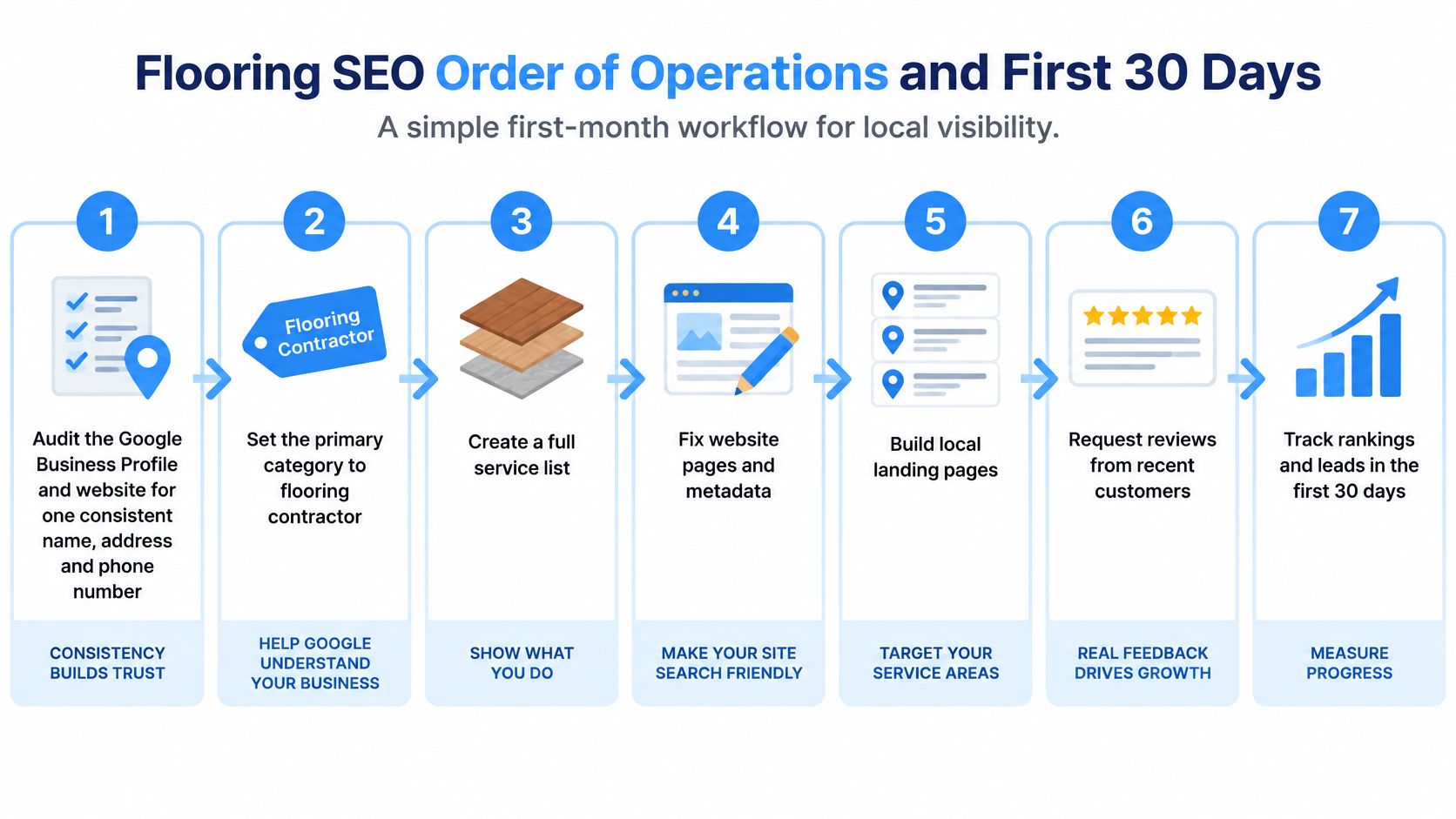
Flooring SEO Order of Operations and First 30 Days
The order matters. First, audit the Google Business Profile and website for one consistent business name, address and phone number. Set the primary category to Flooring contractor, complete the service list and make sure the service areas are accurate. Next, map each core service, such as luxury vinyl tile installation, hardwood refinishing, carpet replacement, tile installation and commercial flooring, to transactional searches like “flooring installer near me” and “hardwood refinishing [city].”
Then build a service-city page structure, remove technical blockers such as slow mobile pages and indexing gaps, add appropriate LocalBusiness markup, earn reviews and citations, publish answer-focused content, and track calls, map visibility and estimate requests each month. Google says local results are based primarily on relevance, distance and prominence, so inaccurate profile information can undermine the rest of the work.
A dedicated local strategy is warranted in a large market, but demand can shift. The U.S. flooring market recorded approximately $23.955 billion in sales in 2024, down 4.6% from 2023, while flooring volume fell 3.5% to 17.206 billion square feet, according to Floor Covering News' 2024 industry analysis. Instead of leaning on one broad “flooring company” page, organize visibility around the services and cities that can produce qualified work.
A practical first-month sequence
- Week one: Choose one material and one city where the company has completed jobs. Start where there's real project evidence to support the page.
- Week two: Audit the profile and website. Confirm the business details, category, service list and areas, then match core services to transactional queries.
- Week three: Build one service hub and two material pages. Include subfloor needs, variables that affect pricing, realistic timelines and a clear estimate call to action. Set up a review request to send when a job is complete.
- Week four: Confirm that the pages are indexed, add and validate markup, and set up tagged call and form tracking.
Don't expand to another city just to increase the page count. Add the next city when the first cluster shows rising impressions and calls, and when the company has local project details to make that next page useful. Transactional provides local SEO, Google Maps optimization and transparent reporting for businesses, so the results can be reviewed by service city rather than hidden behind a single sitewide ranking.
Before signing with an SEO provider: Ask for reporting on map visibility and calls by service city, a documented keyword and content plan, and clear terms. A promised early page-one result isn't a substitute for a measurable plan.
Keyword Research for Transactional Flooring Searches
Flooring keyword research should start with the work a company wants to book. A person searching for hardwood refinishing has a different need from someone comparing vinyl plank and laminate. Give distinct services their own page targets so the profile, service-city pages and answers in search results all match the buyer's specific query.
Product sales can help set priorities. In 2024, luxury vinyl tile generated approximately $9 billion in U.S. sales, or 27% of total floor-covering dollar sales, though its sales declined 4.8%. Hardwood dollar sales increased 2% to about $4.2 billion, while carpet reached approximately $11.24 billion despite a 1% decline, according to Floor Covering Weekly's 2024 product analysis. Use these categories to plan distinct landing pages and decision guidance, rather than trying to cover every material on one page.
Sort terms by intent
- Transactional: “flooring installer near me,” “LVT installation [city],” and “hardwood floor refinishing cost [city].” These searches signal that someone is looking for a contractor or estimate.
- Commercial investigation: “vinyl plank versus laminate” and “engineered versus solid hardwood for a basement.” Give these searchers specific comparisons that help them choose a material.
- Informational: “how long does hardwood installation take” and “how to tell if a subfloor is level.” These queries can introduce a buyer to the company before they are ready to call.
Sales categories are a starting point, not a reason to target every material equally. Hardwood's higher share of sales relative to square-foot volume can support a premium installation, refinishing or restoration cluster. Carpet remains a substantial replacement category. Prioritize the services the crew performs and the jobs the company wants, then assign relevant terms to the profile and the appropriate service-city page.
Score each candidate by buyer intent, local demand, competition and job value. Favor a clear service-and-city query when it represents work the company can take on. A broad, high-volume term may bring visitors outside the service area or people looking for inspiration rather than an installer.
Yelp reported that searches for peel-and-stick tile increased 73% between January–August 2023 and January–August 2024, a query shift to monitor if it matches the company's services (Yelp's State of Services report). Transactional identifies keywords for clients and uses them to optimize Google Business Profiles and other listings. A local keyword research process helps keep terms grouped by service, intent and city. Keep the same groups aligned across the profile, relevant site pages and AI answers, so buyers encounter consistent information as they move from a search to an estimate.
The working output is a prioritized sheet of 15 to 25 terms, grouped by material and city. Refresh it monthly by reviewing current query data, rescoring terms and applying the strongest matches to the profile, service pages and listings. For broader material context, flooring stone guidance for interior designers can inform natural-stone content when that work fits the company's actual services.
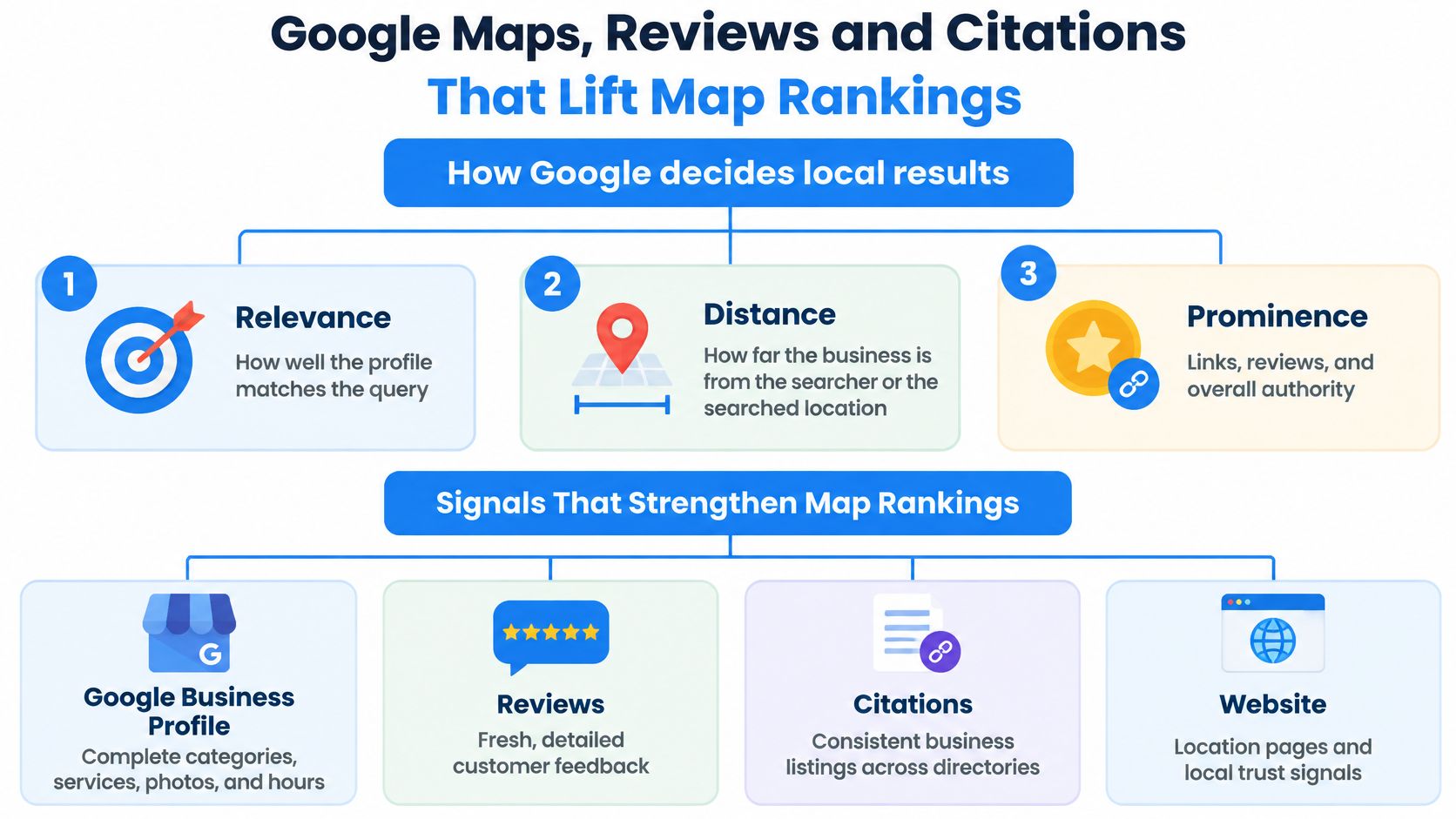
Google Maps, Reviews and Citations That Lift Map Rankings
Google describes local ranking through relevance, distance and prominence. Relevance is how well the Business Profile matches a query; distance is how far the business is from the searcher or specified location; prominence reflects how well-known the business is. Google says links, articles, directories, review quantity and review scores can contribute to prominence, and that a business's position in regular web results also factors into local search (Google's local ranking guidance).
Make the profile easy to match
Set Flooring contractor as the primary category, then use relevant secondary categories for services the company provides. Write the description in ordinary language, naming materials, installation methods and service cities. Complete the service-area information, add real project photos steadily, and use posts and Q&A to answer common questions about estimates and timing.
Distance is the factor a contractor has the least control over. A showroom can't be moved in response to a search, and a service-area business shouldn't claim an address it doesn't have. Define genuine service areas and build city-specific proof through completed jobs, customer feedback and useful local details.
Build review and citation habits
Ask customers for a review when a project is complete, using a direct link. Invite honest feedback, but don't script the customer's wording or offer an incentive. Respond to every review within a few days, including critical reviews, with a professional reply that addresses the issue without sharing private details.
Keep the business name, address and phone number consistent across directories, industry associations and supplier installer programs. Local chamber listings and community sponsorships can also help build relevant links and recognition. For homeowners comparing contractors, a homeowner's guide to hiring flooring professionals offers useful context on evaluating a company's reputation. Transactional offers Google Business Profile packages that optimize the profile to attract more customers and support local search rankings. The local citation checklist can help a team audit its listings.
Review platforms matter to the buyer as well as the search engine. In 2024, 36% of consumers checked two different review sites before choosing a service business, according to ServiceTitan's summary of home-services statistics. That makes a complete profile and a steady, authentic review process part of conversion work, not just a ranking task.
Use this checklist this week: confirm the primary category and services, correct mismatched listings, add current project photos, send review requests to recent customers, and make sure the website supports the same service and location claims as the profile.
Service-City Silos and On-Page Pages That Convert
A useful flooring site connects a central service hub to focused material and restoration pages, then to city-service pages only where the company has real work to show. That structure is stronger than a collection of near-identical pages because each page has a distinct buyer, service and proof.
| Page type | Example URL pattern | Target query | Must include |
|---|---|---|---|
| Service hub | /flooring-services/ |
flooring installer near me | All services, service areas, reviews and estimate form |
| Material page | /luxury-vinyl-tile/ |
LVT installation [city] | Subfloor needs, price factors, timeline and warranty types |
| Restoration page | /hardwood-refinishing/ |
hardwood refinishing cost [city] | Sanding and coating steps, project photos and pricing variables |
| City-service page | /[city]/carpet-replacement/ |
carpet replacement [city] | Local projects, neighborhoods, city reviews and local phone |
| Commercial page | /commercial-flooring/ |
commercial flooring contractor [city] | Project types, lead times, bid process and references |
On each service or material page, use the target query naturally in the heading and opening paragraph. Explain the practical choices that affect an estimate: square footage, removal and disposal, subfloor preparation, trim and transitions, project schedule, and warranty coverage. Separate manufacturer warranties from the installer's workmanship guarantee so the page doesn't blur who covers what. Include a clear estimate action, such as calling or submitting a form.
A city-service page requires more than just changing the city name. Include completed local projects, neighborhoods served, reviews from that city when available, and contact information that helps customers reach the business. Search engines and potential customers have little reason to value pages that repeat the same copy with only the location changed.
Keep every page accountable to the buyer's next step. A search for “hardwood floor refinishing [city]” should land on a page about refinishing in that service area, not a generic flooring page with a phone number buried at the bottom.
Link the pages in a logical path: the service hub points to material pages, material pages point to relevant city-service pages, and every page gives visitors a route to the estimate form. Transactional's home-service SEO combines industry-specific keyword targeting, technical SEO and content marketing; a service-area page framework can help keep geographic pages connected to real services and evidence.
For a flooring company that has one crew and serves one city, publish fewer pages and make each one more useful. A well-developed service page with accurate project evidence is a better investment than a large set of thin pages. When considering material options for a market, a practical reference such as hybrid floors for Melbourne homes may help frame local product questions, but the company's own page should focus on the products it installs and supports.
Earning Visibility in AI Answers Without Losing Maps
AI answers and Google Maps can appear across the same local search environment. One local-search analysis found AI Overviews on 68% of sampled local-business queries, while traditional local packs appeared on 39%. A separate study of 60,000 local queries found AI Overviews in 40.2% of searches and reported that queries without an explicit location were 11.1 percentage points more likely to trigger one (Whitespark's local-search case study). Those findings support a dual approach: make flooring content useful to answer engines, while keeping local business information and Maps signals accurate.
Write answer blocks a buyer can use
Start an answer-focused page with a direct response to a real question, such as “What flooring works best in a humid home?” or “How long does hardwood installation take?” Then explain what changes the answer and provide a local proof point, such as the type of room in a completed project, the installation method used or a relevant service-area detail. Keep the answer specific enough to help a homeowner, not just easy for a model to quote.
A useful format is:
Direct answer: State the recommendation in a sentence. What changes it: Name the room, substrate, moisture conditions or product choice that could change the recommendation. Local proof: Add a genuine project detail or describe how the company evaluates that condition before installation.
Avoid unsupported guarantees and blanket statements. Flooring decisions often turn on subfloor moisture, slab preparation, acclimation, transitions, stairs, pets, radiant heating and warranty terms. A technically clear answer can help a buyer assess fit before requesting an estimate, while also giving AI systems a more precise description of the company's expertise.
Brand-managed details matter too. A 2025 analysis reported by Yext examined 6.8 million AI citations and found that 86% came from brand-managed sources. That finding supports keeping the company website, Google Business Profile and directory listings accurate about services, materials, areas, project evidence and contact details (Yext's AI citations announcement). It's directional evidence, not proof that one tactic guarantees an AI citation.
Transactional builds content for a customer's website and Google Business Listing, which makes consistency across those surfaces a practical part of the work. Track AI citations, impressions, calls, map exposure and booked estimates separately. Website traffic alone can't show whether a flooring company is being surfaced in an answer or earning the local buyer's call.
Technical Checks for Mobile Speed and Local Markup
A slow mobile page can lose a flooring lead before the visitor reaches a project gallery or estimate form. Large installation photos, before-and-after sliders, chat widgets and embedded maps can add weight and delay. Keep the first screen focused on the information a ready-to-hire customer needs, such as relevant services and a clear route to request an estimate.
Fix the mobile bottlenecks first
- Resize and compress photos. Serve modern image formats and use files sized for a phone rather than downloading full-size portfolio images.
- Lazy-load lower-page galleries. Load the first screen promptly, then load images farther down as a visitor reaches them.
- Reserve media dimensions. Set image and embed dimensions so the page does not jump while photos load.
- Defer nonessential scripts. Review chat tools, sliders and marketing tags. Remove or postpone scripts that do not support a lead or necessary site function.
- Check real-user field data. Monitor mobile Largest Contentful Paint, Interaction to Next Paint and Cumulative Layout Shift, rather than relying only on a one-time lab score.
Then check indexing. Important service pages should not be blocked by robots.txt, marked noindex or hidden behind a login. Submit an XML sitemap and use Google Search Console's URL Inspection to see how Google renders each page.
Add accurate local structured data
Use LocalBusiness structured data on the relevant main location and service pages. Include the business name, address or service-area configuration, phone number, opening hours, geographic area and official URL. Validate the markup with Google's Rich Results Test, and make sure each field matches accurate information visible on the page. Give each legitimate staffed location its own markup. Do not create artificial locations or publish a fake showroom address.
For a flooring company without a showroom, describe the service area accurately rather than inventing an address. A service schema markup guide can help with implementation, but structured data does not replace clear page content.
Keep the profile, service-city pages and markup aligned: the Google Business Profile should represent the service area, while each city page explains the flooring services available there. This connected setup helps search engines and AI answer systems interpret the business, while giving transactional buyers a clear path from a local result to a relevant page and estimate request.
Transactional works with WordPress because it works best for helping a company's website show up highest in search results. Whichever platform the business uses, track organic landing-page calls and estimate-form completions alongside real-user speed data.
Measuring Map Calls, Estimates and Rankings
Treat SEO progress as checkpoints, not a promise of a fixed result. In the first month, check business information and indexing. Over the following months, monitor impressions and map visibility by service city, then assess whether those gains lead to calls and estimates. With ongoing SEO efforts, most businesses see ranking improvements within 3–6 months, according to Transactional's stated expectations; timing still depends on the market, competition and the work completed.
| Metric | Source | Check frequency | Healthy signal |
|---|---|---|---|
| Map rank by service city | Map heat grid or rank tracker | Biweekly | Top three for priority transactional terms in each city |
| Search Console queries | Google Search Console | Monthly | Rising impressions for material and city terms |
| Profile calls | Google Business Profile insights | Weekly | Rising calls from each service area against the baseline |
| Estimate form completions | Analytics tagged by landing page | Weekly | Estimates traced to material and city pages |
| Review count and rating | Google Business Profile | Monthly | Steady new reviews with a stable average rating |
| AI answer citations | Manual prompt sampling | Monthly | Track the trend; no reliable baseline yet |
A map heat grid should sample locations across the actual service area, not just one point near the business address. Compare each grid point against the top three results for priority transactional searches, then note where visibility changes by city or neighborhood. Review the grid biweekly alongside keyword timelines by service city; review Search Console queries and review activity monthly.
Connect calls to service areas by combining profile call data with call tracking where appropriate. Tag form submissions by landing page so a material page or city page can be connected to an estimate and, where the business tracks it, a booked job. Include review count and rating in the report because customers use that information to judge a contractor, not just because the profile may rank.
If rankings rise but calls don't, check the phone number, the page's call action and whether the service-area match is clear before changing keywords. Transactional provides transparent reporting that can include keyword timelines by service city, map heat maps, Search Console queries and traffic, with biweekly reporting.
Transactional LLC provides local SEO, Google Maps optimization and transparent reporting for flooring businesses that want to reach buyers searching for specific services in their service areas. If you want a plan tied to transactional searches, map visibility and estimate requests, visit Transactional LLC to discuss your flooring company's search strategy.