


Your AC tech just wrapped a job in north Phoenix, and the shop phone is quiet. Two miles away, a homeowner typed air conditioning repair near me, saw three map listings, and called one of them. It was not you. That query is a transactional search term: the unit is down, and the person is ready to spend. In 2025, 84% of surveyed U.S. consumers searched for local businesses online daily, according to Rio SEO's study of more than 1,000 consumers. SEO for service businesses is how you show up for those ready-to-book searches in the cities your crews cover.
I would not open with a stack of blog posts. I would pick one service and one metro, then follow a fixed order. Calls come from that sequence, not from a rank check taken at the office.
The Service Business SEO Sequence That Brings Calls
The fastest calls come from a fixed order, because each phase feeds the next. Google's local ranking guidance says local results turn on relevance, distance, and prominence. A matching service satisfies relevance, the searcher's area supports distance, and reviews, links, and ordinary web visibility feed prominence. Skip a phase and the later work has nothing to attach to.
Say an HVAC company in Phoenix wants emergency and repair calls, not a national brand page. This is the order I would run.
| Phase | Action | Typical timing | Signal to watch |
|---|---|---|---|
| 1 | Verify and complete the Google Business Profile | Week 1 | Profile appears for brand and service searches |
| 2 | Map service areas and transactional terms | Weeks 1-2 | List of 25 or more terms grouped by city |
| 3 | Build service and city landing pages | Weeks 2-6 | Pages indexed and ranking for target terms |
| 4 | Earn and answer reviews | Ongoing | Review count and response rate rise each month |
| 5 | Add LocalBusiness markup and fix crawl errors | Weeks 3-4 | Search Console reports no errors |
| 6 | Track calls and booked jobs by service and city | From week 2 | Calls tagged to a specific service page and city |
Why you cannot reorder it
Claim and verify the profile first. Nothing else shows on the map without that verified listing. Next, write the searches a homeowner types when a unit fails: air conditioning repair near me, emergency AC repair Phoenix, and AC repair Scottsdale. Then build one service or city page for each target term, earn and answer reviews, add LocalBusiness markup, fix crawl errors, and tag calls by service and city from week two.
A page that ranks without a verified profile in the same city rarely produces map calls. A profile that names a service with no page behind it cannot be matched for that service. Run one service and one metro first, not the whole market.
Practical rule: This week's only action is a list of 25 or more terms for one city, plus a full audit of the profile.
Owners often ask for page one in 30 to 60 days. Treat that as an early checkpoint, not the finish line. Most businesses see ranking improvements within 3 to 6 months with ongoing SEO efforts, so set a 90-day review of map position, calls, and booked jobs. Our work starts with an initial SEO assessment of Maps position and the transactional terms for that city. A business without a website has to build one first. The rest of this system has nowhere to live.
Win the Map Pack With a Complete Google Business Profile
Map rankings are a two-stage problem, not a proximity contest. Stage one is eligibility: an accurate, verified profile and service locations that match where crews drive. Stage two is competitive strength: a steady flow of genuine reviews whose wording names the service. That second stage matters more once the field narrows.
An analysis of 3,269 Google Business Profiles across food, health, law, and beauty, reported by Search Engine Journal, found proximity influenced 55% of local-ranking decisions across positions 1–21. Among the top 10, proximity fell to 36%, while review count rose to 26% and review-keyword relevance reached 22%. The model explained about 92–93% of ranking variance. Ask customers, after a finished job, to describe the service, the neighborhood, and the outcome in their own words. Do not script or pay for that language.
Fields a technician should check in order
Walk the profile the way a lead tech walks a truck before a call.
| Field | HVAC entry | Why it matters |
|---|---|---|
| Primary category | HVAC contractor | Sets the core relevance match for the query |
| Secondary categories | Furnace repair, AC installation, duct cleaning | Opens matches for related service searches |
| Service entries | One per repair, install and maintenance job, each with a short description | Lets the profile match each service term |
| Service area | Cities and neighborhoods the crews actually cover | Sets geographic eligibility |
| Hours | Regular hours plus emergency availability | Answers after-hours calls |
| Photos | Trucks, technicians and completed installs | Confirms the business is real and local |
Post weekly about seasonal work, such as coil cleaning before the first 100-degree week. Answer Q&A before a competitor does. Our Google My Business Optimization sets these fields so a home-service profile can rank and be seen on Google Maps. The same checklist works in-house if you would rather own it.
A single rank check at the office hides whether you show up a mile away. Drop pins on a grid about one mile apart and record the pack for each service and city. That grid tells you whether reviews are pushing visibility outward or only polishing the block around the shop.
Find the Transactional Terms Your Customers Type
A transactional search is a query from someone ready to book: air conditioning repair near me, dentist near me, roofer near me. An informational question, such as why a system blows warm air, is research. Both can live on the site. Only the first group should own your money pages.
Keep one industry on each list. HVAC terms never share a page with dental or pest terms. We tailor the strategy to the demand in that trade, and each month we pick the terms worth ranking for, then apply them to the profile and the other listings.
Five steps before you publish a page
- Export what already works. Pull the queries that bring clicks from Search Console.
- Rank services by profit per job. Repair, install, and maintenance do not deserve equal pages.
- Add city and neighborhood modifiers only where a truck goes.
- Label each term transactional, commercial, or informational.
- Assign each term to exactly one page. Our local keyword research process is built for that one-page rule.
| Search pattern | Intent | Page to build | Example query |
|---|---|---|---|
| Service plus near me | Transactional | Service page with a click-to-call button | air conditioning repair near me |
| Emergency service plus city | Transactional | Service and city page | emergency AC repair Phoenix |
| Service plus neighborhood | Transactional | Neighborhood city page | AC repair Scottsdale |
| Service plus cost or price | Commercial | Pricing guide with a booking link | AC repair cost Phoenix |
| Symptom question | Informational | Troubleshooting article linking to the service page | why is my AC blowing warm air |
| Brand plus service | Navigational | Homepage and Business Profile | Brand name AC repair |
A pest company should keep its own list. A page of mosquito control tips from FullScope Pest Control belongs on a pest site, not on an AC repair URL. Recheck the map each quarter. The queries that produce calls shift with the season, and last July's winners are a weak plan for January.
Build Service Silos, Landing Pages and Technical Basics
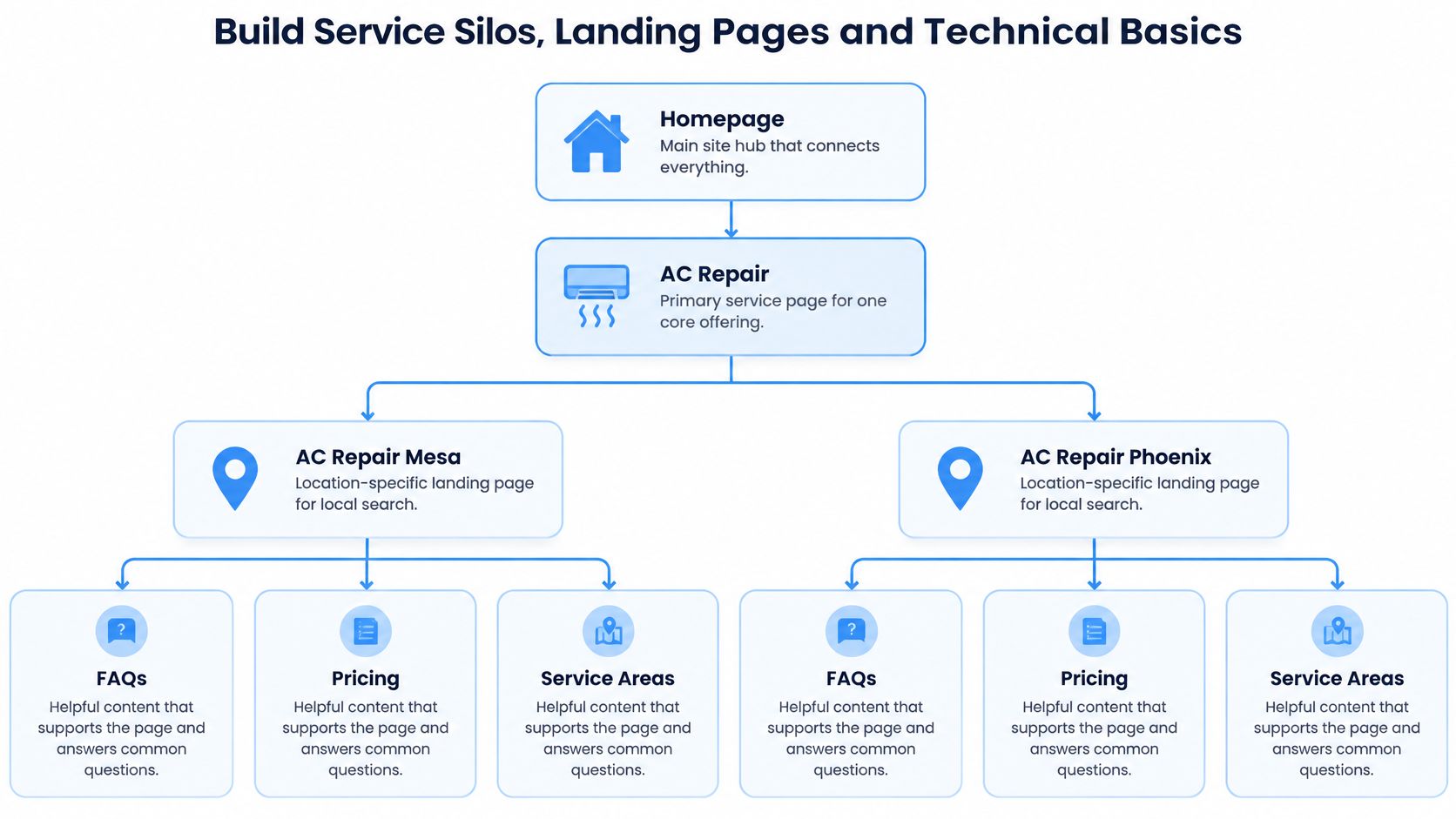
Think of the site as a hub with spokes. The homepage links to a service hub such as AC repair. That hub links to city pages such as AC repair Mesa and AC repair Phoenix. Each city page links to troubleshooting articles, and those articles link back. One primary transactional term per page. The same shape works in other trades: plumbing repairs from Stultz Plumbing sit on a plumbing hub, not inside an HVAC silo.
What goes on the page
Put one service and one city in the title, the H1, the first 100 words, and the meta description. Name the service area in the opening paragraph. On mobile, place a click-to-call button above the fold. The business name, address, and phone on the page must match the profile exactly. A booking form with three fields is enough. Promise a response time only if the office can keep it.
Our home-service work pairs industry-specific terms with technical SEO and content for both the website and the Business Profile, so the silo should list the same services the profile lists. A deeper look at content silos for SEO shows how those internal links pass relevance without making two pages fight for one term.
Markup and crawl health
Google's LocalBusiness documentation treats structured data as an entity layer: hours, departments, on-site reviews, and coordinates where a real customer-facing location exists. Add JSON-LD on the location or contact page, using the most specific subtype, a stable name and phone, full hours, and the same identifiers as the verified profile. Markup should repeat what the page already shows, not invent a second address.
Validate after you deploy, and watch Search Console for parsing issues. The gain is clearer machine reading and eligibility for hours, ratings, directions, or booking actions. It is not a guaranteed rank jump. Pair that with a fast mobile load, crawlable pages, and an XML sitemap. A beautiful city page that Google cannot fetch will not take a call.
Get Recommended in AI Answers and Map Results
There is no secret phrase that puts you inside an AI answer. When someone asks an assistant who can fix AC in Mesa today, the system has to identify the business, the service, the city, and the hours. It pulls that from the Business Profile, the website, and listings that agree with each other.
Google's guidance on AI features points local businesses to Business Profiles for visibility in AI responses and in ordinary Search, and it tells owners to use foundational SEO plus clear local details. That is not a prompt-ranking formula. I would ignore any pitch that sells one.
What to publish so an assistant can name you
- One clear sentence that names the service and the city, such as same-day AC repair in Mesa.
- A short FAQ on each service page, written as the questions customers already ask on the phone, with a direct answer first.
- The same name, address, and phone on the profile and on every directory you control.
- Reviews that describe the job in the customer's words, plus licence details, years in business, and the service area as plain facts on the site.
Add five Q&A entries to the Business Profile this week. Answer them the way the dispatcher would, in one or two sentences.
Assistant citations are not reported in a stable dashboard yet. Track branded searches and profile actions instead. If those rise while the FAQ and the profile stay accurate, you have a signal you can manage. A clever prompt on a thin page will not substitute for that.
Reviews and Citations That Lift Local Rankings
Send a text or email with a direct review link within 24 hours of a completed job. Ask the customer to describe the service and the neighborhood in their own words. Never offer a discount, a gift card, or any other incentive. Reply within 48 hours to every review, including the short ones and the unhappy ones.
A useful reply can name the job without stuffing terms. "Thanks for trusting us with the AC repair in Mesa" is a normal sentence. "Best AC repair Mesa AC repair near me" is not, and it reads like an ad to the next homeowner.
BrightLocal's 2025 Local Consumer Review Survey of 1,026 U.S. adults found that 97% of consumers read reviews for local businesses. 89% would use a business that responds to all of its reviews, compared with 44% who would use a business that does not respond at all. 74% check reviews on two or more sites. That survey measures behavior, not a guaranteed ranking factor. It still explains why a silent profile loses the call even when the pin is close.
Where the name, address, and phone must match
For home services, the core listings are Google, Apple Maps, Bing Places, Yelp, Angi, the Better Business Bureau, and the trade associations your licence already requires. Search the business name, the phone number, and old addresses. Merge or close duplicates, and fix any listing that still shows a retired suite number. Our notes on local SEO citations walk through that cleanup without treating every directory as equal.
Once a month, record review count, response rate, and whether the name, address, and phone still match. A month with lots of jobs and no new reviews is a process failure, not a marketing mystery.
Measure Calls and Booked Jobs, Not Just Rankings
Maps, profiles, and AI Overviews often answer the question before anyone clicks. Visibility can rise while the website gets quieter, and a rank report will not tell you which outcome you had. Business Wire's summary of 2025 local-search findings notes that 60% of surveyed consumers say they click AI-generated Google overviews. In Q4 2025, service-business views increased 12.3% quarter over quarter, while clicks fell 3.3%, including phone calls, website visits, and direction requests.
Split the scoreboard into three layers.
- Discovery: map views, branded searches, and any AI citation you can log by hand.
- Engagement: calls, messages, and form submissions.
- Outcomes: answer rate, close rate, and revenue by service and city.
Put a unique call-tracking number on each service and city page. Tag the service the caller asked for. Give the CRM a field that ties the lead to the job. Every two weeks, set the map heat map beside Search Console queries and booked jobs. A practical setup is covered in our guide on how to track phone calls.
A drop in clicks next to rising calls and bookings can be a win. Only the tracking and the CRM can prove it. Without those, you are guessing.
| Metric | Source | Question it answers | Review cadence |
|---|---|---|---|
| Map views and direction requests | Business Profile insights | Is the profile being seen | Biweekly |
| Calls by service and city | Call tracking number per page | Which city and service produce calls | Biweekly |
| Booked jobs and close rate | CRM | Which calls become revenue | Monthly |
| Branded and service searches | Search Console | Are searches growing for each service | Biweekly |
| Map grid rank by point | Local rank grid tool | Is visibility reaching the service area | Monthly |
| Review count and response rate | Review platforms | Is reputation keeping pace with jobs | Monthly |
Scale From One City to a Full Service Area
Copy the system only after the first city shows top-three map positions across the grid on two monthly checks, and after its calls are tagged to pages. Until then, a second city just splits a thin effort.
- Duplicate the city template with new neighborhoods and the crew area. Do not swap the city name and republish the same paragraphs.
- Build that city's term list and keep one industry on it.
- Add a second service only after the first service's pages hold their positions.
- Run reviews per location, one request for each completed job.
- Split the report by city so a weak city gets a fix before it drags the account.
An HVAC company with AC repair pages in Phoenix can extend that silo to Mesa and Tempe, starting with the emergency terms that already produce the most calls. The same city-by-city rule applies in other trades. A page to find a dentist in Surrey should stay a dental city page, not a paragraph bolted onto a home-service site.
Pick the single city with the highest call volume. If its grid positions have not held for two months, do not add another city this month.
Transactional LLC builds local SEO and Google Maps work around the transactional terms your customers already type, then reports calls and booked jobs by service and city. If you want that sequence started on one metro, with the profile, the pages, and the call tracking in the same plan, visit Transactional LLC and ask for the initial SEO assessment.