


More HVAC leads aren't automatically good news. If your ads bring in out-of-area callers, unanswered calls, or people looking for work rather than service, a rising lead count can disguise wasted spend. HVAC PPC marketing should be judged by qualified calls, booked jobs, and gross profit, not clicks or raw form submissions.
A strong campaign starts with transactional searches, the specific local queries people use when they're ready to hire, such as “air conditioning repair near me.” From there, every decision should help turn that intent into work your team can answer, schedule, and complete profitably.
Start With Transactional HVAC Intent
An HVAC owner checks the ad dashboard and sees plenty of clicks. The phone tells a different story. Some callers are outside the service area, some hang up before anyone answers, and others want a rough quote without scheduling. The campaign attracted attention, but it hasn't yet proved it's producing qualified opportunities.
That distinction starts with search intent. Someone searching “air conditioning repair near me,” “furnace repair near me,” or “HVAC contractor near me” may have a service problem and be ready to contact a local company. A search such as “how to maintain a furnace” is usually earlier research. It may support a useful educational page, but it shouldn't automatically compete for the same budget as an urgent repair search.
Transactional Marketing focuses on specific transactional search terms in local cities, where prospective customers are looking for a service provider. The practical question isn't just whether a person clicked. It's whether that person needed a service you offer, lived in an area you serve, reached your team, and had a request your technicians could handle.
For a useful example of how local HVAC businesses are presented to people searching for a provider, review Bender's Oil Service recommendations. Use the same customer-first lens in your ads: make it clear what you do, where you work, and how a searcher can contact you.
The test: A click is traffic. A qualified opportunity is a relevant request your team can serve. A booked job is the outcome to measure.
Treat that distinction as the filter for your keywords, campaign setup, landing pages, and reporting. An ad can attract the right search and still fail if nobody answers the call or the page sends the visitor in the wrong direction.
Build an Intent-Based Account Structure
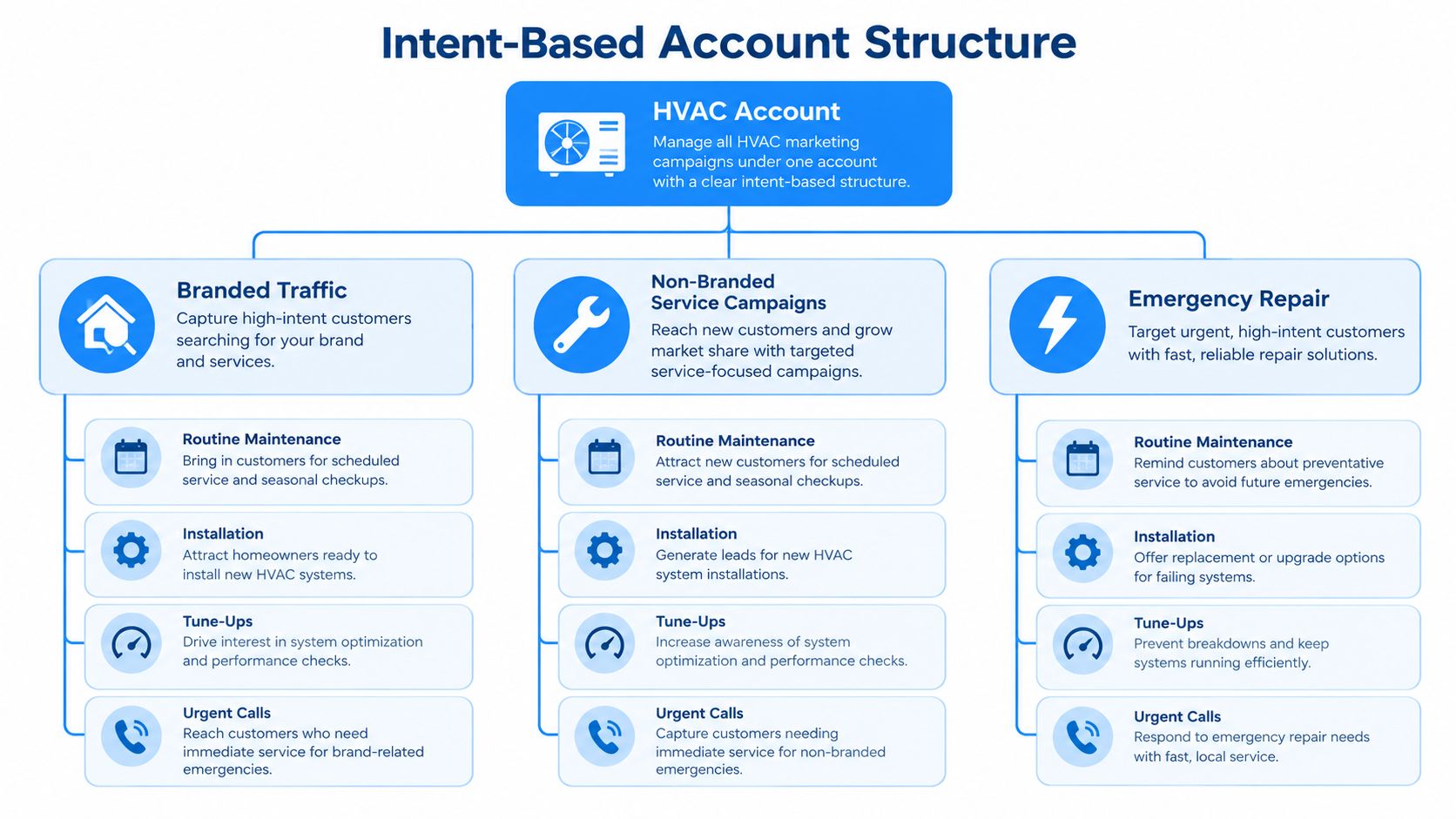
A tangled Google Ads account blends brand searches, emergency calls, maintenance requests, and installation research into results that are hard to act on. Separate those intents so you can see what each campaign is buying and decide where the budget belongs.
Organize campaigns around customer intent
Start with distinct campaign groups:
- Branded traffic: Searches for your company name. Keep these results separate so you can monitor brand demand without blending it into non-brand acquisition.
- Non-branded service campaigns: Group core services such as AC repair, furnace repair, and routine maintenance. Give each service its own ad groups and relevant landing page.
- Emergency repair: Separate urgent calls, including emergency heating and same-day AC repair, from routine service. This lets you manage spend against urgency, staffing, and availability.
- Installation and replacement: Give AC replacement and furnace installation their own campaigns. People comparing a major purchase often need different information from a caller with a breakdown.
- Competitor intent: Keep competitor searches apart from your core service terms. Review them separately before deciding whether their traffic fits your acquisition economics.
For a local HVAC company, a practical map might include a branded campaign, an AC repair campaign with its own service group, a furnace repair campaign, an emergency heating campaign, and an AC replacement campaign. Add maintenance where it fits the company's capacity and offer. Don't put every service and search intent into one ad group just because they share the same website.
Set boundaries before spending
Limit each campaign to locations the company can serve. A city name in a search doesn't make the job serviceable if it's outside your coverage area, so review geographic settings and lead locations. Set schedules and budget controls according to who answers calls and which services the team can fulfill.
The Google Ads campaign setup guide can support the practical account build. The outcome you want is not a neatly labeled dashboard for its own sake. It's a clear view of which local searches generate demand your company can answer and turn into booked work.
Choose High-Value HVAC Keywords
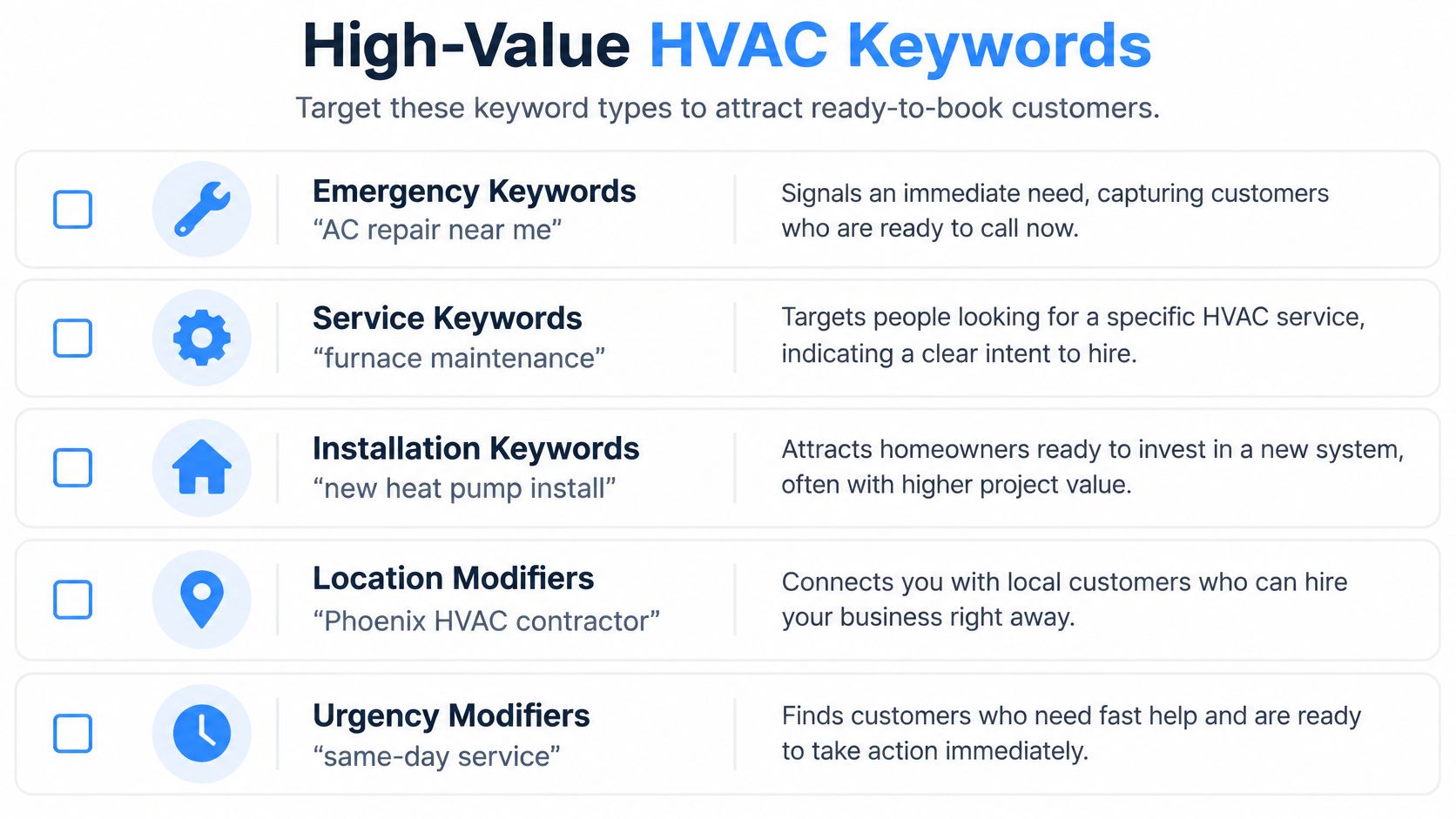
A keyword list shouldn't be a pile of popular phrases. Build it around service, urgency, location, and customer readiness. A broad term might bring a range of searches; a specific combination gives you a better chance of matching the ad and page to what the person needs.
Compare these searches by intent:
| Search | Likely intent | Campaign and page |
|---|---|---|
| “AC repair” | Service need, but location and urgency may be unclear | AC repair campaign and service page |
| “Emergency AC repair” | A more immediate repair need | Emergency campaign and page that clearly explains how to request help |
| “AC repair near me” | Local service-provider search | Geographic AC repair campaign and locally relevant repair page |
| “AC replacement cost” | Installation research and price comparison | Replacement campaign and a page explaining what affects a quote |
Make the keyword sheet useful
For each keyword group, record the service, city or service area, urgency, matching campaign, landing page, and expected conversion action. That turns keyword research into an operating document, not a list to paste into one campaign and forget.
Include modifiers only where they match real services and actual coverage. “Furnace maintenance,” “new heat pump install,” “Phoenix HVAC contractor,” and “same-day service” communicate different needs. A company that doesn't offer same-day appointments shouldn't imply that it does. A location term should lead to a page and service offer that genuinely apply to that area.
Search terms are the real-world check on your keyword choices. Review the report for queries that deserve a dedicated group or page, and flag terms that show research intent or an unrelated need. Keep urgent, service-ready searches visible in their own budget decisions instead of letting broader installation or maintenance searches absorb funds.
The video below offers additional context on HVAC PPC marketing:
Control Negative Keywords and Lead Quality
Negative keywords protect a campaign from paying for searches that don't match the work you sell. They aren't just account cleanup. They help keep the budget focused on people looking for HVAC service rather than DIY instructions, parts, training, or jobs.
Review search terms before blocking them
Build shared negative lists for exclusions that apply across most campaigns, such as employment and training searches. Use campaign-specific exclusions when a term is irrelevant only to one service. Then add negatives based on actual search-term reviews, rather than trying to guess every irrelevant query in advance.
Potential exclusions include searches for DIY repair instructions, wholesale equipment, HVAC jobs, and training courses. Out-of-area city names may also belong on a campaign's list when the company can't serve those locations. But review a term in context before blocking it. A phrase containing “parts,” for example, could still be part of a service search, depending on how the whole query is worded.
Make search-term review a regular operating task. When a new query draws clicks but doesn't fit your service, check whether it's a one-off or a pattern, then add a precise negative where appropriate. The guide to using negative keywords is a useful reference for building that process.
Match the ad promise to the landing page
A person who clicks “emergency AC repair near me” needs immediate clarity: the company handles AC repair, serves the relevant location, and explains how to contact the team. Don't use urgent wording that promises availability your dispatcher can't confirm.
Examples of intent-matched ad language include:
- Emergency AC repair: “Need AC repair in [service area]? Call to discuss your repair request and availability.”
- Furnace replacement: “Explore furnace replacement in [service area]. Contact our team to discuss your home and installation needs.”
- Maintenance request: “Ask about HVAC maintenance in [service area]. See the services offered and request an appointment.”
Keep the claims accurate. If the company offers a particular service, operates in a named location, or answers calls during stated hours, say so. Don't add a price or guarantee unless the business can support it and explain its terms.
The landing page should continue the same conversation. Explain the service, state the service area, provide relevant trust signals, show clear contact options, and make the booking path easy to follow. An emergency page should prioritize contacting the team. An installation page should help visitors understand the service and what information is needed to discuss a project.
Sending every click to the homepage weakens the connection between the search and the offer. Someone searching for furnace replacement shouldn't have to hunt through a general page to find whether you install furnaces. The ad, keyword, and destination page should all describe the same need.
Choose Bidding Strategies by Profit Potential
There's no bidding setting that can make an unprofitable job profitable. Choose bidding controls based on the service's value, how well you can qualify demand, and whether the team has capacity to take the work.
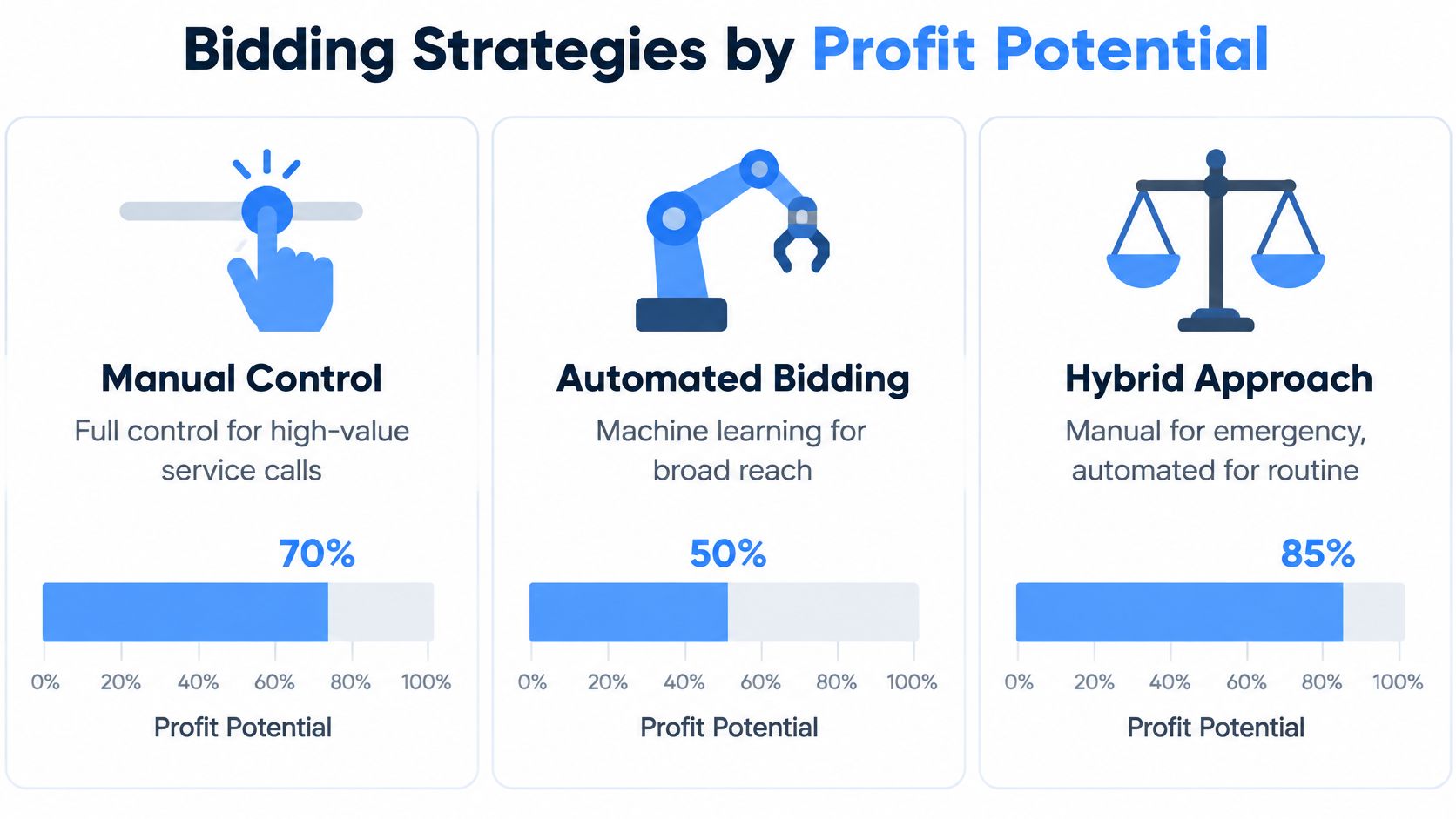
Manual bidding gives you tighter control while you assess which searches and locations bring relevant inquiries. It also asks for regular attention, and it doesn't substitute for accurate conversion data. Automated bidding can adjust delivery toward the conversion actions you've configured, but weak tracking gives it weak goals. A hybrid approach can keep closer control over emergency campaigns while allowing suitable routine campaigns to use automation.
| Approach | Useful when | Watch out for |
|---|---|---|
| Manual control | You're still examining service, location, and query quality | Managing bids alone won't fix poor lead qualification |
| Automated bidding | Your conversion actions reflect valuable outcomes | Raw calls or forms can steer optimization toward weak leads |
| Hybrid management | Different services need different levels of control | Each campaign still needs a clear goal and proper measurement |
The image is a conceptual comparison, not evidence that one method produces a particular profit rate. Choose a strategy for its fit with your account and measurement, not for a promised outcome.
A booked replacement job and a maintenance inquiry don't carry the same economics. Set different expectations by service, and check whether a campaign's leads are qualified, whether the company can complete the work, and whether the resulting gross profit justifies the acquisition cost.
Benchmark figures can help frame the discussion, but they aren't a bidding target. A LocaliQ-based dataset covering 3,211 U.S. search-ad campaigns from April 2024 through March 2025 reported median cost per lead of $127.74 for air-conditioning installation and repair and $129.02 for heating and furnace services (home-service marketing benchmarks). Your market, season, service mix, and conversion definitions can produce different results. Use your own booked-job economics to decide what you can afford.
For an account with reliable qualified-lead data, value-based bidding guidance can help frame how to move optimization toward valuable outcomes. Don't increase spend because a platform reports more conversions. Exclude areas the business can't serve, and adjust campaigns when staffing or service capacity changes.
Track Calls and Booked Job Revenue
A phone call isn't automatically a lead, and a lead isn't automatically a job. Set up measurement so the account can distinguish ad activity from qualified demand and completed business.
Start with Google Ads call conversions for calls from ads and calls made after someone visits the website. Use call tracking or dynamic number insertion to connect each call with useful campaign details, such as the source, keyword, landing page, and location. Document how tracking works so dispatchers and marketers interpret the same records consistently. For an overview, see how call tracking supports attribution.
Set a qualification threshold
Use a meaningful rule to distinguish a substantive conversation from a click or brief hang-up. A connected call lasting 60–90 seconds can serve as a planning benchmark, but calibrate it to your company's calls. A quick call could still be valuable if a dispatcher books the job promptly, while a longer conversation may still involve a request you can't serve.
The call threshold is only an initial filter. Have staff record whether the caller is in the service area, needs a service you offer, and can be scheduled. Then connect qualified leads, booked jobs, and revenue from the CRM or dispatch system back to Google Ads as offline conversions. That lets you evaluate campaigns against operational outcomes, not just a platform's tally of calls and forms.
A practical planning formula for allowable cost per lead is:
Allowable CPL = gross profit per booked job × target marketing-share percentage × booking rate × qualification rate
Use the business's actual gross profit, booking rate, and lead qualification rate. If the qualified calls don't become profitable booked work, revisit the service, targeting, phone handling, or offer instead of treating the platform's lead count as success.
Report what helps you make decisions
Review spend, impression share, search terms, qualified-call rate, booked-job rate, cost per booked job, and attributed gross profit. Check the CRM against platform conversions to catch duplicate calls, short hang-ups, wrong numbers, out-of-area requests, and raw form fills that never become serviceable opportunities.
If you want an example of a clear contact path for a local service business, look at how Black Rhino Electric lets customers request a free electrical quote. The useful principle is a clear next step, not copying another trade's form. Your contact options and questions should fit the HVAC service and the way your team schedules jobs.
Optimize From Booked Jobs Back to PPC
A campaign needs a regular review process, not a launch and a hope. Start with booked jobs and trace backward: which service did the customer need, where did they live, which query brought them in, and did the ad and landing page accurately set expectations? Then compare the answers against capacity and gross profit.
Review performance by keyword, city, device, and ad type. Look at search terms and qualification outcomes alongside booked jobs and revenue. Make controlled changes to negatives, ad copy, pages, bids, and budgets, and give each change enough time to produce interpretable results. One unusually quiet day isn't a sound reason to rewrite the account.
Diagnose the leak before changing spend
Use the pattern of failure to identify the likely fix:
- Clicks without calls: Check whether the search intent matches the page, whether the offer is clear, and whether contact options are easy to find.
- Calls that don't connect: Review call handling, availability, and the number displayed. Don't treat more spend as a substitute for answering.
- Qualified leads that don't book: Listen to calls and review the scheduling path, service fit, and how the team handles the request.
- Strong calls with poor margins: Check which services and searches generated the work. A full schedule of low-margin jobs can still be a poor campaign result.
- Uneven results by city: Compare service coverage, search terms, page relevance, and operating capacity in each location before shifting budget.
Seasonality also affects planning. Available benchmark data indicates that HVAC search demand can rise 266% for air-conditioning terms from February to July and 594% for heating terms from August to December, while peak-season cost-per-click inflation may reach 20–40% (seasonal marketing benchmarks for HVAC and other trades). These figures don't predict what will happen in every city. Use local demand and your own service history to prepare campaigns before the busy period, promote maintenance in shoulder seasons, and reserve urgent-search spend for times when the team can respond.
Spend follows capacity: If dispatch can't answer or technicians can't take the work, more traffic can create operational problems rather than profitable growth.
Connect paid search with local visibility
PPC puts your offer in front of eligible paid-search audiences, but it doesn't guarantee a particular position in Google Maps. Google identifies relevance, distance, and prominence as primary local-ranking factors, and says businesses can't request or pay for a better organic local ranking (Google's local ranking guidance). Measure visibility across service areas rather than relying on a single search from the office, and keep your Business Profile accurate.
AI visibility isn't a separate shortcut either. Google's guidance says pages generally need to be crawlable, indexed, eligible for a normal search snippet, and useful to people. Structured data isn't required for generative AI features, although accurate markup can support broader search eligibility (Google's guide to appearing in AI features). Publish helpful HVAC information about services, locations, maintenance, and emergency situations, and make sure the site supports both people and search engines.
Use this operating checklist to keep the account tied to business results:
- Select transactional searches: Prioritize service, urgency, and location terms that match real customer needs.
- Separate campaign intent: Keep brand, non-brand service, emergency, installation, maintenance, and competitor activity distinguishable.
- Maintain negative keywords: Review search terms and block irrelevant patterns only after checking context.
- Match pages to intent: Send each query to a page that explains the relevant service, service area, and next step.
- Bid against profit potential: Consider lead quality, service economics, and capacity instead of chasing the lowest CPL.
- Measure calls: Track calls from ads and the website, then define what qualifies as a meaningful opportunity.
- Import CRM outcomes: Connect qualified leads, booked jobs, and revenue to campaign performance.
- Review booked work: Compare cost per booked job and attributed gross profit, not just clicks or platform-reported conversions.
- Plan around demand and capacity: Prepare for local heating or cooling demand, promote suitable services in quieter periods, and control spend when the team is full.
Revisit search terms, call quality, booked-job rate, and staffing needs weekly. Review budgets, service-area performance, seasonal priorities, landing pages, and attributed profit monthly. PPC can support a wider strategy that includes SEO, Google Maps optimization, and AI-ready local information, but each channel should be assessed by its role in reaching a customer and helping them become a served, profitable job.
A campaign isn't successful just because it generates clicks or inexpensive leads. It succeeds when your team can answer the demand, book the work, deliver the service, and measure the result against gross profit.
Transactional LLC offers HVAC businesses paid advertising campaign management alongside SEO, Google Maps optimization, and AI-driven content focused on high-intent local searches. Visit Transactional LLC to discuss targeting searches such as "air conditioning repair near me" and connecting campaign activity to booked-job outcomes.