


It's 9:40 p.m. A pipe lets go under the kitchen sink. The homeowner wipes their hands, opens their phone, and types plumber near me. They are not researching how pipes work. They have water on the floor and a card in their wallet.
That single search is what seo for contractors has to win. A ranking for a how-to article doesn't book the truck. A map result with a clear category, recent reviews, and a tap-to-call number does. The same pattern shows up for AC repair near me, roofer near me, and HVAC repair plus a city name. These are transactional search terms. The person searching already intends to spend money.
Rankings alone still don't book jobs. A slow page, a thin review profile, or a wrong phone number can waste a top-three map spot. The work that moves calls is tighter than a keyword list.
Why Transactional Searches Define Contractor SEO
A burst pipe, a dead AC unit, or a missing shingle creates the same behavior. The homeowner searches from a phone, scans the map pack, and calls whoever looks ready tonight. Transactional search is a query from someone ready to take action, not someone collecting background reading.
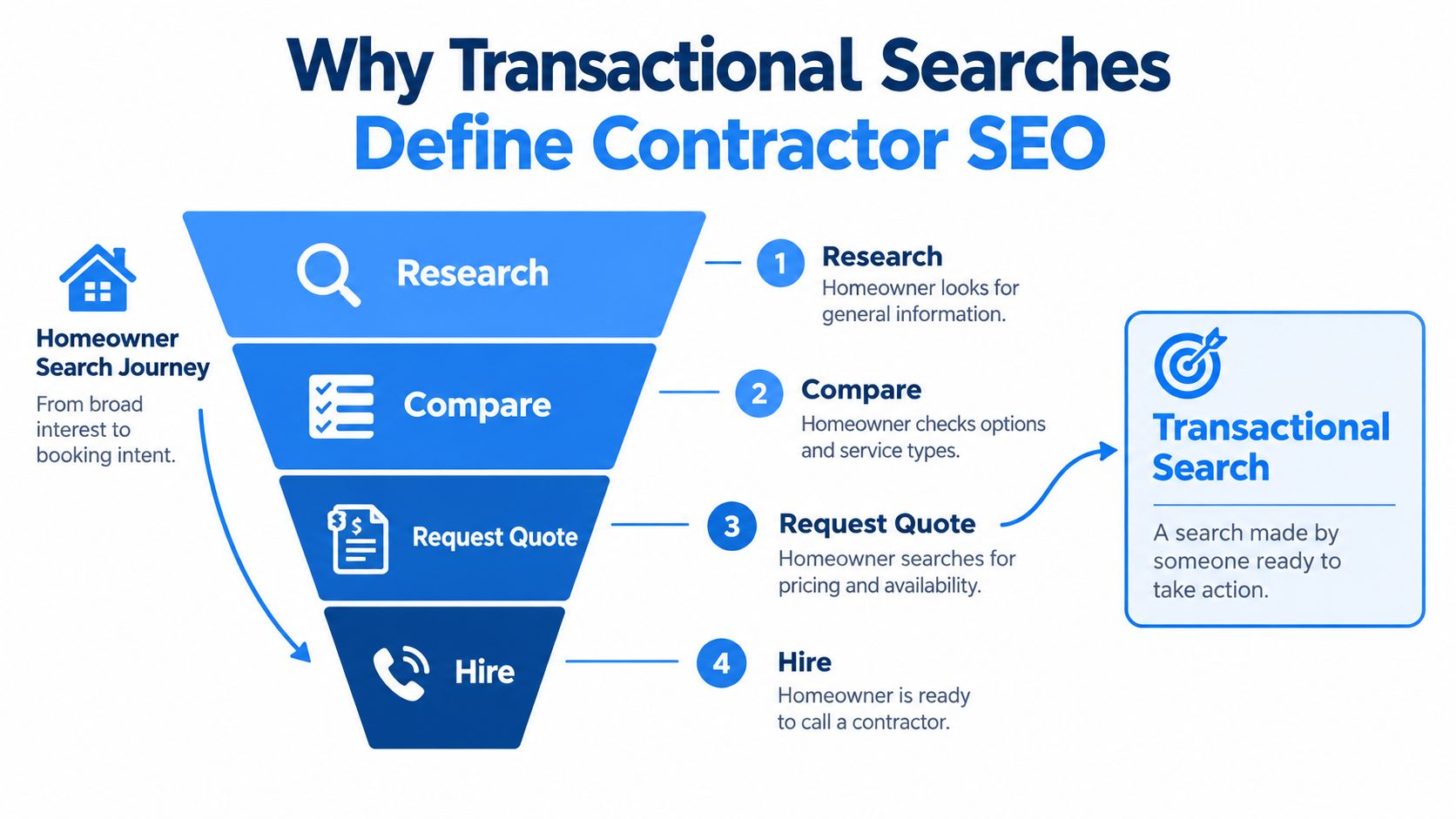
Traffic is not a booked job
Informational queries still matter later in a content plan. How does a furnace work teaches. It rarely produces a same-day service call. Furnace repair near me does. A roofing company that ranks for storm science and misses roofer near me built the wrong asset. A homeowner comparing quotes may later request a free roofing quote, but they start by judging who shows up in the city they typed.
The same split holds across plumbing, HVAC, electrical, roofing, and pest control. Each trade has its own service pages. Mixing those pages into one generic "contractor" URL usually matches none of the queries well.
Practical rule: If the query wouldn't justify sending a tech in the next few hours, it is not the term that pays the payroll.
What Google actually ranks
Google states that local rankings rest on relevance, distance, and prominence. Those three factors decide whether the burst-pipe searcher sees your pin.
Relevance is how closely the Business Profile matches the query. A primary category of plumber beats a vague contractor label for plumber near me. Complete service details matter more than repeating the city name in every sentence.
Distance is how far the business sits from the searcher, or from the place named in the query. You can't move the shop. You can publish honest service areas and real location pages so Google understands which cities you cover.
Prominence is how well known the business is. Links from other sites, plus the number and quality of reviews, feed that signal. Keyword stuffing doesn't override any of the three. Google still checks query-to-profile fit and geographic proximity, then weighs reviews and wider web visibility.
What you can control this month is the profile, the pages that name real cities, and the review habit that makes prominence less of a guess.
Building a Google Business Profile That Wins Calls
Map visibility starts with a finished profile, not a blog post. Google builds local results from several inputs: content crawled from your site, licensed third-party data, user photos and reviews, and Google's own interactions with the place. Your edits are one input. Conflicting names, phones, or service details make it harder to match AC repair near me.
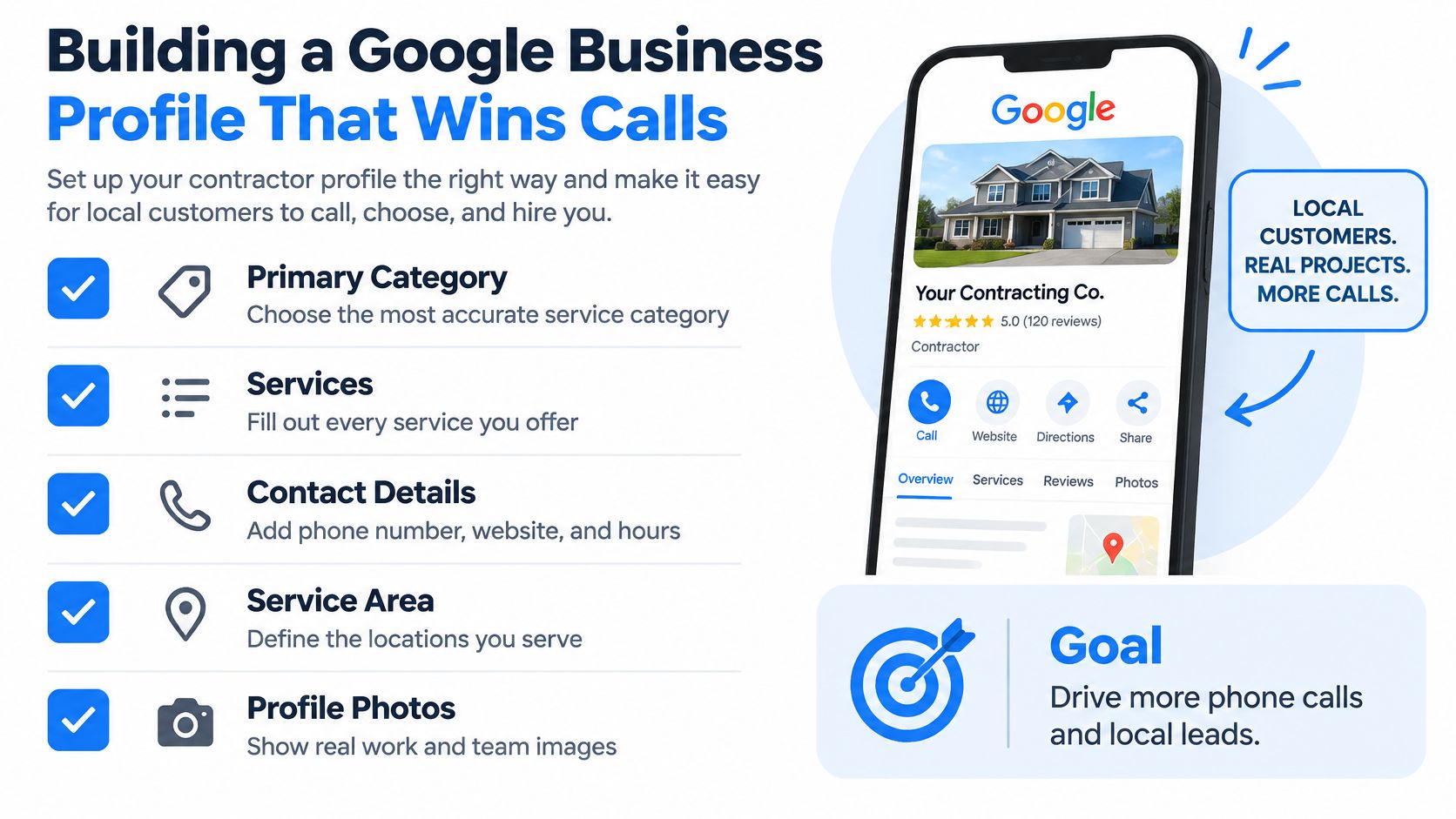
A profile checklist you can finish this week
Tie each ranking lever to one action.
- Relevance: Set the most accurate primary category, then list every service you sell. An HVAC company that hides emergency repair under a generic contractor category loses the match.
- Distance: Define the cities you serve and keep the address, or service-area setup, identical to the website. Don't claim counties you can't reach in a reasonable window.
- Prominence: Publish real hours, including emergency availability, and add recent job photos from those cities. Empty galleries look inactive next to competitors who document finished work.
Phone, website, and hours belong in the same pass. A profile that ranks and routes callers to a dead line is a wasted pin. The fuller walkthrough sits in this guide to a Google Business Profile for contractors.
The short version of profile setup is easier to see than to read.
Name, address, phone, services, and hours should agree across the site, the profile, and major listings. Incomplete signals lose map queries to shops that filled the same fields.
Reviews and Reputation as Local Ranking Assets
A map pin can win the click and still lose the job. Buyers judge the company before they dial.
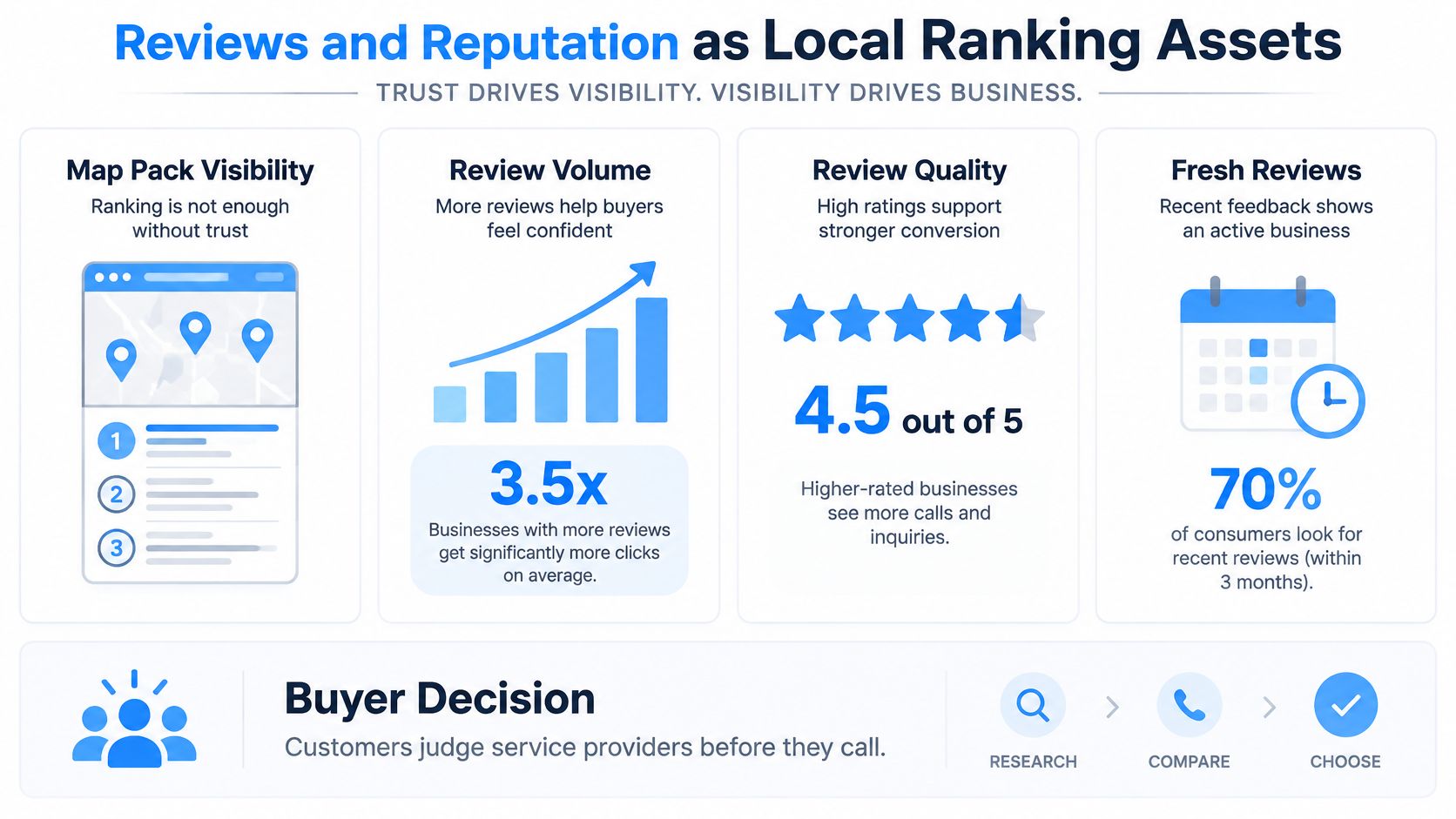
BrightLocal's 2025 Local Consumer Review Survey of 1,026 U.S. adults found that 83% used Google to read reviews for local businesses. Other sources were local news at 48%, Yelp at 44%, Facebook at 40%, and YouTube at 34%. 74% check at least two platforms before they buy. Google Maps work by itself is not a reputation plan.
A routine that feeds prominence
Ask at job completion, while the tech is still on site. Send one direct review link. Follow up once, then stop. Volume without recent dates looks stale. A five-star profile from 2022 doesn't reassure someone booking a same-week roof repair.
Response behavior is part of the asset. In that same survey, 89% of consumers said they would be more likely to use a business that responds to all reviews, while only 44% would use one that doesn't respond at all. Thank specific jobs in positive replies. On negative reviews, state what you fixed and how to reach a manager. Don't argue in public.
Reply to every review within two business days. Silence reads as an unmanaged company, even when the star average looks fine.
Track Google plus at least one second platform your buyers already use. A plumbing or pest-control firm can sit in the map pack and still lose the inquiry if Yelp or Facebook looks abandoned. The operating checklist for request timing and replies is covered in GMB review workflows.
Service-City Pages and Structured Data That Scale
One URL that says "we serve the metro" rarely matches HVAC repair plus a city. Build one template, then change the facts.
Each page should cover one service in one city. Unique proof beats swapped city names: completed jobs, response windows, neighborhoods you drive, and a short testimonial from that area. Duplicate paragraphs with a find-and-replace city name don't rank, and they dilute the pages that could.
Schema that clarifies the entity
At the individual location level, use valid LocalBusiness markup with a physical PostalAddress and geographic coordinates. Google's local business structured data guidance also points to hours and department data when they are real. Explicit fields reduce ambiguity about which contractor serves which location and can make the page eligible for local-business rich results. They do not guarantee higher rankings. Skip unsupported schema fields.
Validate in this order:
- Rich Results Test: Confirm the markup is valid before you clone the template.
- URL Inspection: Check the rendered page, not only the source you think you published.
- Crawl access: Make sure
robots.txt, anoindextag, or a login wall isn't hiding the page. - Sitemap: Submit the URL set after the first page passes.
Multi-location HVAC, plumbing, electrical, and roofing companies should ship one representative location page, test it, then scale the same template with new local facts. A deeper build pattern is in service-area page SEO.
Technical SEO and Page Speed for Mobile Callers
The homeowner with the burst pipe will not wait on a heavy hero image. Speed is a call problem, not a scoreboard.
Google's mobile page-speed benchmarks reported that 53% of mobile visitors leave pages that take longer than three seconds to load. The same analysis found that stretching load time from one second to seven raised predicted bounce probability by 113%. A separate Google mobile-site playbook in that research reported that pages loading one second faster saw up to a 27% increase in conversion rates, while average bounce rates moved from about 13% below three seconds to nearly 60% after nine seconds. These are broad mobile-site studies. Confirm the pattern in your own call tracking.
| Metric | Value | What It Means for Contractors |
|---|---|---|
| Visitors who leave after 3 seconds | 53% | A slow estimate page loses the emergency caller |
| Bounce probability, 1s to 7s | +113% | Extra scripts can erase a map-pack click |
| Conversion change, 1 second faster | Up to 27% | Speed work should show up in calls and forms |
| Bounce below 3s vs after 9s | About 13% to nearly 60% | The first viewport has to load before the pitch |
Fixes that touch the first screen
Compress and size the hero image for the phone, not the desktop mockup. Defer scripts that aren't needed to show the phone number. Cut third-party tags that don't book jobs. Server-render the HTML so the call button exists before extra widgets arrive. Test the mobile template, not a lab homepage.
Then group landing-page calls, form completions, and engagement by speed bucket. A perfect lab score that doesn't change booked jobs is the wrong target. Keep service-city pages indexable with clear internal links, a submitted sitemap, and no accidental noindex.
AI Search and the Dual-Channel Local Strategy
AI answers are a second layer on local discovery. They are not a replacement for Google Maps or organic results.
A 2025 U.S. local-search study reported by SOCi found that 84% of consumers search for local businesses daily, 60% click AI-generated Google overviews, and 53% are unlikely to visit a business with incorrect listings. Another 2025 survey in that same report found that 78.7% still primarily use traditional search engines, while only 2.0% primarily use AI assistants for local-business discovery. Most of the money is still in classic search. The listings those systems repeat still have to be right.
What to keep consistent
Service areas, hours, licensing claims, specialties, photos, reviews, and emergency availability should match across the Business Profile and major third-party sources. Publish plain, evidence-based answers about what you repair, where you drive, and when you answer the phone. Models quote clear facts more reliably than slogan pages.
Measure the channel instead of hoping a blog post "optimized for AI" did something. Track branded mentions, citations inside AI answers, referral traffic, phone calls, and mismatches between an AI summary and your verified details. Google's Ask for me experiment lets Google AI call a business about pricing and availability. That means a staff script, current scheduling data, and a monitored phone, not another generic article.
The operating model for that measurement sits with AI search engine optimization for service businesses that still live or die on map calls.
Choosing the Right Local SEO Approach for Your Business
A roofer ranking for “roofer near me” in one town may be invisible in the next. Choose an SEO setup based on who will manage service-area work, how progress is measured, and whether reporting connects search visibility to calls.
| Approach | Best For | How to Compare Timelines | Map Coverage | Reporting | Contract |
|---|---|---|---|---|---|
| In-house hire | Owners able to manage SEO internally | Ask for examples from comparable trades and service areas, then agree on review milestones | Depends on the hire's Google Business Profile and local-search experience | Set the metrics and reporting cadence internally | Employment agreement |
| Generalist agency | Companies combining SEO with paid ads or social | Request timelines for specific service-and-city searches, not broad organic rankings | Ask how much ongoing work is assigned to Maps | Check whether reports separate calls from other channel results | Terms vary by agency |
| Local SEO partner | Contractors focused on service-area searches | Compare past results for similar markets and ask what could affect timing | Ask how it handles Google Maps and each service area | Look for reporting that connects rankings and calls | Terms vary by firm |
An in-house hire offers direct control, but the owner must budget for tools and ongoing management. A generalist agency can coordinate several channels, though its local SEO work may share time with other priorities. A specialist may concentrate on map visibility and transactional searches. In every case, rankings are an input, not proof that the phone is ringing or jobs are closing.
Transactional LLC is one contract-free option for contractors seeking local SEO support. Compare its scope, reporting, and terms with other providers, and ask how it will measure results in your service cities.
Measuring Results and Your First 30 Days
A monthly rank export doesn't tell you which city produced a booked job. Measure keyword positions by service city, map-pack heat maps, Search Console queries, landing-page calls, form completions, and jobs that closed. The useful dashboard connects a ranking change to the phone.
The first month, in order
- Profile: Claim it, finish categories, services, hours, and photos.
- Listings: Make the name, address, and phone match the site and major directories.
- Reviews: Start the ask-at-completion routine and reply to what's already public.
- Pages: Publish one validated service-city page before you clone the template.
- Speed and calls: Run a mobile audit on that page and turn on call tracking.
Skip the fifty-item backlog. If the profile is wrong, new blog posts won't fix the map pack.
The useful next step is a working session with a local SEO partner who can show heat maps and keyword timelines for your own service cities, not a sample from another market.
Transactional LLC helps contractor and home-service companies show up for transactional searches like roofer near me and AC repair near me, with Google Maps work, service-city pages, and reporting that ties rankings to calls. If you want that system applied to the cities you serve, visit Transactional LLC and book a conversation around your own map results.